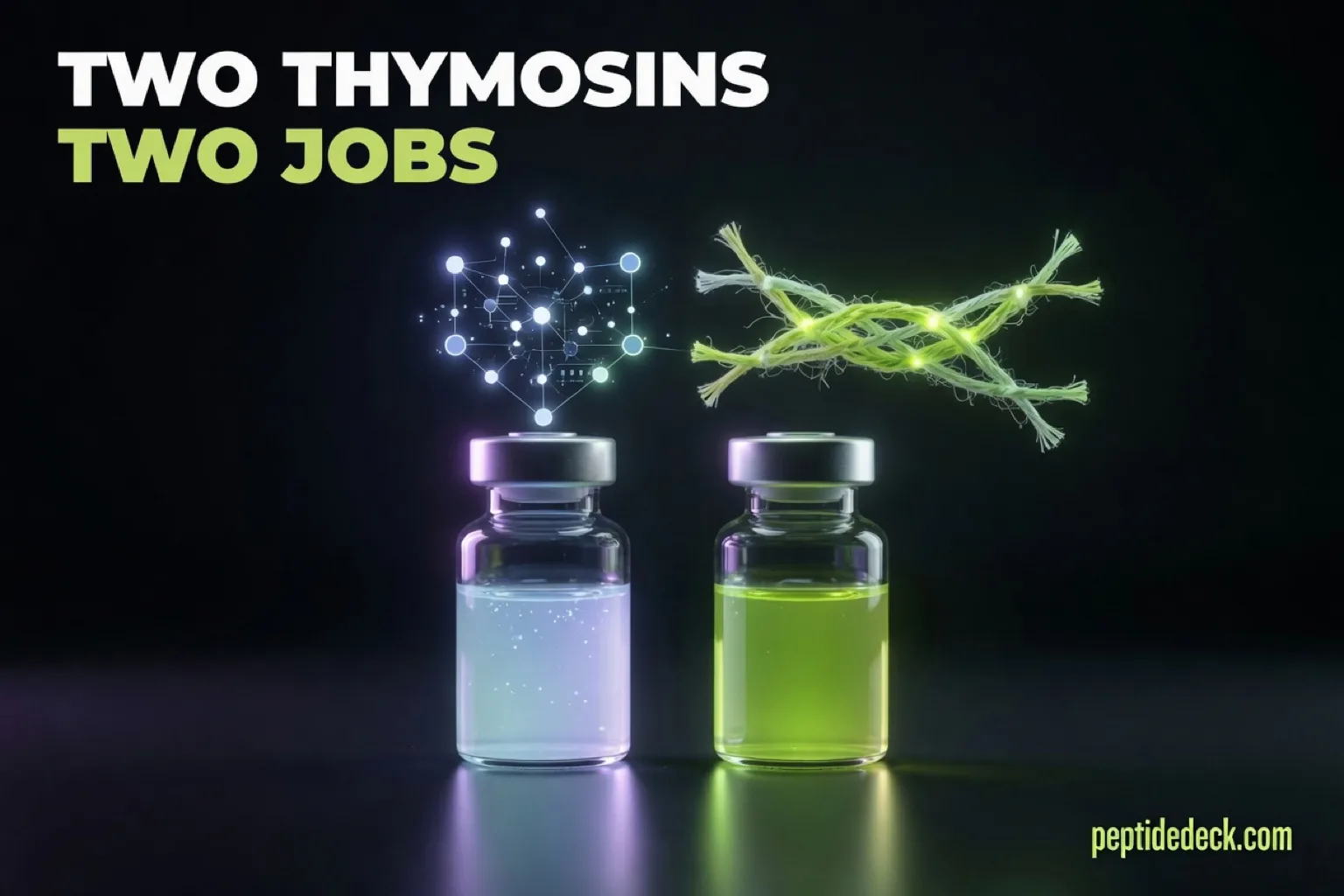
Two peptides share one name. That is where most of the confusion starts. "Thymosin" is a family label, and the two members people actually inject, thymosin alpha-1 and thymosin beta-4 (sold as TB-500), do almost opposite jobs. One steers how your immune system responds. The other helps damaged tissue close and rebuild. If you picked the wrong thymosin, you would be treating a problem you don't have.
🔑 Key Takeaways
- The "thymosins" were named after the thymus, and it turned out that was mostly a mistake
- One question about the problem you have right now decides which one fits you
- The TB-500 in most vials is not the molecule tested in the human beta-4 trials
- The larger alpha-1 trial ended with a result its fans rarely quote
- Two FDA advisory votes went in opposite directions, and one of them is still pending
Below: what each thymosin does in your body, how strong the human evidence really is, what people take and how often, who should skip each one, and whether taking both makes sense.
What Thymosin Peptides Actually Are
Blame a 1960s lab for the shared name. At the Albert Einstein College of Medicine, Allan Goldstein's team pulled an extract out of calf thymus tissue, called it Thymosin Fraction 5, and showed it could restore some immune function in animals born without a thymus (Goldstein, 2007).
Fraction 5 turned out to hold dozens of small peptides. The team labelled them alpha, beta and gamma thymosins by how they moved in an electric field, not by what they did. Thymosin alpha-1 was sequenced in 1977 (PNAS, 1977) and thymosin beta-4 in 1981 (PNAS, 1981).
Here is the twist. Once researchers looked closely, none of the isolated peptides behaved like true thymic hormones. They are made all over the body and they are not even related to each other genetically. A 2007 review says it plainly: "none of the isolated peptides were really thymic hormones" (Hannappel, 2007).
So when you search "thymosin peptides," you get one name covering two unrelated molecules. Two other thymus peptides often get mixed in as well: thymulin, a zinc-dependent thymic hormone, and Thymalin, a Russian thymus extract. Neither belongs to the thymosin family.
Thymosin Alpha-1 vs Thymosin Beta-4 at a Glance
Start with the side-by-side view. The details for each row follow further down.
*Alpha-1 half-life from a study in healthy men given a subcutaneous dose, as summarized in the FDA's December 2024 briefing.
Thymosin Alpha-1: When Your Immune System Keeps Losing
You probably know the pattern already. One cold rolls into the next, a cut takes forever to settle, and recovery from a bad virus drags on for weeks. That feeling of an immune system that is always a step behind is the problem thymosin alpha-1 was built around.
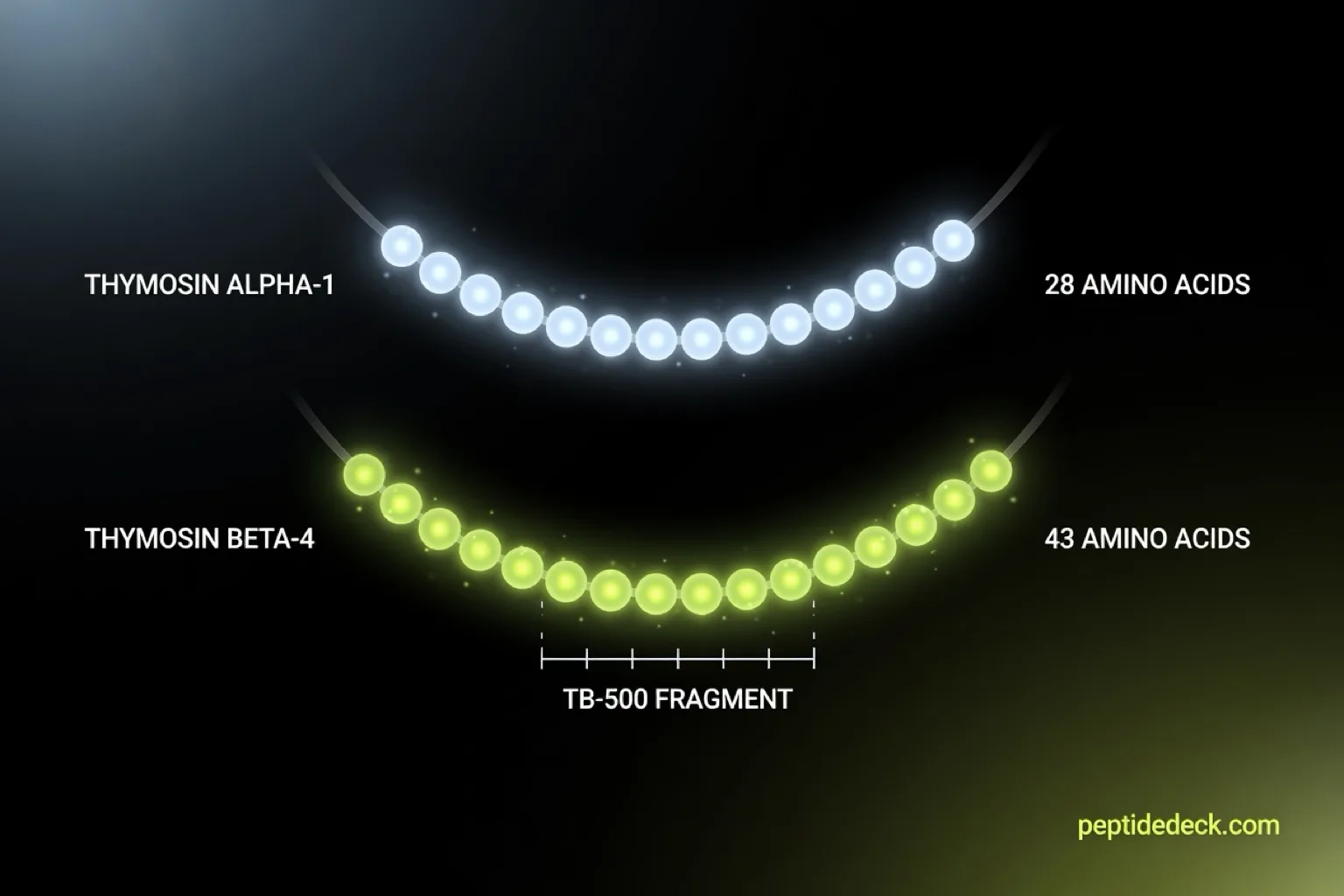
Thymosin alpha-1 is a 28-amino-acid peptide cut from a larger parent protein, prothymosin alpha. It works as a signal to immune cells rather than a building material. It pushes T cells to mature, sharpens natural killer cell activity and changes how dendritic cells present threats. That is why it gets called an immune modulator instead of an immune booster: it can turn a response up where it is weak and help settle it where it runs too hot. The full mechanism is in our thymosin alpha-1 guide.
Where the human evidence comes from
This is the one thymosin with real drug history. Its synthetic form, thymalfasin, is sold as Zadaxin. A review in the World Journal of Virology puts approval at more than 35 countries, mostly for hepatitis B and C and as an immune add-on (Dominari et al., 2020). The FDA notes it cannot verify every one of those approvals, and that thymosin alpha-1 is not approved in the US, Japan or Europe apart from Italy (FDA briefing, 2024).
That same review states the FDA "approved" Zadaxin as an orphan drug. It didn't. The FDA's own briefing says it has approved no drug product containing thymosin alpha-1. You will see the wrong version copied across many peptide sites.
The biggest trial is also the most sobering one. In the TESTS trial, 1,106 adults with sepsis across 22 hospitals in China got thymosin alpha-1 or placebo by injection every 12 hours for seven days. Deaths at 28 days were 23.4% on thymosin alpha-1 and 24.1% on placebo, which is no real difference (BMJ, 2025).
Hepatitis B looks a little better on paper. A Cochrane review published in September 2026 pooled 10 randomized trials with 1,349 people. Thymosin alpha-1 may lower death and serious side effects, but the reviewers rated nearly every result "very low certainty" and said they could not be sure of any of it (Cochrane, 2026).
What that means for you: thymosin alpha-1 has decades of human safety data, but no large trial has proven it prevents bad outcomes. Most people who use it are chasing faster recovery and fewer lingering infections, which no trial has measured directly.
How people take it
The Zadaxin dose is 1.6 mg injected under the skin twice a week, 3 to 4 days apart, and that is the dose most clinical trials used (FDA briefing, 2024). Cycles in the hepatitis trials ran six to twelve months. Most self-directed users run shorter blocks. The thymosin alpha-1 dosage chart converts that dose into syringe units, and our guide on how long to take thymosin alpha-1 covers cycle length.
Thymosin Beta-4: When an Injury Will Not Close
Different problem, different molecule. If a torn muscle, a tendon or a wound has stalled for months, you are not short on immune signals. You are short on repair.
Thymosin beta-4 is a 43-amino-acid peptide found inside almost every cell. Its core job is holding actin, the protein cells use to build their internal scaffolding, in a ready-to-use form. Cells need that scaffolding to change shape and move. Scientists worked out in 1990 that beta-4 holds actin, and it is now known as the main actin-holding peptide in most vertebrate cells (Hannappel, 2007).
That matters for healing because repair depends on movement. Skin cells have to crawl across a wound. Blood vessel cells have to grow into damaged tissue. Beta-4 released at an injury helps both happen, and in studies in animals it also calmed inflammation and reduced scarring.
Where the human evidence comes from
Beta-4 has never been approved anywhere, but it has been tested in people in three forms:
- Eye drops (RGN-259): two late-stage dry eye trials enrolled 601 and 700 people (ARISE-2, ARISE-3). A phase 3 trial in neurotrophic keratopathy, a slow-healing corneal wound, was still listed as recruiting at its last update in December 2025 (SEER-2).
- Topical gel for leg ulcers: a phase 2 trial in 73 people with venous ulcers found the gel as well tolerated as placebo, and about 25% of patients healed completely within three months (Guarnera, 2010).
- Intravenous safety study: 40 healthy volunteers took 42 mg to 1,260 mg a day for 14 days with no dose-limiting side effects (Ruff et al., 2010).
Notice what is missing. None of those trials used the injectable peptide sold online as TB-500.
Where TB-500 Fits (It Is 7 of the 43)
TB-500 is not thymosin beta-4. It is a synthetic copy of one short stretch of it: amino acids 17 to 23, the sequence LKKTETQ, with an acetyl group added to the front end (Ho et al., 2012). That stretch is the part of beta-4 that grabs actin and drives cell movement, which is why it was chosen. It first surfaced as a veterinary product, and horse racing labs were among the first to build tests for it.
The FDA's July 2026 review of TB-500 searched for human data and found none: no clinical studies, no human pharmacokinetic studies and no published case reports. Even the three references the nominator submitted were studies of full-length beta-4, not TB-500 (FDA briefing, 2026).
Some vendors sell full-length beta-4 under the TB-500 name, so check the certificate of analysis for the sequence and molecular weight. Our thymosin beta-4 guide covers the full molecule, and the TB-500 peptide guide covers the fragment.
The Evidence Gap Nobody Mentions
Put the two side by side and the gap is wide.
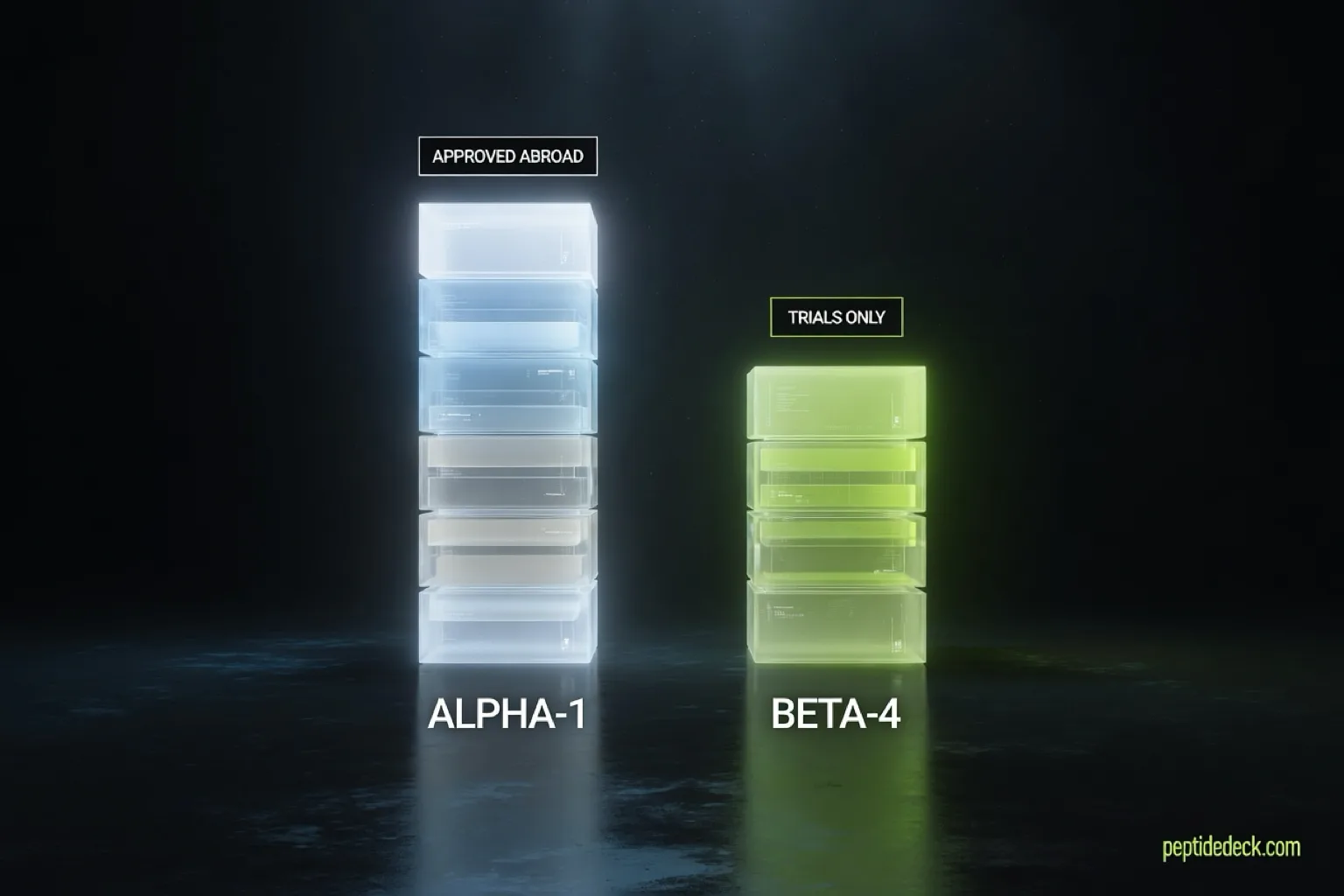
Thymosin alpha-1 has an approved product abroad, dozens of randomized trials and a known dose. Its weakness is that the big trials mostly failed to show hard benefits.
Thymosin beta-4 has promising phase 2 and phase 3 data, but only as eye drops, a skin gel and an IV infusion. The injectable TB-500 that people use for tendons and muscles sits on studies in animals and user reports. That doesn't mean it fails. It means nobody has run the trial that would tell you.
Be careful with borrowed evidence: when a TB-500 page cites "clinical trials," check whether those trials used full-length beta-4 eye drops or gel. They almost always did.
Which Thymosin Fits Your Problem?
One question sorts most people. What is going wrong right now?
Match the thymosin to the problem
- You keep getting sick, or can't shake a long recovery after an infection: thymosin alpha-1 is the one aimed at that. It has the longer human safety record of the two.
- You have a muscle, tendon, ligament or skin injury that has stalled: thymosin beta-4 or TB-500 is the repair option. Many people compare it with BPC-157 first; see BPC-157 vs TB-500.
- You compete in tested sport: beta-4 and TB-500 are out. See the legal section below.
- You are on immune-suppressing drugs or have had a transplant: alpha-1 is the riskier choice for you. Talk to your specialist first.
If your goal is general immune support rather than one of these problems, our list of the best peptides for immune support compares alpha-1 with the other options.
Can You Take Thymosin Alpha-1 and TB-500 Together?

People do, usually after surgery or a hard illness, when they want recovery and immune support at the same time.
No study has tested the combination. The two act on different systems, alpha-1 on immune cell signaling and beta-4 on the cell scaffolding, and no interaction between them has been reported. That is an absence of data, not proof of safety.
The practical downside is that if you start both on the same day and feel better, or worse, you won't know which one caused it. Starting one, waiting two to three weeks, then adding the other gives you an answer.
Side Effects and Who Should Skip Each
Neither thymosin has a long list of side effects, but the risks sit in different places.
Thymosin alpha-1
Across trials using 1 to 16 mg, the most common problems were irritation, redness and discomfort at the injection site (FDA briefing, 2024). In the sepsis trial, no safety outcome differed from placebo.
The FDA flagged two groups. People who have had a stem cell transplant face a possible risk of graft-versus-host disease or graft failure, possibly because alpha-1 stimulates the immune cells involved. The FDA also noted a risk of the body forming antibodies against the peptide, which may be higher with concentrated or poorly made products. People with autoimmune disease should involve their doctor, because a drug that shifts immune activity can shift it the wrong way.
Thymosin beta-4 and TB-500
Full-length beta-4 was well tolerated in the trials above. For TB-500 there are no trial safety data, and the FDA found no studies of whether it causes cancer. Because beta-4 encourages new blood vessel growth, anyone with active cancer or a recent cancer history should skip it. User reports and what to watch for are covered in our TB-500 side effects guide.
Both are unstudied in pregnancy and breastfeeding. Skip both then.
Legal Status, Sport and Buying in 2026
Neither thymosin is an approved drug in the US. After that, their paths split.
Thymosin alpha-1: in December 2024, the FDA's Pharmacy Compounding Advisory Committee voted 17 to 4 against letting compounding pharmacies use it, citing a lack of convincing evidence that it works (FDA meeting minutes). It is not on the list of substances compounding pharmacies can use. That leaves three real routes: a clinical trial, treatment in a country where Zadaxin is sold, or vials bought online.
TB-500: in July 2026 the same committee voted 8 to 6, with one abstention, in favor of allowing it for compounding, even though FDA staff opposed it. The vote is not binding, and the FDA had not added TB-500 to the list by late September 2026. Our breakdown of the July 2026 FDA peptide vote covers every tally.
Sport: the World Anti-Doping Agency bans thymosin beta-4 and its derivatives, TB-500 included, at all times under its S2 class (WADA Prohibited List). Thymosin alpha-1 is not named on the list, but check with your own anti-doping body before you use anything.
Price follows the dose. At the Zadaxin dose of 1.6 mg twice a week, a 10 mg thymosin alpha-1 vial lasts about three weeks and lists near $100. At the usual 2 to 2.5 mg twice a week, a 5 mg TB-500 vial lasts about one week and lists near $60. Before you pay, compare purity reports and shipping in our guides on where to buy thymosin alpha-1 and on TB-500 for sale from US vendors. The TB-500 dosage chart shows how that vial maps to syringe units.
Frequently Asked Questions
Medical Disclaimer: This article is for informational purposes only and does not constitute medical advice. Thymosin alpha-1, thymosin beta-4 and TB-500 are not approved by the FDA for any use, and the evidence described here comes from trials that may not match the products sold online. Talk to your doctor before starting either peptide, especially if you have a transplant, cancer history, autoimmune disease, or are pregnant or breastfeeding.