No peptide is approved to treat depression. That is the fact most pages about peptides for depression skip. The largest placebo-controlled peptide trial in major depression we could find gave oral semaglutide to 72 adults for 16 weeks and found no effect on depressive symptoms (PMID 41218611). The one positive result is a pilot of 23 people using oxytocin nasal spray alongside talk therapy.
🔑 Key Takeaways
- Why the most famous peptide drug on earth was tested in depression, and what the mood scores actually showed.
- The one peptide that moved depression scores in a placebo-controlled trial, and the condition attached to it.
- What "boosts BDNF" really rests on for Semax and Selank.
- The BPC-157 serotonin claim that should never guide a decision about your SSRI.
- Six questions to bring to your doctor before you add anything.
Depression is exhausting to live with. Treatment is slow, too. Antidepressants usually take weeks to help, and about one third of people do not respond to their first treatment, whether that is medication or therapy (PMID 38445382). So when a forum says a peptide lifts mood in days, the pull is real. This guide grades each one by what happened in actual humans.
What peptides for depression actually means
It means two very different groups. The first group is peptide drugs made by pharmaceutical companies and tested in proper trials: semaglutide, the GLP-1 drug behind Ozempic and Wegovy, and the hormone oxytocin. The second group is the peptides sold online with mood claims: Semax, Selank, PE-22-28 and BPC-157.
Neither group contains an approved antidepressant. The newer fast-acting drugs for postpartum depression, brexanolone and zuranolone, are often lumped in, but they are neurosteroids, not peptides.
The sales claims follow a pattern: BPC-157 "balances serotonin," Semax and Selank "raise BDNF," NAD+ drips "reset" mood. None has a placebo-controlled depression trial behind it.
The evidence, graded peptide by peptide
Here is every option on one screen. The middle column is what matters: was it tested in people with depression, and how many?
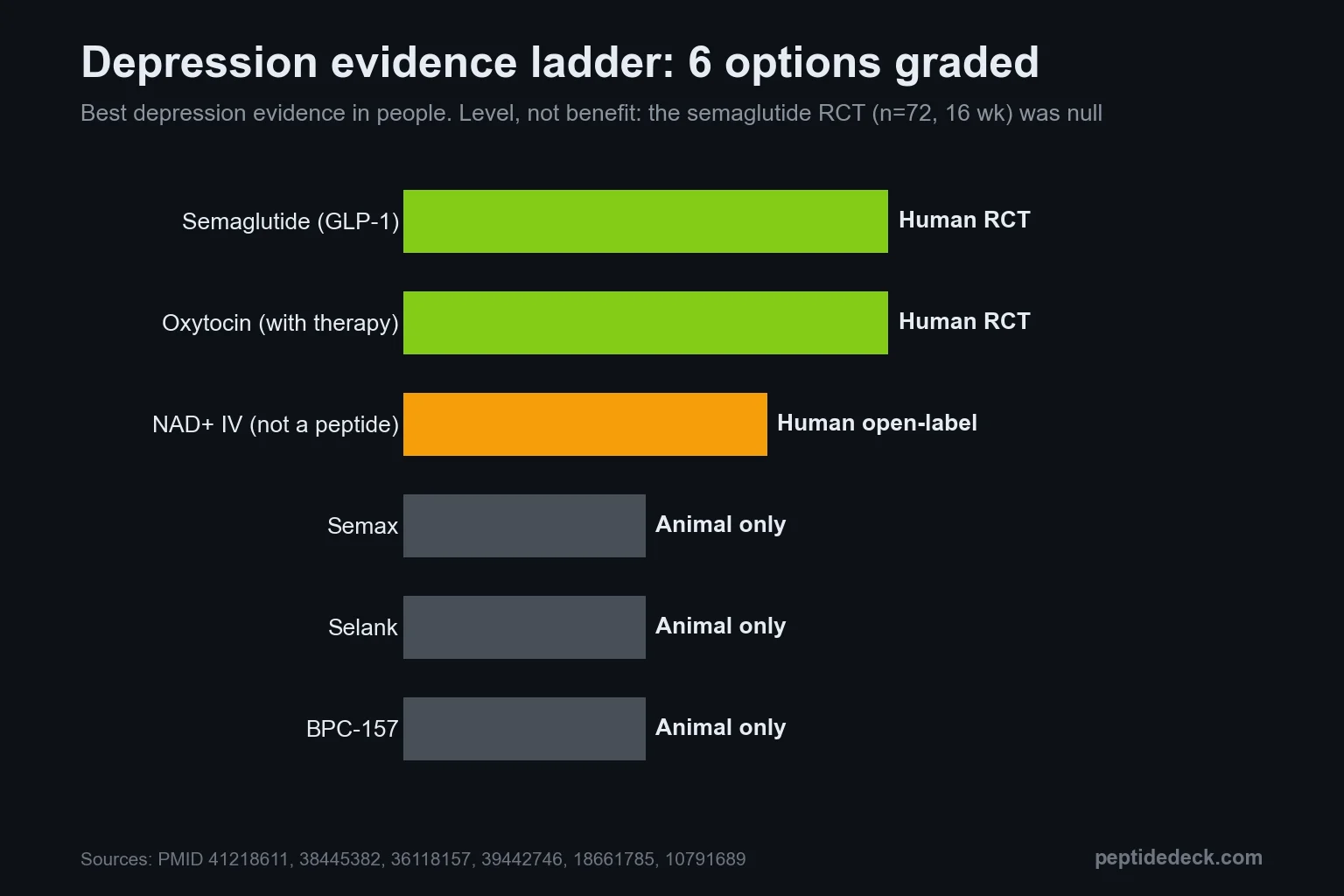
Only two rows reach a randomized trial in people, and one of them was negative for mood. Every peptide sold with a mood claim sits on the animal-only rung or below it.
Semaglutide: the biggest test came back flat
This trial had a good reason to exist. Earlier work hinted that GLP-1 drugs might sharpen thinking. A Toronto team ran a 16-week, double-blind, placebo-controlled trial in 72 adults with major depression, measurable cognitive problems and a BMI of 25 or more (PMID 41218611). Half added 14 mg of oral semaglutide, the top Rybelsus dose, to their usual care.
- Primary goal, executive function: no improvement (p = 0.60).
- Depressive symptoms: no change versus placebo.
- Suicidal ideation: no change in frequency.
- Weight: down 6.0 kg more than placebo (p < 0.001).
- Global cognition: a small secondary gain (p = 0.03).
The trial was funded by the Physicians' Services Incorporated Foundation, not by the drug maker. Its limit is size: 72 people can miss a small effect. Still, the result fits the larger picture.
A 2025 JAMA Psychiatry meta-analysis pooled 80 placebo-controlled trials covering 107,860 people with obesity or diabetes (PMID 40366681). GLP-1 drugs did not change depressive symptoms (g = 0.02) and did not raise serious psychiatric side effects. They did improve mental health-related quality of life a little (g = 0.15). If you take a GLP-1 drug for weight or blood sugar, our guide to GLP-1 medications covers the options; just do not expect it to stand in for an antidepressant.
Oxytocin: one small trial worth watching
This is the only clear positive result. In a double-blind pilot, 23 adults with major depression had 16 sessions of interpersonal therapy (PMID 38445382). Before each session, 12 of them sprayed 24 IU of oxytocin (Syntocinon) into the nose and 11 sprayed a placebo.
The oxytocin group's symptoms fell faster. The effect size was d = 0.75 at the end of treatment and d = 0.82 six months later, which counts as medium to large. Patients on oxytocin also reported a stronger bond with their therapist from the first session, and agreement on goals with the therapist explained part of the benefit.
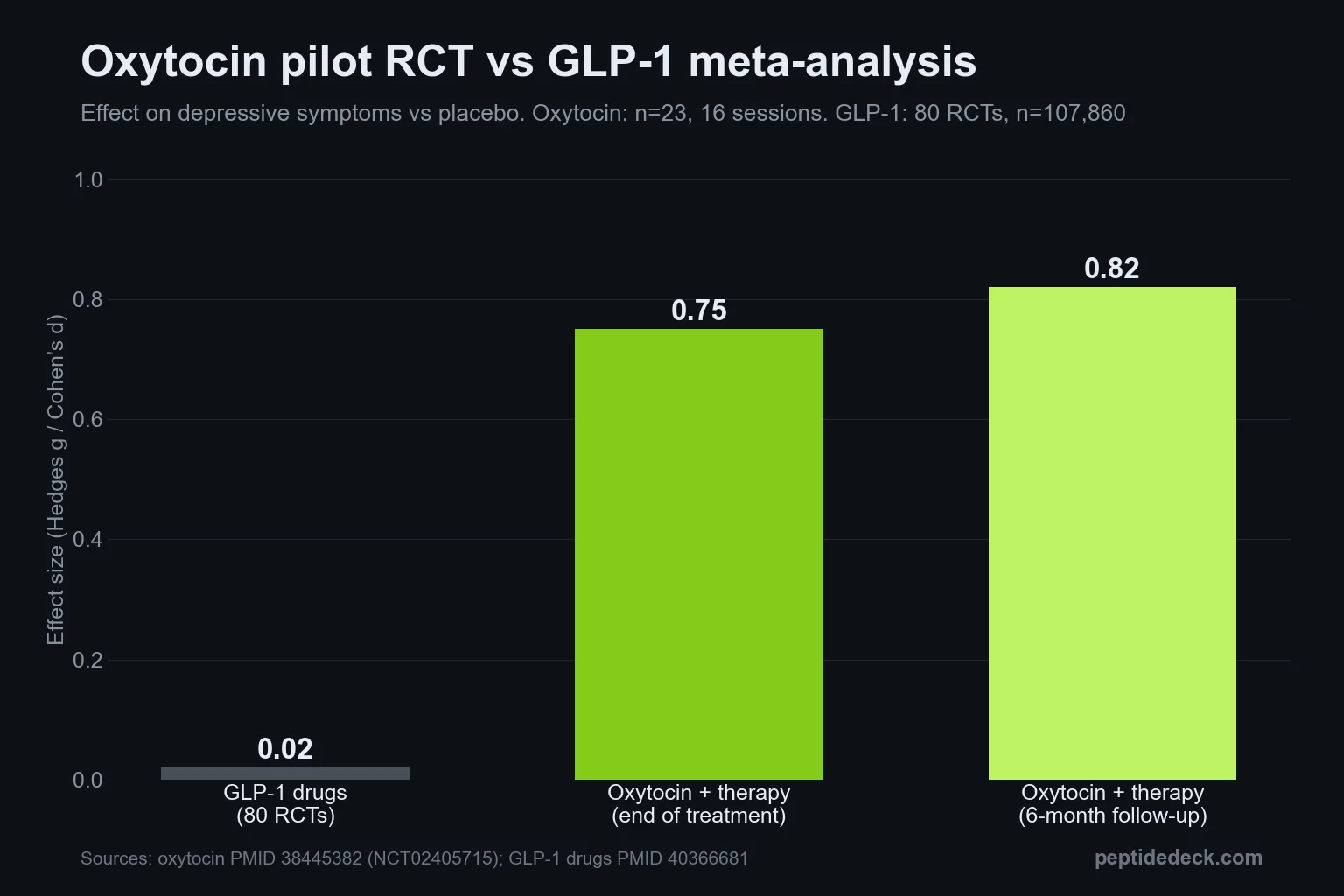
Read the chart with care. The GLP-1 bar pools people who were mostly not depressed; the oxytocin bars come from one tiny study. Oxytocin here was a prescription nasal spray used only before therapy, not a stand-alone daily antidepressant. More on how it works is in our oxytocin guide.
Semax: sold for mood, studied in animals
Semax is the peptide sold most often for low mood. It is a short fragment of ACTH, developed in Russia, and usually used as a nasal spray. The best depression data comes from a 2024 study in male lab animals under chronic unpredictable stress (PMID 39442746).
Daily injections at 60 nmol/kg reduced stress-induced anhedonia, measured by a sweet-water preference test, and restored hippocampal BDNF levels. In the forced-swim test, though, neither stress nor Semax changed anything. The bottom line: Semax has no human data for depression.
If you still want to compare products, a 10 mg vial of Semax lists at about $50 at Ascension before discount codes, and our guide on where to buy Semax covers testing and vendor checks (Ascension pays us a commission at no extra cost to you). For dosing and the nootropic side of Semax, see our Semax peptide guide.
Selank: a Russian anxiety drug, not an antidepressant
Selank is closer to anxiety care than depression care. It is a synthetic version of the immune peptide tuftsin, registered as an anti-anxiety drug in Russia and sold to US buyers as a "supplement" despite being poorly studied (PMID 34396551).
Its depression evidence is one 2008 animal study (PMID 18661785). In a genetic model of depression, repeated high doses of 1,000 to 2,000 µg/kg reduced immobility and restored interest in sweet water. In mice, low doses worked once, but repeated or higher doses did nothing. The human Selank studies are small Russian comparisons in anxiety, such as 62 patients against the benzodiazepine medazepam, with no placebo arm (PMID 18454096). Our Selank guide and peptides for anxiety page go further on that side.
BPC-157: the serotonin claim, examined
The BPC-157 mood story starts in 2000. A Croatian group gave BPC-157 to lab animals in a forced-swim test and a chronic stress model (PMID 10791689). At 10 µg/kg and 10 ng/kg it cut immobility about as much as the antidepressants imipramine and nialamide.
A 2005 paper from the same group reported that BPC-157 blunted serotonin syndrome in animals given an MAO inhibitor plus tryptophan (PMID 15840402). Some sellers now present that as a reason BPC-157 is "safe with SSRIs." It is not evidence of that. No one has tested BPC-157 with an antidepressant in a person.
The only human BPC-157 reports come from one clinic group, published in Altern Ther Health Med, with no control arm, and none looked at depression. Our BPC-157 for anxiety and depression page covers the gut-brain theory in more depth.
PE-22-28 and NAD+ drips: no controlled trials
PE-22-28 gets the boldest marketing. It is pitched as a fast-acting mood peptide that blocks the TREK-1 potassium channel. It has no human data at all: no trial in people has been published. Our PE-22-28 guide walks through what the animal work does and does not show.
NAD+ is not a peptide, but IV clinics sell it beside them. The only human mood data is an uncontrolled report of 50 people with substance use disorder receiving NAD+ and enkephalinase infusions (PMID 36118157). Depression scores fell from baseline, but there was no placebo group, and the authors say larger placebo-controlled trials are needed.
TB-500, epitalon, dihexa, DSIP, kisspeptin, MOTS-c, GHK-Cu, KPV, CJC-1295, ipamorelin and PT-141 also have no human depression data.
Safety: what can actually go wrong
The biggest risk is not the peptide. It is what people stop taking to try one.
- Do not stop antidepressants to try a peptide. Stopping suddenly can bring discontinuation symptoms and a relapse of depression. Any change needs a taper planned with your prescriber.
- BPC-157 with SSRIs or MAOIs: the "serotonin syndrome protection" is animal data (PMID 15840402). It says nothing about how the two behave together in your body.
- Selank and Semax: there is almost no Western safety data. Selank acts on GABA, so mixing it with benzodiazepines or alcohol may add sedation no one has measured (PMID 34396551).
- Injectables and mast cells: injectable peptides can activate mast cells directly through the MRGPRX2 receptor, so people with mast cell activation syndrome, hives or eczema may react at the injection site or beyond.
- GLP-1 drugs and suicidal thoughts: regulators reviewed reports, but large data sets show no excess risk. A cohort of 240,618 people with obesity found a lower risk of new suicidal ideation on semaglutide (HR 0.27) than on other weight drugs (PMID 38182782). Labels still advise watching for mood changes.
If you are thinking about suicide or harming yourself, call or text 988 in the US to reach the Suicide and Crisis Lifeline right now, or call your local emergency number.
What to ask your doctor
- My current treatment is not working well enough. What are the next proven steps, such as a dose change, a switch, adding therapy or an add-on drug?
- Would a GLP-1 drug make sense for my weight or blood sugar, and how would we watch my mood on it?
- Is there a trial I could join, for oxytocin with therapy or another new treatment?
- If I take Semax, Selank or BPC-157, how could it interact with my antidepressant or anxiety medication?
- What would a safe taper look like if I ever want to come off my medication?
- Which warning signs mean I should call you or 988 straight away?
Do not stop prescribed medication without your prescriber's guidance.
Frequently Asked Questions
Sources
- Badulescu S, et al. Semaglutide for cognitive dysfunction in major depressive disorder: an RCT. Med. 2026;7(1):100916. PMID 41218611
- Pierret ACS, et al. GLP-1 receptor agonists and mental health: a meta-analysis. JAMA Psychiatry. 2025;82(7):643-653. PMID 40366681
- Ellenbogen MA, et al. Intranasal oxytocin and psychotherapy for major depressive disorder: a pilot RCT. Psychol Med. 2024;54(9):2122-2132. PMID 38445382
- Wang W, et al. Association of semaglutide with risk of suicidal ideation in a real-world cohort. Nat Med. 2024;30(1):168-176. PMID 38182782
- Sikiric P, et al. The antidepressant effect of pentadecapeptide BPC 157 in Porsolt's test and chronic stress. J Physiol Paris. 2000;94(2):99-104. PMID 10791689
- Boban Blagaic A, et al. Gastric pentadecapeptide BPC 157 effective against serotonin syndrome. Eur J Pharmacol. 2005;512(2-3):173-9. PMID 15840402
- Sarkisova KIu, et al. Effects of Selank on genetic and situational symptoms of depression in behavior. Zh Vyssh Nerv Deiat Im I P Pavlova. 2008;58(2):226-37. PMID 18661785
- Inozemtseva LS, et al. Antidepressant-like effects of Semax and Melanotan II under chronic unpredictable stress. Eur J Pharmacol. 2024;984:177068. PMID 39442746
- Doyno CR, et al. Sedative-hypnotic agents that impact GABA receptors, including Selank. J Clin Pharmacol. 2021;61 Suppl 2:S114-S128. PMID 34396551
- Zozulia AA, et al. Selank in generalized anxiety disorder and neurasthenia. Zh Nevrol Psikhiatr Im S S Korsakova. 2008;108(4):38-48. PMID 18454096
- Blum K, et al. NAD+ and enkephalinase inhibition infusions in substance use disorder: fifty cases. Curr Psychiatry Res Rev. 2022;18(2):125-143. PMID 36118157
- Semaglutide in major depressive disorder with cognitive impairment. ClinicalTrials.gov NCT04466345
- Intranasal oxytocin and interpersonal therapy for major depression. ClinicalTrials.gov NCT02405715
Medical Disclaimer: This article is for general information and is not medical advice. Peptides sold online are not regulated as medicines. Do not start, stop or change any medication, including antidepressants, without talking to your prescriber. If you are in crisis, call or text 988 in the US or your local emergency number.