SSRIs take four to six weeks to lift mood, if they work at all. PE-22-28 is in a different category. It is one of a handful of compounds shown to act on depression circuitry within days, by blocking a single potassium channel that the brain uses to keep the mood floor low.
🔑 Key Takeaways
- PE-22-28 is a 7-amino-acid peptide derived from spadin, which itself is a fragment of the propeptide of sortilin (the precursor of neurotensin receptor 3).
- Its primary mechanism is selective inhibition of the TREK-1 potassium channel, the same channel knocked out in mice that show SSRI-resistant antidepressant phenotypes.
- Blocking TREK-1 raises serotonin signaling efficiency in the dorsal raphe and the prefrontal cortex, which is the circuit SSRIs eventually modulate, but indirectly and slowly.
- In animal models, PE-22-28 produces antidepressant-like behavior within 4 days of dosing, compared to the 4 to 6 weeks SSRIs typically need.
- It also raises hippocampal BDNF expression by 30 to 42%, supports neurogenesis, and shows preliminary stroke recovery effects in animal models.
- No human clinical trials have been completed. There is no validated human dose, no human safety data, and no FDA approval.
- Common community dosing is 100 to 500 mcg per day intranasal, or 100 to 300 mcg per day subcutaneous, cycled 4 to 8 weeks on with 2 to 4 weeks off.
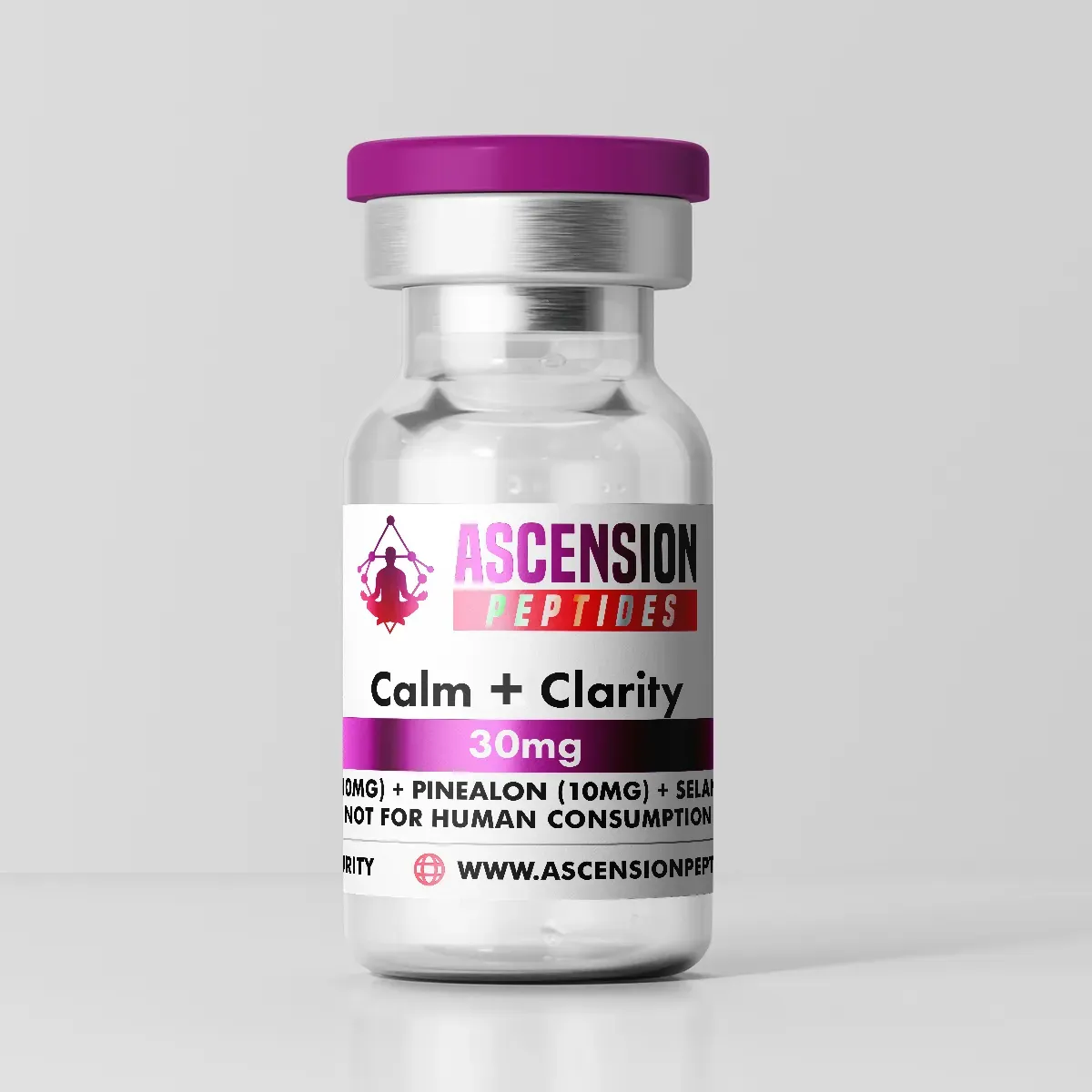
- It often shows up alongside Selank and Pinealon in nootropic stacks like Calm + Clarity, where each peptide handles a different mood and cognitive layer.
This page is the honest reference on PE-22-28. What the spadin parent compound is, how TREK-1 inhibition actually drives the fast antidepressant effect, what the dosing protocols look like for both intranasal and subcutaneous routes, how it compares to Selank, Semax, and traditional SSRIs, and what the current 2026 evidence supports versus what is hype.
What Is PE-22-28?
A truncated, more potent version of spadin.
PE-22-28 is a synthetic 7-amino-acid peptide. The "22-28" comes from its position within a longer parent sequence: it represents amino acid residues 22 through 28 of the propeptide of sortilin (also called NTSR3, neurotensin receptor 3). The full 17-amino-acid version of this fragment is called spadin, which was first characterized as an endogenous TREK-1 channel inhibitor with antidepressant properties. PE-22-28 was developed by Mazella and colleagues as a shorter, more stable, more selective version of spadin.
PE-22-28 at a Glance
- Length: 7 amino acids (heptapeptide)
- Parent compound: Spadin (17 amino acids, derived from sortilin propeptide)
- Primary target: TREK-1 potassium channel (selective)
- Approximate plasma half-life: 30 to 90 minutes; CNS effects can persist longer due to depot effect
- Bioavailability: 60 to 70% intranasal, 70 to 75% subcutaneous, negligible oral
- Developed by: Mazella lab at the Institute of Molecular and Cellular Pharmacology, France
- Stage: Animal data only. No human clinical trials
The reason the truncation matters: spadin contains a cysteine residue and a disulfide bridge, which makes it harder to manufacture, store, and dose consistently. PE-22-28 removes the cysteine and the bridge while preserving the TREK-1 binding domain, producing a peptide that is more stable in solution (92% purity at 14 days room temperature versus 68% for spadin) and roughly 4-fold more selective for TREK-1 over related K2P channels.
How PE-22-28 Works
The TREK-1 channel is the leverage point.
TREK-1 is a "leak" potassium channel that sits in the membranes of serotonin-producing neurons in the dorsal raphe nucleus, and in pyramidal neurons in the hippocampus and prefrontal cortex. When TREK-1 is open, potassium leaks out and the neuron stays hyperpolarized, which makes it harder to fire. When TREK-1 is blocked, the neuron is closer to firing threshold, and serotonergic and BDNF-related signaling becomes more efficient.
Genetic knockout of TREK-1 in mice produces an antidepressant phenotype that is resistant to behavioral despair tests like the forced swim and tail suspension. Those animals behave as if they are already on an SSRI, without the SSRI. PE-22-28 mimics this knockout pharmacologically, by selectively blocking the channel rather than deleting the gene.
Why this is different from how SSRIs work
SSRIs raise extracellular serotonin by blocking its reuptake. The actual antidepressant effect, though, does not come from raising serotonin acutely. It comes from the slow downstream changes that elevated serotonin produces over weeks: BDNF upregulation, hippocampal neurogenesis, dendritic spine density changes, and 5-HT1A autoreceptor desensitization. The 4 to 6 week SSRI lag is the time those structural changes take to express.
PE-22-28 short-circuits the lag. By directly making serotonergic neurons fire more efficiently, the BDNF and neurogenesis cascade starts much sooner. In animal models, BDNF rises within days, dendritic spine density increases within 2 to 3 weeks, and behavioral antidepressant effects show up within 4 days. Whether that timeline holds in humans is unknown.
BDNF, neurogenesis, and the structural change
The downstream effects PE-22-28 produces in animals look like the effects produced by exercise, by ketamine, by chronic SSRI use, and by electroconvulsive therapy. The common thread is structural neuroplasticity: more BDNF, more new neurons in the dentate gyrus, more dendritic spines on hippocampal pyramidal cells. These are the changes that correlate with mood recovery in human depression imaging studies.
PE-22-28 Benefits
What the animal data and the limited human-adjacent evidence support.
Fast antidepressant-like effects
The headline use case. In multiple animal models of depression (forced swim, tail suspension, chronic mild stress, learned helplessness), PE-22-28 produces antidepressant-like behavior within 4 days of starting dosing. The effect size is comparable to fluoxetine in the same paradigms, but the onset is dramatically faster. Whether this translates to human depression with the same speed is one of the central open questions.
Hippocampal BDNF and neurogenesis
Brain-derived neurotrophic factor levels in the hippocampus rise 30 to 42% in PE-22-28 treated animals compared to controls. BrdU labeling studies show roughly doubled rates of new neuron formation in the dentate gyrus over 21-day dosing windows. These are the structural changes that distinguish "treatment-responsive depression recovery" from acute symptom relief.
Cognitive and learning effects
Beyond mood, PE-22-28 has been tested in spatial memory and contextual fear conditioning paradigms, where it improves performance. The community uses this as the basis for a "nootropic" framing, although the cognitive data is thinner than the antidepressant data and is more clearly an animal-model finding.
Stroke recovery and neuroprotection
In animal models of ischemic stroke, PE-22-28 administered after the ischemic event reduced infarct size and improved functional recovery. The proposed mechanism is the same TREK-1 inhibition plus BDNF upregulation, applied to a context where neuronal survival is the limiting factor. Human stroke recovery data does not exist.
What is overstated
Some sources frame PE-22-28 as a "ketamine alternative" or as a "fast cure for depression". The animal data is genuinely interesting, but no human has been treated for depression with it in a controlled trial. The "ketamine alternative" framing is mechanistically wrong (ketamine is an NMDA antagonist, PE-22-28 is a K2P inhibitor) and clinically premature.
PE-22-28 Dosage
The community has settled on a narrow range, but it is not validated.
PE-22-28 is most commonly used by two routes: intranasal spray and subcutaneous injection. Oral dosing produces almost no systemic exposure because the peptide is digested in the stomach.
Reconstitution
For a 5 mg vial: add 2.5 mL bacteriostatic water for a final concentration of 2,000 mcg per mL. For a U-100 insulin syringe, 5 units (0.05 mL) delivers 100 mcg. For nasal spray, transferring the reconstituted peptide to a metered nasal spray bottle that delivers approximately 100 mcg per actuation gives you 2 to 4 sprays for a typical mood-targeted protocol. Refrigerate after reconstitution and use within 30 days.
Why intranasal is the dominant route
Two reasons. First, intranasal dosing exploits direct olfactory bulb to brain transport, which is more efficient for CNS-targeted peptides than relying on systemic circulation crossing the blood-brain barrier. Second, the convenience and lack of needles is the difference between a protocol someone follows daily for 6 weeks and one they abandon after 10 days. Adherence is part of dosing.
Common dosing mistakes
- Going too high too fast. Doses above 600 to 800 mcg are commonly reported to produce lethargy, low motivation, and a flat affect, the opposite of the intended effect. More is not more.
- Dosing in the evening. Mild stimulation at higher doses can disrupt sleep. AM dosing is the default for a reason.
- Skipping the off-cycle. Continuous chronic dosing is outside the protocol the animal data supports. Cycle.
- Stacking with SSRIs without medical input. Layering a TREK-1 inhibitor on top of an SSRI raises serotonin signaling through two parallel mechanisms, with no human safety data on the combination.
PE-22-28 Side Effects
The reported profile is mild, with one important unknown.
Reported side effects from community use are limited and mild:
- Nasal irritation with the intranasal route, usually mild, often resolves with hydration or formulation changes
- Mild headache in the first few days, typically resolves on its own
- Transient fatigue at higher doses (over 500 to 600 mcg)
- Mild nausea in a small fraction of users, usually with subcutaneous dosing
- Sleep disruption at higher doses or with evening dosing
The more important unknowns:
- SSRI interaction. Combined TREK-1 inhibition and SSRI use has not been studied in humans. There is no obvious serotonin-syndrome mechanism, but the combination is uncharacterized.
- Long-term TREK-1 inhibition consequences. TREK-1 has roles in pain, cardiac function, and neuroprotection. Chronic continuous inhibition is not what the animal protocols studied.
- Pregnancy and nursing data does not exist. Avoid in pregnancy or while nursing.
- Children and adolescents have not been studied at all. Adult use only.
PE-22-28 vs Selank, Semax, and SSRIs
The three comparisons that matter most.
Practical framing: Selank is the anxiety peptide, Semax is the focus peptide, PE-22-28 is the depression and neuroplasticity peptide, SSRIs are the validated standard with a slow onset. They are not interchangeable, and the depression-specific peptide with the strongest human data remains the SSRI class, not PE-22-28.

PE-22-28 Stacks
The Calm + Clarity blend is the canonical example.
The most well-known stack containing PE-22-28 is the Calm + Clarity nootropic blend, which combines PE-22-28 with Selank and Pinealon. Each peptide handles a different layer: Selank for the anxiety floor, PE-22-28 for the depression floor and neuroplasticity, Pinealon for the cognitive aging layer. We cover the full blend in our Calm + Clarity review.
The standalone-PE-22-28 use case is different: a person targeting depression-specific symptoms, who does not want the GABA modulation Selank brings, and who wants to titrate just the antidepressant peptide independently. For that user, monotherapy at 200 to 400 mcg intranasal is the typical entry point.
Where to Buy PE-22-28
Authentication is the issue, more than legality.
PE-22-28 is sold by peptide vendors online. The legal status is the same as most other research peptides in the United States: not FDA-approved for any human use, not scheduled, sold as a non-prescription compound by vendors who specify it for analytical purposes. The bigger practical issue is authenticity.
What to verify before buying:
- HPLC purity showing 98% or higher
- Mass spectrometry confirming the 7-amino-acid sequence (M+H around 775)
- Sequence transparency. Some vendors list "PE-22-28" but ship Spadin or another fragment. The sequence should be specified explicitly
- Batch-specific COA rather than a generic one repeated across orders
For broader sourcing standards, see our peptide vendor guide and how to read a peptide COA.
Frequently Asked Questions
Medical disclaimer. This article is informational only and does not replace individualized medical advice. PE-22-28 is not approved by the FDA for any human use. Every efficacy claim discussed here is based on animal studies. Anyone considering use, especially in the context of an existing depression or anxiety treatment plan, an existing antidepressant or anxiolytic prescription, or a history of suicidal ideation, should consult a qualified mental health clinician before starting.