Most weight-loss pills never reach your blood. That is the problem with peptide supplements for weight loss: a peptide is a short chain of amino acids, and your stomach is built to break exactly those chains into food. Two pills have got around that problem in large human trials. Everything else on the shelf is a bet, and this guide shows you which bets have numbers behind them.
🔑 Key Takeaways
- Only one true peptide pill has a large weight-loss trial behind it, and the way you swallow it decides whether it works.
- The strongest needle-free weight-loss pill of 2026 is not a peptide at all.
- The capsule most vendors call "the oral fat-loss peptide" got its results from injections.
- One popular oral compound made people in a two-year trial heavier, not lighter.
- Over-the-counter peptide powders work in a way you can copy for the price of a chicken breast.
If you are tired of needles, or you simply want a pill you can keep in a drawer, you are not being unreasonable. Pills are easier. They travel well, they do not need a fridge, and nobody at work notices you taking one. The question is only which pills do something. Here is how to tell.
Why Most Peptide Pills Never Reach Your Bloodstream
Your gut is a peptide shredder. Stomach acid unfolds the chain, then enzymes such as pepsin and trypsin cut it into single amino acids. That is how you digest a steak, and it is the same thing that happens to most swallowed peptides.
Even the success story shows how hard this is. Semaglutide tablets are paired with an absorption helper called SNAC, which helps it get absorbed through the stomach wall. According to the FDA label for Rybelsus and Ozempic tablets, only about 0.4% to 2% of each dose gets into your blood. The same drug injected under the skin reaches 89%, per the Wegovy label. The pill works only because Novo Nordisk packs far more drug into it: 25 mg every day versus 2.4 mg once a week for the shot.
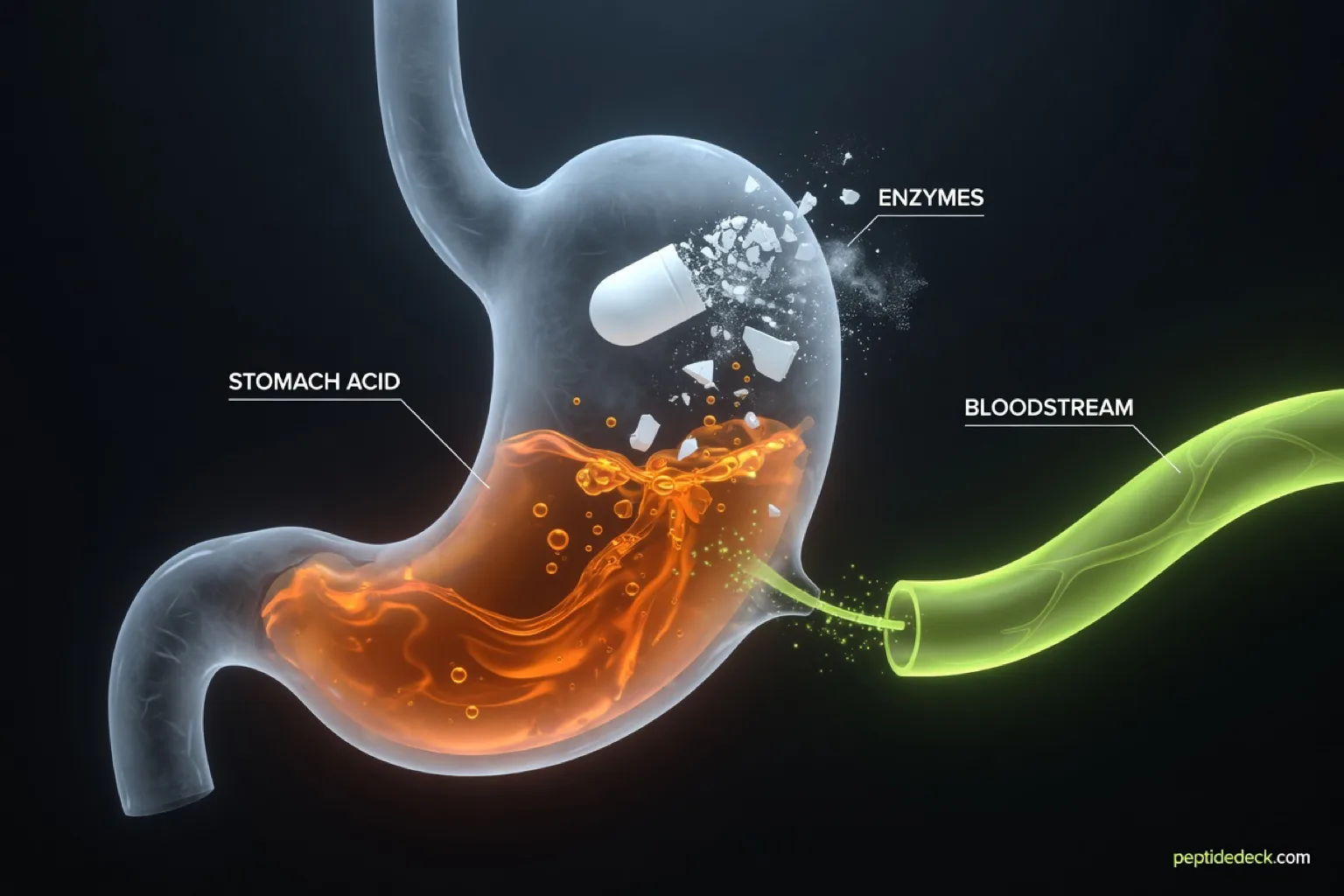
So when a capsule of an ordinary peptide claims to melt fat, ask what it does to get past your stomach. Usually the answer is nothing.
The three-question swallow test (use it on any label)
- Does it survive digestion? Look for an absorption helper (like SNAC), a molecule that is not a peptide, or a measured oral absorption figure.
- Is there a human weight trial? A trial in people that measured body weight and used a placebo group. Studies in animals and cell studies do not count.
- How is it sold? A drug with an FDA label tells you what is in it. A supplement or a vendor capsule gives you only the maker's word, plus a COA if you are lucky.
Only two products pass all three questions. Most of the rest fail the first one.
Peptide Supplements for Weight Loss: Every Oral Option Ranked
Here is the whole field on one screen. It is ranked by human evidence, not by hype.
Notice the pattern. The two options that clearly work need a prescription. Everything you can buy without one has either no human weight data or a small one.
If you are open to a weekly shot instead, the picture changes completely. Our ranking of injectable peptides for weight loss covers tirzepatide, retatrutide and the rest. This page stays with pills.
The Two Pills With Real Weight-Loss Results
Both were approved within four months of each other. That changed the whole oral market.
The Wegovy pill (oral semaglutide 25 mg)
This is the Wegovy shot, as a pill. The FDA approved Wegovy tablets on December 22, 2025 (NDA 218316). It is the same semaglutide as the Wegovy shot, in a daily tablet you step up from 1.5 mg to 25 mg, one dose level every 30 days.
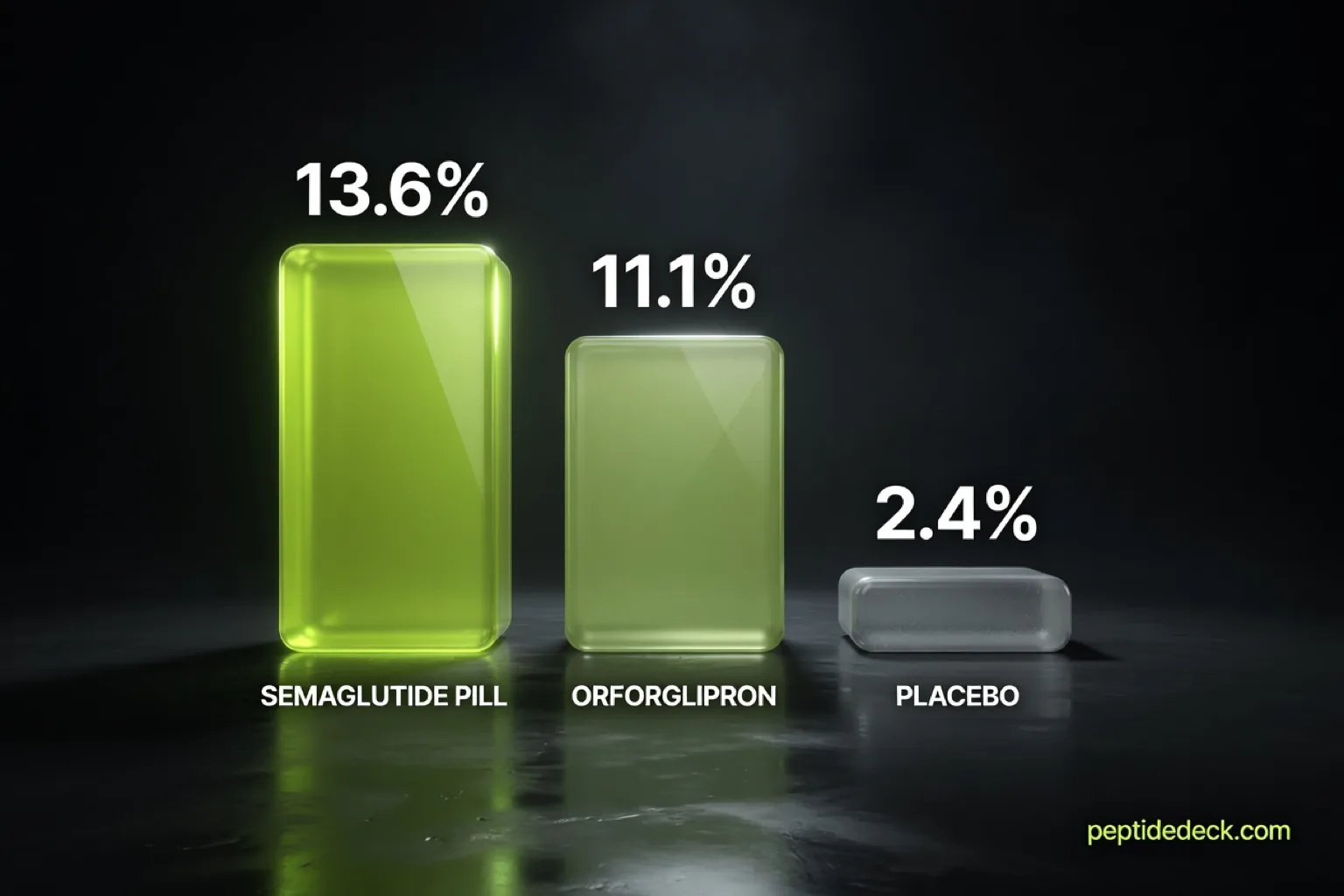
In the 64-week trial on the label, people taking 25 mg lost 13.6% of their body weight on average, against 2.4% on placebo. For someone starting at 230 pounds, 13.6% is about 31 pounds. Only 6.9% stopped because of side effects, versus 5.9% on placebo.
The catch is the routine. You take it on an empty stomach in the morning with no more than 4 ounces of plain water, then wait at least 30 minutes before food, coffee or other pills. Skip that step and less of that roughly 1% gets in. If mornings are chaos for you, that matters more than any trial number. Our oral vs injectable semaglutide comparison goes deeper on who does better with which.
Foundayo (orforglipron): the pill that is not a peptide
Foundayo is where the "peptide pill" label breaks. Orforglipron switches on the same GLP-1 receptor as semaglutide, but it is a small molecule, so your stomach cannot digest it. The Foundayo label puts its oral absorption at 77%. Compare that with about 1% for semaglutide tablets.
That is why you can take it with or without food, at any time of day. The FDA approved it for weight loss on April 1, 2026 (NDA 220934).
The results are slightly smaller. In the 72-week trial of 3,127 adults without diabetes (NCT05869903, published in the New England Journal of Medicine), the top 17.2 mg dose averaged 11.1% weight loss, against 2.1% on placebo. Across both of its weight-loss trials, 35% had nausea at that dose and 10% stopped because of side effects. The full breakdown is in our Foundayo guide.
What the two pills cost in 2026
The prices are almost identical. Both makers now sell direct to cash payers.
Self-pay prices per month (checked September 2026)
- Wegovy pill via NovoCare Pharmacy: $149 at 1.5 mg, $199 at 4 mg, $299 at 9 mg and 25 mg.
- Foundayo via LillyDirect: $149 at 0.8 mg and 2.5 mg, $199 at 5.5 mg, $299 at 9 mg, 14.5 mg and 17.2 mg. The 14.5 mg and 17.2 mg price needs a refill within 45 days or it goes to $349, and the 2.5 mg and 5.5 mg prices are a promotion through December 31, 2026.
- With commercial insurance that covers Foundayo: as little as $25 a month with Lilly's savings card.
So at a full dose, you are looking at about $299 a month for either pill. More detail on the semaglutide side is in our Wegovy pill cost breakdown.
Why Rybelsus is not the weight-loss pill
Rybelsus was the first oral semaglutide, approved in 2019. Its current label, which also covers the newer Ozempic tablets, lists two uses: blood-sugar control and heart protection in type 2 diabetes. Weight loss is not one of them. It tops out at 14 mg a day, well below the 25 mg Wegovy dose. If you do not have diabetes, the Rybelsus route is the wrong door.
Both pills carry the same warnings as the shots. That includes the boxed warning about thyroid C-cell tumors, and neither pill is for anyone with a personal or family history of medullary thyroid cancer or MEN 2. A needle-free drug is not a gentler drug.
What the Oral Capsules Sold by Peptide Vendors Actually Do
This is where the marketing gets loud. Four names come up in almost every "oral peptides for weight loss" list. Here is what each one has behind it.
5-Amino-1MQ: promising, but the results came from injections
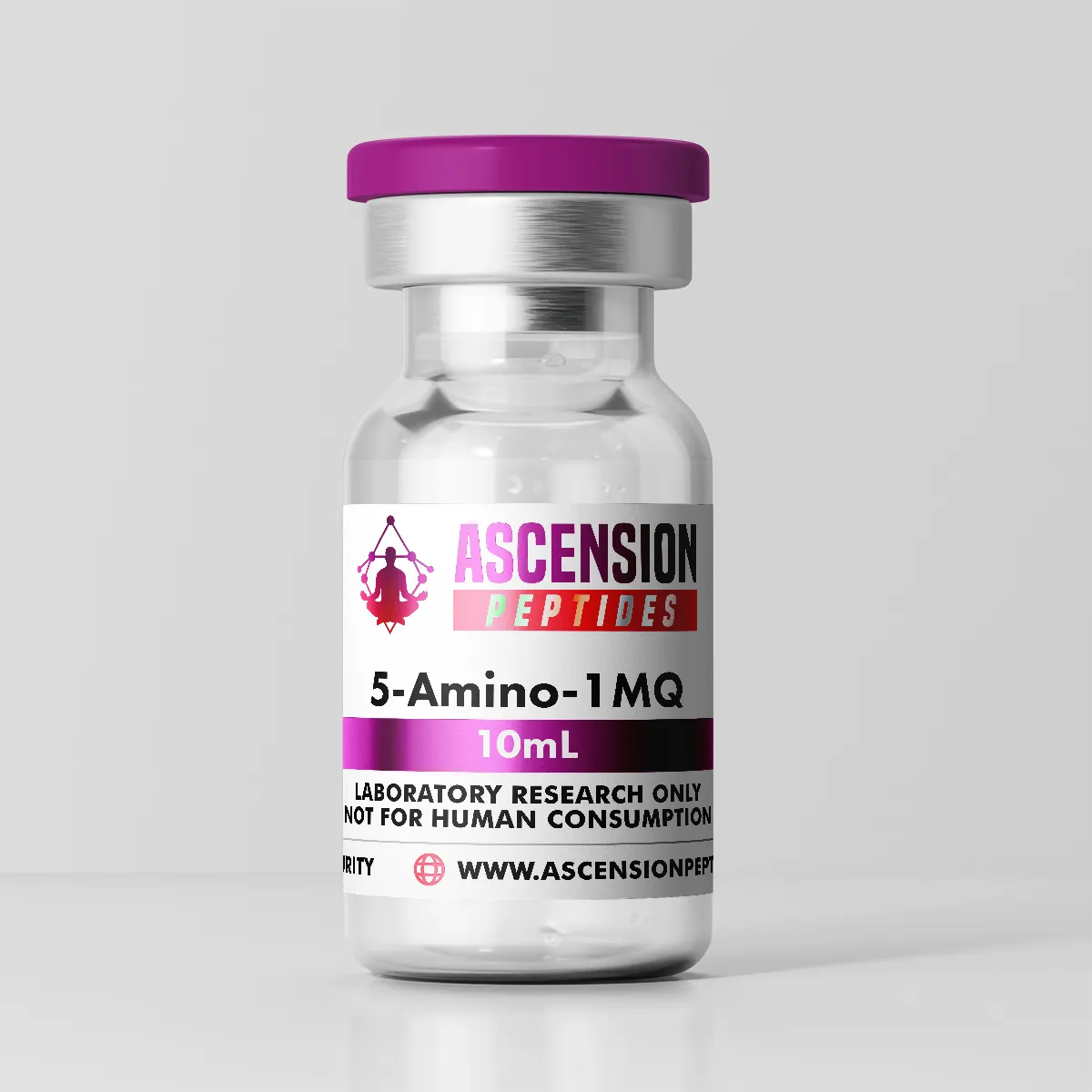
This one works on your fat cells directly. 5-Amino-1MQ blocks an enzyme called NNMT, which builds up in fat tissue. Block it, and fat cells burn more energy. It is usually sold in capsules and called "the oral fat-loss peptide." It is not a peptide. It is a small molecule.
The early data is real. In a 2018 study in obese animals, an NNMT blocker cut body weight and white fat without making the animals eat less. A 2024 follow-up gave 5-Amino-1MQ once daily for 30 days and found that the high dose held weight gain to 0.9 g, against 5.4 g in untreated animals, with less fatty liver.
But read how it was given. Those 30 days used injections under the skin. The same paper tested the capsule route too, and measured an oral absorption of just 3.5%. The authors blamed poor uptake from the gut and fast breakdown in the liver. Two more things to know: several of the 2024 authors work for Ridgeline Therapeutics, the company developing NNMT blockers, and ClinicalTrials.gov lists no human trial of 5-Amino-1MQ at all.
If you still want to try it, the form closest to the data is the injectable one, not the capsule. When you compare 5-Amino-1MQ for sale, you will mostly see 10 mg vials, which list at about $95 and are often discounted to around $52 at US vendors. Start with our 5-Amino-1MQ dosage chart, and know that you are going on data from animals only.
AOD-9604: the oral peptide that was actually tested, and faded
AOD-9604 is a fragment of human growth hormone. Unlike most items on this list, it went through proper oral trials in people. Its developer ran two oral phase IIb studies in about 300 and 500 adults with obesity.
According to a 2014 safety review by people involved in its development, the weight effect seen in the early trials did not show up in the last study, which added an intensive diet and exercise program. It was never approved as an obesity drug. It is well tolerated, but "works as a pill" is not what the trials found. More on its current use is in our AOD-9604 guide.
MK-677: an oral pill that raises your appetite
This pill has the opposite problem. MK-677 is often sold next to fat-loss peptides because it raises growth hormone. It works well by mouth, because it is a small molecule. The trouble is what it does to hunger.
In a two-year trial of 65 adults aged 60 to 81, 25 mg a day added lean mass. But body weight went up 2.7 kg on MK-677 versus 0.8 kg on placebo, with no drop in total or belly fat. Fasting blood sugar rose, insulin sensitivity fell, and increased appetite was the most common side effect, easing after a few months. If your goal is the number on the scale, this pill pushes it the wrong way. Our MK-677 results page covers what it is good for.
BPC-157 capsules: a gut peptide, not a fat-loss one
BPC-157 belongs in your gut, not your fat. It is one of the few peptides with a plausible reason to be swallowed, since it comes from a stomach protein and people mostly use it for gut comfort. There is no human trial of BPC-157 for weight loss, by mouth or by injection. Take it for your gut if you like; do not expect it to move your weight. See our BPC-157 capsules review.
Over-the-Counter Peptides for Weight Loss: What's in the Bottle

No over-the-counter peptide works like a GLP-1 drug. Every peptide with that kind of effect needs a prescription in the US. What you find at pharmacies, supplement stores and Amazon falls into three groups.
Collagen peptides
Collagen is the honest one. It is the one "peptide supplement" your body really absorbs, because it is sold pre-digested into tiny fragments. In a 12-week trial of 90 overweight adults, 2,000 mg a day of fish-skin collagen cut body fat by 1.2 kg, while the placebo group gained 0.3 kg. That is one small trial, and one of the authors worked for the company that made the collagen.
The simpler explanation is that collagen is protein, and protein keeps you full. You can get a similar effect from any protein-rich meal. Our collagen peptides guide covers doses and types.
"Active peptide" and "GLP-1" powders and pills
Watch for the small dagger. These products name hunger hormones on the front, promise extra calories burned, and put a small dagger next to each claim. That dagger points to the line every supplement must print: the statement has not been evaluated by the FDA. Supplements can make these structure/function claims without proving them the way a drug must.
Most "GLP-1 support" products contain fiber, probiotics or plant extracts that may nudge your own GLP-1 a little. That is a real but small effect, covered in our guide to natural GLP-1 boosters. None of them contains semaglutide.
Pills with hidden drugs
The riskiest group looks like the most effective one. The FDA keeps a list of weight-loss supplements found to contain hidden drug ingredients, and it added several new products in August and September 2026 alone. If a bottle with no prescription promises Ozempic-level results, that is the red flag. Our page on buying semaglutide over the counter explains the legal ways to get the real thing.
Which Oral Route Fits You?
Start with what you want to happen. Then pick the pill that has actually done it.
- You want the most weight loss from a pill: the Wegovy pill, if you can keep the empty-stomach routine every morning.
- Your mornings are unpredictable: Foundayo, which does not care about food or timing.
- You want to avoid a prescription: be honest with yourself that nothing over the counter comes close. A protein-first diet gives you most of what collagen powders offer.
- You are curious about 5-Amino-1MQ: treat it as an experiment built on animal data, prefer the injectable form, and buy only with a batch COA.
- You would take a weekly shot after all: injectables still lead on results. Compare them in our best weight loss pills ranking and the injectable guide above.
Before you pay for any capsule: run the three-question swallow test. If you cannot answer yes to the first two questions, you are paying for a hope, not a result.
For the bigger picture on needle-free peptides for other goals, from skin to sleep, see our oral peptides guide.
Frequently Asked Questions
Medical Disclaimer: This article is for informational purposes only and does not constitute medical advice. Oral semaglutide and orforglipron are prescription drugs with serious possible side effects, and compounds such as 5-Amino-1MQ, AOD-9604 and MK-677 have not been approved by the FDA for weight loss. Talk to your doctor before starting any weight-loss medication or supplement, especially if you have diabetes, take other medicines, or are pregnant or planning a pregnancy.