Both drugs come from the same company. If you're weighing eloralintide vs retatrutide, you're really asking which of Eli Lilly's two next-generation weight loss shots fits your situation. You already know the current drugs work, and you know their weak spots: the nausea, the plateaus, the people they don't help enough. Lilly built these two molecules to attack those weak spots from opposite directions. One copies a fullness hormone the current drugs ignore. The other stacks three hormone signals into one weekly injection. The trial numbers now let us compare them honestly, and they don't all point the same way.
🔑 Key Takeaways
- They work on different hormones, which is why comparing them on the scale alone misses the point.
- At the same 48-week mark, one drug is clearly ahead on weight loss. The gap widens in people with type 2 diabetes.
- The side effect you'd notice first is not the same on each drug.
- Lilly's most interesting move isn't either drug alone. It's what happens when amylin is paired with an incretin.
- One of them is roughly a year ahead in the race to approval.
Below, we put the two side by side: how each one works, what the trials found at 48 and 80 weeks, side effects, muscle loss, the combination question, and when each could reach a pharmacy.
Eloralintide vs Retatrutide at a Glance
Here is the whole comparison in one table.
Keep one caution in mind for every number on this page. No trial has put these two drugs head to head. The figures come from separate trials with different people, lengths and analysis methods, so treat the gaps as direction, not a final score.
How They Work: Amylin vs Three Incretin Signals
Think of two different brakes on hunger.
Eloralintide copies amylin. Your pancreas releases amylin alongside insulin every time you eat. It slows how fast your stomach empties, tells the brainstem you've had enough, and holds back glucagon after meals. Lilly calls eloralintide "selective" because it targets the amylin receptor while largely avoiding the related calcitonin receptor that some other amylin drugs, such as Novo Nordisk's cagrilintide, also hit. It does nothing at the GLP-1 receptor, which is the receptor behind Ozempic and Wegovy.
Retatrutide pulls three levers at once. GLP-1 slows the stomach and quiets appetite. GIP adds to the insulin and fat-tissue effects, the extra lever that made tirzepatide stronger than semaglutide. Glucagon is the new one: paired with the other two, it pushes the body to burn more energy and clear fat from the liver. That third signal is the working explanation for why reta's numbers run ahead of every approved drug. Our retatrutide guide covers the molecule in more depth.
So the honest framing isn't "which one is stronger." Eloralintide is Lilly's bet that a different hormone can help people the incretin drugs don't suit. Retatrutide is its bet on more of the incretin approach, pushed as far as it will go.
Weight Loss Results: The Trials Side by Side
Start at the one time point both drugs share.
Eloralintide phase 2. Published in The Lancet in November 2025, this trial gave 263 adults with obesity or overweight, and no type 2 diabetes, a weekly shot of eloralintide or placebo for 48 weeks. They started at an average of 109.1 kg (240 lb). Lilly reported average weight loss of 9.5% on 1 mg, 12.4% on 3 mg, 17.6% on 6 mg and 20.1% on 9 mg, which is 21.3 kg (47 lb). People who started at 6 mg and stepped up to 9 mg lost 19.9%; those who started at 3 mg and stepped up lost 16.4%. Placebo: 0.4%.
Retatrutide phase 2. Published in the New England Journal of Medicine in 2023, this trial followed 338 adults with obesity or overweight for 48 weeks. Average weight loss was 8.7% on 1 mg, 17.1% on 4 mg, 22.8% on 8 mg and 24.2% on 12 mg, against 2.1% on placebo. On 12 mg, 83% of people lost at least 15% of their body weight, and weight was still falling at week 48.
Retatrutide phase 3. In TRIUMPH-1, 2,339 adults without diabetes took retatrutide or placebo for 80 weeks. Lilly's medical information page reports 19.0%, 25.9% and 28.3% weight loss on 4, 9 and 12 mg, against 2.2% on placebo, counting people who stayed on treatment. The full paper in NEJM (September 2026), counting everyone randomized, gives 17.6%, 23.7% and 25.0% against 3.9%. On 12 mg, 45.3% of people lost at least 30% of their weight. Counting everyone who stopped treatment too, the 12 mg figure was 25.0%. Our TRIUMPH-1 breakdown covers the full table.
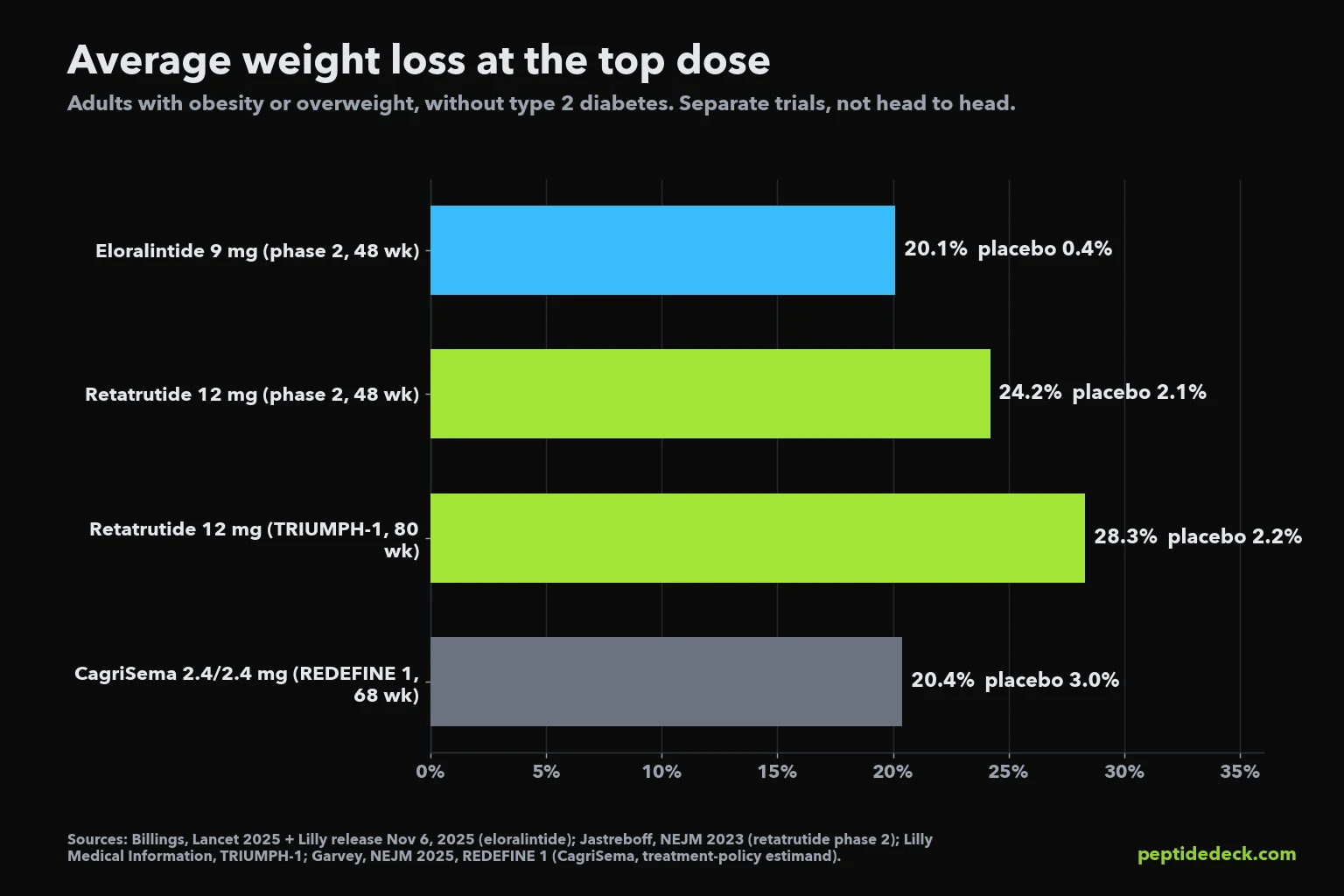
Two things stand out. At 48 weeks, retatrutide's top dose sits about four points ahead of eloralintide's. And eloralintide's 20.1% lands in the same zone as CagriSema, Novo's amylin-plus-semaglutide combination, which reached 20.4% at 68 weeks in its REDEFINE 1 trial. For a drug that copies a single hormone, landing next to a two-drug combination is a notable result, even allowing for the different trial lengths and analysis methods.
The Type 2 Diabetes Gap
This is where the two drugs split hardest.
Weight loss drugs usually take off less weight in people with type 2 diabetes. Retatrutide follows that pattern but keeps most of its punch. Eloralintide alone, in its first diabetes data, lost far more ground.
Eloralintide on its own topped out at 12.3% in people with diabetes, about 8 points below its result in people without diabetes. Retatrutide's 12 mg dose reached 20.8% in TRIUMPH-2 and lowered A1C by up to 1.6 points. If you have type 2 diabetes, the data so far favors retatrutide over eloralintide alone by a wide margin. Our TRIUMPH-2 results page has the A1C detail.
The interesting row is EloraTZP. Paired with tirzepatide, eloralintide helped produce 23.3% in 48 weeks, in people with diabetes, which is more than retatrutide managed in 80 weeks in a similar group. That's the combination story, and we come back to it below.
Side Effects: Nausea, Fatigue and Skin Sensations
Each drug has its own weak spot.
Eloralintide's issue is tiredness. In phase 2, fatigue hit 43% of people on 9 mg and 46% of those who stepped from 6 mg to 9 mg, against 12% on placebo. That is far higher than retatrutide's 10.1% in TRIUMPH-1. If low energy is already a problem for you, it's worth knowing before anything else.
Eloralintide's nausea depends on how you start. Jumping straight to 6 mg caused nausea in 64% of people. Stepping up from 3 mg to 9 mg cut that to 25%. Lilly's phase 3 trials use a gradual climb for that reason.
Retatrutide's issue is the gut, plus two newer signals. On 12 mg in TRIUMPH-1, 42.4% had nausea, 32.0% diarrhea and 25.3% vomiting, mostly mild to moderate and clustered in the dose-raising weeks. Two less familiar effects also showed up: dysesthesia, a burning or tingling skin sensation, in 12.5%, and low blood pressure in 8.8%, more often in people already on blood pressure pills. Heart rate also rose with the dose in phase 2 and peaked around week 24. Our retatrutide side effects guide lists every frequency.
One honest gap: the eloralintide phase 2 abstract doesn't break out vomiting or stopping rates, and the trial was small. The five ENLIGHTEN trials, with 5,615 people in total, are what will show its real side effect profile.
Muscle and Lean Mass
Every weight loss drug costs some muscle.
The question is how much. For retatrutide, a body-scan substudy of its phase 2 diabetes trial, published in The Lancet Diabetes & Endocrinology in 2025, enrolled 189 people for DXA body scans. Total fat mass fell 26.1% on 8 mg and 23.2% on 12 mg over 36 weeks, against 4.5% on placebo. The authors concluded that the share of lean mass lost relative to total weight was similar to other obesity treatments, not worse.
For eloralintide, there's less to go on. The lead investigator, Dr. Liana Billings, told Healio that 60% to 70% of the weight lost in phase 2 was fat, roughly two-thirds fat to one-third lean. That is in the usual range for this drug class, but it comes from a conference interview, not a published table.
The practical takeaway is the same for both: neither drug is proven to spare muscle. Because retatrutide takes off more total weight, the absolute amount of lean tissue lost can be larger. Enough protein and regular strength training remain your best protection, which is also what the TRIUMPH-1 lifestyle counseling asked of every participant.
The Combination Question: Amylin Plus an Incretin
This is where the field is heading.
Amylin and GLP-1 send separate "I'm full" signals through separate receptors. Stack them and you get two brakes instead of one louder one. That's the logic behind CagriSema, Novo's cagrilintide-plus-semaglutide pairing, and it's exactly the logic behind Lilly's EloraTZP. Our CagriSema vs retatrutide comparison shows how that first amylin combination stacks up against the triple agonist.
EloraTZP's September 2026 results, presented at the EASD meeting in Milan, are the strongest case yet for the idea. In 367 adults with obesity and type 2 diabetes, eloralintide 9 mg plus tirzepatide 15 mg cut weight by 23.3% at 48 weeks, against 14.8% on tirzepatide alone. Even the lower 6 mg plus 5 mg pairing reached 19.4%, more than full-dose tirzepatide.
The catch is real, though. Between 10.8% and 27.0% of people on the combinations stopped because of side effects, against 2.9% on tirzepatide alone. Lilly plans to start phase 3 of a single-shot EloraTZP by the end of 2026 with what it calls an "optimized escalation schedule." Whether a slower climb fixes the dropout problem is the main open question.
What about eloralintide plus retatrutide? A search of ClinicalTrials.gov on October 19, 2026 shows no registered trial of that pairing. Lilly's chosen partner for eloralintide is tirzepatide, plus its experimental drug macupatide in two phase 2 trials. People who already stack retatrutide with an amylin drug on their own are using cagrilintide, and our retatrutide and cagrilintide stack guide covers what is and isn't known about that approach. There's no trial data behind it.
When Could Each Drug Be Available?
Retatrutide is about a year ahead.
Lilly says it will submit retatrutide to the FDA in the first quarter of 2027, a filing that was pushed back because the manufacturing package needed more time. A decision usually takes 10 to 12 months after filing. Eloralintide's phase 3 primary completion dates run from January to June 2028 on ClinicalTrials.gov, so a filing would follow after that. These approval dates are our estimates; Lilly hasn't given one for either drug. For the full retatrutide calendar, see our retatrutide FDA approval timeline.
Who Might Each Drug Suit?
Neither is approved, so this is about fit, not prescriptions.
Retatrutide looks like the stronger option if you need the largest possible weight loss, you have type 2 diabetes, or you carry weight-linked problems it has already been tested on. In TRIUMPH-1's sub-groups, 12 mg cut sleep apnea events by 31.7 per hour against 9.9 on placebo and eased knee arthritis pain. The trade-offs: more stomach side effects at the top dose, the skin-sensation signal, and a heart rate rise worth discussing with a doctor if you have a rhythm problem.
Eloralintide looks interesting if GLP-1-type drugs haven't worked well enough for you. Lilly has said it could serve as an alternative to incretin therapies, and its ENLIGHTEN-6 trial specifically enrolls 900 people who still have obesity despite a weekly incretin drug. If that trial shows meaningful extra loss on top, eloralintide becomes the add-on for people who stall. The trade-offs: tiredness, weaker results with diabetes, and no access before 2028 at the earliest outside a trial.
Our full eloralintide guide lists every ENLIGHTEN trial if you want to check whether you might qualify for one.
Availability, Vials and Price Today
Only one of the two is sold widely.
Eloralintide isn't available outside Lilly's trials. A few websites list vials under the name, but there's no published reference standard or independent testing record to check them against, so you have no way of knowing what's inside. Our eloralintide peptide page covers what those listings claim.
Retatrutide (reta) has no FDA approval either, and Lilly has filed lawsuits against several sellers. Vials are still sold online by peptide vendors, and the rules on buying an unapproved drug for personal use vary by country, so check yours first. If you are comparing sellers, the one document that matters is a lab report for the exact batch you're buying, showing purity, the real milligrams in the vial and an identity test. Our guide to the best place to buy retatrutide explains how to read one and which red flags to avoid.
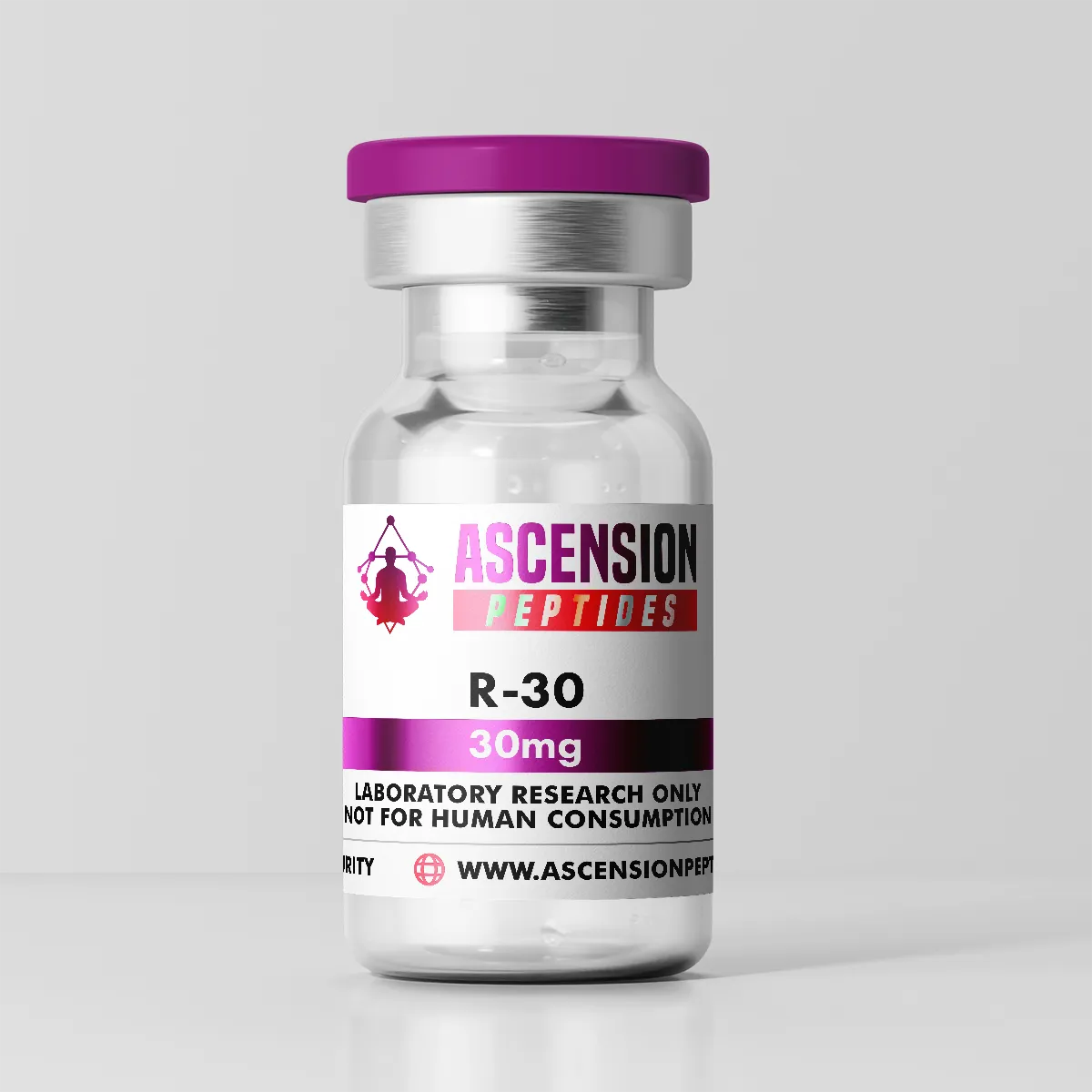
On price, our partner Ascension lists its 30 mg vial (R-30) at $250, or $125 with code PEPTIDEDECK, and the 10 mg vial (R-10) at $100, or $50 with the code. At 4 mg a week, one 30 mg vial lasts about 7.5 weeks. You can check current stock and batch reports on our retatrutide for sale page. PeptideDeck earns a commission on purchases through partner links, at no extra cost to you.
Before you decide: the limitation that matters most with retatrutide today isn't the drug, it's the supply chain. The trial results describe pharmaceutical-grade product under medical supervision. A vial without a batch-matched lab report can't promise you either.
For more matchups in the same family, see mazdutide vs retatrutide.
Frequently Asked Questions
Sources
- Billings LK, et al. Eloralintide, a selective amylin receptor agonist for the treatment of obesity: a 48-week phase 2, multicentre, double-blind, randomised, placebo-controlled trial. The Lancet. 2025;406:2631-2643. Funded by Eli Lilly. PMID 41207310
- Eli Lilly and Company. Lilly's selective amylin agonist, eloralintide, demonstrated meaningful weight loss and favorable tolerability in a Phase 2 study of adults with obesity or overweight. November 6, 2025. Press release
- Eli Lilly and Company. Lilly's EloraTZP (combination of eloralintide and tirzepatide) delivered greater weight loss and A1C reduction vs. tirzepatide 15 mg in adults with obesity and type 2 diabetes. September 30, 2026. Press release (NCT06603571)
- Jastreboff AM, et al. Triple-hormone-receptor agonist retatrutide for obesity: a phase 2 trial. N Engl J Med. 2023;389:514-526. Funded by Eli Lilly. PMID 37366315
- Lilly Medical. What are the results of retatrutide from TRIUMPH-1 in participants with obesity or overweight without type 2 diabetes? Accessed October 19, 2026. Lilly Medical Information
- Eli Lilly and Company. Lilly's triple agonist, retatrutide, delivered substantial weight loss and A1C reduction, underscoring its potential promise for people with obesity and type 2 diabetes (TRIUMPH-2). September 29, 2026. Lilly investor news
- Coskun T, et al. Effects of retatrutide on body composition in people with type 2 diabetes: a substudy of a phase 2, double-blind, parallel-group, placebo-controlled, randomised trial. Lancet Diabetes Endocrinol. 2025. PMID 40609566
- Garvey WT, et al. Coadministered cagrilintide and semaglutide in adults with overweight or obesity (REDEFINE 1). N Engl J Med. 2025;393:635-647. PMID 40544433
- Healio. Novel amylin receptor agonist induces clinically meaningful weight loss. December 10, 2025. Healio
- ClinicalTrials.gov: ENLIGHTEN-1 (NCT07321886), ENLIGHTEN-2 (NCT07282600), ENLIGHTEN-3 (NCT07369011), ENLIGHTEN-4 (NCT07353931), ENLIGHTEN-6 (NCT07392190). Accessed October 19, 2026.
- BioSpace. Lilly preps FDA run for triple G weight loss drug with phase 3 data. July 2026. BioSpace
- TRIUMPH-1 full results: "Retatrutide, a Triple Hormone Receptor Agonist, for Treatment of Obesity." New England Journal of Medicine, September 29, 2026. doi:10.1056/NEJMoa2604169
Medical Disclaimer: This content is for informational purposes only and does not constitute medical advice. Neither eloralintide nor retatrutide has FDA approval, and the results described come from clinical trials under medical supervision. Always consult a qualified healthcare provider before starting any new medication or treatment. PeptideDeck may earn a commission from affiliate links at no additional cost to you.