Mazdutide vs retatrutide comes down to one receptor.
One drug pulls two levers, the other pulls three. You've probably seen both called "the next Ozempic" and wondered which one actually wins. That's a fair question, and the honest answer is more useful than a winner. Mazdutide is already a prescription drug in China. Retatrutide has the bigger weight loss numbers but no approval anywhere. And the two have never been tested against each other, in trials run on very different people.
🔑 Key Takeaways
- Mazdutide acts on two receptors (GLP-1 and glucagon). Retatrutide adds a third, GIP, the one tirzepatide uses.
- Retatrutide's trial numbers run well ahead, but its trial volunteers were much heavier. That gap explains more of the difference than most comparisons admit.
- On liver fat, the two land almost exactly level. It's the one measure where the comparison is close to fair.
- Mazdutide beat semaglutide head to head in a diabetes trial. Retatrutide has no head-to-head result yet.
- Where you live decides most of this. One of these drugs can be prescribed today, but only in one country.
Below, we line up every published trial for both drugs, show where the comparison holds and where it breaks, and cover side effects, dosing, cost and who each one realistically fits.
Mazdutide vs Retatrutide: The Short Answer
Retatrutide looks stronger. Mazdutide is real today.
On the numbers, retatrutide produced roughly 25% to 28% average weight loss at 80 weeks in its biggest trial, while mazdutide's best phase 3 figure is about 17% to 19% at 60 weeks. On access, mazdutide has been sold by prescription in China since mid-2025, and retatrutide is still waiting for Eli Lilly to file it with the FDA, planned for early 2027.
But the gap on weight loss is smaller than it looks. Mazdutide's phase 3 trials enrolled Chinese adults with a mean BMI of 31 to 34. Retatrutide's TRIUMPH-1 enrolled people with a mean BMI of 40. Heavier people tend to lose a larger share of their weight on these drugs, so the trials weren't measuring the same thing.
How Each Drug Works: Two Levers vs Three
Both drugs share two levers.
GLP-1 is the appetite lever. It slows your stomach, strengthens the "full" signal to your brain, and helps your pancreas release insulin when blood sugar rises. It's the whole mechanism behind semaglutide.
Glucagon is the burn lever. On its own it raises blood sugar, which sounds like the wrong direction. Paired with GLP-1, which keeps blood sugar in check, glucagon signaling is thought to raise energy use and pull fat out of the liver. Innovent describes mazdutide as an analogue of oxyntomodulin, a natural gut hormone that hits both of these receptors.
GIP is the lever only retatrutide has. It's the second receptor in tirzepatide (Mounjaro, Zepbound), and adding it to GLP-1 produced more weight loss than GLP-1 alone. Retatrutide stacks all three in one molecule, which is why people nickname it GLP-3.
Mazdutide isn't the only GLP-1/glucagon drug either. Boehringer Ingelheim's survodutide uses the same pairing, and our survodutide vs retatrutide comparison runs the same dual-vs-triple question with a different drug.
Mazdutide vs Retatrutide Side by Side
Here's the whole matchup in one place.
Weight Loss: What Every Trial Actually Found
Start with the numbers each journal published.
Mazdutide's first phase 3 trial, GLORY-1, was published in the New England Journal of Medicine in 2025. It enrolled 610 Chinese adults with a mean weight of 87.2 kg (about 192 lb) and a mean BMI of 31.1. At 48 weeks, average weight fell 14.0% on 6 mg and 11.0% on 4 mg, while the placebo group was essentially flat (+0.3%). Half the 6 mg group (49.5%) lost at least 15% of their weight. Innovent's headline figure of 14.8% is the same trial analyzed as if everyone stayed on the drug.
GLORY-2, published in JAMA in August 2026, pushed the dose to 9 mg in 461 Chinese adults with a mean BMI of 34.3. At 60 weeks, weight fell 16.65% against 1.50% on placebo, and 84.3% lost at least 5%. Innovent's own topline put the figure at 18.55%, and at 20.08% in people without type 2 diabetes.
Retatrutide's numbers start higher. In the 2023 phase 2 trial in NEJM, 338 adults lost 24.2% on average at 48 weeks on 12 mg, against 2.1% on placebo. Then TRIUMPH-1, the first big phase 3 obesity trial, published in NEJM on September 29, 2026: 2,339 adults without diabetes, a mean weight of 112.7 kg (248.5 lb) and a mean BMI of 40.0. At 80 weeks, weight fell 25.0% on 12 mg and 23.7% on 9 mg, against 3.9% on placebo. Lilly's headline of 28.3% is the efficacy estimand, which counts only people who stayed on treatment. For a full rundown of every reta study so far, see our retatrutide clinical trials tracker.
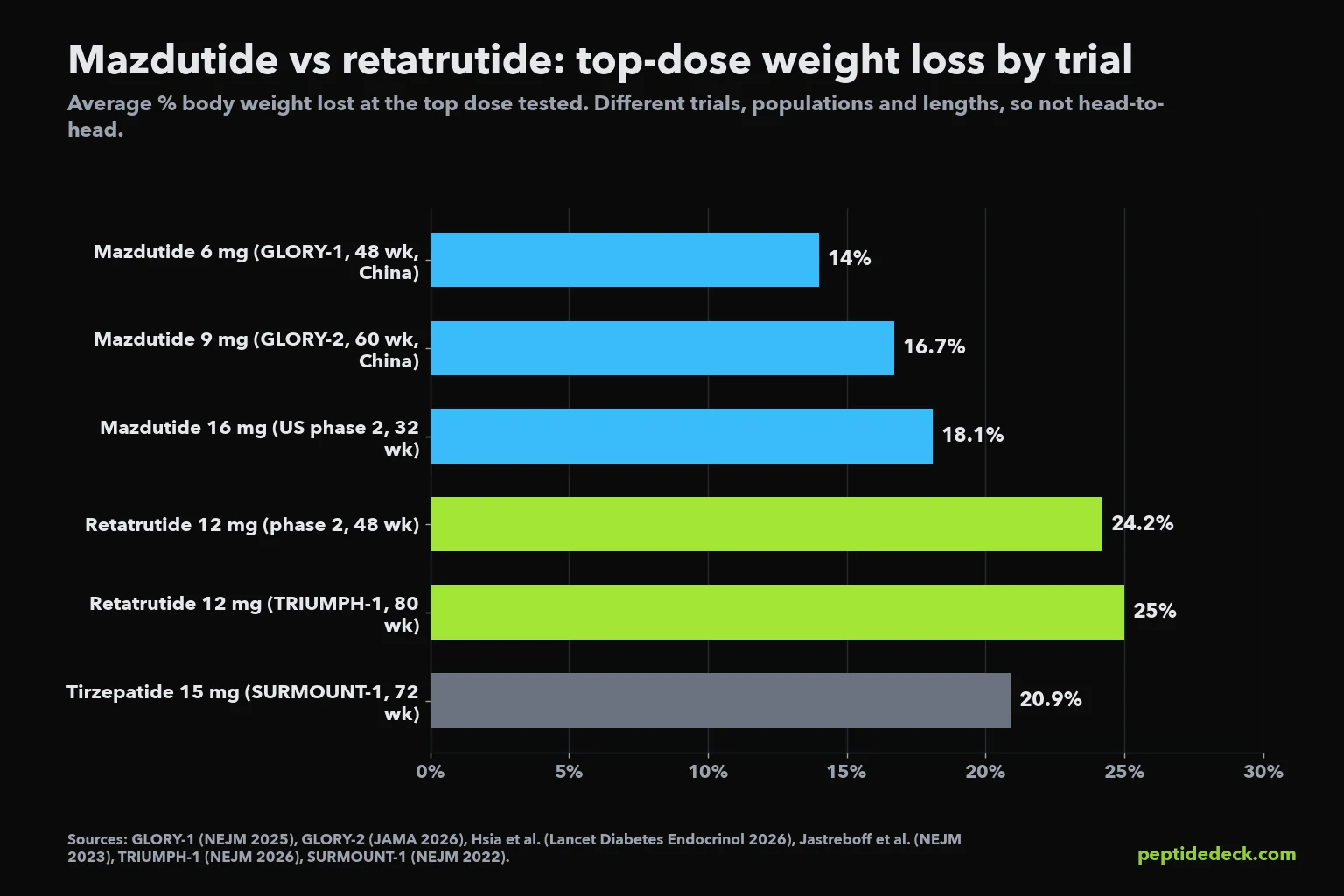
Why You Can't Line These Numbers Up Directly
Three things skew every chart like the one above.
Starting weight. GLORY-1 volunteers averaged 87.2 kg; TRIUMPH-1 volunteers averaged 112.7 kg. In real terms, the 6 mg mazdutide group lost about 12 kg (27 lb), while the 12 mg retatrutide group lost about 28 kg (62 lb). The percentage gap is real, but part of it comes from who walked into each trial.
Population. Mazdutide's phase 3 trials were run entirely in China, where obesity is defined at a BMI of 28, not 30. Its approved label covers adults with a BMI of 28 or higher, or 24 or higher with a weight-related condition. Results in a younger, lighter Chinese cohort (GLORY-2's average age was 33.9) may not carry over to a typical American patient.
Length and dose. TRIUMPH-1 ran 80 weeks; GLORY-1 ran 48. Retatrutide's phase 2 weight curve hadn't flattened by week 48, and Lilly's US mazdutide trial saw more loss after week 32, so a longer trial tends to post a bigger number.
The best bridge so far is Lilly's own US trial of mazdutide. In 179 American adults without diabetes, 16 mg produced 18.1% weight loss at 32 weeks, with more lost by week 48. That's a strong number at an early time point, and it suggests mazdutide at higher doses could land closer to retatrutide than the Chinese data imply. The cost was tolerability: 20% of the 16 mg group stopped treatment because of side effects, mostly stomach problems.
Bottom line on efficacy: retatrutide leads in every published comparison, but by a margin nobody can state precisely. A fair answer needs a head-to-head trial, and none has been announced.
Liver Fat: The Closest Thing to a Fair Fight
Here the two drugs meet in the middle.
Both trials measured liver fat by MRI in people who started with at least 10% fat in the liver, which is the clearest like-for-like comparison available. In GLORY-1, mazdutide 6 mg cut liver fat by 80.2% at 48 weeks, against 5.3% on placebo. In a retatrutide phase 2 substudy of 98 people with fatty liver disease, 12 mg cut liver fat by 82.4% at 24 weeks, and 86% of that group got their liver fat back into the normal range (under 5%).
That near-tie makes sense. Liver fat is where glucagon does its most visible work, and both drugs carry the glucagon lever. If fatty liver is your main concern, the dual agonist doesn't appear to give much up. Innovent is now testing mazdutide 9 mg head to head against semaglutide 2.4 mg in people with obesity and fatty liver (GLORY-3); results haven't been reported.
Type 2 Diabetes: Mazdutide Has the Head-to-Head Win
This is mazdutide's strongest card.
In DREAMS-3, an open-label phase 3 trial in 349 Chinese adults with early type 2 diabetes and obesity, mazdutide 6 mg was compared directly with semaglutide 1 mg (the Ozempic dose) for 32 weeks. 48.0% of the mazdutide group reached both an A1C under 7% and at least 10% weight loss, against 21.0% on semaglutide. Mean weight loss was 10.29% against 6.00%, and A1C fell 2.03 points against 1.84. These are company-reported topline numbers and the full paper isn't out yet.
Two earlier trials, published together in Nature, back it up. In DREAMS-1, mazdutide 6 mg lowered A1C by 2.15 points at 24 weeks against 0.14 on placebo. In DREAMS-2, both doses beat dulaglutide 1.5 mg (Trulicity) on A1C and on weight.
Retatrutide's diabetes numbers are larger but lack that direct comparison. In TRIUMPH-2 (1,152 adults with obesity and type 2 diabetes across eight countries, mean BMI 38.2, The Lancet, September 2026), 12 mg produced 18.8% weight loss at 80 weeks against 5.1% on placebo, or 20.8% against 4.0% counting only people who stayed on treatment. A1C fell 1.4 to 1.6 points from a start of 7.7%. Dysesthesia showed up here too, in 7% on 12 mg against 1% on placebo. Our TRIUMPH-2 breakdown covers the full results.
Side Effects: Similar Stomach, One Signal That's Different
Expect the stomach to complain on either drug.
Nausea, vomiting and diarrhea dominate both safety tables, mostly mild to moderate and worst while the dose is going up. In GLORY-2, vomiting hit 53.1% of the mazdutide 9 mg group, nausea 46.9% and diarrhea 39.4%, yet only 2.9% stopped because of side effects. In TRIUMPH-1, nausea hit 42.4% on retatrutide 12 mg against 14.8% on placebo, and 11.3% stopped because of side effects, against 4.9% on placebo.
The low dropout in the Chinese mazdutide trials is worth reading carefully. When Lilly tested mazdutide 16 mg in Americans, one in five stopped because of side effects. Dropout rates depend on dose, titration speed and the trial culture, not just the molecule.
The signal that sets retatrutide apart is dysesthesia, an abnormal skin sensation such as tingling, burning or sensitivity to touch. It hit 12.5% of people on 12 mg in TRIUMPH-1 against 0.9% on placebo. The mazdutide abstracts we read don't report it. Retatrutide also raised heart rate in a dose-dependent way in phase 2, peaking around week 24 before easing. Our guide to whether retatrutide is safe goes through each signal in detail.
The cautions shared by every drug in this class apply to both: a boxed warning on approved GLP-1 drugs based on thyroid tumors seen in non-human studies (not shown in humans), plus pancreatitis, gallbladder problems, low blood sugar when combined with insulin or sulfonylureas, and dehydration from vomiting or diarrhea.
Dosing: How Each One Is Taken
Both are once-a-week injections under the skin.
Mazdutide is approved in China at 4 mg and 6 mg for weight management, with a 9 mg dose filed for review in November 2025 for moderate to severe obesity. Lilly's US trials have gone higher, to 10 mg and 16 mg, but those doses aren't approved anywhere. Our mazdutide guide covers the trial doses in more detail.
Retatrutide was started at 2 mg in phase 2 and stepped up no faster than every 4 weeks: 2 mg, then 4 mg, 8 mg and 12 mg as the top dose. Phase 3 trials used maintenance doses of 4, 9 and 12 mg. Many people stop escalating at 4 to 8 mg if results and tolerance are good. A 10 mg vial mixed with 2 mL of bacteriostatic water gives 5 mg per mL, so a 2 mg starting dose is 40 units on a U-100 insulin syringe. The full week-by-week plan is in our retatrutide dosing schedule.
Availability, Legal Status and Cost
Geography decides most of this.
Mazdutide is a licensed prescription drug in China, sold as Xinermei since July 2025. At launch, Innovent's recommended price for four 6 mg injector pens, four weekly doses at the top approved dose, was 2,920 yuan, about $411, and it isn't covered by China's national insurance for weight loss. Outside China it has no approval. Lilly keeps the rights there and published its US phase 2 trial in August 2026, but as of our check it had not announced a US phase 3 program or an FDA filing.
Retatrutide has no approval anywhere. Lilly plans to submit it to the FDA in the first quarter of 2027, which puts a decision in late 2027 at the earliest. Since August 2026, a narrow expanded-access route exists for very sick patients whose doctors apply for them; our retatrutide early access guide explains who qualifies. The FDA said in June 2026 that selling unapproved GLP-1 drugs like retatrutide to consumers is illegal and that retatrutide can't be compounded, and in August 2026 Lilly sued six sellers.
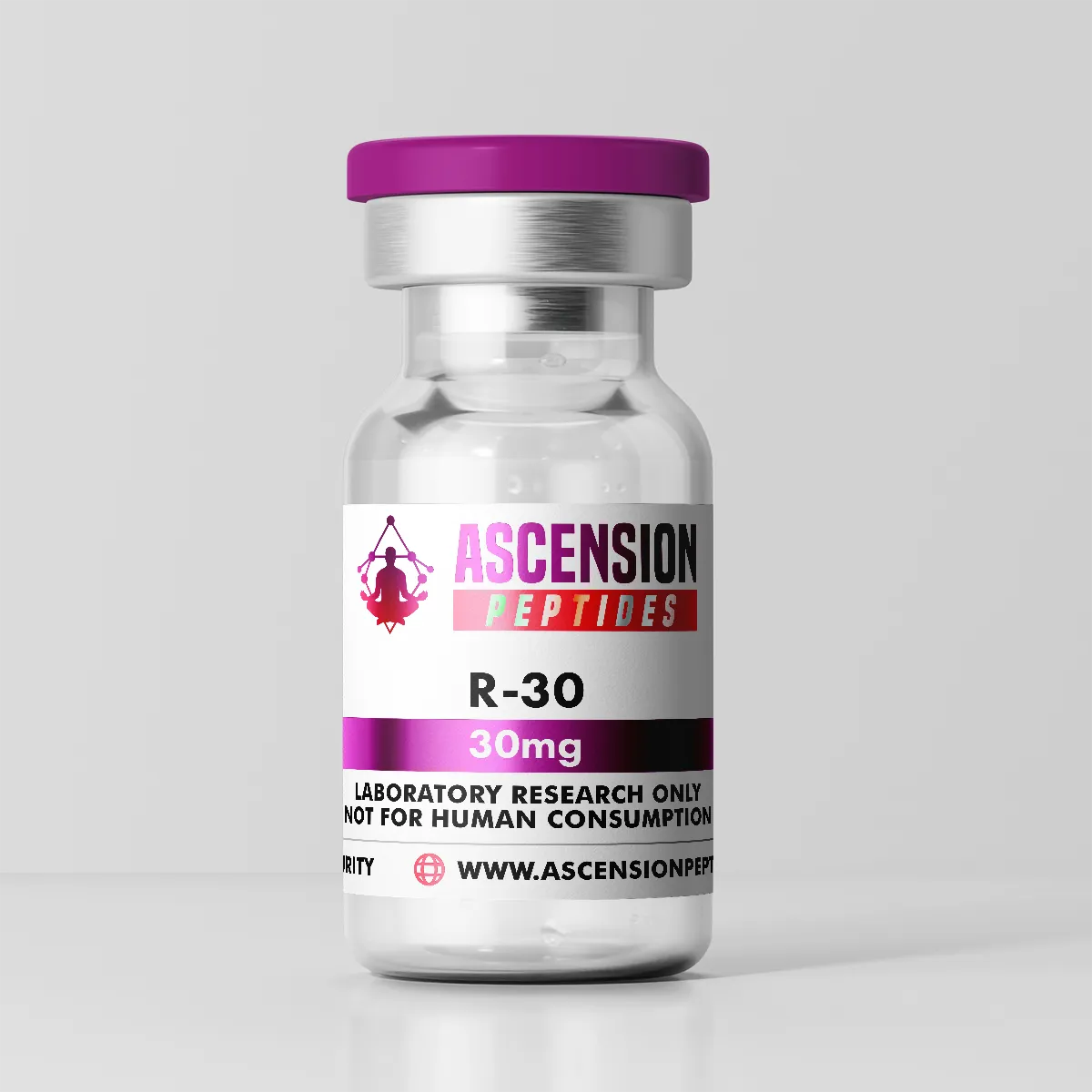
That context matters if you're still thinking about buying it. Online vendors sell freeze-dried vials, and the quality range is enormous, so the one document that matters is a lab report for the exact batch, showing purity, net content and an identity test. Our guide on where to buy retatrutide compares sellers on exactly those checks. For price reference, Ascension's 30 mg vial lists at $250, or $125 with code PEPTIDEDECK, roughly $4.17 per mg, and our buy retatrutide online page shows the current batch report (we earn a commission on that partner link). The rules on buying and holding an unapproved drug for personal use vary by country, so check yours first.
Which One Fits Whom?
It comes down to three questions.
Do you live in China, or have reliable care there? Then mazdutide is the only one of the two you can get with a prescription, a label and a pharmacist behind it. Its type 2 diabetes data, including the win over semaglutide, make it a strong fit if blood sugar is part of the picture.
Is maximum weight loss the goal, with a BMI well above 35? Reta's numbers are the highest in the class, and its heaviest trial volunteers kept losing weight out to 104 weeks. The trade-offs are no approval, a dysesthesia and heart rate signal still being studied, and an unregulated supply. If you're already on tirzepatide and stalled, our retatrutide vs tirzepatide comparison is the more relevant read.
Is fatty liver the main worry? The liver fat data is close to a tie, so the decision falls back on access and supervision rather than the molecule.
One limitation cuts against our own verdict. Every mazdutide phase 3 trial was funded and co-authored by Innovent, and every retatrutide trial by Lilly, so neither drug yet has independent replication. That doesn't change the ranking, but it's a reason to treat the exact percentages as provisional. For the bigger picture on the triple agonist, start with our retatrutide hub.
Frequently Asked Questions
Sources
- Ji L, et al. Once-Weekly Mazdutide in Chinese Adults with Obesity or Overweight (GLORY-1). N Engl J Med. 2025;392:2215-2225. PMID 40421736. PubMed
- Innovent Biologics. GLORY-1 published in NEJM (efficacy estimand and liver fat results), May 25, 2025. Press release
- Gao L, et al. Treatment With 9-mg Mazdutide for Weight Reduction in Chinese Adults With Obesity: The GLORY-2 Randomized Clinical Trial. JAMA. 2026;336(5):377-388. PMID 42251595. PubMed
- Innovent Biologics. Mazdutide 9 mg supplementary application accepted for review by China's NMPA, November 25, 2025. Press release
- Hsia SH, et al. Efficacy and safety of mazdutide in adults with obesity or overweight: a US-based, multicentre, phase 2, randomised, placebo-controlled trial. Lancet Diabetes Endocrinol. 2026;14(11):879-893. PMID 42628555. PubMed
- Innovent Biologics. Mazdutide approved by China's NMPA for chronic weight management, June 27, 2025. Press release
- Shirley M. Mazdutide: First Approval. Drugs. 2025;85(12):1621-1627. PMID 41028652. PubMed
- Innovent Biologics. DREAMS-3: mazdutide vs semaglutide head-to-head phase 3 results, October 26, 2025. Press release
- Zhu D, et al. Mazdutide versus placebo in Chinese adults with type 2 diabetes (DREAMS-1). Nature. 2026;652:174-180. PMID 41407859. PubMed
- Guo L, et al. Mazdutide versus dulaglutide in Chinese adults with type 2 diabetes (DREAMS-2). Nature. 2026;652:181-188. PMID 41407860. PubMed
- Eli Lilly. Who is developing mazdutide and for which potential indications? Lilly Medical, reviewed November 6, 2025. Lilly Medical
- Reuters. Innovent's weight-loss drug highlights China challenge for Novo, Lilly (Xinermei launch and price), 2025. Reuters via TradingView
- Jastreboff AM, et al. Triple-Hormone-Receptor Agonist Retatrutide for Obesity: A Phase 2 Trial. N Engl J Med. 2023;389:514-526. PMID 37366315. PubMed
- Jastreboff AM, et al. Retatrutide, a Triple Hormone Receptor Agonist, for Treatment of Obesity (TRIUMPH-1). N Engl J Med. Published online September 29, 2026. PMID 42814954. PubMed
- Eli Lilly. Retatrutide delivered powerful weight loss in pivotal phase 3 obesity trial (TRIUMPH-1 topline), May 21, 2026. Press release
- Sanyal AJ, et al. Triple hormone receptor agonist retatrutide for metabolic dysfunction-associated steatotic liver disease: a randomized phase 2a trial. Nat Med. 2024;30:2037-2048. PMID 38858523. PubMed
- BioSpace. Lilly preps FDA run for triple-G weight loss drug with phase 3 data (BLA planned Q1 2027), July 2026. BioSpace
- STAT. Eli Lilly retatrutide expanded access, August 3, 2026. STAT
- Healio. Eli Lilly files lawsuits against six companies for allegedly selling retatrutide, August 14, 2026. Healio
- Bellido V, et al. Retatrutide in adults with obesity and type 2 diabetes (TRIUMPH-2): a phase 3 trial. Lancet. 2026;408:1455-1472. PMID 42810372. PubMed
- Jastreboff AM, et al. Tirzepatide Once Weekly for the Treatment of Obesity (SURMOUNT-1). N Engl J Med. 2022;387:205-216. PMID 35658024. PubMed
Medical Disclaimer: This content is for informational purposes only and does not constitute medical advice. Retatrutide has no FDA approval, and mazdutide is approved only in China. Always consult a qualified healthcare provider before starting any new medication or treatment. PeptideDeck may earn a commission from affiliate links at no additional cost to you.