Embody GLP-1Sema & Tirz from EmbodySemaglutide & Tirzepatide from Embody·Wegovy$1,349$69/mo95% lessNo long-term commitmentFree shippingAll doses included
Take the 1-min quizTake quiz
PDPeptideDeck
01· StoreShop Peptides↗02GLP-1 Suppliers03Calculator04Free TrialAI Coach
Shop
Home/Peptides/Emerging glp metabolic peptidesEloralintide: Benefits, Dosage & Side Effects (2026)
Emerging glp metabolic peptides10 min read

Eloralintide: Benefits, Dosage & Side Effects (2026)

Published August 13, 2026Updated August 13, 2026
Quick Brief

Eli Lilly's selective amylin agonist delivered up to 20.1% weight loss at 48 weeks in Phase 2, with GI side effects close to placebo at lower doses. Mechanism, benefits, dosing, tolerability and whether you can get it.

Eloralintide: Benefits, Dosage & Side Effects (2026)

Procurement

Embody Compounded Semaglutide
In StockShips from USA

Embody Compounded Semaglutide

Embody Compounded Semaglutide via licensed US telehealth. Flat $69/month, normally $299. Includes all doses, provider visits and fast free shipping. No long-term commitment.

Start Semaglutide — $69/mo
Contents0%
What Is Eloralintide?How Eloralintide WorksEloralintide BenefitsPhase 2 ResultsEloralintide DosageEloralintide Side EffectsHow It ComparesCan You Get Eloralintide?Frequently Asked Questions
Embody Compounded Semaglutide

Procurement

Embody Compounded Semaglutide

In StockShips from USA
Start Semaglutide — $69/mo

Eloralintide is Eli Lilly's once-weekly selective amylin receptor agonist, previously known as LY3841136. It matters because its Phase 2 data put it in the same weight-loss range as the leading GLP-1 drugs while producing a notably gentler side-effect profile — and because it works through a pathway none of them use.

It is not approved, not prescribable, and not sold anywhere. Phase 3 enrollment began at the end of 2025.

🔑 Key Facts

  • Up to 20.1% mean weight reduction at 48 weeks in Phase 2, against 0.4% for placebo
  • It is an amylin agonist, not a GLP-1. Different hormone, different receptor, different satiety pathway
  • Tolerability is the headline, not just efficacy — GI side effects tracked close to placebo in the lower-dose arms
  • Once weekly, injectable, and studied in adults with obesity or overweight without type 2 diabetes
  • Not available in any form. No approval, no prescription, no research-chemical version worth trusting

What Is Eloralintide?

Eloralintide is a synthetic, long-acting agonist of the amylin receptor. Amylin is a hormone co-secreted with insulin by pancreatic beta cells, and it is one of the body's genuine satiety signals — it slows gastric emptying, suppresses inappropriate glucagon release, and acts on the brainstem to end a meal.

The word doing the work in its description is selective. Pramlintide, the older amylin analog, hits both amylin and calcitonin receptors. Cagrilintide, Novo's entrant, is also non-selective. Eloralintide was designed to activate amylin receptors specifically, which is the stated basis for its cleaner tolerability.

How Eloralintide Works
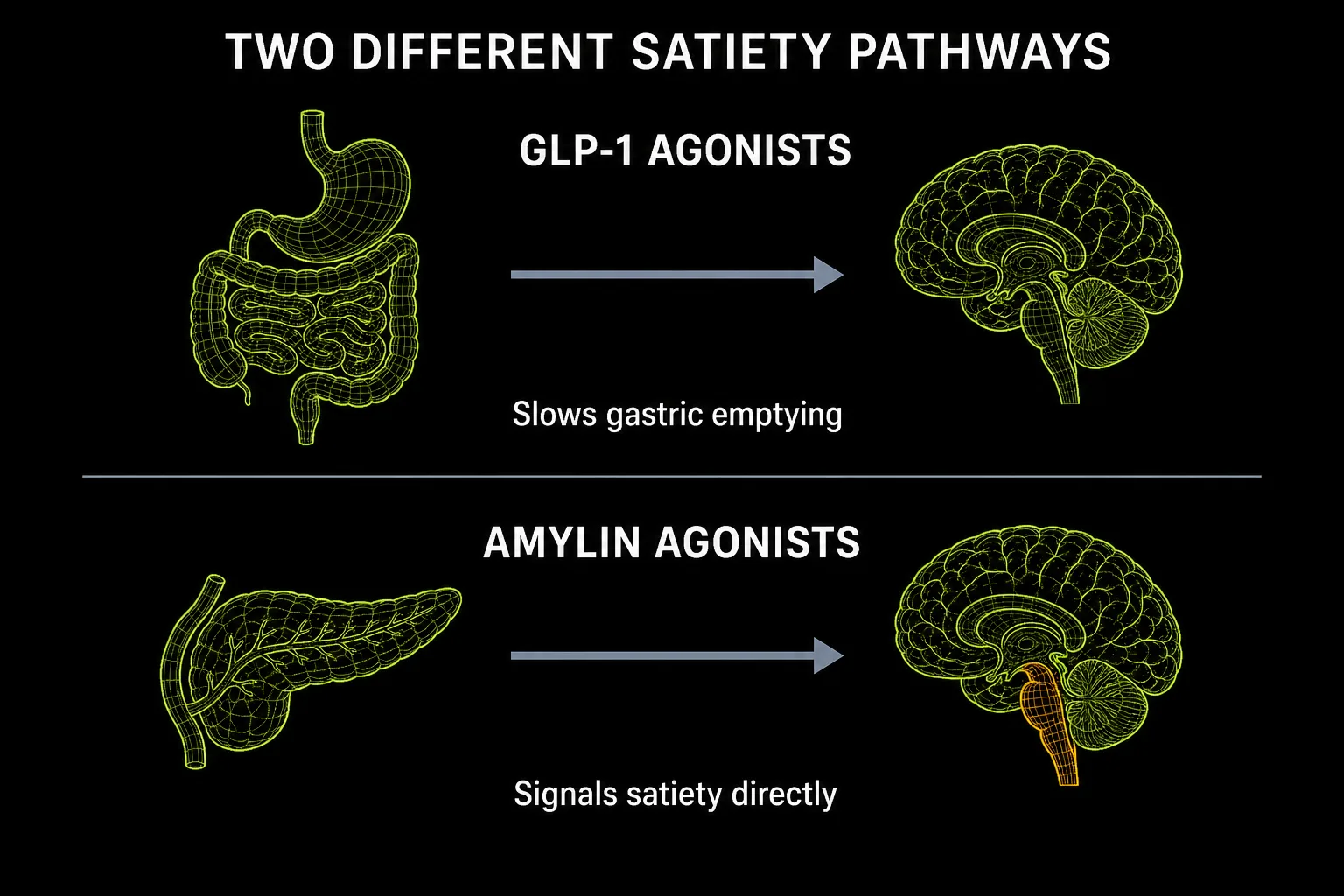
Diagram contrasting GLP-1 agonists acting via the gut to slow gastric emptying against amylin agonists signalling satiety directly through the brainstem
Amylin is a separate satiety system from GLP-1 — which is why the two can be combined rather than swapped.

GLP-1 drugs like semaglutide and tirzepatide work largely by slowing gastric emptying and acting on GLP-1 receptors in the hypothalamus. Amylin signals satiety through a different route, primarily via the area postrema in the brainstem.

Two consequences follow. First, appetite suppression arrives without leaning as hard on gastric slowing, which is the mechanism behind much of the nausea people report on GLP-1s. Second, because the pathways are separate, amylin agonists are candidates for combination with GLP-1s rather than replacement — which is exactly what Lilly and Novo are both pursuing.

Eloralintide Benefits

Outcome
What Phase 2 showed
Comparison
Confidence
Weight reduction
9.5% to 20.1% at 48 weeks
Placebo 0.4%
High — primary endpoint met in all arms
Tolerability
GI effects mild to moderate
Similar to placebo at lower doses
High
Waist circumference
Improved
Consistent with weight loss
Moderate
Blood pressure
Improved
Secondary endpoint
Moderate
Lipid profile
Improved
Secondary endpoint
Moderate
Glycemic control
Improved
In a non-diabetic population
Moderate
Inflammatory markers
Improved
Secondary endpoint
Moderate
Weight reduction
What Phase 2 showed
9.5% to 20.1% at 48 weeks
Comparison
Placebo 0.4%
Confidence
High — primary endpoint met in all arms
Tolerability
What Phase 2 showed
GI effects mild to moderate
Comparison
Similar to placebo at lower doses
Confidence
High
Waist circumference
What Phase 2 showed
Improved
Comparison
Consistent with weight loss
Confidence
Moderate
Blood pressure
What Phase 2 showed
Improved
Comparison
Secondary endpoint
Confidence
Moderate
Lipid profile
What Phase 2 showed
Improved
Comparison
Secondary endpoint
Confidence
Moderate
Glycemic control
What Phase 2 showed
Improved
Comparison
In a non-diabetic population
Confidence
Moderate
Inflammatory markers
What Phase 2 showed
Improved
Comparison
Secondary endpoint
Confidence
Moderate

The cardiometabolic cluster is worth noting because it was measured in people without type 2 diabetes. Improvements in glycemic control and inflammation in that population suggest effects beyond what weight loss alone would predict, though secondary endpoints in a Phase 2 are hypothesis-generating rather than conclusive.

Phase 2 Results
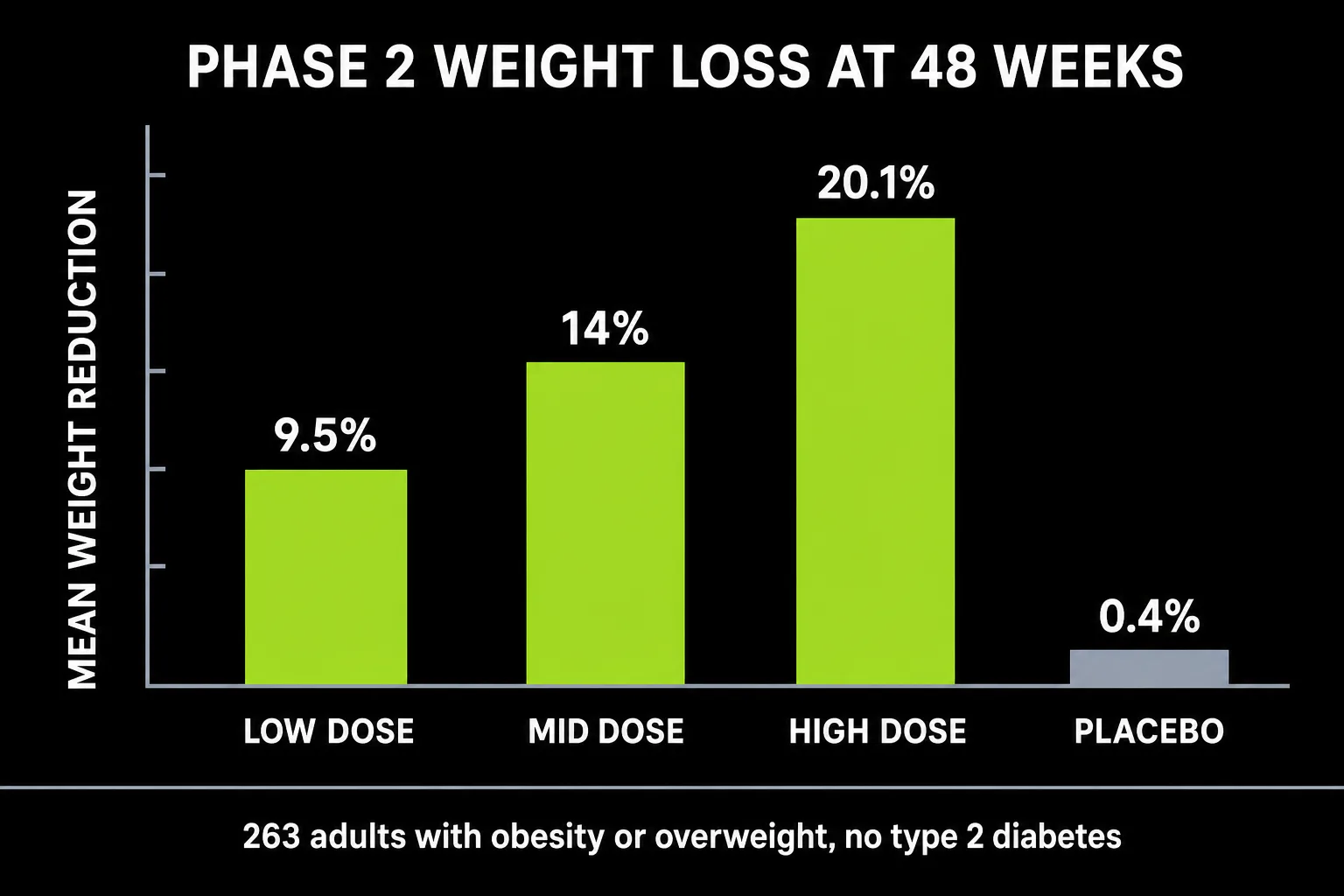
Bar chart of eloralintide Phase 2 weight loss at 48 weeks showing 9.5 percent at low dose up to 20.1 percent at high dose against 0.4 percent for placebo
All dose arms beat placebo. The spread between the lowest and highest arm is the whole dose-response story.

The trial enrolled 263 adults with obesity, or overweight with at least one obesity-related comorbidity, and excluded people with type 2 diabetes. Every treatment arm met the primary endpoint at 48 weeks, with mean weight reductions ranging from 9.5% in the lowest arm to 20.1% in the highest, against 0.4% on placebo.

For scale: 20.1% puts the top arm in tirzepatide territory and above what semaglutide achieves in comparable trials. The caveat that matters is cross-trial comparison — different populations, durations and protocols make head-to-head claims unreliable until someone runs the actual head-to-head. See retatrutide vs tirzepatide for how these comparisons usually shake out.

Embody Compounded Semaglutide
Top Pick Embody Compounded Semaglutide Embody Compounded Semaglutide via licensed US telehealth. Flat $69/month, normally $299. Includes all doses, provider visits and fast free shipping. No long-term commitment.
Start Semaglutide — $69/mo

Eloralintide Dosage

Eloralintide is dosed once weekly by subcutaneous injection. The Phase 2 program was a dose-ranging study with multiple arms, which is where the 9.5%-to-20.1% spread comes from — higher arms lost more.

Beyond that, there is no dosing guidance to give, and anyone offering you a specific milligram protocol is inventing it. The trial doses have not translated into an approved label, no titration schedule has been published for clinical use, and the drug does not exist outside the trial supply chain. When Phase 3 completes and a label is written, that will be the number to use.

Eloralintide Side Effects

Mild-to-moderate gastrointestinal symptoms were the most common adverse events — nausea, and the usual GI cluster that follows any drug affecting gastric handling and satiety.

The finding that generated the attention: in the lower-dose arms, GI adverse event incidence was similar to placebo. That is unusual in this drug class. GLP-1 and dual-agonist trials typically show a clear separation from placebo on nausea, and tolerability is the single most common reason people stop taking them.

Two honest caveats. Tolerability was better at lower doses, and lower doses also produced less weight loss — so the gentle profile and the 20.1% headline may not belong to the same arm. And a 263-person Phase 2 is not where rare adverse events surface. Phase 3 is. For how the established drugs compare on this, see GLP-1 side effects compared.
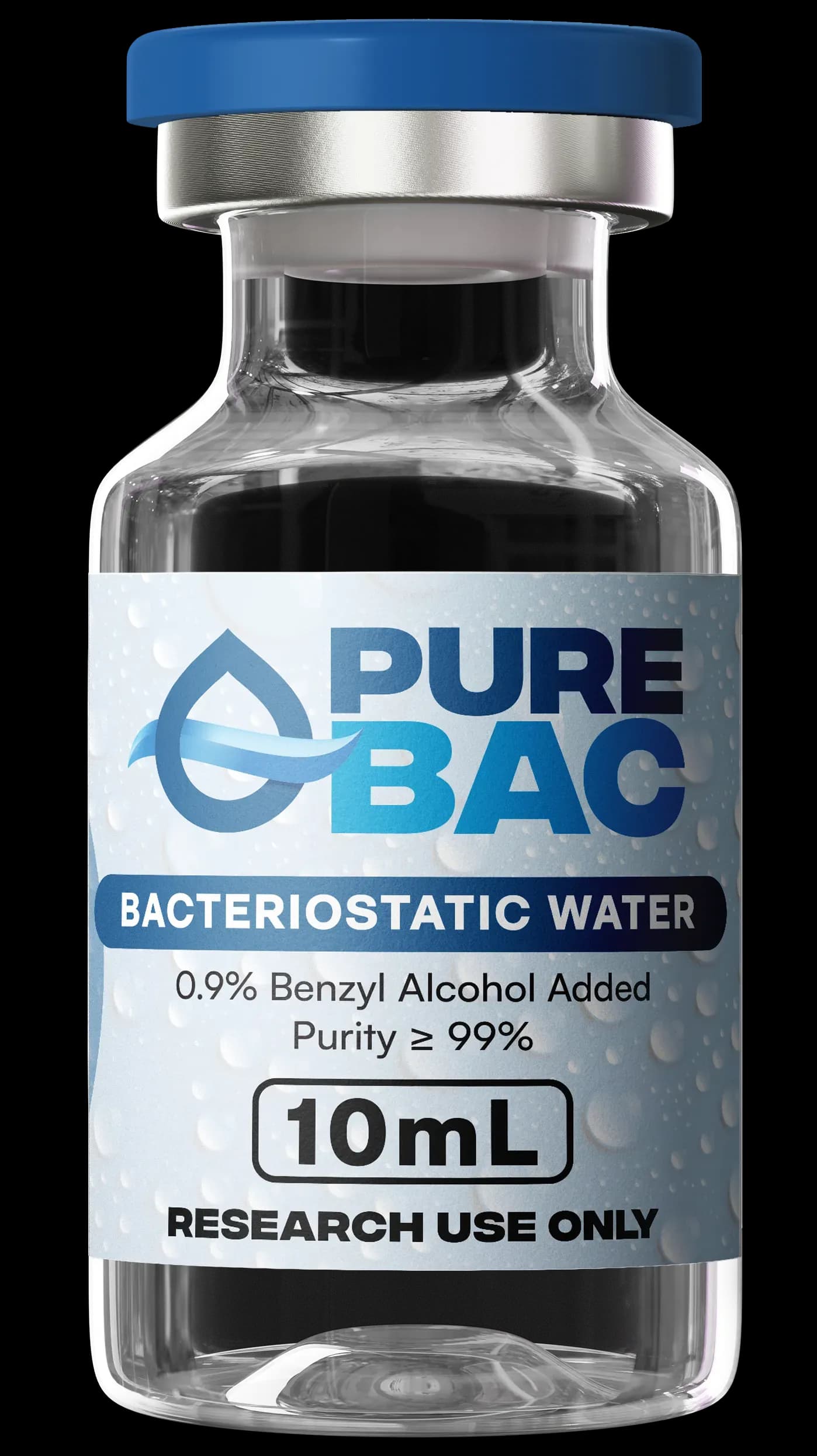
PureBac 7x tested bacteriostatic water 10mL vial
7x Quality Tested Bac Water

Don't ruin a $300 peptide on generic bac water.

Sterile, non-pyrogenic, exactly 0.9% benzyl alcohol, with a COA on every batch. Made for peptide reconstitution, not repackaged from generic stock.

0.9% benzyl alcohol 7x tested in USA COA every batch
Get PureBac bac water From $7.99 · Free shipping over $150

How It Compares

Drug
Class
Best reported weight loss
Status
Eloralintide
Selective amylin agonist
20.1% at 48 weeks
Phase 3 enrolling
Petrelintide
Amylin analog
Phase 2 reported
Phase 3
Retatrutide
Triple GLP-1/GIP/glucagon
~24% at 48 weeks
Phase 3
Tirzepatide
Dual GLP-1/GIP
~22.5% at 72 weeks
Approved
Semaglutide
GLP-1
~15% at 68 weeks
Approved
Eloralintide
Class
Selective amylin agonist
Best reported weight loss
20.1% at 48 weeks
Status
Phase 3 enrolling
Petrelintide
Class
Amylin analog
Best reported weight loss
Phase 2 reported
Status
Phase 3
Retatrutide
Class
Triple GLP-1/GIP/glucagon
Best reported weight loss
~24% at 48 weeks
Status
Phase 3
Tirzepatide
Class
Dual GLP-1/GIP
Best reported weight loss
~22.5% at 72 weeks
Status
Approved
Semaglutide
Class
GLP-1
Best reported weight loss
~15% at 68 weeks
Status
Approved

Read that table as orientation, not a ranking — the durations differ, which alone makes the percentages non-comparable. Our deeper comparison of the amylin class is in petrelintide and eloralintide, and the wider pipeline in tirzepatide vs the next-generation GLP-1 drugs.

Can You Get Eloralintide?

No, and this is the part worth being blunt about.

Eloralintide is not FDA approved. There is no prescription route, no compounding pathway, and no legitimate research-chemical supply. Any vendor listing "eloralintide" is selling you something whose identity nobody has verified — a peptide this new has no established reference standard for a third-party lab to test against.

If you want a clinician-supervised weight-loss option that exists today, the approved and compounded GLP-1s are the realistic route. What is GLP-1 covers the landscape, and survodutide and mazdutide cover the other pipeline drugs at a similar stage.

Frequently Asked Questions

What is eloralintide?
A once-weekly selective amylin receptor agonist developed by Eli Lilly, previously designated LY3841136. It is an investigational obesity drug that entered Phase 3 enrollment at the end of 2025 and is not approved anywhere.
How much weight did people lose on eloralintide?
In the Phase 2 trial, mean weight reduction at 48 weeks ranged from 9.5% in the lowest dose arm to 20.1% in the highest, against 0.4% for placebo. All treatment arms met the primary endpoint.
Is eloralintide a GLP-1?
No. It targets the amylin receptor, which is a separate satiety pathway. GLP-1 drugs act largely through slowing gastric emptying and hypothalamic GLP-1 receptors; amylin signals satiety through the brainstem. Because the mechanisms differ, the two classes are being developed as combinations rather than substitutes.
What are eloralintide side effects?
Mild to moderate gastrointestinal symptoms were most common. Notably, GI adverse event incidence was similar to placebo in the lower-dose arms, which is unusual for this drug class. Bear in mind the better-tolerated arms were also the less effective ones, and a 263-person trial is too small to surface rare events.
What is the eloralintide dosage?
Once weekly by subcutaneous injection, in dose-ranging arms during Phase 2. No specific protocol is publishable for clinical use — there is no approved label and no published titration schedule. Any source quoting exact milligrams for personal use is making them up.
Can I buy eloralintide?
No. It is not approved, has no prescription route, and has no legitimate research supply. A compound this new has no established reference standard, so even a certificate of analysis cannot confirm what is in a vial claiming to be eloralintide.
Eloralintide vs retatrutide — which is better?
Retatrutide has reported higher peak weight loss at around 24%, against 20.1% for eloralintide. But eloralintide reported tolerability close to placebo at lower doses, which retatrutide does not, and the two work through entirely different mechanisms. Neither is approved, and no head-to-head trial exists.

This article is for educational purposes and is not medical advice. Eloralintide is an investigational drug that is not approved for use in any country and is not available for purchase. Trial results described here are from Phase 2 and may not replicate in Phase 3.

Embody Compounded Semaglutide

Recommended Supplier

In StockShips from USA

Embody Compounded Semaglutide

Embody Compounded Semaglutide via licensed US telehealth. Flat $69/month, normally $299. Includes all doses, provider visits and fast free shipping. No long-term commitment.

Start Semaglutide — $69/mo

Related Topics

eloralintideeloralintide side effectseloralintide dosageamylin agonisteli lilly obesity drugLY3841136weight loss drugsobesity pipeline
Back to Peptides
Contents0%
What Is Eloralintide?How Eloralintide WorksEloralintide BenefitsPhase 2 ResultsEloralintide DosageEloralintide Side EffectsHow It ComparesCan You Get Eloralintide?Frequently Asked Questions
Embody Compounded Semaglutide
Start Semaglutide — $69/mo
PDPeptideDeck

Research-backed guides, dosing tools and reviews for peptides and GLP-1 medications.

01 · Explore

  • Peptide Guides
  • Oral Peptides
  • HRT Guide
  • TRT Guide
  • Blog
  • Calculators
  • AI Coach
  • Shop

02 · GLP-1

  • GLP-1 Guide
  • GLP-1 Programs
  • GLP-1 Reviews

03 · Company

  • About
  • Contact

04 · Dosing Charts

5-Amino-1MQAOD-9604BPC-157CagrilintideCJC-1295EnclomipheneEpithalonFOXO4-DRIGHK-CuGLOWGlutathioneIGF-1 LR3IpamorelinKisspeptinKLOWKPVMelanotanMK-677MOTS-cMounjaroNAD+PT-141RetatrutideSelankSemaglutideSemaxSermorelinSS-31TB-500TesamorelinThymosin Alpha-1WegovyWolverine StackZepbound
© 2026 PeptideDeck