Eloralintide is Eli Lilly's next big obesity bet. It's a once-weekly injection that copies amylin, a fullness hormone your pancreas already makes, and in its Phase 2 trial people lost up to 20.1% of their body weight in 48 weeks. On September 30, 2026, Lilly added a second headline: eloralintide paired with tirzepatide took off 23.3%. This guide covers what eloralintide is, how it works, every trial result so far, its side effects, and when you might be able to get it.
🔑 Key Takeaways
- It works on a different hormone from Wegovy and Zepbound, which is why Lilly pairs it with one
- The dose that did best on the scale wasn't the easiest one to live with
- People with type 2 diabetes lost noticeably less on eloralintide alone
- The newest combination beat tirzepatide, but more people quit
- One Phase 3 trial tests it on people a GLP-1 drug didn't get far enough
📰 Latest eloralintide news (September 30, 2026)
At the EASD diabetes meeting in Milan, Lilly reported that EloraTZP, eloralintide combined with tirzepatide, cut weight by up to 23.3% and A1C by up to 2.9 points in 48 weeks in adults with obesity and type 2 diabetes, beating tirzepatide 15 mg alone (14.8%). Lilly plans to start Phase 3 trials of a single-shot EloraTZP by the end of 2026. Full results below.
If you've followed the weight-loss drug race, you know the names: semaglutide, tirzepatide, retatrutide. They all lean on the same gut hormone, GLP-1. Eloralintide doesn't. That's what makes it interesting, and it's why Lilly is testing it both alone and as a partner for the drugs you already know.
What Is Eloralintide?
It's an amylin shot, taken once a week. Eloralintide (code name LY3841136) is an investigational drug from Eli Lilly for obesity and overweight. It is a long-acting version of amylin, a hormone your pancreas releases alongside insulin every time you eat.
It isn't approved anywhere yet. It's in five Phase 3 trials, and the first results are due in 2028. The idea of an amylin drug isn't new: pramlintide (Symlin), a short-acting amylin copy, has been approved since 2005 for people with diabetes who use mealtime insulin, but it has to be injected before every meal. Eloralintide lasts long enough for once-weekly dosing.
Lilly calls it "selective" because it targets the amylin receptor and largely avoids the related calcitonin receptor that some other amylin drugs, such as cagrilintide, also activate. Whether that selectivity matters for side effects is one of the things Phase 3 should settle.
How Eloralintide Works
Amylin is your "that's enough" signal. When you eat, your pancreas releases it with insulin, and it does three things: it slows how fast your stomach empties, it tells the brainstem you're full, and it holds back glucagon, the hormone that pushes blood sugar up after meals.
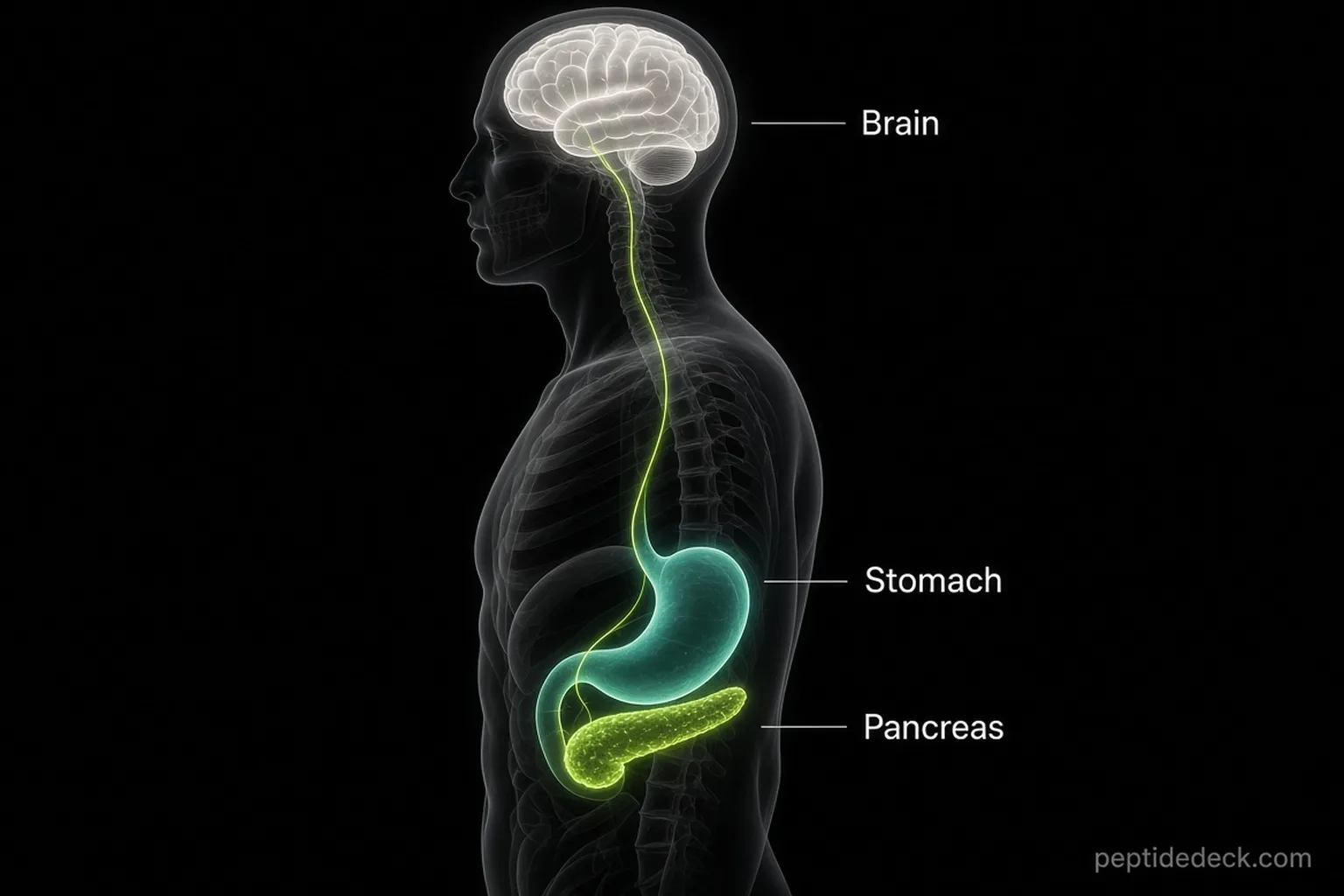
GLP-1 drugs like semaglutide work on appetite through a different receptor. That's why the pairing makes sense: two separate fullness signals instead of one louder one. In a small first-in-human study, a single 12 mg dose of eloralintide cut body weight by 4.4% within four weeks, against a 0.6% gain on placebo, and its time in the blood supported once-weekly dosing.
If you already know the feeling of being hungry again an hour after a big meal, amylin is the part of that system that's supposed to stop it. Our petrelintide vs eloralintide comparison covers the other amylin drugs in development.
Eloralintide Phase 2 Results
The dose made most of the difference. Lilly's Phase 2 trial, published in The Lancet in November 2025, gave 263 adults with obesity or overweight (and at least one weight-related condition, but no type 2 diabetes) a weekly shot of eloralintide or placebo for 48 weeks. They started at an average of 109 kg (240 lb) and a BMI of 39.
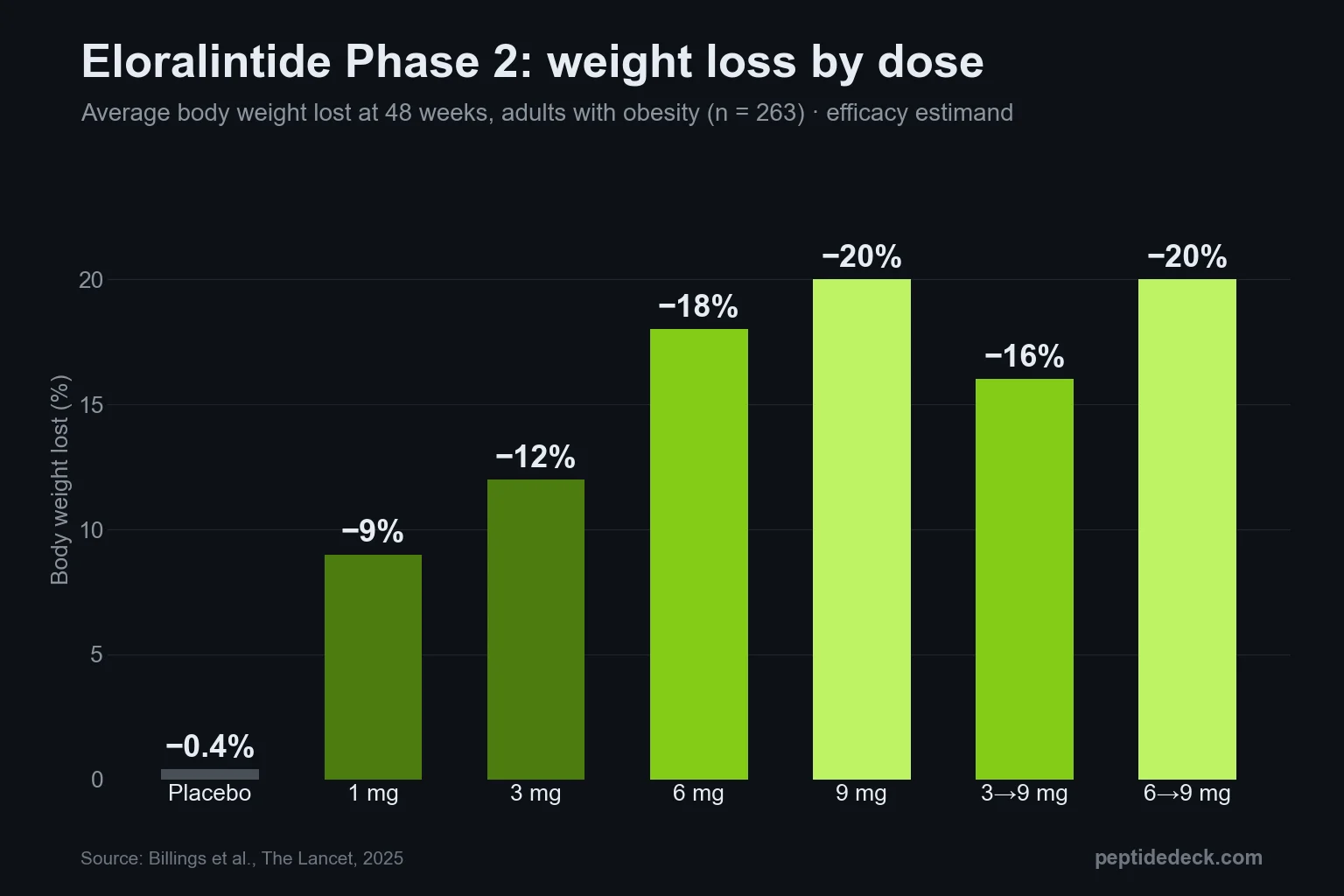
Two things jump out. The 9 mg dose and the 6-to-9 mg ramp both reached about 20%, the same territory as tirzepatide. Phase 3 runs longer, 64 weeks, so the final numbers could land higher or lower.
The tolerability picture is more mixed than the headline. Starting straight at 6 mg caused nausea in 64% of people, far more than the 25% who ramped up from 3 mg. Starting low and stepping up clearly helps, which is why the Phase 3 trials use a gradual escalation.
Latest News: EloraTZP Results (September 2026)
This is the result everyone is talking about. EloraTZP is eloralintide given alongside tirzepatide (the drug in Mounjaro and Zepbound). Lilly tested it in 367 US adults with obesity or overweight and type 2 diabetes, starting at an average of 232 lb and an A1C of 8.1%.
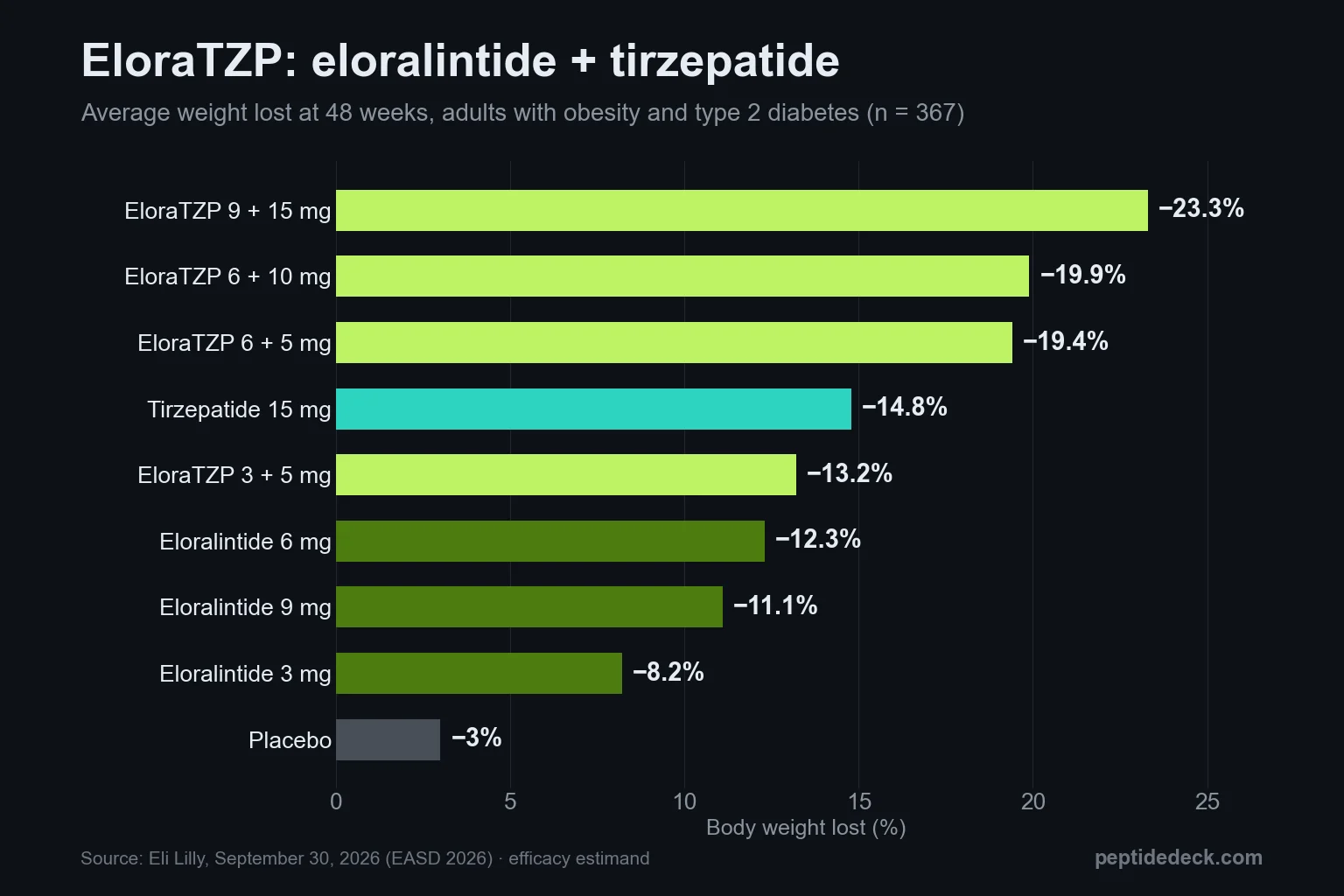
Three findings matter more than the 23.3% headline. First, the combination worked at lower tirzepatide doses: 6 mg eloralintide plus just 5 mg tirzepatide reached 19.4%, more than full-dose tirzepatide alone. Second, eloralintide on its own did much less in people with diabetes (8.2% to 12.3%) than in the earlier trial without diabetes (up to 20%). That pattern is familiar: GLP-1 drugs also take off less weight in people with diabetes.
Third, and this is the honest catch: more people quit. Between 10.8% and 27.0% of people on the combinations stopped treatment because of side effects, against 2.9% on tirzepatide alone. Stomach side effects were the most common, and they mostly came during the dose ramp. Lilly says Phase 3 will use an "optimized escalation schedule" to fix that. Whether it does is the key question for 2027.
The same EASD meeting also brought the full retatrutide diabetes data; see our retatrutide TRIUMPH-2 results for how the triple-hormone shot compares.
Eloralintide Side Effects
Nausea and tiredness lead the list. In Phase 2, the most common side effects were nausea and fatigue, and both climbed with dose.
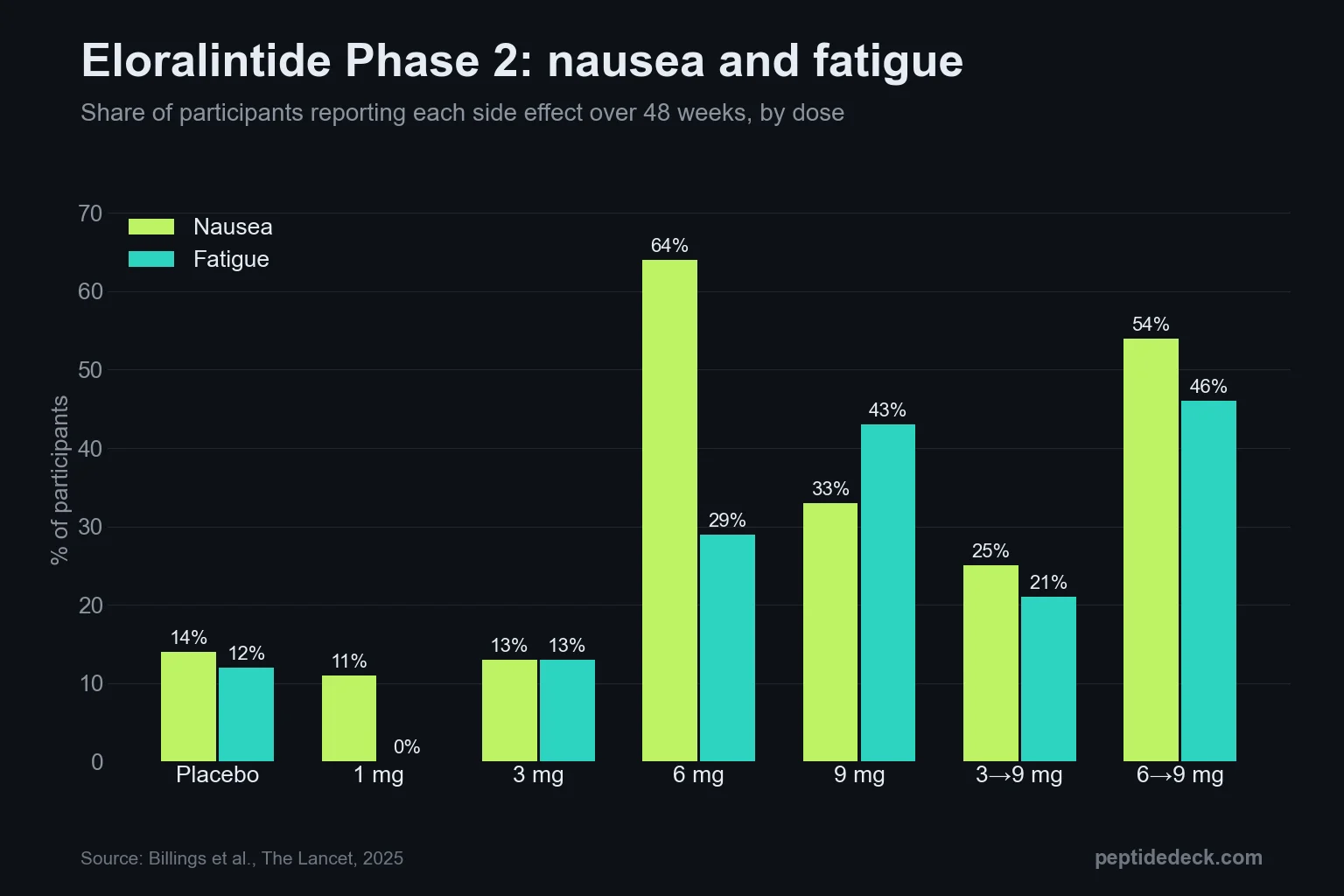
- Nausea: 11% to 64% depending on dose and how fast it was raised, against 14% on placebo.
- Fatigue: up to 46% on the higher doses, against 12% on placebo. That's more prominent than with most GLP-1 drugs, and worth knowing if you already struggle with low energy.
- Timing: in the combination trial, stomach side effects were mostly mild to moderate and clustered in the dose-raising weeks.
These are Phase 2 numbers from a few hundred people. Rarer side effects only show up in trials of thousands, which is exactly what the ENLIGHTEN program is for. Our eloralintide peptide guide covers side effects and dosing questions in more detail.
Eloralintide vs Semaglutide and Tirzepatide
Different hormone, similar ballpark. Here is how the headline trial results line up.
Read this table with care. The trials ran for different lengths, in different people, and some report results assuming everyone stayed on the drug while others count people who stopped. Eloralintide's figure comes from a 263-person Phase 2 trial; the others come from Phase 3 trials of about 2,000 to 3,400 people. There's no head-to-head trial of eloralintide against semaglutide or tirzepatide.
The bigger difference is how they work. Semaglutide is a GLP-1 drug. Tirzepatide adds GIP. Eloralintide works on neither, which is why Lilly's longer-term plan leans on combining it with tirzepatide rather than replacing it.
Eloralintide Phase 3 Trials: The ENLIGHTEN Program
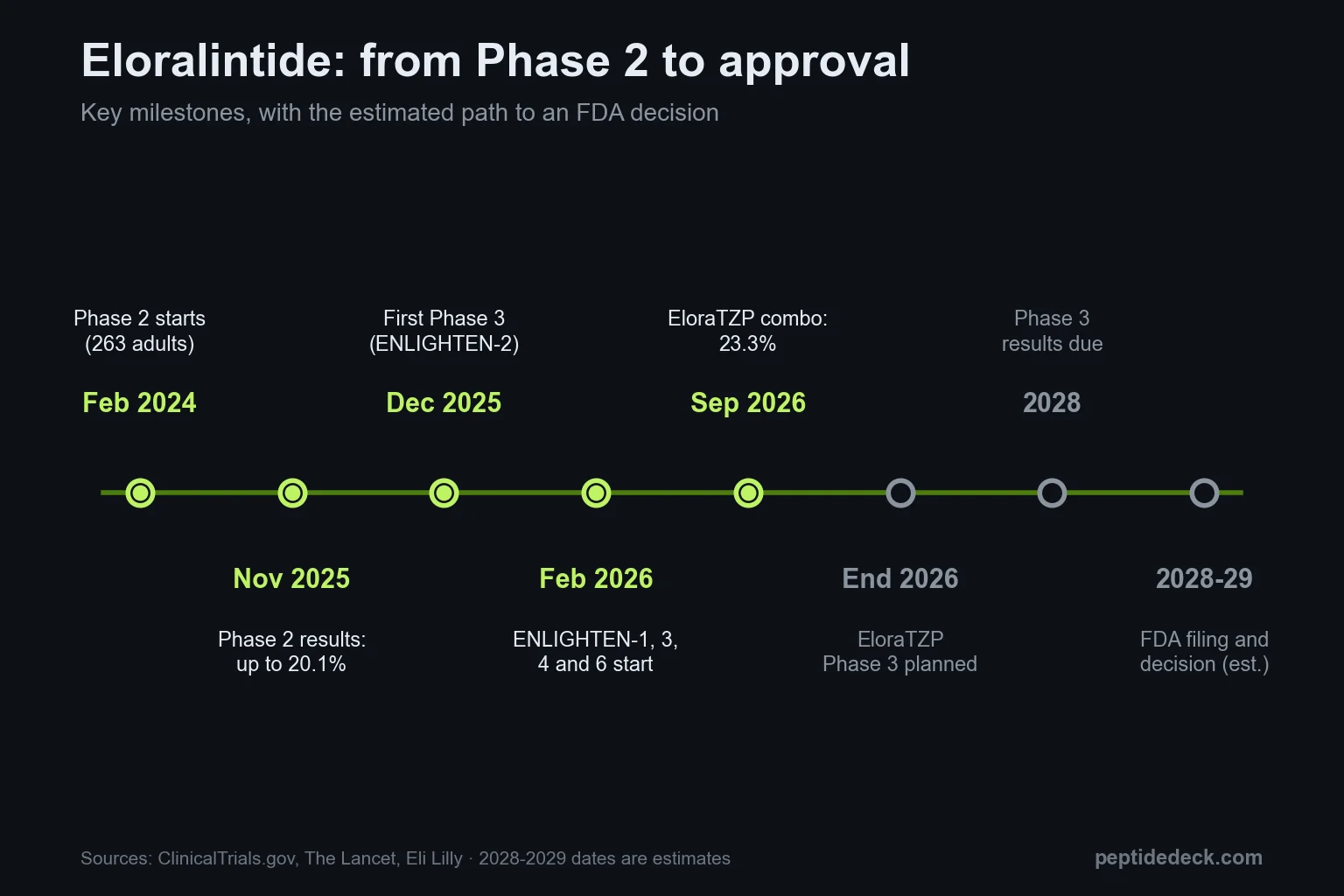
Phase 3 is already running. Lilly started the first ENLIGHTEN trial in December 2025 and four more in February 2026. Each gives eloralintide or placebo for 64 weeks, with weight change as the main result.
ENLIGHTEN-6 is the one to watch. It enrolls people who are still living with obesity despite taking a weekly incretin drug such as semaglutide or tirzepatide. If eloralintide adds meaningful weight loss on top, it becomes an option for the many people whose progress stalls on today's drugs.
Lilly is also testing eloralintide with its experimental drug macupatide in two Phase 2 trials, and plans a separate Phase 3 program for the single-shot EloraTZP combination by the end of 2026.
When Will Eloralintide Be Available?
Not before 2028 at the earliest. The main Phase 3 results are due between January and June 2028. Lilly would then file with the FDA, and a standard review takes about a year, which puts a realistic approval in 2029. That's an estimate: Lilly hasn't announced a filing date.
Can You Get Eloralintide Now?
Only through a clinical trial. Eloralintide isn't sold by any pharmacy, and Lilly doesn't supply it outside its studies. Some websites list "eloralintide" for sale, but there's no way to check what's in those vials.
If you're looking for weight loss now, tirzepatide is the closest available relative: it's half of EloraTZP, and in the combination trial 15 mg alone took off 14.8% even in people with diabetes. Compounded versions cost far less than the brand; our guide to the cheapest tirzepatide compares current prices. To see if you qualify for an eloralintide trial, search ClinicalTrials.gov for "eloralintide" or ask your doctor.
Frequently Asked Questions
Sources
- Billings LK, et al. Eloralintide, a selective amylin receptor agonist for the treatment of obesity: a 48-week phase 2, multicentre, double-blind, randomised, placebo-controlled trial. The Lancet. 2025;406(10520):2631-2643. PubMed
- Eli Lilly and Company. Lilly's EloraTZP (combination of eloralintide and tirzepatide) delivered greater weight loss and A1C reduction vs. tirzepatide 15 mg in adults with obesity and type 2 diabetes. September 30, 2026.
- Eli Lilly and Company. Eloralintide Phase 2 results. November 2025.
- Eloralintide (LY3841136), a novel amylin receptor agonist for the treatment of obesity. Molecular Metabolism. 2025;102:102271. PubMed
- ClinicalTrials.gov: ENLIGHTEN-1, ENLIGHTEN-2, ENLIGHTEN-3, ENLIGHTEN-4, ENLIGHTEN-6.
- Wilding JPH, et al. Once-weekly semaglutide in adults with overweight or obesity (STEP 1). N Engl J Med. 2021;384:989-1002. PubMed
- Jastreboff AM, et al. Tirzepatide once weekly for the treatment of obesity (SURMOUNT-1). N Engl J Med. 2022;387:205-216. PubMed
- Coadministered cagrilintide and semaglutide in adults with overweight or obesity (REDEFINE 1). N Engl J Med. 2025;393:635-647. PubMed
Medical Disclaimer: This article is for informational purposes only and does not constitute medical advice. Eloralintide is an investigational drug that has not been approved by the FDA or any other regulator, and the results described come from clinical trials under medical supervision. Talk to your doctor about weight-loss treatment options that are available to you now.