One syringe, three peptides, one ratio you cannot change.
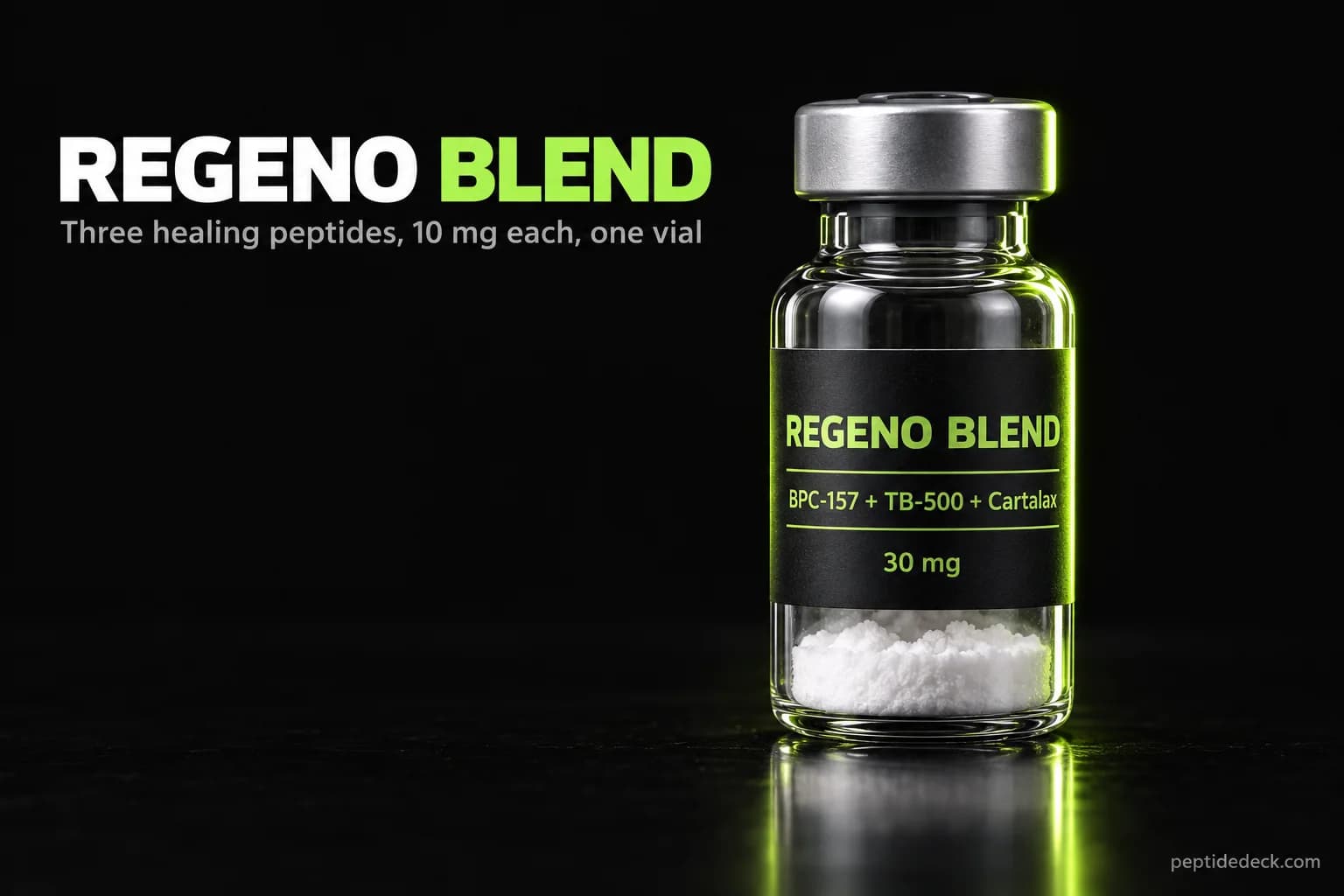
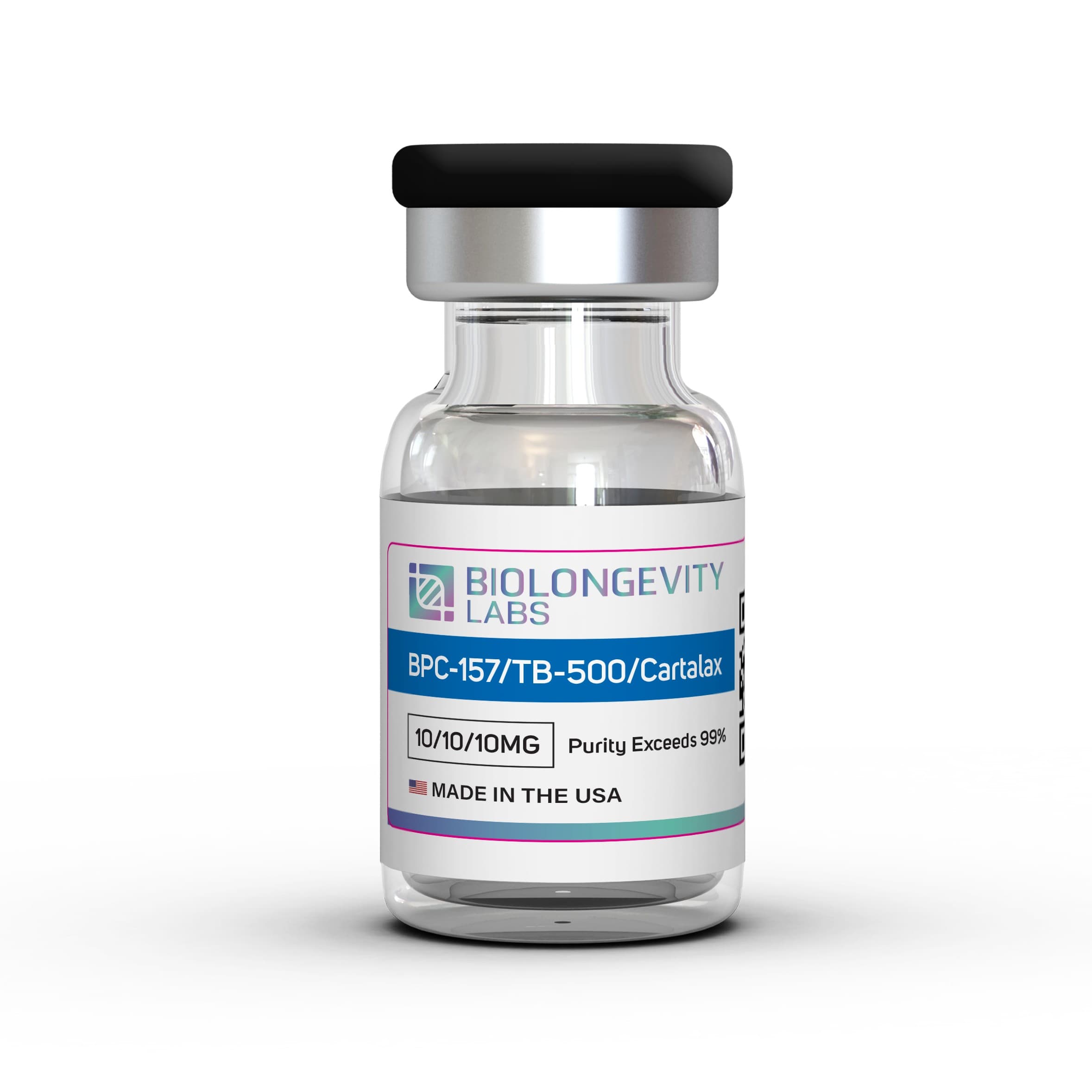
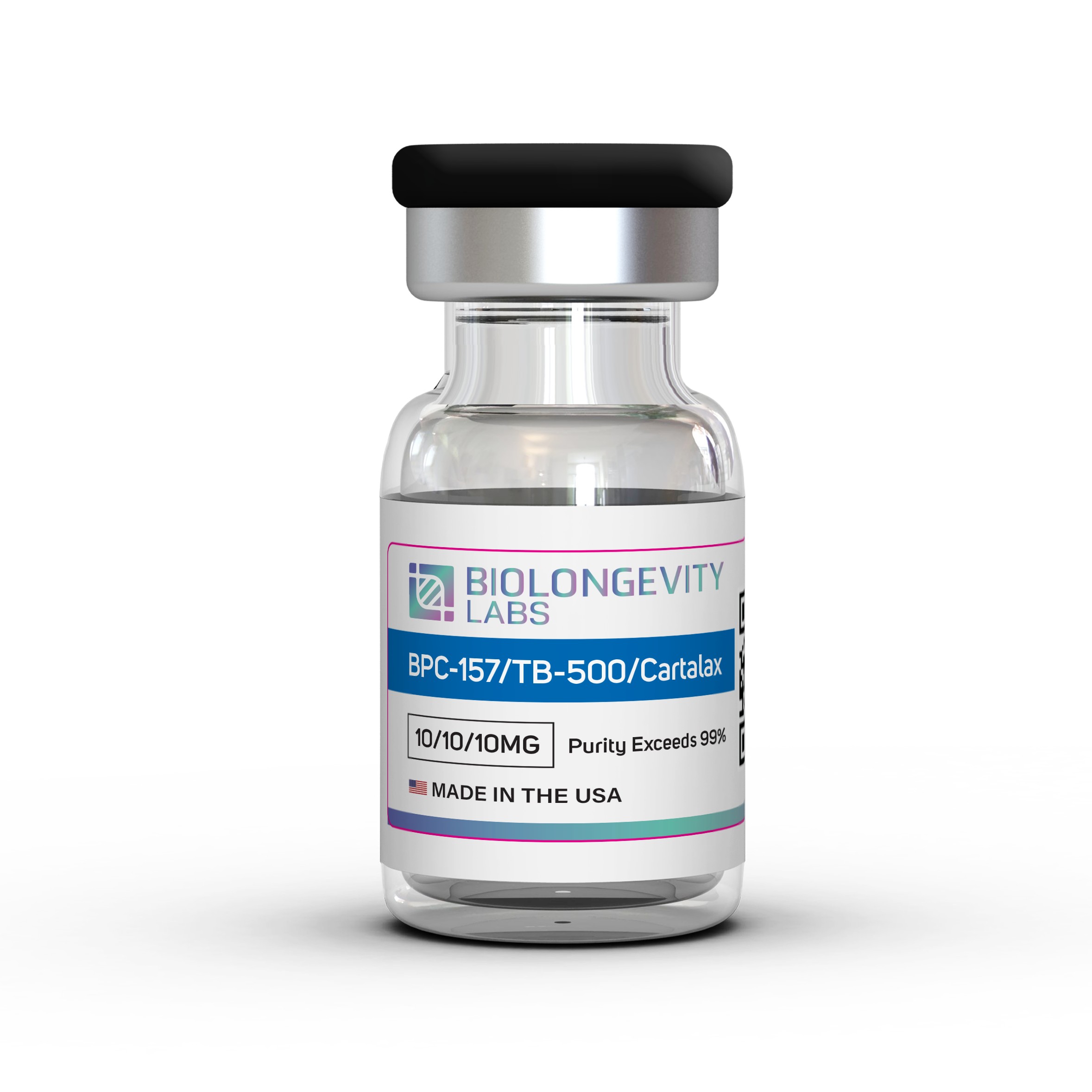
That is the deal with Regeno Blend: BioLongevity Labs' 30 mg vial of BPC-157, TB-500 and Cartalax at 10 mg each, $279.97, sold as a single-vial answer to a tendon, a joint or a soft-tissue injury that has stopped getting better on its own. The convenience is real. So is the catch, and no page selling it mentions the catch: those three peptides are normally taken at weekly doses that differ by a factor of three to seven, and a 1:1:1 vial makes that impossible. Whichever one you dose correctly, the other two are wrong.
If you are here because something has been hurting for months — a shoulder that will not settle, a knee that swells after every run — you are exactly who this vial is built for, and you deserve the arithmetic before the checkout. Here is what is in it, what each part has behind it, what the ratio does to the dose, and what the same money buys separately.
🔑 Key Takeaways
- Regeno Blend is BioLongevity's Wolverine stack — BPC-157 plus TB-500 — with a third peptide added: Cartalax, a three-amino-acid cartilage bioregulator from the Russian tradition. Same vendor sells the two-peptide version for $119.97.
- The three have very different usual doses. Dose the vial to TB-500 and you get a third of the usual Cartalax; dose it to Cartalax and you get three to five times the usual BPC-157. The only published protocol underdoses all three.
- The blend is $55 cheaper than the three vials separately — and the separate vials carry twice the Cartalax and let each peptide run on its own schedule.
- Two other products called "Regeno Blend" are on sale from other sites. One does not say what is in it. One lists entirely different peptides. The name is not protected, so check the label, not the name.
- What each component actually has behind it, the reconstitution numbers for a 30 mg vial, and who this vial is genuinely right for, below.
Start with the three ingredients, because two of them you probably know and the third is the reason this vial costs what it does.
What Is in Regeno Blend
Two familiar peptides and one that is not.
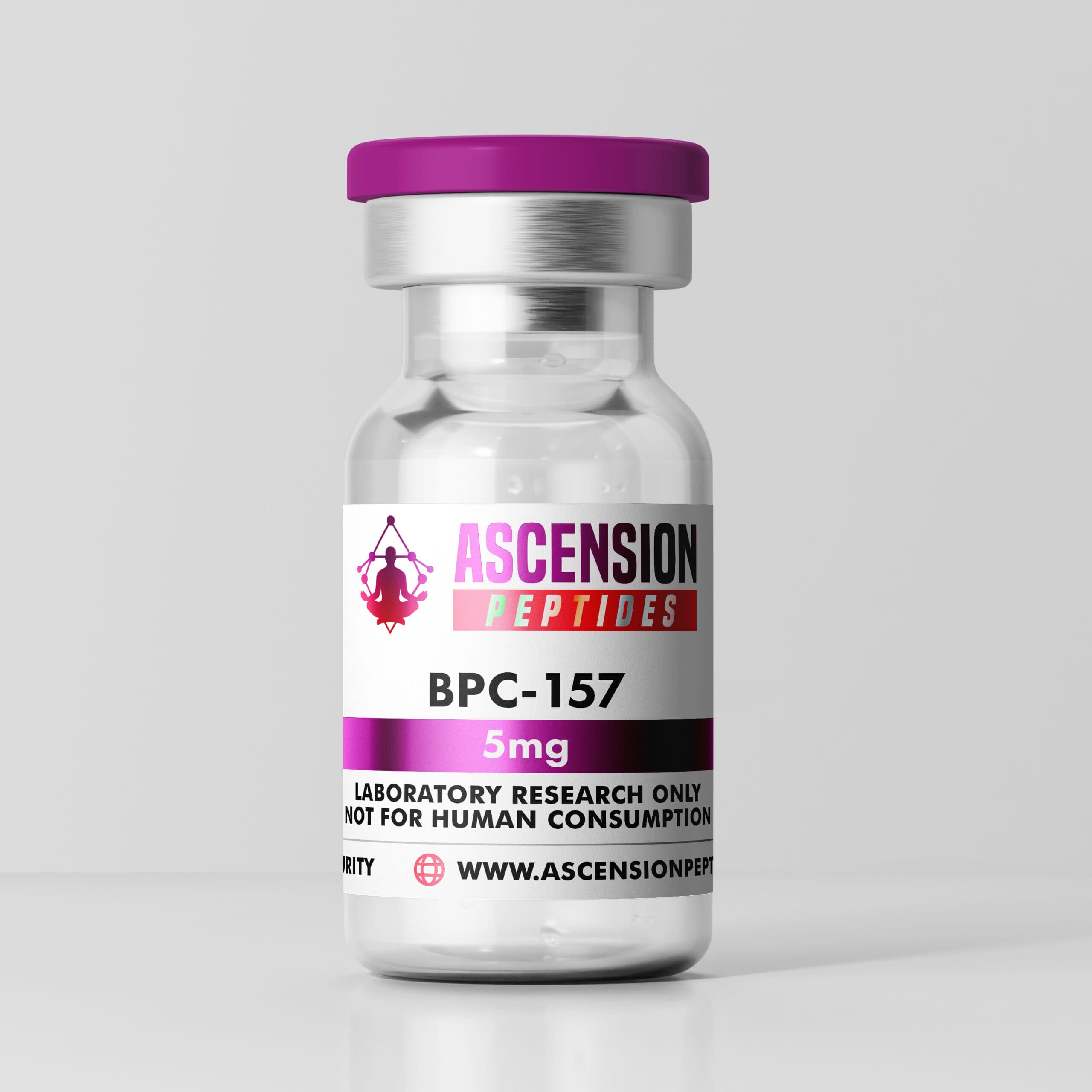
BPC-157, 10 mg. The fifteen-amino-acid gastric peptide with the broadest animal healing literature of anything in this category — tendon, ligament, muscle, gut — and no completed randomised trial in people. Our first mention of it on any page links to the compounding-pharmacy buying guide for a reason: it is the one peptide here you can also get made under a prescription.
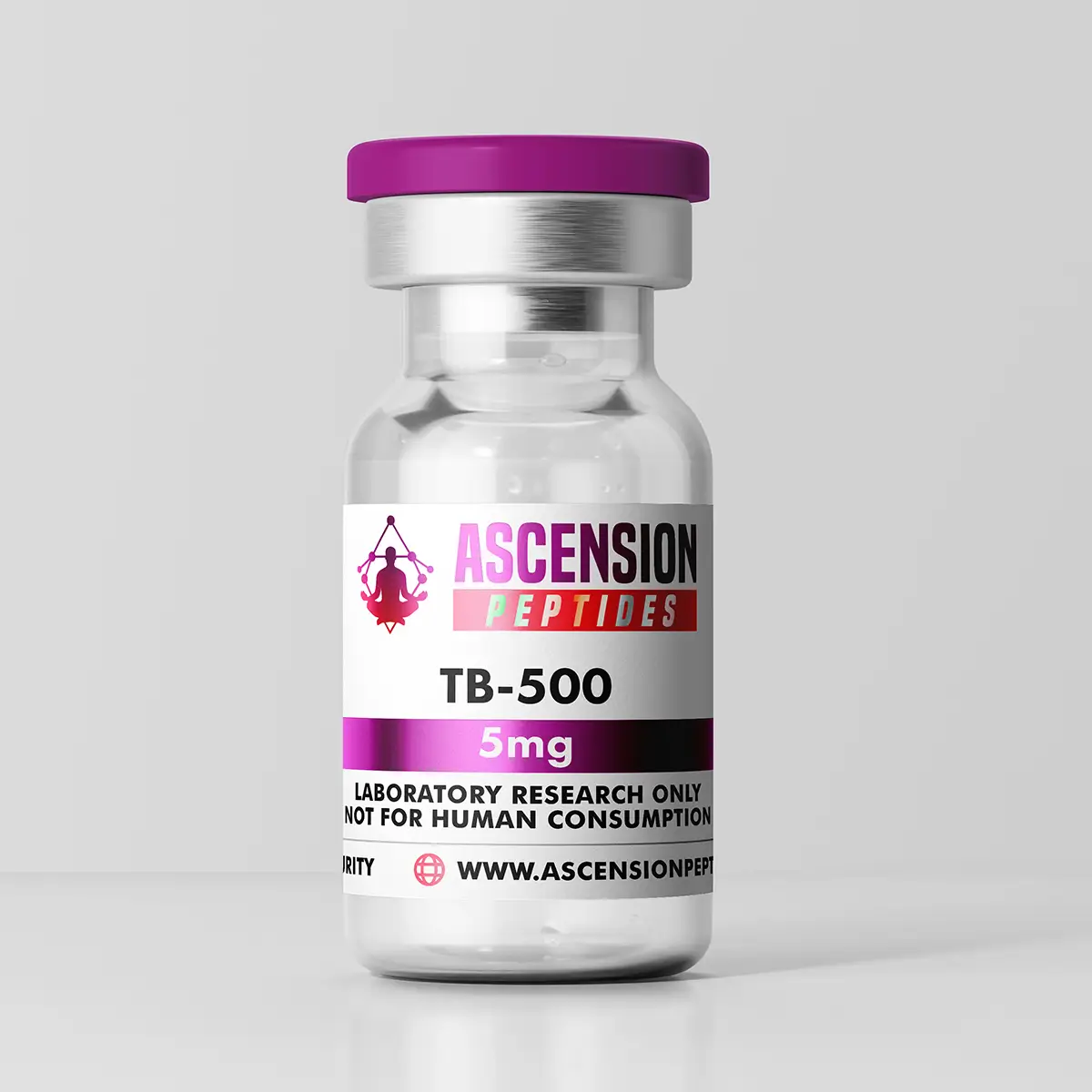
TB-500, 10 mg. Sold as the healing fragment of thymosin beta-4, the actin-binding protein that helps cells migrate into a wound. BioLongevity's own TB-500 listing gives the full 43-amino-acid thymosin beta-4 sequence rather than a fragment, which is worth knowing when you compare certificates. Animal wound and cardiac data are broad; human data on the injectable as sold are absent. Our TB-500 guide has the detail.
Cartalax, 10 mg. The odd one out: Ala-Glu-Asp, a tripeptide designed in St Petersburg from a cartilage extract, part of the Khavinson family of bioregulator peptides. Its evidence is Russian observational reports of osteoarthritis pain relief and cell-culture work on cartilage cells; there are no randomised trials and essentially no Western safety data. It is also normally taken at a much higher dose than the other two, which is where the trouble starts. Our Cartalax guide covers it on its own.
Together, the pitch is a three-stage repair: BPC-157 for blood supply and early healing, TB-500 for cell migration and inflammation, Cartalax for the cartilage matrix. It is a coherent story. It has never been tested as a combination in anything.
Same vendor, two versions. BioLongevity sells the two-peptide Wolverine version — 5 mg BPC-157 plus 5 mg TB-500 — for $119.97. Regeno is that pair doubled, plus 10 mg of Cartalax, for $160 more. If cartilage is not your problem, the cheaper vial is the same idea. Our Wolverine stack dosage guide covers how that pair is run.
The 1:1:1 Ratio Problem
Three peptides, three different doses, one syringe.
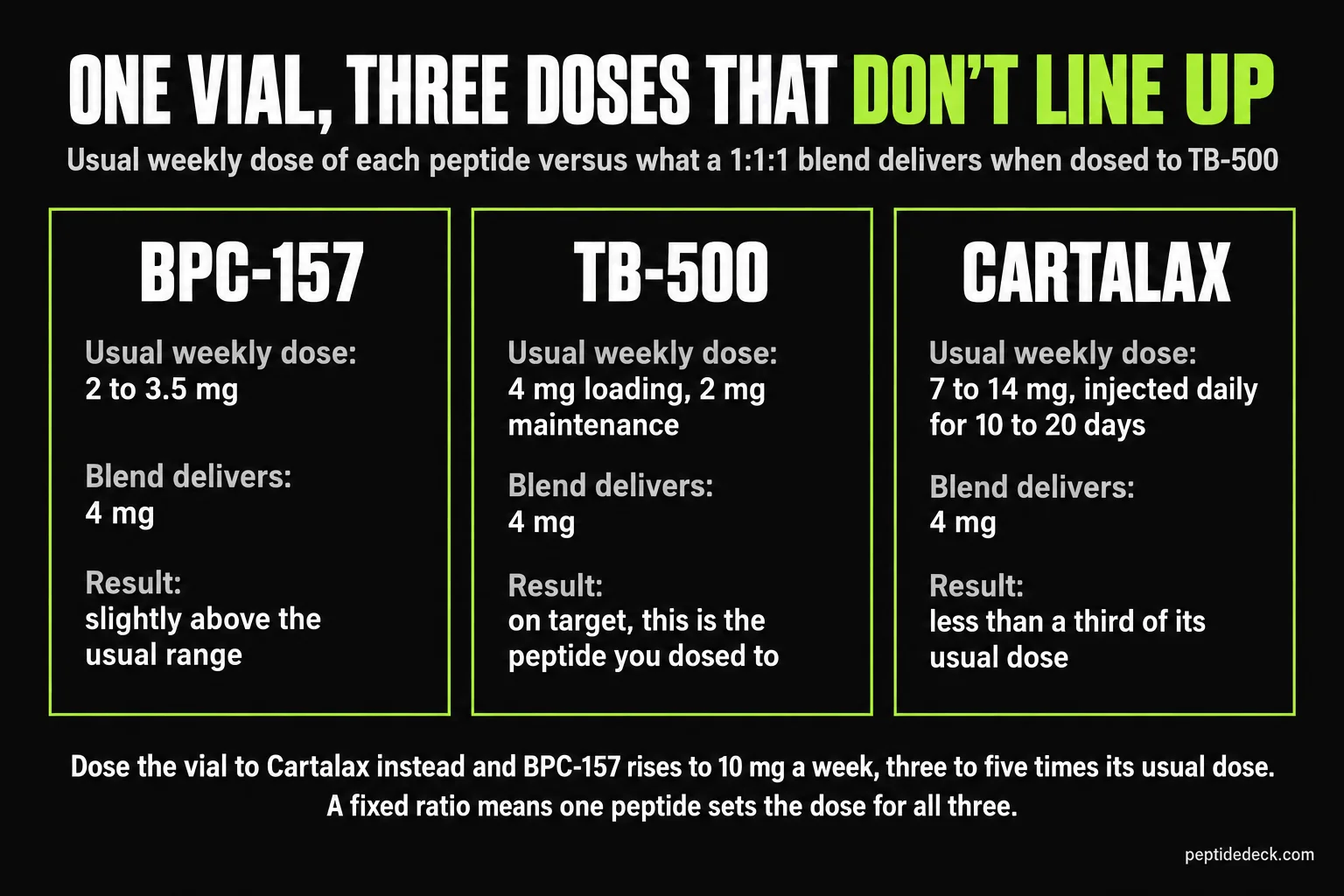
Here is how each of the three is normally run on its own, using the ranges from our own single-peptide guides:
- BPC-157: 300 to 500 mcg a day, so 2.1 to 3.5 mg a week.
- TB-500: 2 mg twice a week for the first four weeks, then 2 mg once a week — 4 mg a week loading, 2 mg maintaining.
- Cartalax: 1 to 2 mg a day by injection for 10 to 20 days, so 7 to 14 mg a week during a course.
In a 1:1:1 vial every unit you draw contains the same mass of each. Pick the peptide you want right, and the others follow:
The last row is the one protocol anyone has published for this vial — 750 mcg of total peptide a day, five days on and two off, six weeks on and four off, from the affiliate site that resells it. It works out to 1.25 mg of each peptide a week, which is below the usual range for all three and less than a fifth of a Cartalax course. It makes the vial last eight weeks, which may be the point. It is not a dose anyone has studied, and neither is any other row.
None of this means the blend cannot work; nobody knows what any of these doses does in a person. It means the blend removes the one lever a single-peptide user has, and that the peptide most likely to be underdosed is Cartalax — the one you paid the extra $160 for.
Regeno Blend Dosage: The Numbers for a 30 mg Vial
The vial holds 30,000 mcg. Every dose is a third each.
Reconstitute with 3 mL of bacteriostatic water and you have 10 mg of total peptide per mL — 3.33 mg per mL of each — and 100 mcg total per unit on a standard 100-unit insulin syringe. From there:
Two practical notes. Reconstituted peptide keeps for roughly four weeks refrigerated, so the eight-week protocol outlives its own vial — mix half if you run it. And the 60-unit twice-weekly dose is 0.6 mL, a large subcutaneous volume for one site; split it. Our reconstitution guide covers the technique.
Warning: none of the three peptides in Regeno Blend has an approved medical use or an established human dose, and the combination has never been studied. Everything above is arithmetic applied to what people do, not a recommendation. Anyone with a cancer history should avoid growth-promoting peptides entirely, and anyone with a current injury should have it diagnosed before treating it with anything.
What the Evidence Is for Each Part
Three peptides, three very different piles of paper.
The pattern is the usual one for this category: a strong animal case, no human trials, and a combination that has been assembled from plausibility rather than tested. What is specific to Regeno is that its weakest-evidenced component, Cartalax, is also the one the fixed ratio is most likely to underdose and the one that justifies the price over the Wolverine pair.
Price: The Blend vs the Same Three Vials
The blend is cheaper. Here is what it costs you.
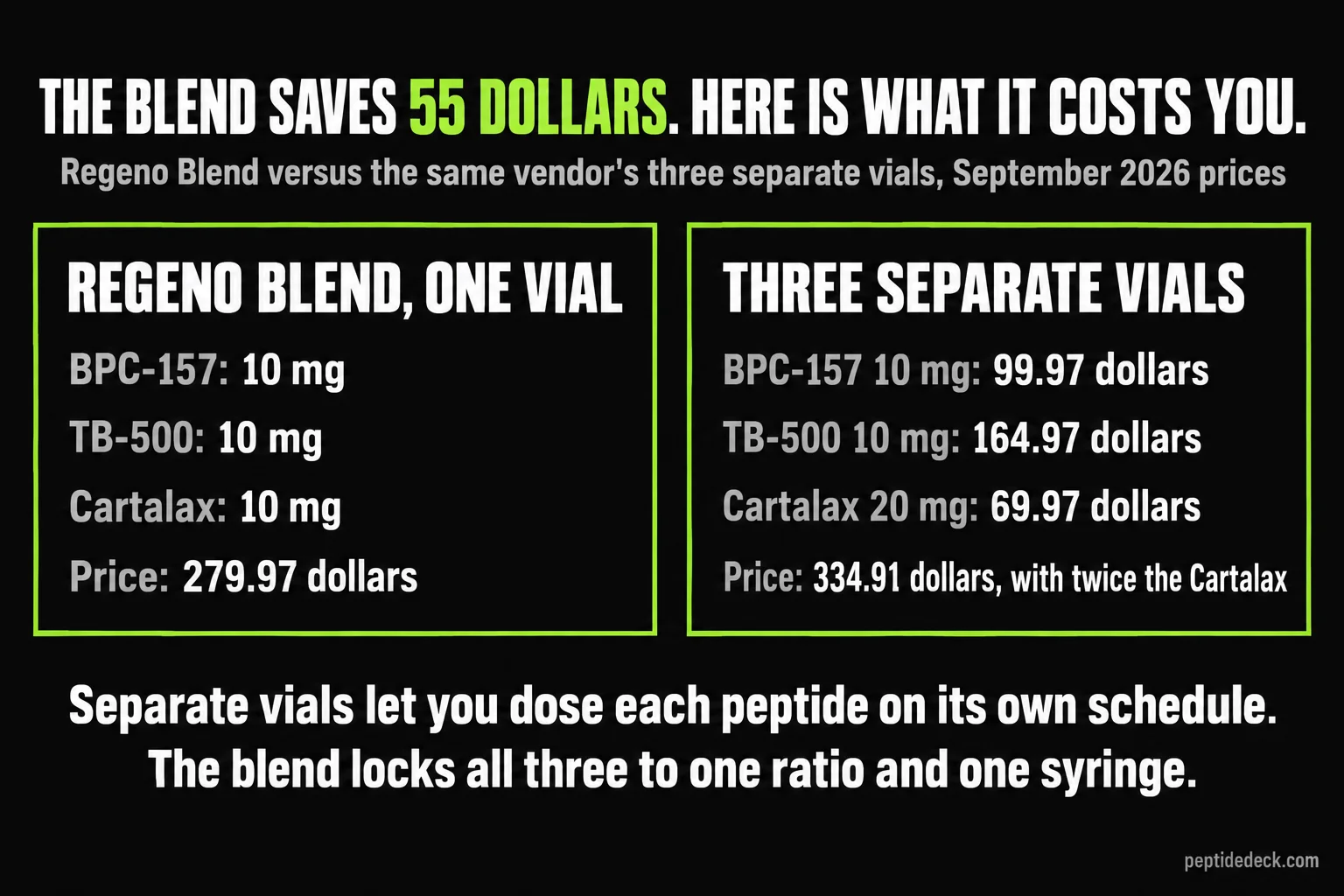
At BioLongevity's own prices, the three separate vials are BPC-157 10 mg at $99.97, TB-500 10 mg at $164.97 and Cartalax 20 mg at $69.97 — $334.91, against $279.97 for the blend. The blend wins by $55, or about 16 percent. Separately, though, you get 20 mg of Cartalax rather than 10, and you can run BPC-157 daily, TB-500 twice a week, and a Cartalax course at its own pace — the schedule the single-peptide evidence, such as it is, was built on.
The other way to read it: TB-500 is the expensive ingredient at $16.50 a milligram, BPC-157 is $10, and Cartalax is $3.50. The blend's $9.33 a milligram is mostly TB-500 pricing applied to 10 mg of a tripeptide that costs a third of that on its own.
Three Products Called "Regeno Blend"
The name is not protected. The label is what counts.
Searching the term turns up three different things wearing it. BioLongevity's vial, with the 10/10/10 composition and lot-matched certificates from MDx BioAnalytical, BioRegen and SafeCert; it is also resold under a wellness brand at $279 and through an affiliate storefront at the same price. A second site sells a "Regeno Blend 30mg" for $200, marked down from $279.97, whose page does not say what the 30 mg is made of. And a third ranks with a page headed "Regeno Blend — Muscle Building Peptide Stack" that lists the contents as GHK-Cu and thymosin, which is a different product entirely, with no doses, no studies, and an empty side-effects section.
If the vial you are looking at does not name three peptides and three milligram figures and link to a certificate for the batch, it is not the product this article is about. How to read a peptide COA covers what a real one shows, including how a three-peptide blend should appear on one.
Side Effects
Three sets of unknowns, sharing one syringe.
- Injection-site reactions. The common one for all three, and more likely with the larger volumes a blend pushes you toward.
- BPC-157 and TB-500. Both are broadly tolerated in informal use; both carry the theoretical growth-signalling concern that keeps anyone with a cancer history away. Blood-pressure and dizziness reports exist for BPC-157; fatigue and headache for TB-500.
- Cartalax. Essentially no Western safety data exist. The Russian clinical tradition reports it as well tolerated; nobody has looked hard.
- Attribution. The blend's specific problem: if something happens, you cannot tell which peptide did it, and you cannot drop one without dropping all three.

Who Regeno Blend Is Actually For
A narrower group than the listing suggests.
The blend makes sense for someone who has already decided on all three peptides, is content with a roughly equal weekly dose of each — which means accepting a low Cartalax dose — and values one vial and one syringe over dosing control. If that is you, it is $55 cheaper than the parts and comes from a vendor that posts real certificates.
It makes less sense if the joint is the problem. Cartalax is the cartilage peptide here, and the ratio starves it; buy it separately and run a proper course. It makes little sense if you have never used any of the three, because you will learn nothing about which one helped. And if cartilage is not the target at all, the vendor's own $119.97 Wolverine vial is the same idea without the surcharge — our Wolverine stack explainer and review cover it.
For a wider look at who is worth ordering from, our peptide vendor comparison covers the sources we have checked directly.
The Bottom Line on Regeno Blend
Convenient, certified, and fixed in the wrong ratio.
The fair version: this is a real product from a vendor that tests its batches, it combines the two best-known healing peptides with the cartilage bioregulator that fits the story, and it costs less than the parts.
The equally fair version: the three peptides are normally dosed three to seven times apart, the 1:1:1 vial makes that impossible, the only published protocol underdoses all three, the component with the least evidence is the one most starved by the ratio, and the combination has never been studied in anyone. Two other things sold under the same name contain something else.
If your problem is a tendon or a muscle, the two-peptide vial does the same job for less. If your problem is cartilage, buy the Cartalax on its own and dose it properly. Regeno is for the person who wants all three and is happy to let the syringe decide the ratio.
Frequently Asked Questions
Medical Disclaimer: This content is for informational purposes only and does not constitute medical advice. None of the peptides in Regeno Blend has an approved medical use or an established human dose, and the combination has not been studied. Always consult a qualified healthcare provider before starting any new supplement, medication, or treatment. PeptideDeck may earn a commission from affiliate links at no additional cost to you.