No peptide has passed a placebo test for ADHD. That is the short, honest answer on peptides for ADHD in 2026. No peptide is approved for ADHD by the FDA, and the most-cited study, a Russian course of Cortexin injections in 635 children aged 3 to 7, had no comparison group at all (PMID 29652302). Semax, the peptide most people actually search for, has never been given to a single person with ADHD in a published study.
🔑 Key Takeaways
- Why the biggest "positive" study cannot tell you whether the peptide did anything
- What the only Semax-for-ADHD paper proposed, and the one thing it never did
- The Selank result that sounds like focus but came from anxiety patients on sedatives
- The stimulant interaction hiding inside the Semax theory itself
- What does have evidence, and five questions to bring to your prescriber
If you or your child lives with ADHD, you already know the trade-offs. Stimulants help a lot of people, but the lost appetite, the bad sleep and the 4 pm crash are real. So a nasal spray sold as "focus without the jitters" sounds like a fair thing to look into. This page checks that promise against every ADHD study we could find on PubMed.
What "peptides for ADHD" actually means
It usually means one of three things. The first is Semax or Selank, two Russian-developed nasal peptides sold online as nootropics. The second is a pair of brain-derived injections, Cortexin and Cerebrolysin, which Russian child neurologists have used in clinics. The third is a long tail of trending peptides, like BPC-157 and dihexa, that get pulled into ADHD threads with no ADHD study behind them.
None of these is approved for ADHD in the US or Europe. Cortexin, a mix of polypeptides from calf brain cortex, is described as a clinically approved drug in Russia (PMID 31099784), but that approval is not specific to ADHD and the product is not what US peptide vendors sell.
The "natural Adderall" pitch, that Semax and Selank raise BDNF and dopamine, traces back to one 2007 hypothesis paper and to animal work (PMID 16996699). No human ADHD trial of either peptide exists.
The evidence, peptide by peptide
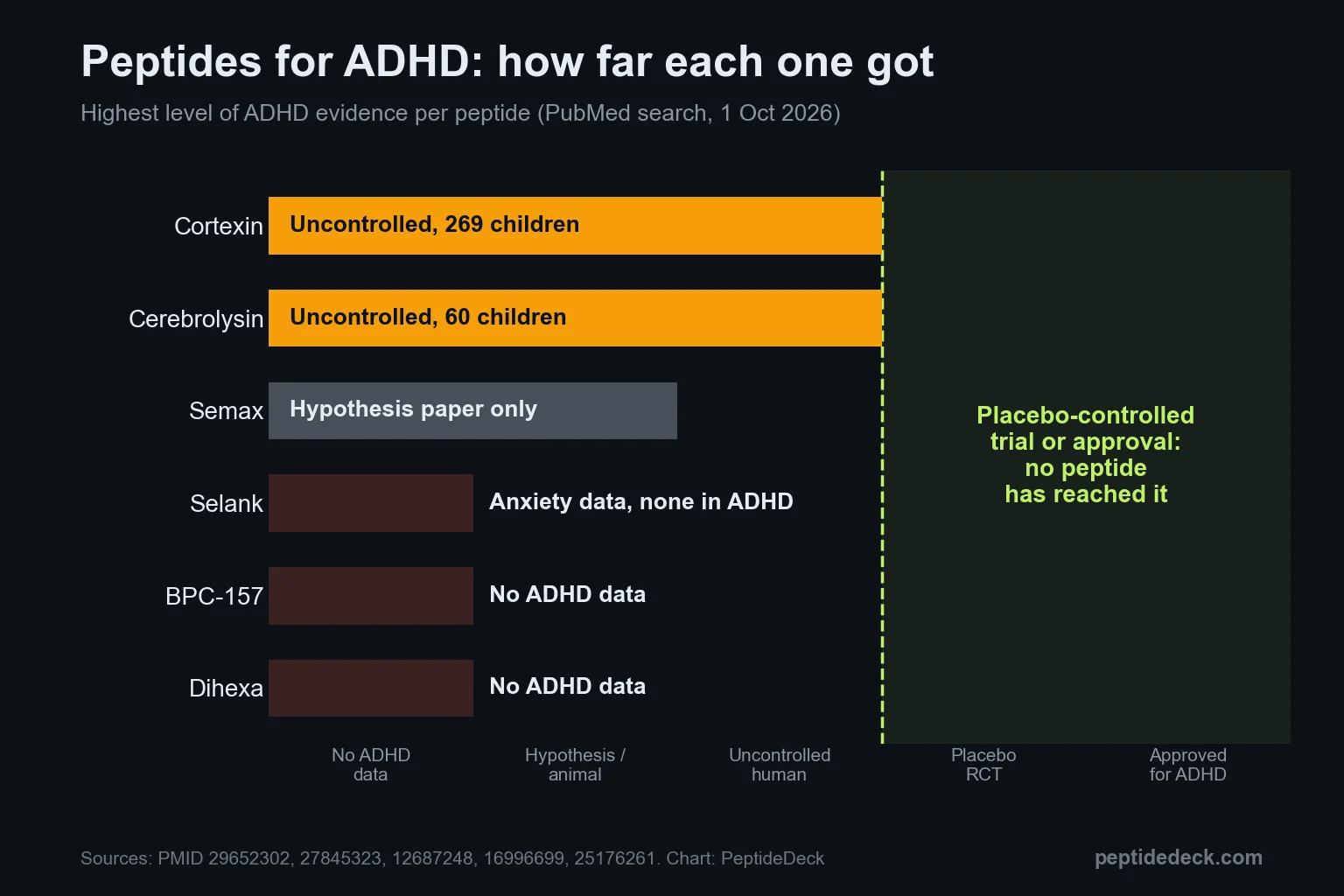
Here is every ADHD study we found.
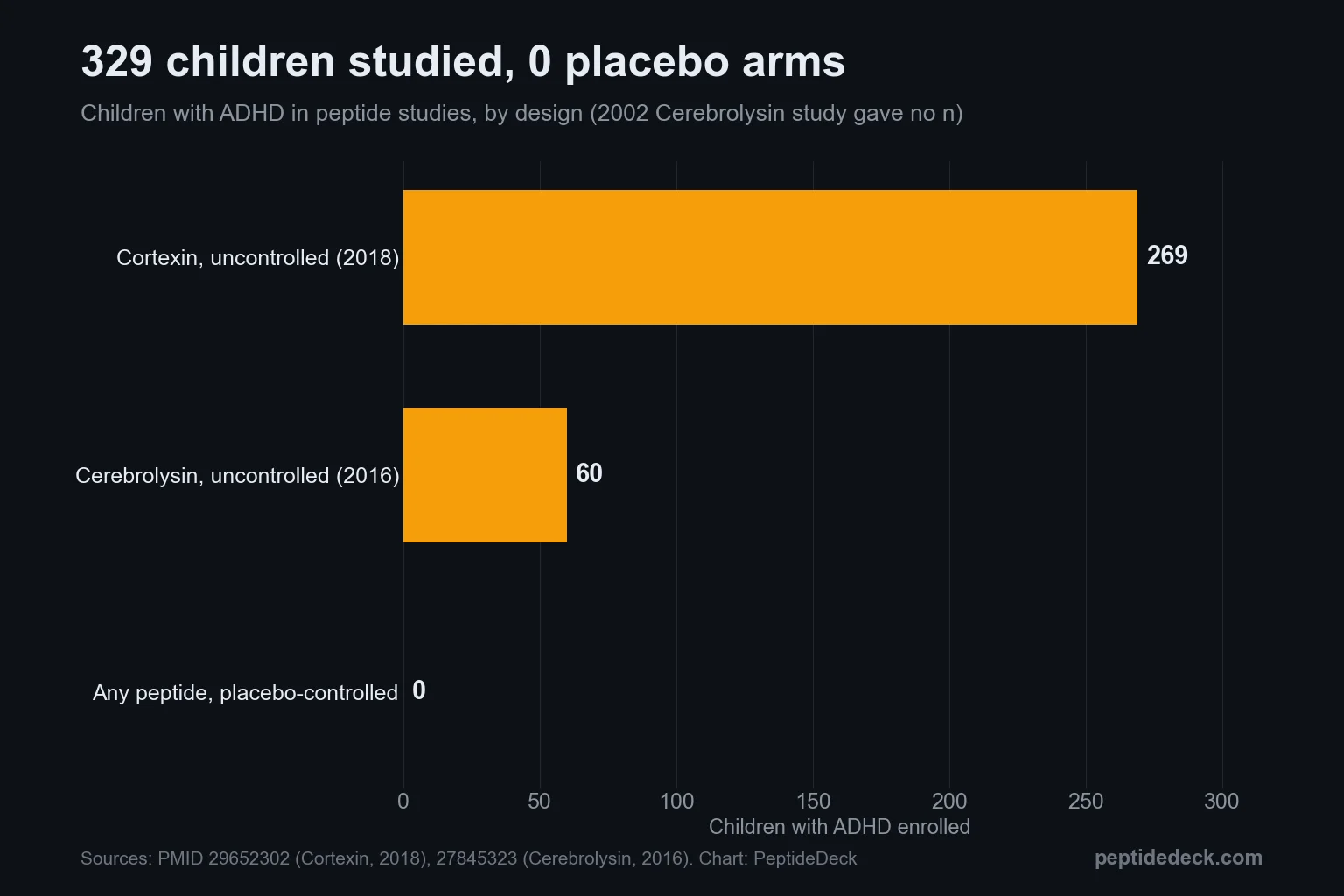
Notice what the "positive" rows have in common. Every one is uncontrolled. Parents and doctors knew each child was getting the drug, and nobody compared those children with similar children who got a dummy injection.
That matters more in ADHD than in most conditions. Symptoms swing with sleep, season and school stress. Families tend to seek help when things are at their worst, so many children look better a month later whatever happens. And a 3-year-old changes fast. An uncontrolled study cannot separate any of that from the drug.
Cortexin and Cerebrolysin: the Russian injection studies
These studies are the strongest data that exist. The 2018 Cortexin study enrolled 635 children aged 3 to 7 in a multicentre study across Russian children's hospitals (PMID 29652302). Only 269 had ADHD. The rest had speech delay (215), after-effects of a brain injury around birth (82) or an "asthenic/neurotic" syndrome (69).
Each child received 10 intramuscular injections. The authors tested attention, visual memory and thinking before and after, and reported the best response in 3- and 4-year-olds with ADHD. They called tolerability "good" but gave no side-effect counts in the abstract, did not state funding, and published in Russian only.
The Cerebrolysin data is thinner. A 2016 St Petersburg study of 60 children aged 9 to 12 reported improvement in 70.0% and 86.7% of two ADHD subtypes, again with no control group (PMID 27845323). A 2002 study gave 1 mL per 10 kg for a month and focused on immune cell counts, not attention scores (PMID 12687248).
Two limits stand out. These were pharmacy products given by neurologists, not vials bought online. And a 70% to 87% "improvement" rate with no comparison arm is exactly what a placebo response plus time can produce in ADHD.
Semax for ADHD: one hypothesis, zero patients
Semax for ADHD starts with one paper. In 2007 Shih-Jen Tsai, a psychiatrist at Taipei Veterans General Hospital, published a short argument in Medical Hypotheses, a journal for untested ideas (PMID 16996699).
His reasoning went like this. Some people with ADHD do not respond to stimulants such as methylphenidate, or cannot tolerate them. Semax is a copy of a small piece of the hormone ACTH (fragment 4-10) with no hormonal activity. Earlier reports said nasal Semax improved memory and attention. In animals it raised brain BDNF and boosted the dopamine release that stimulants cause. Since ADHD involves dopamine and BDNF, he proposed Semax "may have good therapeutic potential".
That is a fair question, not an answer. The paper dosed nobody. In the 19 years since, PubMed lists no Semax study in people with ADHD; our search returned three records, the hypothesis itself and two papers on oxygen deprivation in newborn animals.
There is also a twist inside the theory. The mechanism Tsai described is that Semax amplifies the dopamine effect of stimulants. For someone already taking Adderall or Ritalin, that is not an alternative. It is an unstudied interaction.
If you are an adult who still wants to try Semax for focus, product quality is the part you can control. It has no FDA approval, so label accuracy depends on the seller. A 10 mg vial lists at about $50 before discount codes, and our guide on where to buy Semax compares third-party testing and price per mg (Ascension pays us a commission at no extra cost to you). The Semax product box on this page is there for adults who have already decided. It is not a recommendation for ADHD, and it is never for children.
Selank: anxiety data, not attention data
Selank was studied for anxiety, not attention. Three small Russian studies make up most of its human record. In 62 people with generalised anxiety or neurasthenia, Selank (30 patients) worked about as well as the sedative medazepam (32), with added "psychostimulant" effects (PMID 18454096). In 60 patients compared against phenazepam, the authors reported a "mild nootropic" effect (PMID 25176261).
The third study is the one that gets quoted as "Selank improves focus". In 70 anxiety patients, adding Selank to phenazepam reduced the benzodiazepine's own side effects, including poor attention and memory, measured with the Stroop test (PMID 26356395). That shows Selank may soften a sedative's fog. It says nothing about ADHD.
None of these studies had a placebo arm, and none reported effect sizes in the abstract. A 2021 US pharmacology review called Selank "poorly studied" and noted it is sold to American consumers as a dietary supplement (PMID 34396551). Since anxiety and ADHD often travel together, our page on peptides for anxiety and stress covers that side in more depth.
BPC-157, dihexa and the rest
These show up in forums, not in ADHD studies. A PubMed search on 1 October 2026 for BPC-157, dihexa or epitalon with ADHD returned zero records. BPC-157's few human reports come from one clinic group, published in Altern Ther Health Med, with no control arm, and none involve attention. If someone sells you a "focus stack" for ADHD, ask for the study. There is not one.
The same goes for mood. If low mood sits alongside attention problems, our sibling page on peptides for depression grades that evidence the same way.
What actually has evidence for ADHD
Approved ADHD treatments have real trials behind them. Stimulants such as methylphenidate and amphetamine salts are first-line, a point even the Semax hypothesis paper starts from (PMID 16996699), and each was approved after placebo-controlled trials. For people who do not respond or cannot tolerate them, non-stimulants such as atomoxetine, guanfacine and viloxazine are approved options. Behavioural therapy carries its own trial evidence: parent training is usually the first step for preschool children, and cognitive behavioural therapy helps many adults. If your current plan is not working, a dose change, a different stimulant or a non-stimulant is a far better-tested next step than any peptide.
Safety: what can go wrong
The risks are mostly unknowns, not known harms.
- No data in children. There is no paediatric dosing or safety data for vendor Semax or Selank sprays, or for any injectable sold online. The Cortexin children received a pharmacy product under neurologists (PMID 29652302).
- Stimulant interactions are unstudied. No study has combined Semax or Selank with methylphenidate or amphetamine. Semax boosted stimulant-driven dopamine release in animals (PMID 16996699), so effects on blood pressure, heart rate and sleep are a real unknown.
- Selank and sedatives. Selank is thought to act on GABA, the same system as benzodiazepines and alcohol, and the added effect has not been measured (PMID 34396551). It also showed anticoagulant activity in lab tests (PMID 16634437), which matters if you take a blood thinner.
- Product quality. Online peptides are unregulated, so purity and dose depend on the seller, and Semax side effects such as headache and irritability are reported mostly from user accounts, not trials.
- Injections and mast cells. Many injected peptide drugs can trigger mast cells directly through the MRGPRX2 receptor, causing flushing, hives or itching without a true allergy (PMID 25517090).
- Do not stop prescribed ADHD medication. Stopping a stimulant to "switch" to a peptide can bring back symptoms quickly, along with tiredness and low mood. Change medication only with your prescriber.
What to ask your doctor
Bring these questions to your prescriber or your child's paediatrician:
- If my current medication is not working, what is the next tested option: a dose change, a different stimulant or a non-stimulant?
- Would behavioural therapy or parent training add to what I am already doing?
- Could anything I take, including supplements or nasal sprays, interact with my ADHD medication or raise my blood pressure?
- Are my sleep, appetite or anxiety side effects manageable with timing or formulation changes?
- If I am curious about Semax as an adult, is there any reason it would be unsafe for me specifically?
Frequently Asked Questions
Sources
- Zykov VP, et al. Results of a multicenter study on the efficacy of cortexin in treatment of cognitive dysfunction in children. Zh Nevrol Psikhiatr Im S S Korsakova. 2018;118(3):27-31. PMID 29652302
- Chutko LS, et al. Clinical and neurophysiological heterogeneity of attention deficit hyperactivity disorder. Zh Nevrol Psikhiatr Im S S Korsakova. 2016;116(10):117-121. PMID 27845323
- Sotnikova NY, et al. Dual effect of cerebrolysin in children with attention deficit syndrome with hyperactivity. Russ J Immunol. 2002;7(4):357-64. PMID 12687248
- Tsai SJ. Semax, an analogue of adrenocorticotropin (4-10), is a potential agent for the treatment of attention-deficit hyperactivity disorder and Rett syndrome. Med Hypotheses. 2007;68(5):1144-6. PMID 16996699
- Kuznik BI, et al. Epigenetic mechanisms of peptide-driven regulation and neuroprotective protein FKBP1b. Mol Biol (Mosk). 2019;53(2):339-348. PMID 31099784
- Zozulia AA, et al. Efficacy and possible mechanisms of action of a new peptide anxiolytic selank in the therapy of generalized anxiety disorders and neurasthenia. Zh Nevrol Psikhiatr Im S S Korsakova. 2008;108(4):38-48. PMID 18454096
- Medvedev VE, et al. A comparison of the anxiolytic effect and tolerability of selank and phenazepam in the treatment of anxiety disorders. Zh Nevrol Psikhiatr Im S S Korsakova. 2014;114(7):17-22. PMID 25176261
- Medvedev VE, et al. Optimization of the treatment of anxiety disorders with selank. Zh Nevrol Psikhiatr Im S S Korsakova. 2015;115(6):33-40. PMID 26356395
- Doyno CR, White CM. Sedative-hypnotic agents that impact gamma-aminobutyric acid receptors: focus on flunitrazepam, gamma-hydroxybutyric acid, phenibut, and selank. J Clin Pharmacol. 2021;61 Suppl 2:S114-S128. PMID 34396551
- Liapina LA, et al. Comparison of anticoagulant effects of regulatory proline-containing oligopeptides: glyprolines, semax and selank. Izv Akad Nauk Ser Biol. 2006;(2):193-203. PMID 16634437
- McNeil BD, et al. Identification of a mast-cell-specific receptor crucial for pseudo-allergic drug reactions. Nature. 2015;519(7542):237-41. PMID 25517090
Medical Disclaimer: This article is for general information only and is not medical advice. No peptide is approved for ADHD, and the studies described here are small and uncontrolled. Do not stop, change or add to any ADHD medication, and do not give any peptide to a child, without talking to a qualified healthcare provider.