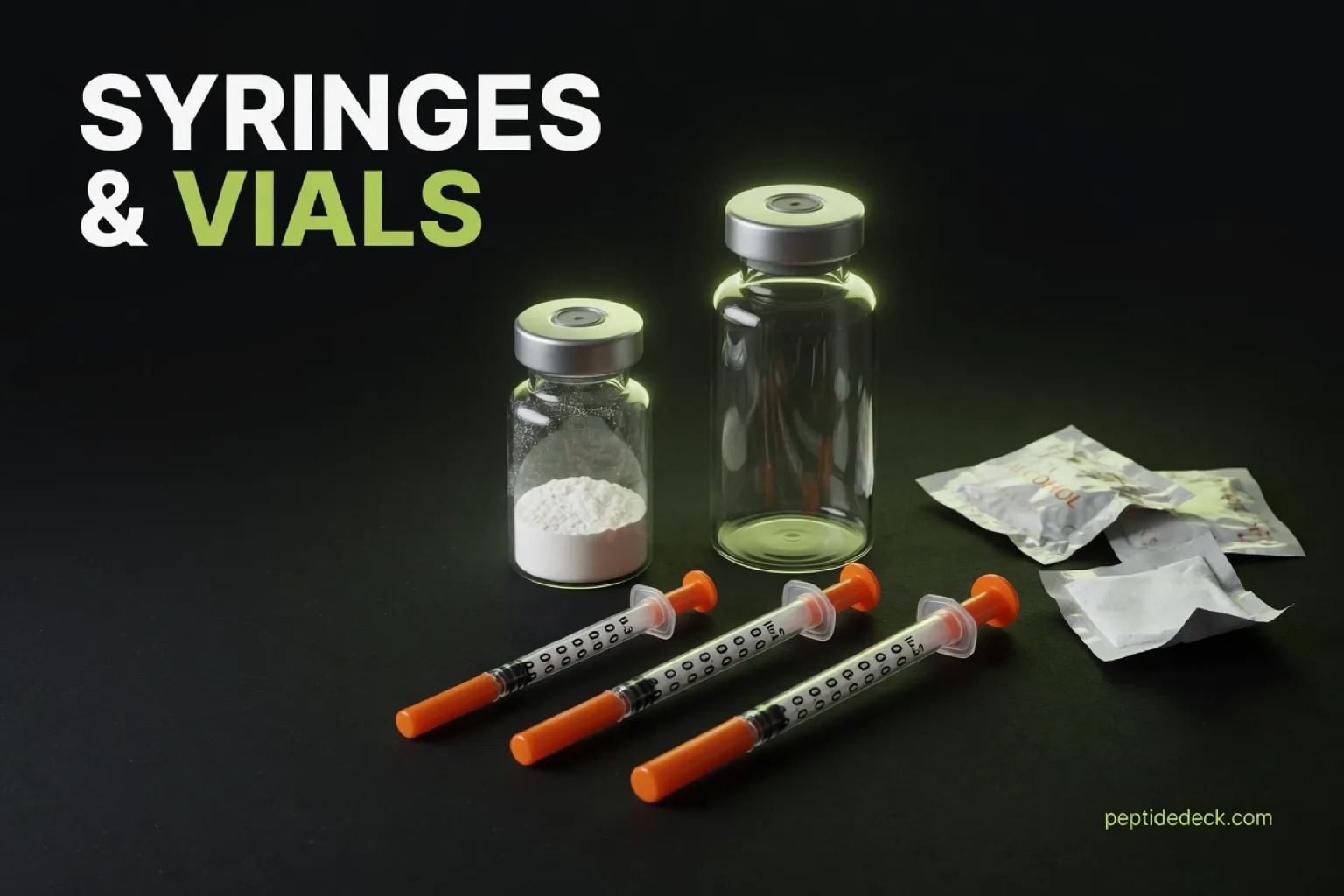
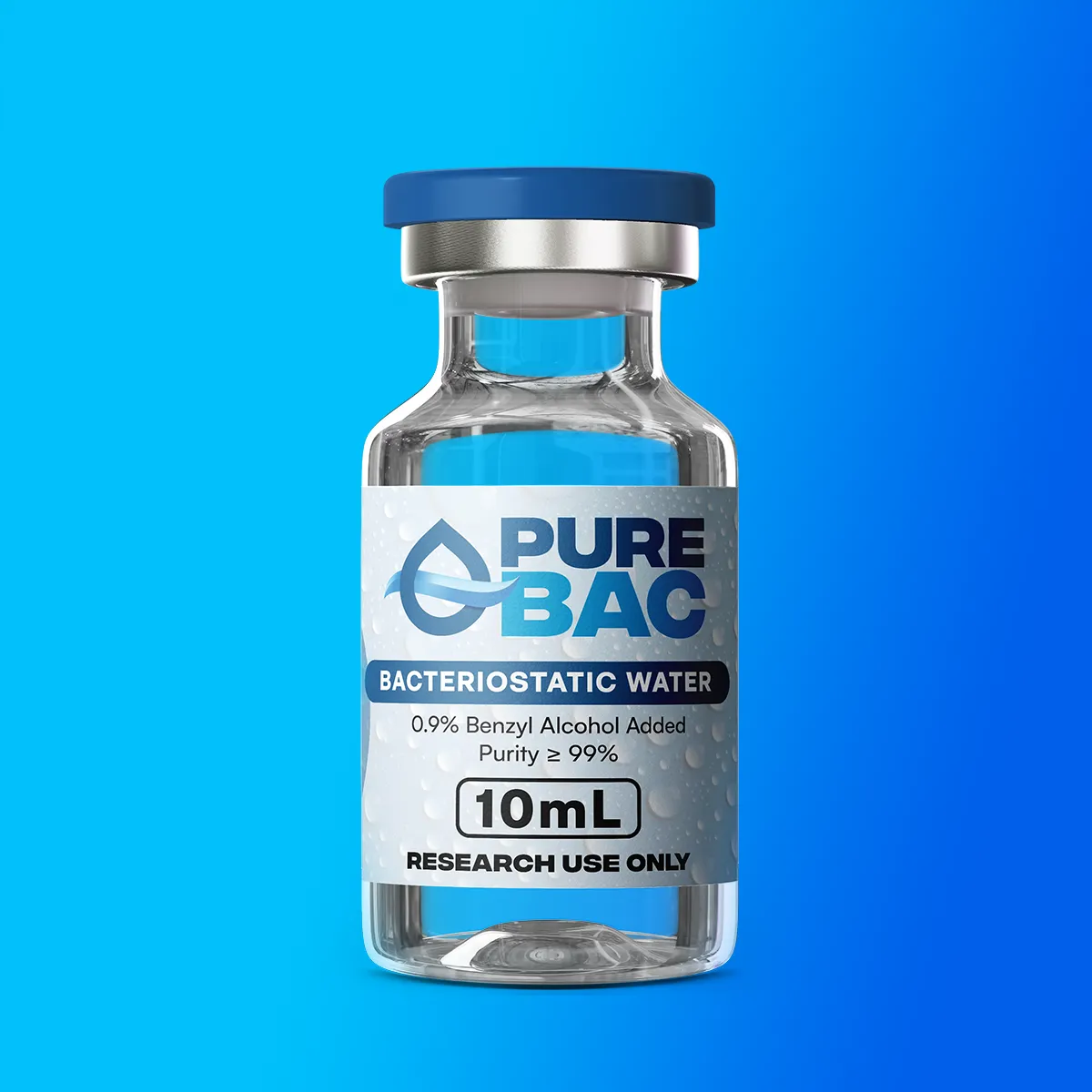
Your peptide arrived without any of the supplies. A peptide vial ships as a few milligrams of white powder under a rubber stopper, and everything between that powder and your dose, the water, the syringe, the needle, the spare vial, the sharps bin, is a separate purchase nobody explains. Most people grab whatever syringes the pharmacy has, and that one choice quietly decides whether every dose you draw is accurate or a guess.
🔑 Key Takeaways
- The syringe everyone buys first is the least precise one for small doses. There is a specific dose size where it stops being usable.
- One common syringe type throws away about a third of a vial before you notice anything is wrong.
- The water you add to the vial and the syringe you draw with have to be chosen together. Most guides treat them as separate decisions.
- Needle length matters more than gauge, and the "standard" length is longer than the evidence supports.
- Empty sterile vials solve three real problems. They also create one new risk you need to plan for.
This guide is about equipment: what to buy, which sizes, what it costs, and the mistakes that waste a vial you paid for. If you already have your supplies and need the mixing steps, our peptide reconstitution guide walks through them one at a time.
What's Actually Inside a Peptide Vial
Less than you'd think. A peptide vial is usually a small glass vial holding a freeze-dried (lyophilized) cake of powder, sealed with a rubber stopper and an aluminium crimp cap. The number on the label, 5 mg or 10 mg, is the amount of peptide in that powder. It is not a volume. There is no liquid in the vial until you add it.
That is why one vial can mean very different things. How many shots it holds depends on only two numbers: the milligrams on the label and the dose you take.
- A 5 mg vial at a 250 mcg dose gives 20 doses (5,000 mcg ÷ 250 mcg).
- A 10 mg vial at the same dose gives 40 doses.
- A 10 mg vial at a 500 mcg dose gives 20 doses.
The water you add changes none of those counts. It only changes how much liquid each dose takes up in the syringe. And that is where the equipment decisions start to matter.
Once the stopper has been punctured, the vial is on a clock. The CDC's safe injection guidance says an opened multi-dose vial should be dated and discarded within 28 days unless the manufacturer states otherwise. Keep that date in mind when you pick vial and water sizes, because it quietly decides how much of a big vial you'll actually use.
Why the Syringe and the Vial Have to Match
Here's the part most guides skip. Every U-100 insulin syringe reads the same scale: 100 units equals 1 mL. So 10 units is 0.1 mL and 2 units is 0.02 mL, on any brand, in any barrel size.
What changes between syringes is how far apart the lines are. And the water you put in the vial decides how many lines your dose covers.
Worked example: the dose that lands on one line
- 10 mg vial + 2 mL of water = 5,000 mcg per mL
- A 100 mcg dose = 0.02 mL = 2 units
- On a 1 mL syringe, the smallest lines are 2 units apart. Your whole dose is one tick mark.
- Misread by a single unit and you are 50 mcg off. That is half your dose.
Two fixes work, and you can use either. Add more water so the dose takes up more of the barrel, or switch to a smaller syringe with finer lines. On a 0.3 mL syringe with half-unit markings, that same 2-unit dose spans four lines instead of one.
The rule of thumb that falls out of this: pick your water volume so your usual dose lands somewhere between about 5 and 50 units, then pick the smallest syringe that holds it. Our peptide calculator does the arithmetic for any vial and dose, and the step-by-step dosing math guide shows the formula if you'd rather do it by hand.
Peptide Syringes: Which Size Fits Your Dose
Three barrel sizes cover almost everyone. All three are U-100 insulin syringes with the needle built in, and all three are what people mean when they say "peptide syringes." The difference is how much they hold and how finely they are marked.
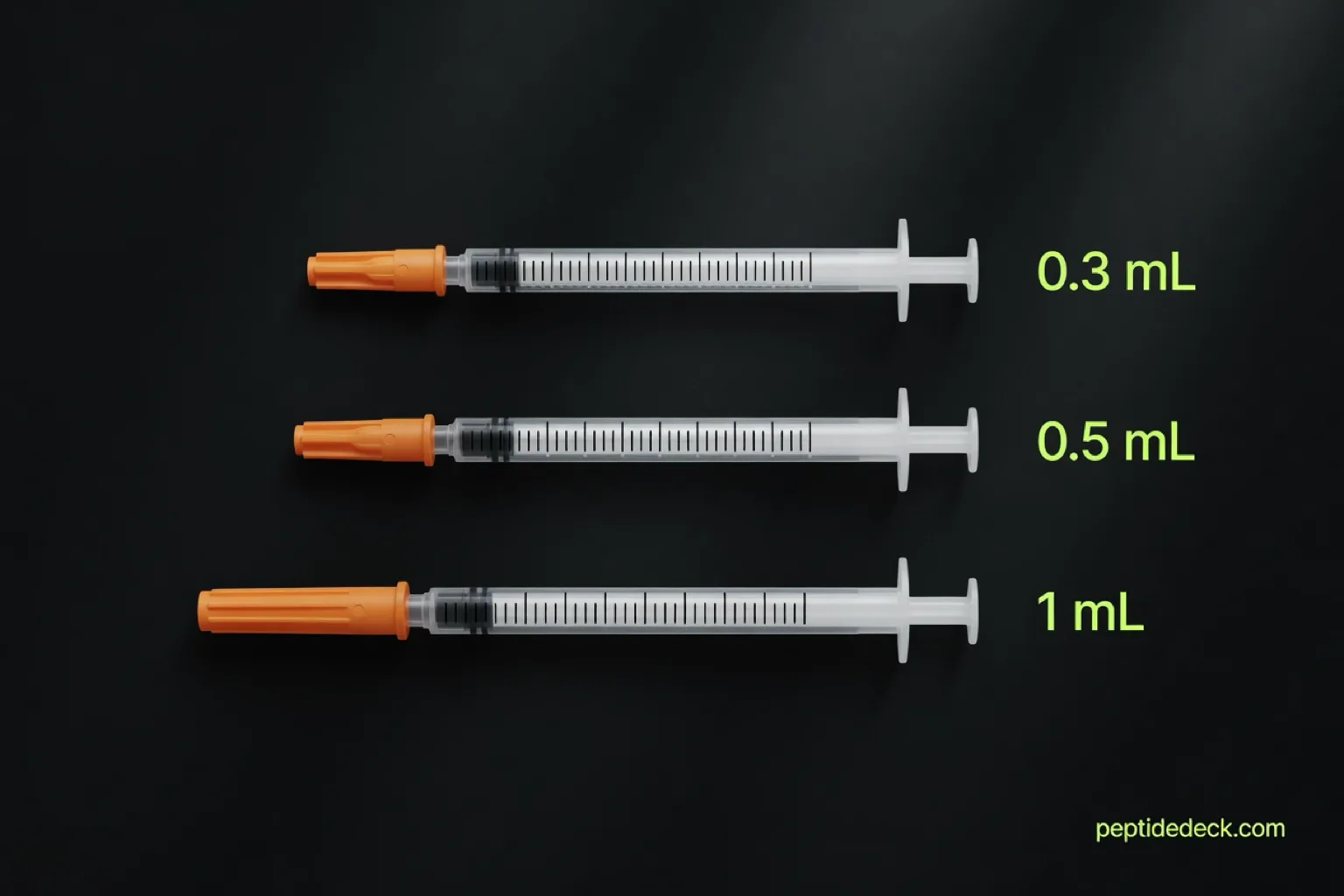
The 1 mL syringe is the default in most kits and on most pharmacy shelves. It is also the worst choice for small doses, for the reason in the worked example above: at 2 units per line, a 4-unit dose is two tick marks.
One honest limitation of the smaller barrels: a 0.3 mL syringe can't take more than 30 units, so if you ever need 40 you'll be drawing twice. The half-unit version is also harder to find than the standard one. For most people running doses in the 5 to 25 unit range, that trade is still worth it, because precision is the thing you can't fix after the dose is in.
Insulin syringe for peptides vs a detachable-needle syringe
This one costs real money. Syringes with a screw-on or push-on needle (Luer lock or Luer slip, like the 1 mL tuberculin syringe in the study below) leave liquid trapped in the hub after you press the plunger all the way down.
How much? In a 2018 cost study, a 1 mL tuberculin syringe with a detachable needle held 0.05 mL in the hub after every injection. The comparison was an insulin syringe with a fixed 31-gauge needle, the low-dead-space option, and the authors concluded it cut product waste. On a U-100 scale, 0.05 mL is 5 units.
What that does to a vial: take a 5 mg vial mixed with 2 mL of water (2,500 mcg per mL) and a 250 mcg dose. Each shot uses 0.10 mL for the dose plus 0.05 mL lost in the hub. You get about 13 doses out of the vial instead of 20. Roughly a third of what you paid for ends up in the sharps bin.
So the answer to "what syringe for peptides" is specific: a U-100 insulin syringe with a fixed needle. Every dosing chart on this site, including the peptide dosage chart, assumes that scale.
Needle Gauge and Length: What the Numbers Mean
Gauge is thickness, and it runs backwards. A higher number is a thinner needle, so 31G is finer than 29G. For under-the-skin injections, insulin syringes mostly come in 29G, 30G and 31G, and any of them will do the job.
- 31G is the thinnest common option and the one most people find most comfortable. It draws a little more slowly.
- 29G or 30G draws faster and bends less on a stiff stopper. You may feel it slightly more.
Gauge doesn't change your dose. Length is the number that deserves more of your attention.
Insulin syringes are sold with needles from 6 mm to 12.7 mm (1/2 inch), with 8 mm (5/16 inch) the most common. The skin itself is only about 1.9 to 2.4 mm thick at the usual injection sites, according to ultrasound measurements in 388 adults. The fat layer under it varies far more.
That variation is the problem. A follow-up analysis estimated that an 8 mm needle inserted straight in, without pinching the skin, reaches muscle about 25% of the time in the thigh and 9.7% of the time in the abdomen. The international FITTER injection recommendations name the 6 mm syringe needle as the first-line choice for everyone.
The practical pick: 31G, 6 mm if you can find it. If you only have 8 mm (5/16 inch), pinch up a fold of skin or go in at an angle, especially in the thigh or if you are lean. Skip 12.7 mm (1/2 inch) needles entirely for under-the-skin shots.
If you inject a weekly GLP-1 from a vial, the same numbers apply. Our guide on where to inject tirzepatide covers the sites themselves.
Empty Sterile Vials: When You Need One and Which Size
Most people never need one. But when you do, nothing else works.
An empty sterile vial is a glass vial that has been sterilized and sealed with a rubber stopper and crimp cap, with nothing inside. Good ones are Type I borosilicate glass, sterile and pyrogen-free, and come with a lot number. They solve three specific problems:
- Mixing two peptides into one vial so you take one shot instead of two. Not every pairing is compatible, so check our guide on whether you can mix peptides together first.
- Diluting a concentrated peptide when your dose is too small to read. Moving the solution into a larger vial with more water turns a 2-unit dose into a 10-unit one.
- Splitting a large vial into portions so you only open what you'll use inside the 28-day window.
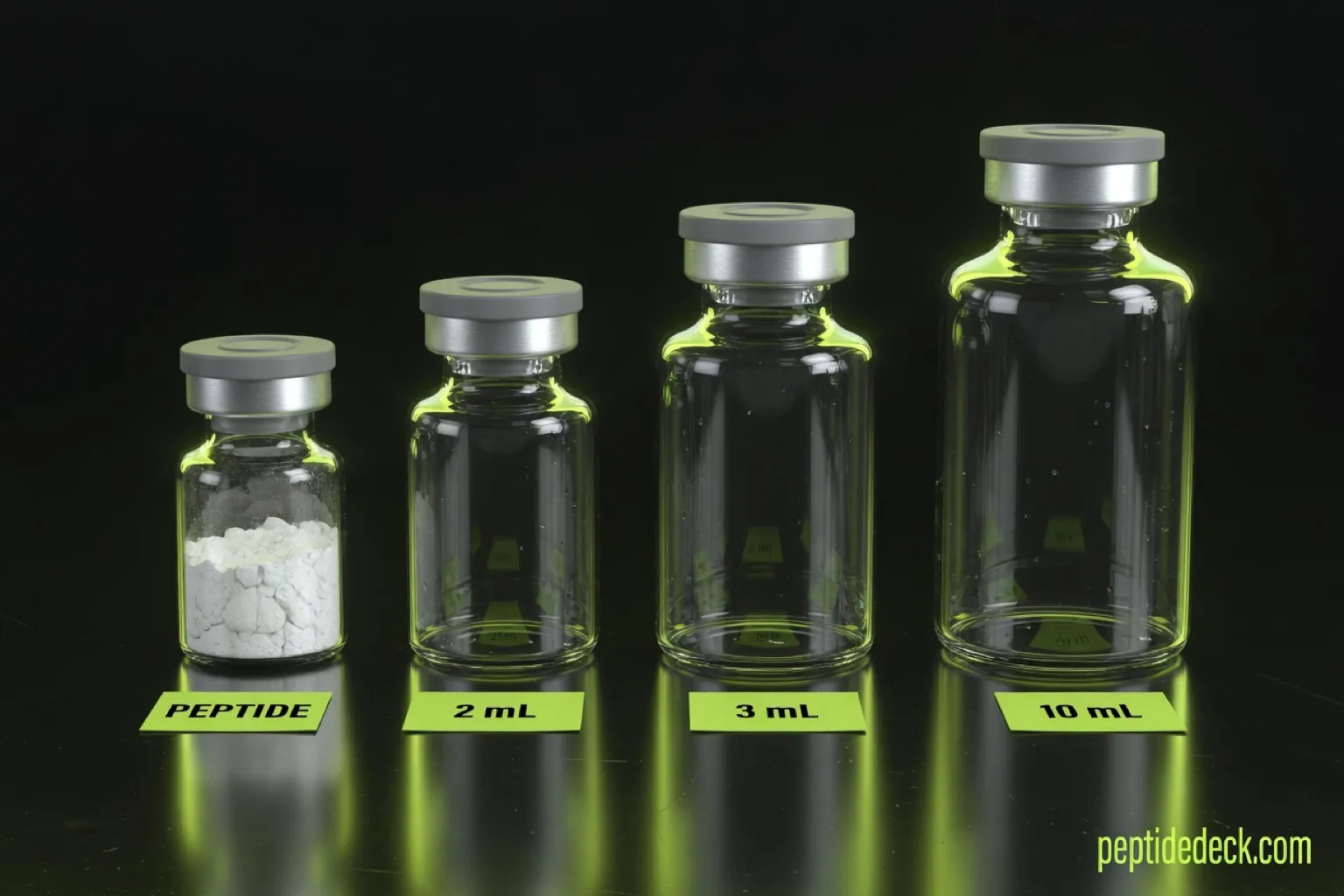
Which size to buy
Match the vial to the job. 2 mL and 3 mL vials suit splitting a vial into portions. A 10 mL vial suits blends and dilutions, where you need room for more water. Sterile empty 10 mL vials cost roughly $1.25 to $1.66 each from medical-supply sellers we checked in September 2026 (one sells a 25-pack for $41.58).
Here's the new risk they bring. Every transfer from one vial to another is one more needle through one more stopper, and one more chance to bring contamination in. The empty vial is sterile only until the first puncture. After that, the 28-day clock starts on whatever you put in it.
Two handling notes save a lot of frustration. Liquid pushed into a sealed vial pressurizes it, so push slowly and let the plunger ease back if it resists. And label every vial you fill with what is in it, the concentration and the date. A clear liquid in an unlabeled vial is anyone's guess three weeks later.
The Full Peptide Supplies Checklist (and What It Costs)
Here is the whole kit. Nothing on this list is expensive; the expensive thing is the peptide itself, and every item here exists to protect it.
How many syringes? One per injection, plus about a fifth extra. A daily dose for a month means a box of 50 covers you with room to spare; a weekly shot means a box of 10 lasts two months.
Bacteriostatic water deserves its own note. It is a prescription product: Hospira's label on DailyMed is marked Rx only and lists 0.9% or 1.1% benzyl alcohol. Our bacteriostatic water buying guide covers prices, the two strengths and why the 30 mL size is usually the wrong buy, and the bac water vs sterile water vs saline page explains when plain sterile water is fine.
The peptide is the one line not in the table. Common single vials run roughly $49 to $120 at the vendors we track, and our page of peptides for sale compares current prices, vial sizes and COAs side by side, so you can match the vial size to the syringe and water plan above before you order.
Where to Buy Peptide Syringes and Vials
Easier than most people expect. Insulin syringes are sold without a prescription at pharmacies in most US states, as a 2024 secret-shopper study of chain pharmacies notes. The same study found wide price swings: the average 10-pack cost $4.53, with individual stores charging anywhere from $1.70 to $11.44.
- Pharmacy counter. Fastest option. Ask for U-100 insulin syringes by size, gauge and length, for example "0.3 mL, 31 gauge, 6 mm." Some stores keep them behind the counter and a few states add limits.
- Medical-supply websites. Best for boxes of 100 and for the half-unit 0.3 mL size, which chain stores often don't stock. Also the most reliable place for sealed empty sterile vials.
- Amazon and marketplaces. Convenient, but check that the box is sealed, each syringe is individually wrapped, and the expiry date is printed. Return anything that arrives loose or opened.
Whatever the source, the spec on the box is what you are buying. "U-100", the barrel size, the gauge and the needle length should all be printed on it. If any of those is missing, keep looking.

Five Mistakes That Waste a Peptide Vial
None of these are dramatic. That is why they keep happening.
- Mixing with a big 18-gauge needle. Large needles punch small plugs of rubber out of the stopper, called coring. In a test of repeated vial punctures, 18G needles cored the stopper in 38% of vials, far more than smaller needles. A 2025 review adds that perpendicular entry and repeated punctures raise the risk too. Use a fine needle for mixing as well as for injecting.
- Drawing tiny doses with a 1 mL syringe. Under about 10 units, the 2-unit lines make every dose an estimate. Switch to a 0.3 mL syringe or add more water.
- Using a detachable-needle syringe. That 0.05 mL in the hub is lost on every single shot.
- Leaving a needle parked in the stopper. The CDC warns against it because it gives germs a direct route into the vial. Draw, withdraw, and use a fresh syringe next time.
- Reusing syringes. Once a syringe has been used, it is no longer sterile. The CDC's rule for injections is one needle, one syringe, only one time.
If a vial does end up cloudy or discolored after mixing, don't use it. Our peptide storage guide covers how to keep powder and mixed vials stable in the first place.
How to Get Rid of Used Syringes
Right away, every time. The FDA's two-step sharps guidance is simple: put the needle in a sharps container the moment you're done, and when the container is about three-quarters full, dispose of it the way your community allows. That might be a pharmacy or hospital drop box, a household hazardous waste site, a mail-back program or a special pick-up.
No official container yet? The FDA's container page says a heavy-duty plastic household container, such as a laundry detergent bottle with a tight, puncture-resistant lid, is an accepted stand-in. Label it clearly and keep it away from children and pets.
Frequently Asked Questions
Medical Disclaimer: This article is for informational purposes only and does not constitute medical advice. Syringe, needle and vial choices depend on your specific medication, dose and body. Talk to your doctor or pharmacist before starting any injectable peptide or changing how you prepare or inject it.