The scale hasn't moved in weeks. That stings.
You're injecting every week, you're eating less than you used to, and you've read about people losing 20% of their body weight. So the question keeps coming back: why am I not losing weight on retatrutide? The answer is almost never "the drug doesn't work for me". In the phase 2 trial, every single person on the 8 mg and 12 mg doses had lost at least 5% of their weight by week 48. When reta stalls in real life, something specific is usually getting in the way, and most of those things can be checked in an afternoon.
🔑 Key Takeaways
- Before you troubleshoot, check whether you're actually behind. The trial curves give you a clear benchmark by dose and week.
- Outside trials, the most common cause sits inside the vial, not inside your body.
- One piece of syringe math quietly halves the dose for a lot of people. It takes ten seconds to check.
- A slowdown after month six is expected. A flat line at month two is not.
- Some causes need a doctor, not a higher dose. We list the signs.
Below: what "normal" looks like on each dose, nine causes in the order we'd check them, a step-by-step plan, and when to see a doctor instead of adjusting things yourself.
Are You Actually Off Track? What Normal Looks Like
Start with the trial numbers, not with forum posts.
The best benchmark is the phase 2 obesity trial published in the New England Journal of Medicine in 2023 (Jastreboff et al., PMID 37366315). It enrolled 338 adults with obesity or overweight for 48 weeks, starting at 2 mg (or 4 mg in some groups) and stepping up every 4 weeks. Here is what the average person lost, and how many cleared the common milestones.
Put that into pounds. A 220 lb person losing 12.9% by week 24 drops about 28 lb, or roughly 1.2 lb a week on average. On 12 mg the same person would be around 38 lb down at week 24 and 53 lb down at week 48.
Two things matter for troubleshooting. The early weeks are slow by design, because everyone started low, so the first month or two look modest even in groups that went on to lose a quarter of their weight. And on 4 mg and above, almost nobody failed to respond: only 8% of the 4 mg group, and none of the 8 mg or 12 mg groups, finished under 5%.
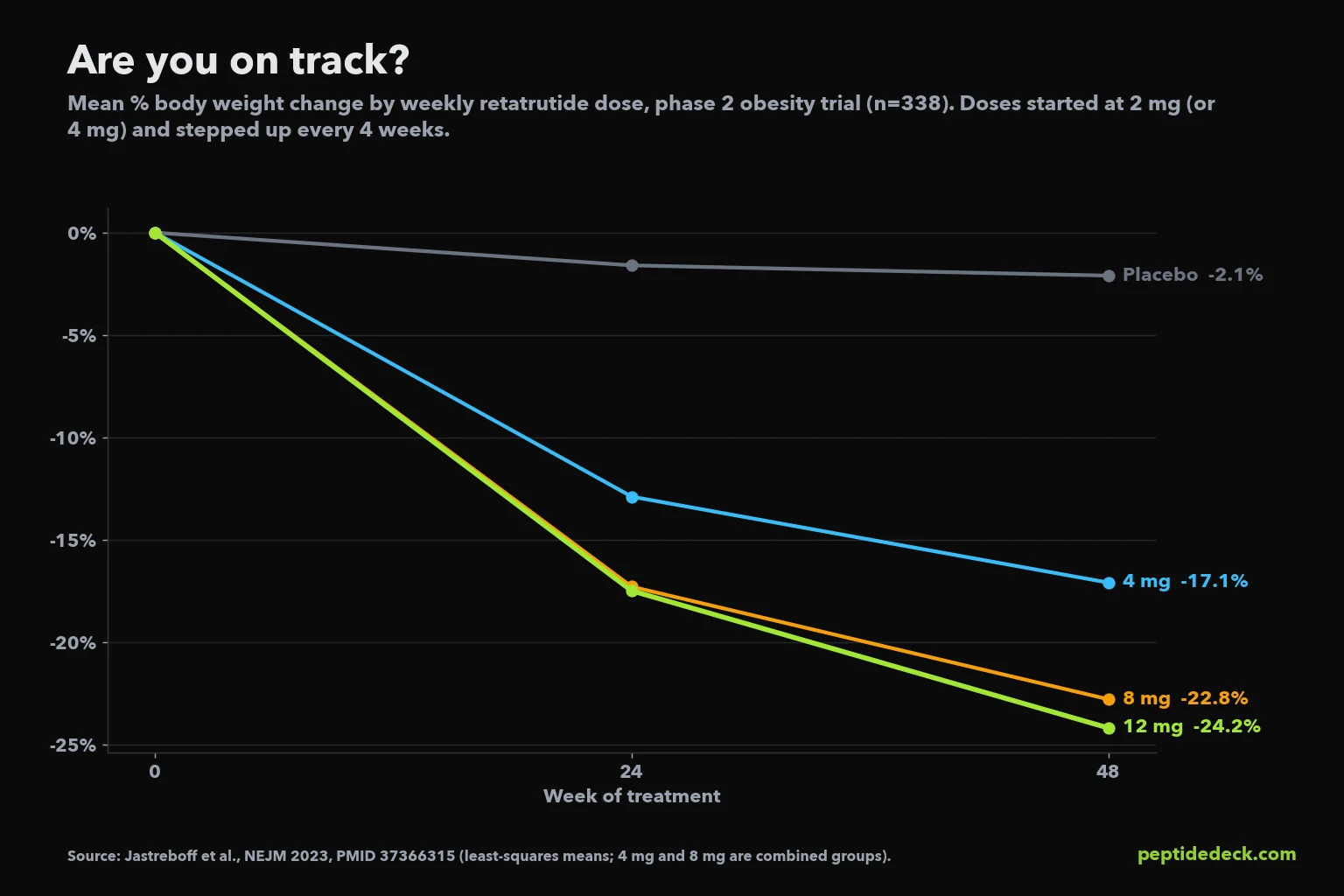
So here is a fair working line, which is our reading of those curves rather than a medical rule. If you've spent at least 8 weeks at 4 mg or higher and you're down less than about 5%, something is probably off. If you're still on 2 mg, or you've been on retatrutide for under two months, you may simply be early. Our guide to how long retatrutide takes to work breaks the timeline down month by month.
One limitation: the trial was funded by Eli Lilly, ran under close supervision and used drug made by the manufacturer. Real-world results with GLP-1 drugs run modestly lower than trial results, as the 2025 nutrition advisory cited below notes.
Why Am I Not Losing Weight on Retatrutide? 9 Reasons, Ranked
We ranked these by how often they explain a stall.
Work down the list in order. The first three are about whether the right amount of drug is reaching you at all, and they're the cheapest to fix.
1. You're still on a starter dose, or you stalled your titration
Starter doses are for your stomach, not your waistline.
The 2 mg dose exists to let your gut adjust. The trial shows the gap: 1 mg averaged 8.7% at 48 weeks, 4 mg averaged 17.1%. If nausea pushed you back to 2 mg, or you've sat at a low dose for two or three months, the scale is behaving as expected.
The opposite mistake happens too. People jump from 2 mg to 8 mg in a few weeks, get hit with vomiting, skip doses or drop back, and spend months below an effective dose. The house approach mirrors the trial: start at 2 mg, then 4 mg, 8 mg and 12 mg, stepping up no faster than every 4 weeks, and many people stop climbing at 4 to 8 mg if results and tolerance are good. Our retatrutide dosing schedule lays out each week.
2. The vial is underdosed, degraded or fake
This is the cause we'd suspect first.
Retatrutide has no FDA approval and can't be compounded, so every vial used outside a trial comes from the gray market. A "10 mg" vial can hold 10 mg, 6 mg, a different peptide or nothing useful, and the powder looks the same either way.
Your body gives the first clue. Gut effects such as nausea and early fullness were the most common side effects in every trial, and most people on 4 mg or more notice a clear drop in appetite. If you've reached 4 or 8 mg and feel nothing at all, suspect the vial before your metabolism.
A batch-matched lab report, called a certificate of analysis (COA), is the second check. A useful one has all of these:
- A batch number that matches your vial. A generic report proves nothing about yours.
- Purity by HPLC, ideally 98% or higher.
- Net content in milligrams. A 99% pure vial holding 6 mg is still underdosed.
- Identity by mass spectrometry, confirming the molecule is retatrutide and not a cheaper peptide.
- A named testing lab you can contact, ideally with endotoxin and sterility screens.
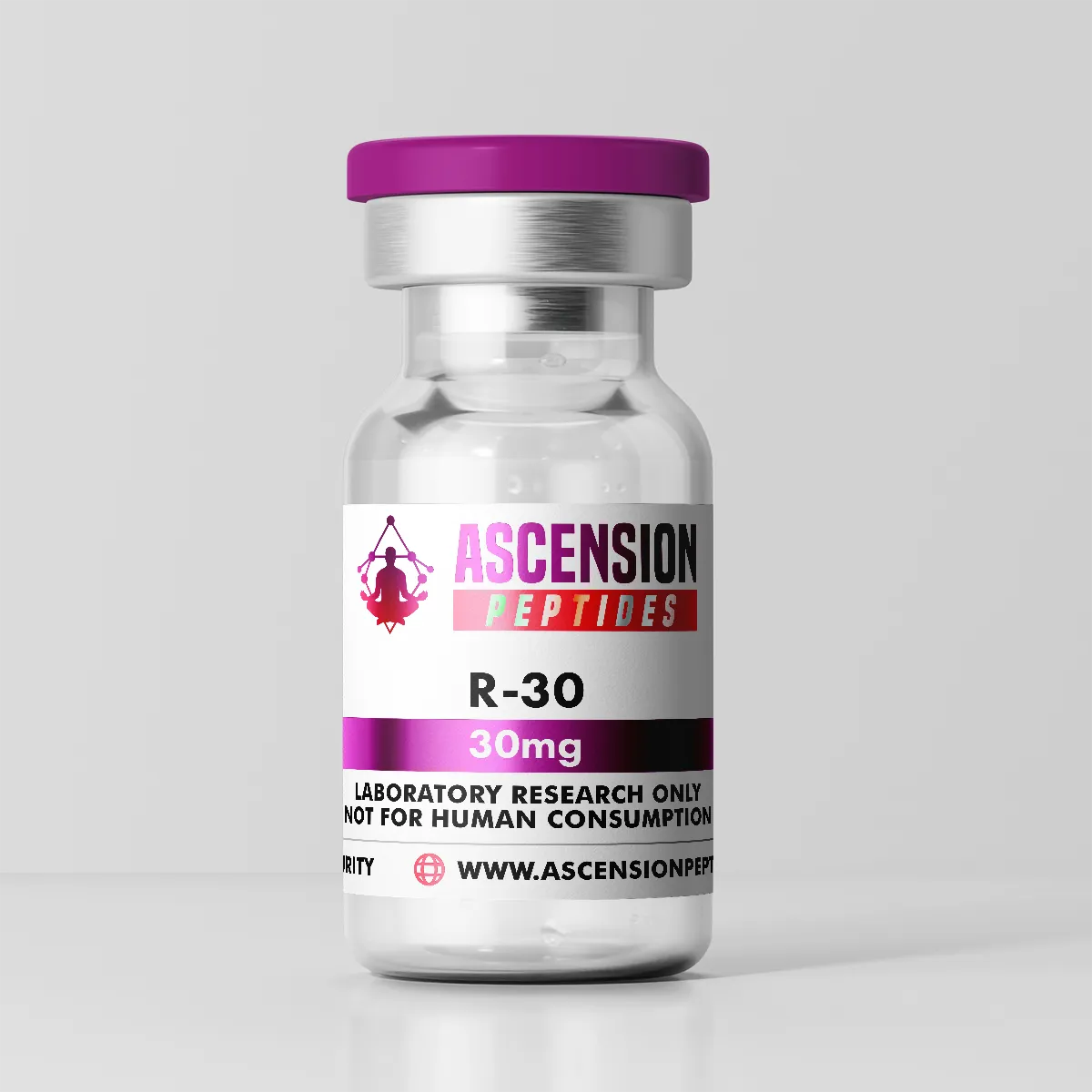
If you doubt a vial you already have, some independent labs will test a sample, which costs less than months of injecting something that doesn't work. When you restock, compare sellers on our guide to where to buy retatrutide, which covers what each one publishes. If you'd rather go straight to a vendor that posts batch-level reports, you can buy retatrutide from our partner Ascension, where the R-30 (30 mg) lists at $250, or $125 with code PEPTIDEDECK, about $4.17 per mg, and the R-10 (10 mg) is $50 with the code. PeptideDeck may earn a commission on those links at no cost to you.
To be fair, a verified vial won't fix a stall caused by the other eight reasons. It removes the biggest unknown, so the rest of your troubleshooting means something.
3. Mixing, units or storage mistakes
Good powder can still become a bad dose.
The most common error is syringe math. Units on an insulin syringe measure volume, not milligrams, so the units for 2 mg depend on how much water you added. Here is our standard.
Here is what goes wrong. Switch from a 30 mg vial to a 10 mg vial but keep drawing 20 units, and you get 1 mg instead of 2. Mix a 10 mg vial with 3 mL instead of 2 and draw 40 units, and you get about 1.3 mg. Fill one 100-unit syringe on 8 mg from a 10 mg/2 mL vial, and you get 5 mg. Each looks like "retatrutide stopped working". Each is a dose problem. Run your numbers through our retatrutide dosage calculator or the step-by-step retatrutide reconstitution guide.
Storage is the quieter problem. After mixing, keep the vial in the fridge at 2 to 8 °C, use it within 28 days, and never freeze it or leave it at room temperature for days. That window catches a lot of people. At 2 mg a week a 30 mg vial takes 15 weeks to finish, and at 4 mg it takes 7.5 weeks, so the last doses come from solution well past 28 days. A parcel that sat in a hot mailbox is another suspect.
Quick check: write the mixing date on every vial. If your stall started a month or more after mixing, and your appetite came back at the same time, the solution may have lost strength. A fresh vial is the test.
4. Calories are coming back in through the side door
Smaller meals don't always mean fewer calories.
Retatrutide cuts hunger. It doesn't stop you drinking calories or grazing when you're bored or stressed. Liquid calories barely register as food: specialty coffees, juice, smoothies and alcohol. Alcohol carries 7 calories per gram, and a bottle of wine runs to roughly 600 calories that don't fill you up. Our guide to retatrutide and alcohol covers how drinking interacts with the drug's side effects too.
The fix is boring but works: log everything you eat and drink for 7 days, honestly.
5. Too little protein, and too much muscle loss
Losing muscle makes the scale lie later.
When appetite drops this far, protein is often the first thing to go. A 2025 joint advisory from four US obesity and nutrition societies notes that 1.2 to 1.6 g of protein per kg of body weight a day has been proposed during active weight loss, and that intake should not fall below 0.4 to 0.5 g/kg (Mozaffarian et al., Obesity Pillars 2025, PMID 40673264). It lists muscle and bone loss among the main challenges of GLP-1 drugs and recommends resistance training.
Muscle burns more energy than fat, so losing a lot of it lowers your daily burn and the scale slows sooner. Lift and eat enough protein, and the reverse can happen: the scale holds still while your waist shrinks. Our article on muscle loss and plateaus on retatrutide goes deeper on training while on the drug.
6. Water, constipation and your cycle are hiding the loss
Scale weight isn't the same as fat.
Daily weight swings by a few pounds with salt, carbs, hydration and hard workouts. Constipation, a common trial side effect, adds weight that hasn't left yet. Many women also hold water before a period, which can mask a week of fat loss. Our guide to retatrutide for women covers the cycle and other female-specific questions.
Stop judging single weigh-ins. Weigh each morning, compare weekly averages, and measure your waist at the navel once a week. A shrinking waist means the drug is still working.
7. You've hit a normal plateau
Every weight loss curve flattens. Reta's too.
Look at the trial again. On 12 mg, people lost 17.5% in the first 24 weeks, then another 6.7 points in the next 24. That's normal: a lighter body needs less energy and pushes back with hunger. Still, on the top doses weight was still falling at week 48. In the longer TRIUMPH-1 phase 3 trial, Lilly reported 28.3% average loss at 80 weeks on 12 mg, against 2.2% on placebo, among people who stayed on treatment (company release, May 2026). Counting everyone randomized, the NEJM paper puts it at 25.0%.
So a slower month after six months is expected. A flat line in month two isn't a plateau; it means one of the causes above applies. If you're losing faster than you want, that's a different problem, covered in our guide to losing too much weight on retatrutide.
8. Another medication is working against it
Some prescriptions push weight up.
A 2018 review of medication-induced weight gain found that some drugs in five classes were linked to significant gain: antipsychotics, antidepressants, diabetes medicines, blood pressure medicines and corticosteroids (Wharton et al., Diabetes Metab Syndr Obes 2018, PMID 30174450). Examples often named include olanzapine, mirtazapine, paroxetine, insulin, sulfonylureas, some beta-blockers and long courses of prednisone.
The review notes that most of these classes have weight-neutral alternatives. Never stop a prescribed medicine on your own; ask your doctor whether one could be switched.
9. Thyroid, PCOS, insulin resistance or diabetes
Your starting point changes the finish line.
People with type 2 diabetes tend to lose less on drugs in this class, and retatrutide follows the pattern. In TRIUMPH-2 (1,152 adults with obesity and type 2 diabetes), 12 mg produced 20.8% average loss at 80 weeks, against 28.3% at the same dose and length in people without diabetes in TRIUMPH-1. If you have diabetes, compare yourself with the TRIUMPH-2 numbers. Our TRIUMPH-2 results breakdown has the details.
An underactive thyroid, polycystic ovary syndrome and strong insulin resistance can also slow loss. All are common and treatable. If you're tired, cold, losing hair or have irregular periods on top of a stall, ask for blood tests.
Retatrutide Not Working? Match the Sign to the Cause
Your symptoms usually point to the answer.
What to Do About a Retatrutide Plateau: A 6-Step Plan
Change one thing at a time.
Change dose, diet and vial in the same week, and you'll never know which fixed it. Go in this order.
- Measure properly for two weeks. Daily morning weigh-ins compared as weekly averages, plus a weekly waist measurement and photo. Scale-only tracking invents a lot of "stalls".
- Audit the vial. Match the batch to its COA, check the mixing date, confirm refrigeration and redo the units math.
- Check your dose and time on it. At 2 mg, or under 4 weeks at any dose, you may simply be early.
- Log food and drink for 7 days. Aim for 1.2 to 1.6 g of protein per kg, cut liquid calories first, and lift two or three times a week.
- Sort out constipation and sleep. Both raise scale weight or appetite.
- Only then, consider the next dose step. If you tolerate your dose and it's been 4+ weeks since your last increase, one step up (4 to 8 mg, or 8 to 12 mg) is how the trials pushed further. Don't exceed 12 mg, the highest dose studied.
Give each change three to four weeks. For a reality check on other people's timelines, see our roundup of retatrutide before and after results is a useful reality check.
When to Talk to a Doctor
Some stalls aren't a dosing problem.
Get a medical opinion, rather than adjusting things yourself, if any of these apply:
- You're gaining weight while eating very little, or you've had no loss at all after 12 weeks on 4 mg or more with a verified vial.
- You have signs of a thyroid or hormone problem: fatigue, feeling cold, hair thinning, irregular or missed periods.
- You take insulin, a sulfonylurea or any of the weight-gain drugs listed above.
- You have severe or constant stomach pain, pain in the upper right abdomen, ongoing vomiting, or signs of dehydration. These need prompt attention whatever the scale says.
- You're pregnant, trying to conceive or breastfeeding.
A doctor can run the blood tests for thyroid, PCOS and insulin problems and review your medicines. Our guide to retatrutide side effects covers which symptoms are expected and which aren't.
Frequently Asked Questions
Sources
- Jastreboff AM, et al. Triple-Hormone-Receptor Agonist Retatrutide for Obesity: A Phase 2 Trial. New England Journal of Medicine, 2023. PMID 37366315. pubmed.ncbi.nlm.nih.gov/37366315
- Eli Lilly and Company. Lilly's triple agonist, retatrutide, delivered powerful weight loss in pivotal Phase 3 obesity trial (TRIUMPH-1), May 21, 2026. investor.lilly.com
- Eli Lilly and Company. Retatrutide TRIUMPH-2 results in obesity and type 2 diabetes, presented at EASD and published in The Lancet, September 2026. investor.lilly.com
- Mozaffarian D, et al. Nutritional priorities to support GLP-1 therapy for obesity: a joint advisory from the American College of Lifestyle Medicine, the American Society for Nutrition, the Obesity Medicine Association and The Obesity Society. Obesity Pillars, 2025. PMID 40673264. pmc.ncbi.nlm.nih.gov/articles/PMC12264624
- Wharton S, et al. Medications that cause weight gain and alternatives in Canada: a narrative review. Diabetes, Metabolic Syndrome and Obesity, 2018. PMID 30174450. pubmed.ncbi.nlm.nih.gov/30174450
- TRIUMPH-1 full results: "Retatrutide, a Triple Hormone Receptor Agonist, for Treatment of Obesity." New England Journal of Medicine, September 29, 2026. doi:10.1056/NEJMoa2604169
Medical Disclaimer: This content is for informational purposes only and does not constitute medical advice. Retatrutide has no FDA approval. Always consult a qualified healthcare provider before starting, changing or stopping any medication or treatment. PeptideDeck may earn a commission from affiliate links at no additional cost to you.