Nobody has tested retatrutide and alcohol together. Not once.
If you're on retatrutide and a wedding or a Friday night is coming up, you want a straight answer on retatrutide and alcohol: can you have a drink? You've probably noticed food doesn't pull at you the way it used to. Maybe wine doesn't either. Forum posts swing from "one beer wrecked me" to "nothing changed". The honest answer sits between those, and the evidence comes from the drugs that came before retatrutide, not from retatrutide itself.
🔑 Key Takeaways
- There is no retatrutide-specific alcohol study in people. Everything useful comes from semaglutide, liraglutide and exenatide data, and we label it that way below.
- The class evidence points in a surprising direction: these drugs tend to make people want less alcohol, not more.
- The popular claim that you'll get drunk "20 to 40% faster" has no study behind it. The one human measurement we found showed something closer to the opposite, with its own catch.
- Four risks are real: stomach side effects, dehydration, low blood sugar for some people, and pancreatitis. One group should skip alcohol entirely.
- Timing matters more than most people think, and it isn't about the injection day.
Below we cover what has actually been studied, why so many people on reta drink less without trying, the risks with a plain table of what to do about each, and a practical plan for the nights you do decide to drink.
Can You Drink on Retatrutide? The Short Answer
Usually a little, with care.
Retatrutide has no FDA approval, so it has no label and no official alcohol warning. The approved drugs in the same family, semaglutide (Wegovy) and tirzepatide (Zepbound), don't ban alcohol either. Their labels don't list alcohol as a drug interaction. What they do list are warnings that alcohol can make worse: stomach side effects, dehydration and kidney strain, low blood sugar when combined with insulin or sulfonylureas, and pancreatitis.
So for most healthy adults on a stable dose, one or two standard drinks with food is unlikely to cause a problem. Heavy drinking while you're stepping up your dose is a very different bet. And a few people shouldn't drink at all on this drug.
Retatrutide and Alcohol: What Has Actually Been Studied
Almost nothing, directly.
We searched ClinicalTrials.gov in October 2026. The only registered retatrutide interaction study tests how it affects metoprolol, a heart medicine. There is no retatrutide alcohol trial, finished or planned. By contrast, at least six trials of tirzepatide in alcohol use disorder are registered, most of them recruiting, so the dual-agonist data should arrive first.
The single piece of alcohol data on retatrutide itself comes from a 2025 non-human study published in Psychopharmacology. A single dose of semaglutide, tirzepatide or retatrutide each blunted how strongly the subjects could perceive alcohol's effects. Interesting biology, but it says nothing about how many drinks are safe for a person on 4 mg a week.
Everything else in this article borrows from the GLP-1 drugs that have human data. That's a reasonable starting point, because retatrutide acts on the same GLP-1 receptor. It's also a limit worth naming: retatrutide adds GIP and glucagon activity, and nobody has measured whether that changes the alcohol picture.
What GLP-1 Trials Show About Drinking
The randomized evidence is small but consistent.
The first trial: semaglutide, 9 weeks. In the JAMA Psychiatry trial led by Christian Hendershot (published 2025), 48 adults with alcohol use disorder who were not seeking treatment took low-dose semaglutide (0.25 mg, then 0.5 mg, then one week at 1.0 mg) or placebo. In a lab session where they could drink freely, the semaglutide group drank fewer grams of alcohol and reached a lower peak breath alcohol. Outside the lab, semaglutide cut drinks per drinking day and weekly craving. It did not change how many days people drank. Those doses are well below the 2.4 mg used for weight loss.
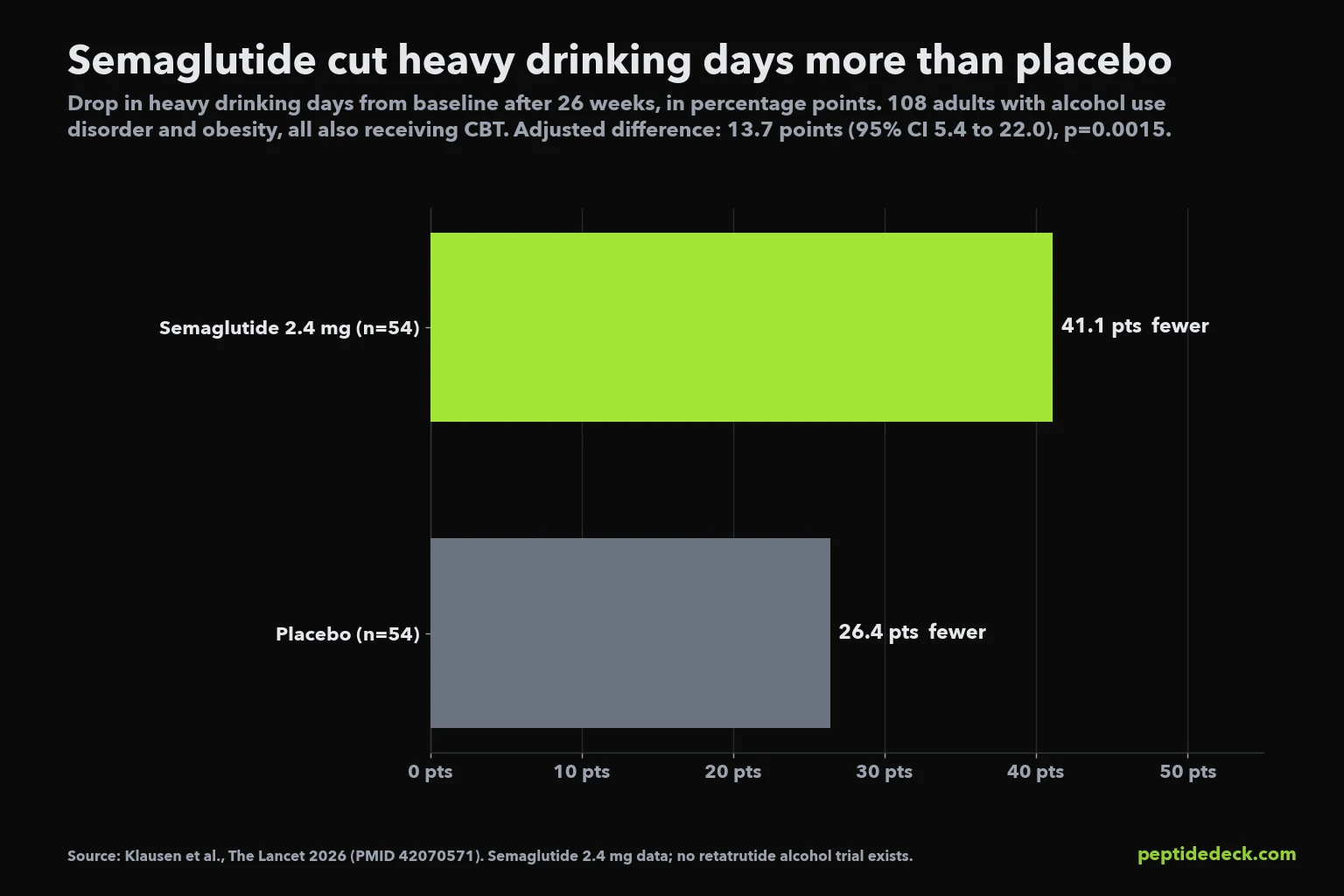
The bigger trial: semaglutide 2.4 mg, 26 weeks. A Danish trial published in The Lancet in May 2026 enrolled 108 adults with moderate to severe alcohol use disorder and obesity, all of whom also got cognitive behavioral therapy. Heavy drinking days fell by 41.1 percentage points on semaglutide and 26.4 points on placebo. The adjusted difference between the groups was 13.7 points. (The raw gap looks like 14.7; the published 13.7 comes from the trial's statistical model, so don't let anyone tell you it's a typo.) Side effects were mostly mild to moderate stomach problems.
A trial that didn't work, mostly. An earlier Danish trial of exenatide, an older GLP-1 drug, in 127 people with alcohol use disorder found no overall drop in heavy drinking days. In an exploratory look at participants with a BMI over 30, though, heavy drinking days and total intake did fall. That pattern, stronger effects in people with obesity, shows up again and again, and it's the group most people on retatrutide belong to.
Real-world records. A Swedish cohort of 227,866 people with alcohol use disorder found that periods on semaglutide were linked to a 36% lower risk of alcohol-related hospitalization (adjusted hazard ratio 0.64), better than any approved alcohol medicine in the same data. A US analysis of 83,825 patients with obesity linked semaglutide to a 50 to 56% lower risk of a new or recurring alcohol use disorder diagnosis over 12 months, compared with other weight loss drugs. A 2025 meta-analysis of 14 studies found GLP-1 drugs lowered scores on the standard alcohol screening test (AUDIT) by 7.81 points on a 40-point scale, though results varied widely between studies.
Two cautions. Observational studies can't prove the drug caused the change. And every one of these studies tested semaglutide, liraglutide or exenatide. Retatrutide is a reasonable guess to behave similarly. It's still a guess.
Why Many People Drink Less on Reta
The appetite drop doesn't stop at food.
GLP-1 receptors sit in the brain's reward circuits, not just the gut. On a drug like retatrutide, the pull that used to make a second glass feel automatic often goes quiet. Users commonly describe pouring a drink and leaving half of it, often around the time their food noise fades.
Not everyone gets that effect. In the r/Retatrutide community, some users report the opposite, saying reta left them craving sugar and that alcohol filled that gap until they noticed the pattern. If that sounds like you, treat it as information, not a failure: the drug changes the reward signal, it doesn't make choices for you.
There's a physical side too. When you already feel full after half a plate, a pint of beer has nowhere comfortable to go.
Will You Get Drunk Faster on Retatrutide?
Probably not faster. Possibly later.
Several sites say GLP-1 drugs make alcohol hit "20 to 40% harder". We couldn't find a study behind that number. The one human measurement we found points the other way. In a 2025 pilot study in Scientific Reports, 20 people with obesity, half on a GLP-1 drug and half not, drank the same calculated dose of alcohol. In the GLP-1 group, breath alcohol rose more slowly: at 20 minutes it read 0.017 against 0.037 in the controls. They also felt less drunk early on, and the difference wasn't explained by nausea. From 35 minutes on, the two groups' levels were no longer significantly different.
Here's the catch. A slow start can fool you. If the first drink barely registers, it's easy to order the second and third before the first has fully landed. With only 20 people and no retatrutide users, this study is a hint, not a rule.
Tolerance can still drop over the months, for a simpler reason. Alcohol spreads through your body water, and as you lose weight, there's less of you for each drink to spread into. Someone who has lost 50 pounds on reta shouldn't assume their old three-drink limit still applies.
The Real Risks of Drinking on Retatrutide
These are the ones with evidence behind them.
Retatrutide's most common side effects are already in the gut. In the TRIUMPH-4 phase 3 trial, 43.2% of people on 12 mg reported nausea, 33.1% diarrhea and 20.9% vomiting, against 10.7%, 13.4% and 0.0% on placebo. Alcohol irritates the stomach on its own. Stacking the two is how a normal night turns into a bad one. Our full guide to retatrutide side effects covers the rest of the list.
One more risk is easy to miss: your liver. In the phase 2 liver substudy published in Nature Medicine in 2024, retatrutide 12 mg cut liver fat by 82.4% at 24 weeks, and 86% of people on that dose got back to a normal liver fat level. That's one of the best things this drug does. Regular heavy drinking pushes the other way.
How to Drink More Safely on Retatrutide
Timing beats willpower here.
Watch the dose step, not the injection day. With a half-life of about six days, retatrutide never clears between weekly shots, so there's no "safe" day after your injection the way some sites suggest. What does change is how your body is coping. In the phase 2 trial, stomach side effects were concentrated during dose escalation and eased once people settled on a dose. The practical rule: avoid alcohol for the first week or two after each step up (2 mg to 4 mg, 4 mg to 8 mg and so on). Our retatrutide dosing schedule shows when those steps fall. If your own queasiness peaks a day or two after your shot, as many users report, keep drinking nights away from those days.
Don't skip a dose to drink. Because the drug lingers, skipping one injection barely lowers your level for the weekend, but it can throw off your schedule. The house rule for a missed dose is to take it within four days or skip to the next scheduled day. If you move your injection day, our guide on how to inject retatrutide covers how to shift it cleanly.
Set the limit before the first sip. One or two standard drinks is a sensible ceiling on a stable dose. A standard drink in the US is 12 oz of 5% beer, 5 oz of 12% wine or 1.5 oz of 80-proof spirits.
Eat, then drink, then drink water. A small meal with protein first. A full glass of water between drinks. Fizzy and sugary mixers make bloating worse, so soda water and a lime beat a margarita.
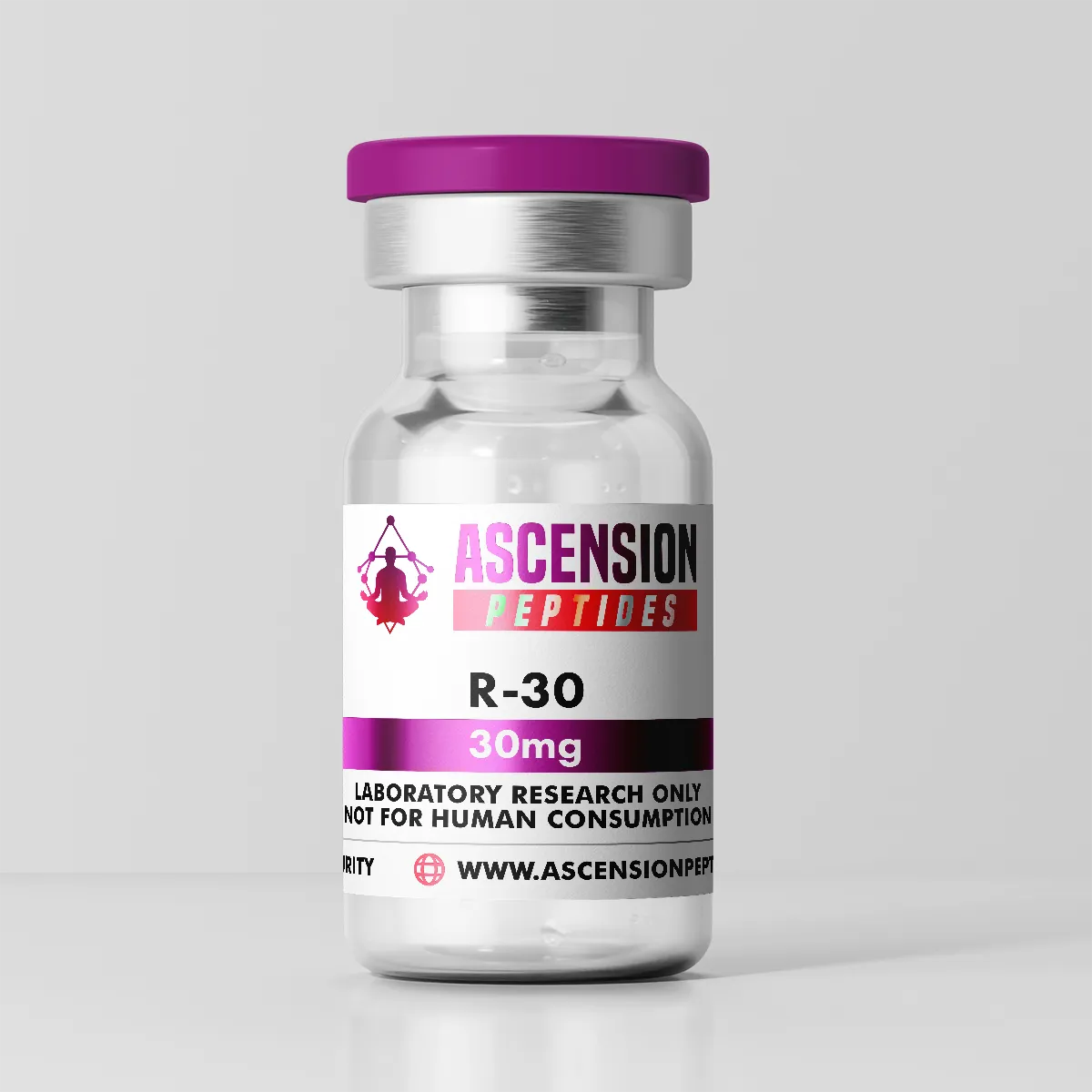
Know your vial. This part rarely comes up, and it should. Retatrutide outside a trial comes from online sellers, and the dose in the vial isn't always the dose on the label. When an Australian drug-checking service had three vials labelled 10 mg tested in 2026, they held 5.13 mg, 16.5 mg and 19.0 mg. A vial that's nearly double strength means your "4 mg" week is really closer to 8 mg, with the nausea to match, and that's a bad week to add alcohol. Before you order, our guide to the best place to buy retatrutide explains how to read a batch lab report for purity and net content. Ascension's R-30 (30 mg) is $250, or $125 with code PEPTIDEDECK, and you can compare current batches on our retatrutide for sale page. (PeptideDeck earns a commission on partner links at no cost to you.)
Night-out checklist: stable dose for at least two weeks · no vomiting or diarrhea today · a real meal first · one to two standard drinks, counted · water between each · no driving · if you use insulin or a sulfonylurea, a glucose check before bed and fast sugar on the nightstand.
When to Skip Alcohol Entirely
For some people, the answer is simply no.
- You've had pancreatitis before. GLP-1 drugs haven't been studied in people with a pancreatitis history, and alcohol is a leading cause of it. This combination isn't worth it.
- You're struggling with alcohol use. The trial data is encouraging, but no GLP-1 drug, and certainly not retatrutide, is approved to treat alcohol use disorder. Talk to a doctor; approved treatments exist.
- You use insulin or a sulfonylurea and haven't talked to your prescriber about alcohol and lows.
- You're in the middle of a dose increase, or you've vomited or had diarrhea in the last 24 hours.
- You're pregnant or trying to conceive. Retatrutide and alcohol are both off the table.
If you're weighing the bigger picture, our guide on whether retatrutide is safe covers the heart rate signal, skin sensitivity and the other open questions. And if drinking nights seem to be stalling your progress, not losing weight on retatrutide walks through the usual culprits.
Frequently Asked Questions
Sources
- Hendershot CS, et al. Once-Weekly Semaglutide in Adults With Alcohol Use Disorder: A Randomized Clinical Trial. JAMA Psychiatry. 2025;82(4):395-405. PMID 39937469. PubMed
- Klausen MK, et al. Once-weekly semaglutide versus placebo in patients with alcohol use disorder and comorbid obesity: a randomised, double-blind, placebo-controlled trial. The Lancet. 2026;407(10540):1687-1698. PMID 42070571. PubMed
- Klausen MK, et al. Exenatide once weekly for alcohol use disorder investigated in a randomized, placebo-controlled clinical trial. JCI Insight. 2022. PMID 36066977. PubMed
- Lähteenvuo M, et al. Repurposing Semaglutide and Liraglutide for Alcohol Use Disorder. JAMA Psychiatry. 2025;82(1):94-98. PMID 39535805. PubMed
- Wang W, et al. Associations of semaglutide with incidence and recurrence of alcohol use disorder in real-world population. Nature Communications. 2024;15:4548. PMID 38806481. PubMed
- Eshraghi R, et al. Effects of glucagon-like peptide-1 receptor agonists on alcohol consumption: a systematic review and meta-analysis. EClinicalMedicine. 2025;90:103645. PMID 41324012. PubMed
- Quddos F, et al. A preliminary study of the physiological and perceptual effects of GLP-1 receptor agonists during alcohol consumption in people with obesity. Scientific Reports. 2025;15:32385. PMID 41093891. Full text
- Windram M, et al. Semaglutide, tirzepatide, and retatrutide attenuate the interoceptive effects of alcohol (non-human study). Psychopharmacology. 2026;243(5):1185-1197. PMID 40699363. PubMed
- Eli Lilly and Company. TRIUMPH-4 topline results press release, December 11, 2025. PR Newswire
- Jastreboff AM, et al. Triple-Hormone-Receptor Agonist Retatrutide for Obesity: A Phase 2 Trial. New England Journal of Medicine. 2023;389:514-526. PMID 37366315. PubMed
- Sanyal AJ, et al. Triple hormone receptor agonist retatrutide for metabolic dysfunction-associated steatotic liver disease: a randomized phase 2a trial. Nature Medicine. 2024;30:2037-2048. PMID 38858523. PubMed
- Piatkowski T, et al. Composition and Labelling Accuracy of Products Sold as Retatrutide in Australia. Drug and Alcohol Review. 2026;45(6):e70231. PMID 42559975. Full text
- Zepbound (tirzepatide) Prescribing Information, sections 5.3, 5.5 and 5.7. U.S. Food and Drug Administration. FDA label PDF
- National Institute of Diabetes and Digestive and Kidney Diseases. Symptoms and Causes of Pancreatitis. NIDDK
- American Diabetes Association. Alcohol and Diabetes. diabetes.org
- Centers for Disease Control and Prevention. What Is a Standard Drink? CDC
- ClinicalTrials.gov searches for retatrutide and alcohol (one interaction study, NCT06808802, metoprolol) and for tirzepatide in alcohol use disorder (six registered trials), accessed October 19, 2026. ClinicalTrials.gov
Medical Disclaimer: This content is for informational purposes only and does not constitute medical advice. Retatrutide has no FDA approval. Always consult a qualified healthcare provider before starting any new medication or treatment, and before combining any medication with alcohol. PeptideDeck may earn a commission from affiliate links at no additional cost to you.