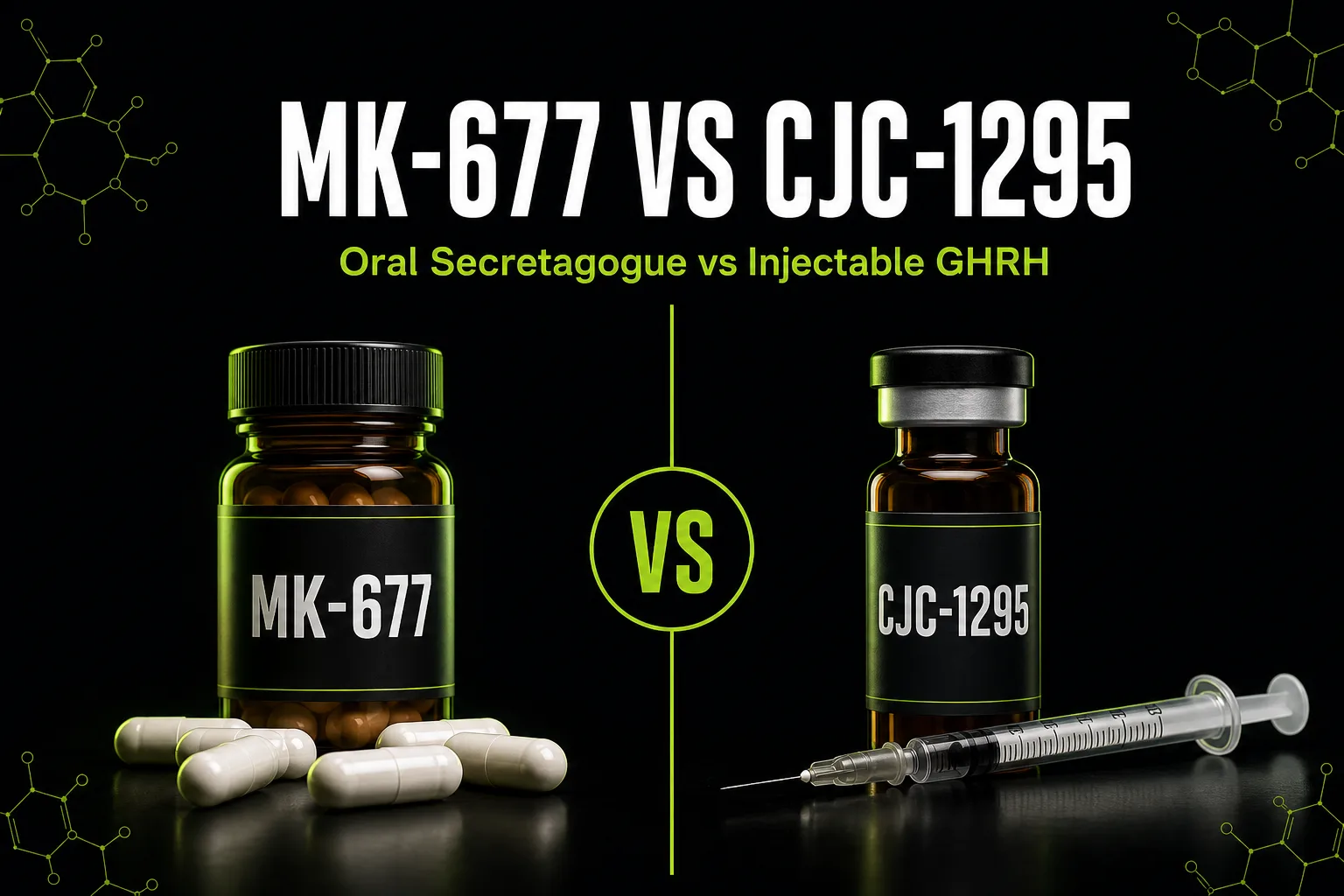
MK-677 and CJC-1295 both raise growth hormone and IGF-1. They do it from opposite ends of the system, in opposite shapes, with opposite convenience trade-offs. One is an oral compound you swallow once a day that keeps growth hormone elevated around the clock. The other is an injectable that either produces sharp pulses or a week-long plateau depending on which version you buy.
The choice usually gets framed as "pills versus needles." That framing misses the more consequential question, which is whether you want growth hormone elevated continuously or released in pulses — and whether the safety signal attached to the continuous option bothers you.
🔑 Quick Decision
- Choose CJC-1295 (no DAC) if: you want to preserve natural pulsatile GH release and are willing to inject daily
- Choose MK-677 if: oral convenience outweighs everything else and you have no glucose or cardiac concerns
- MK-677 has real human trial data, and some of it is unflattering — reduced insulin sensitivity, edema in roughly half of elderly participants, and a hip-fracture trial stopped early over a heart failure imbalance
- The DAC version matters enormously. CJC-1295 with DAC has a 5.8-8.1 day half-life; without DAC it is about 30 minutes. These are not interchangeable
- Neither is FDA approved, and CJC-1295 was removed from the 503A Category 2 list in September 2024 without being added to Category 1
MK-677 vs CJC-1295: At a Glance
The Shape of the Curve Is the Real Difference
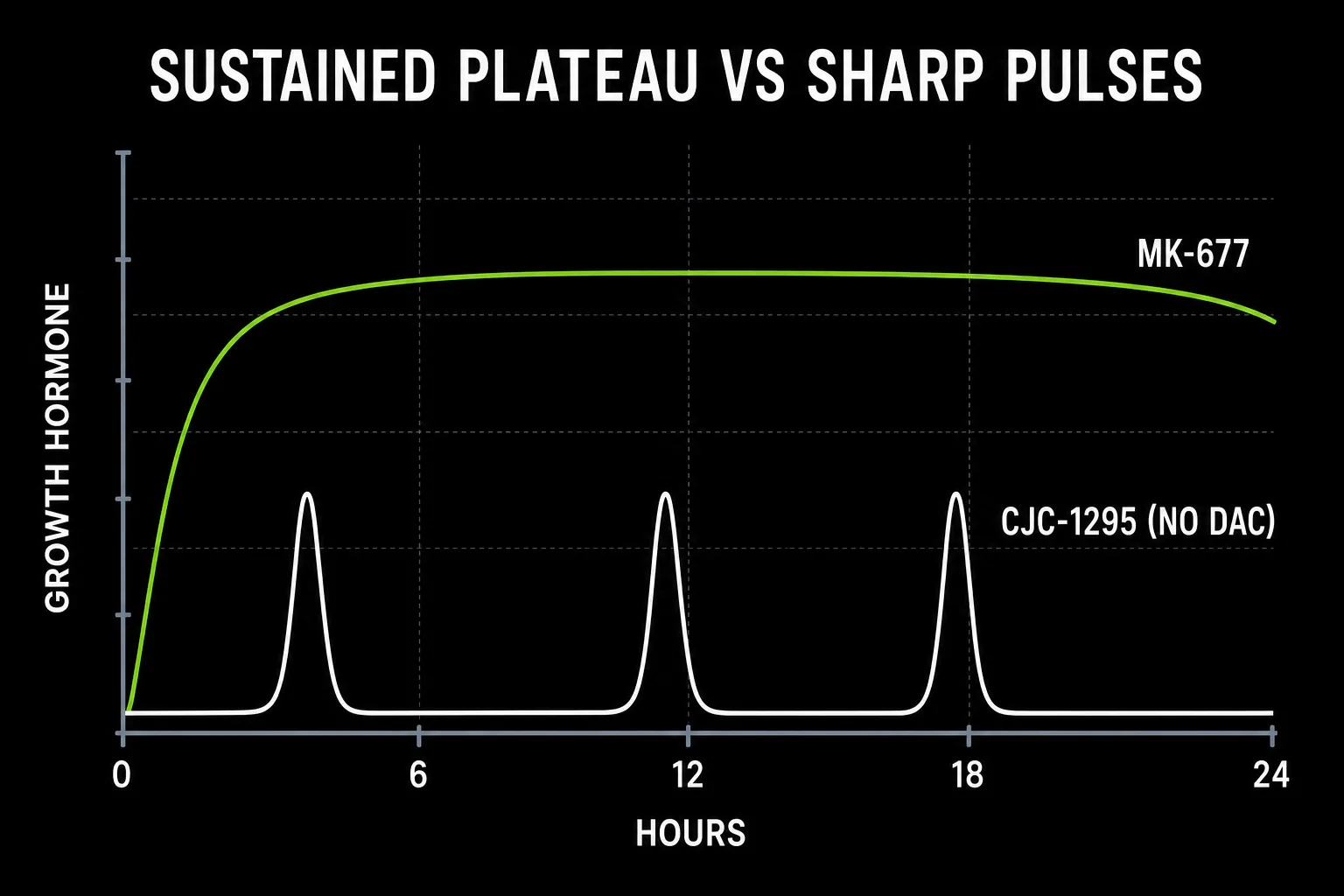
Growth hormone is not secreted at a steady level in a healthy person. It comes in pulses, largest during deep sleep, with low troughs between. There is a reasonable body of thinking that the pulse pattern itself matters — that receptors respond to the peaks, and that continuous exposure invites desensitisation and metabolic drift.
MK-677: A Plateau
MK-677, or ibutamoren, is not a peptide at all — it is an orally bioavailable small molecule that activates GHS-R1a, the ghrelin receptor. A single 25 mg oral dose in older adults produces sustained growth hormone and IGF-1 elevation across a full 24 hours. IGF-1 typically rises 40-60%.
That around-the-clock elevation is the appeal and the problem in the same breath. It is why one pill a day works. It is also why the metabolic effects show up. Our MK-677 guide and MK-677 dosage guide cover protocol detail.
CJC-1295: Pulses, or a Week-Long Plateau
CJC-1295 exists in two versions that behave so differently they should arguably have different names, and confusing them is the single most common mistake people make with this compound.
Without DAC — also sold as modified GRF (1-29) or mod GRF 1-29 — has a plasma half-life of roughly 30 minutes. Growth hormone pulses within 15 to 30 minutes of a subcutaneous injection and returns to baseline shortly after. It requires multiple daily injections, usually timed immediately before sleep to reinforce the natural nocturnal pulse. This is the version that preserves physiologic pulsatility.
With DAC carries a maleimidopropionyl linker that binds covalently to circulating albumin after injection, giving a measured human half-life of 5.8 to 8.1 days. That permits once-weekly dosing and produces sustained growth hormone and IGF-1 elevation — a plateau much like MK-677's, arrived at by a different route.
So the honest comparison is not two-way. If you pick CJC-1295 with DAC, you have chosen a continuous-elevation strategy, the same category as MK-677, just injectable and weekly. We break the two versions apart in CJC-1295 with DAC vs without DAC.
What the MK-677 Human Data Actually Shows
MK-677 is unusual among compounds in this space in having genuinely substantial human trial data. It is worth reading, because it is not uniformly good news, and the enthusiast summaries tend to quote the IGF-1 number and stop.
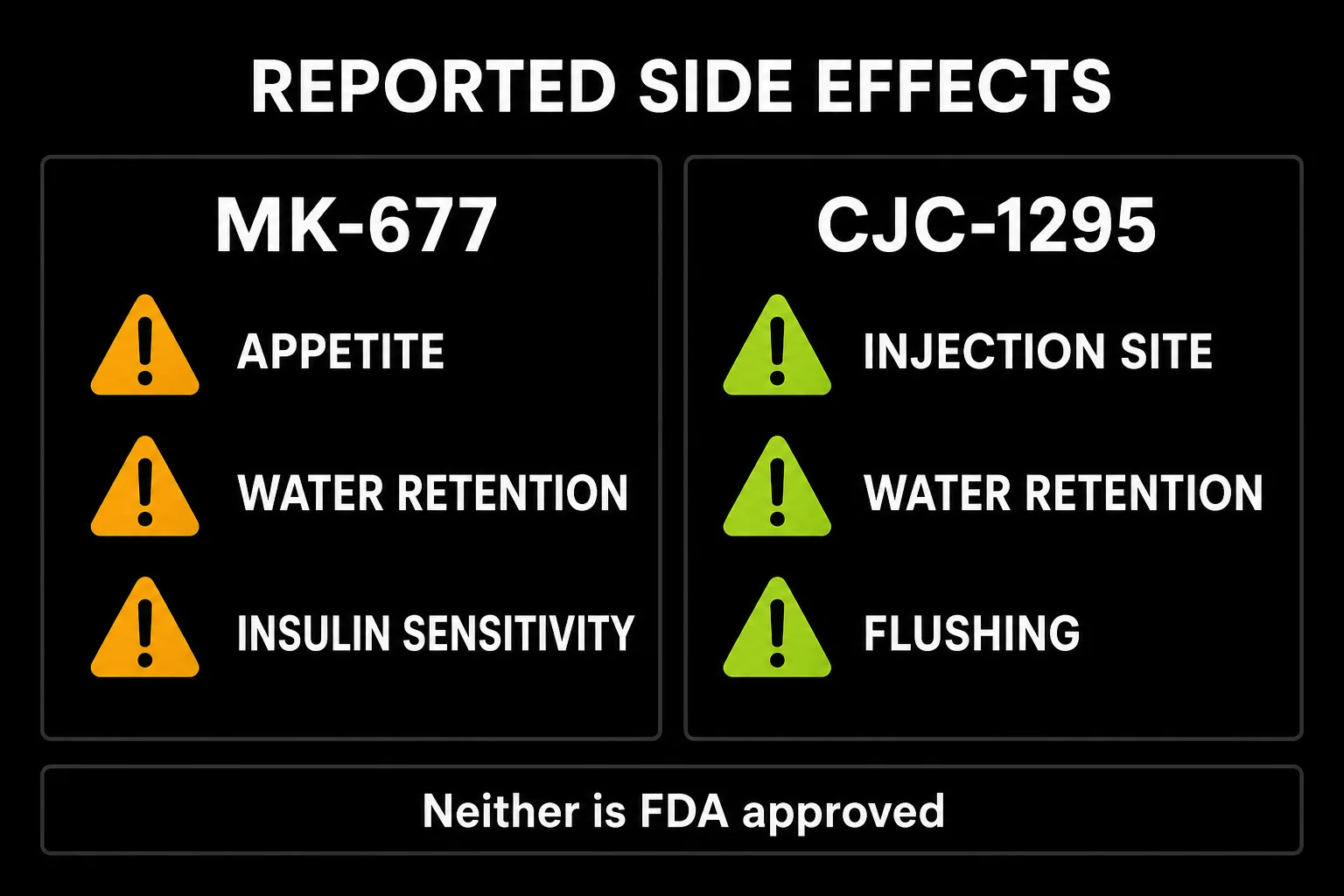
Insulin sensitivity. In the Nass two-year randomised controlled trial in healthy older adults, fasting glucose increased and insulin sensitivity decreased in the MK-677 group. Fasting glucose elevations in the range of 0.3-0.5 mmol/L have been documented. MK-677 may antagonise insulin, metformin and sulfonylureas, which matters if you take any of them.
Edema. Peripheral edema was reported in roughly half of elderly participants in that same two-year trial. This is not a rare footnote effect; it is common and it is the reason many people stop.
The cardiac signal. The Adunsky hip-fracture trial recorded a higher congestive heart failure rate in the ibutamoren arm than placebo — 6.5% versus 1.7% — and was terminated early as a result. That population was elderly and post-fracture, so the finding does not transfer directly to a healthy 30-year-old. But a trial stopped early for a safety imbalance is a meaningful data point, and it is the reason MK-677 has never completed a Phase III program or reached approval for any indication.
Our is MK-677 safe page goes deeper on the risk picture, and MK-677 benefits and results covers the upside honestly.
What the CJC-1295 Data Shows
Less. That is the short version, and it cuts both ways.
CJC-1295's pharmacokinetics are well characterised — the 5.8-8.1 day albumin-bound half-life is a measured human figure, not an estimate. What does not exist is a multi-year randomised controlled trial tracking insulin sensitivity, edema rates and cardiac events the way MK-677 has been tracked.
So CJC-1295 does not have a cardiac safety signal partly because nobody has run the trial that could find one. Its cleaner-looking profile is in part an artefact of less scrutiny. Reported effects are the standard growth hormone cluster: injection site reactions, water retention, transient flushing after injection, occasional headache. See CJC-1295 side effects for the detail.
Dosing Compared
The 2-hour fasting window on the no-DAC version is not optional trivia. Elevated blood glucose and insulin blunt the growth hormone response, so injecting after a meal wastes the dose. Full protocol detail is in the CJC-1295 dosage guide. If you need help converting vial strength to units, use our reconstitution calculator.
Legal Status
Neither compound is FDA approved for any indication.
MK-677 is sold as a research chemical and is prohibited in sport by WADA. It has never completed a Phase III program.
CJC-1295 was removed from the FDA's interim 503A Category 2 list on 27 September 2024 after the nominators withdrew the nomination — the same action that covered ipamorelin. It was not added to Category 1, so it is not eligible for pharmacy compounding. It was not among the seven peptides reviewed at the July 2026 PCAC meeting either.
Can You Stack Them?
Mechanistically yes — MK-677 hits GHS-R1a and CJC-1295 hits the GHRH receptor, and combining a ghrelin-receptor agonist with a GHRH analog produces a larger growth hormone response than either alone.
Whether you should is a different question. Stacking a compound that already elevates growth hormone continuously with one that adds more does not obviously serve most goals, and it compounds the water retention. The far more common pairing is CJC-1295 with ipamorelin, which achieves the same GHRH-plus-GHRP synergy without MK-677's glucose and appetite baggage — covered in CJC-1295 vs ipamorelin.
Which Should You Choose?
For the broader field, see best growth hormone peptides in 2026, MK-677 vs injectable GH secretagogues and CJC-1295 vs sermorelin.
Where to Buy
CJC-1295 is widely available from US research-peptide vendors with third-party testing — pricing and vendor comparison is in where to buy CJC-1295. MK-677 is sold through a different set of suppliers, since most peptide vendors do not stock it; see where to buy MK-677.
Frequently Asked Questions
This article is for research and educational purposes and is not medical advice. Neither compound is approved for human use, and MK-677 carries documented metabolic and cardiac findings that warrant physician input before use.