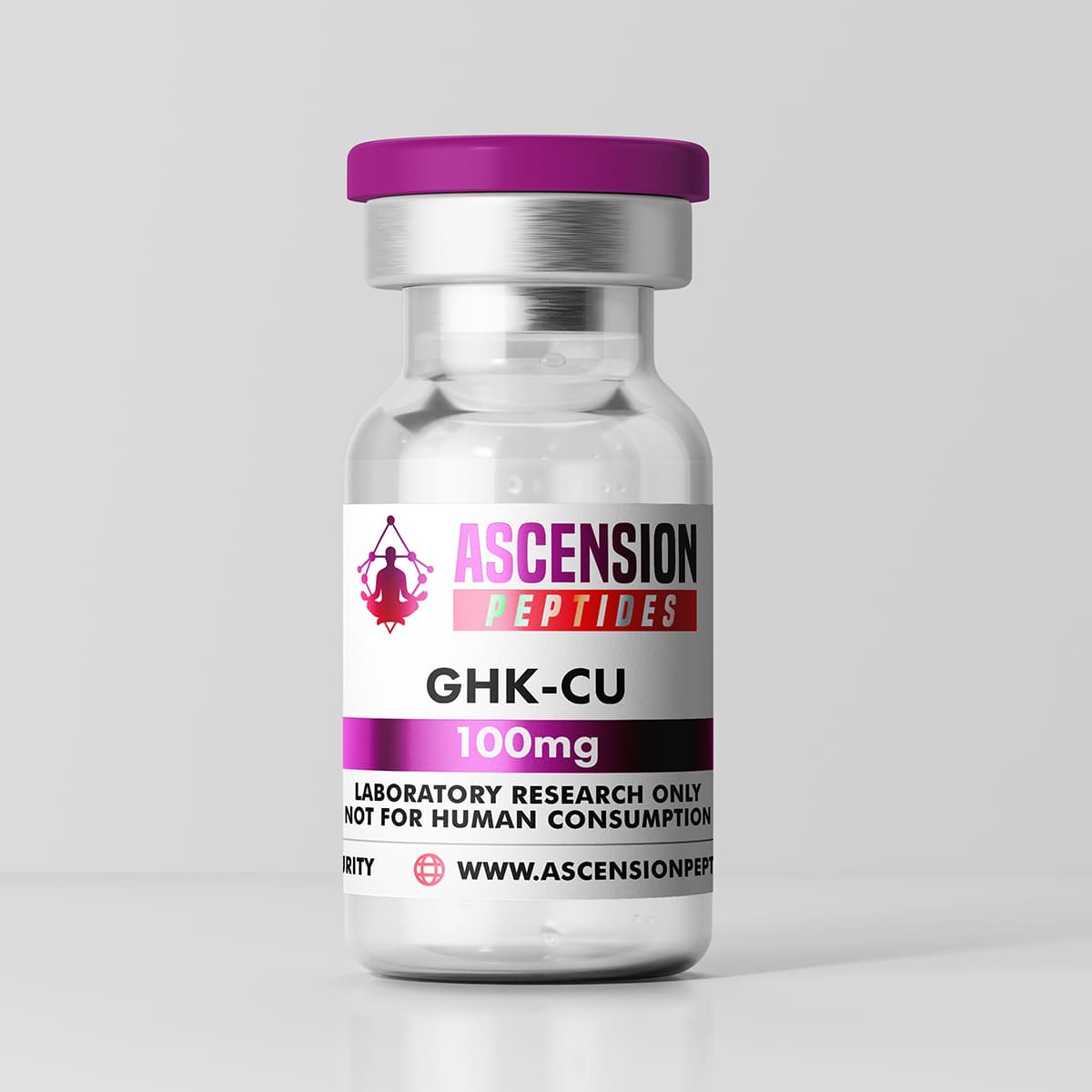
"How long does GHK-Cu last" is really two questions wearing the same words. One is pharmacokinetic: once the copper tripeptide is in your body, how long does it circulate before it is cleared? The other is practical: how long does the vial last, both as a dry lyophilized powder and after you reconstitute it, before it loses potency? The answers differ sharply. Free GHK is cleared from the bloodstream quickly, on the order of minutes to a couple of hours, while a properly stored vial of powder can stay good for many months. This guide separates the two and covers refrigeration, light, freezing, expiry, travel and a storage table you can use. This page owns half-life, shelf life and storage.
🔑 Key Takeaways
- GHK-Cu has a short pharmacokinetic life in the body. In a rat study, intravenous GHK was rapidly degraded to its metabolite His-Lys (HK), which was also eliminated rapidly, so free tripeptide does not linger or accumulate.[4]
- Your own circulating GHK falls with age, from roughly 200 ng/mL at age 20 to about 80 ng/mL by age 60, part of why exogenous GHK-Cu is of interest.[1][2]
- Dry lyophilized powder is the stable form. Stored cold, dark and sealed, it commonly keeps potency for one to two years, because freeze-dried peptides are far more stable than peptides in water.[5]
- Once reconstituted, GHK-Cu should be refrigerated at 2 to 8 degrees C and used within a few weeks. A lab study found GHK stable in water and pH 4.5 to 7.4 buffers for at least two weeks at 60 degrees C, but real vials face light, oxygen and handling.[3]
- GHK-Cu degrades fastest under basic (high pH) and oxidative conditions, less under acidic stress, all by first-order kinetics, so heat, light and air are the enemies of shelf life.[3]
- Avoid repeated freeze-thaw cycles of reconstituted solution and keep the vial out of direct light. These habits protect potency more than any expiry date.[3][5]
Two Questions Hiding in One: Half-Life vs Shelf Life
Be precise about what is being measured. Half-life is pharmacokinetic: how long it takes for the active GHK in your blood to fall by half after a dose. Shelf life is a storage property: how long the molecule in the vial stays intact and potent. A peptide can have a very short half-life in the body yet a long shelf life in a freezer, and GHK-Cu is exactly that kind of molecule. If half-life is a new concept, our explainer on how long a peptide stays in your system covers clearance and washout in detail.
GHK-Cu Half-Life: How Long It Lasts in the Body
GHK-Cu (glycyl-L-histidyl-L-lysine copper) is a small naturally occurring tripeptide complexed to a copper(II) ion, first isolated from human plasma by Loren Pickart in 1973 as the factor in albumin that made aged liver tissue behave like younger tissue.[1] Because it is tiny and water-loving, it is short-lived once in circulation.
Why the Half-Life Is So Short
Small peptides are easy targets for the body's peptidases, the enzymes that snip peptide bonds. In a rat pharmacokinetic study, GHK given as a single intravenous dose was rapidly degraded to L-histidyl-L-lysine (HK), which was eliminated rapidly as well.[4] The study is telling for another reason: to even measure GHK in plasma samples, the researchers had to add o-phenanthroline to protect it from degrading before analysis.[4] GHK starts breaking down almost as soon as it meets serum enzymes, so it behaves like a short-acting signal, cleared within minutes to a couple of hours rather than days, and it does not build up with repeated dosing.
This short systemic life is one reason GHK-Cu is discussed as a local, tissue-level actor rather than a circulating hormone. Much of its documented activity, stimulating collagen, elastin and glycosaminoglycan synthesis, encouraging blood-vessel and nerve outgrowth, and acting as an antioxidant that blocks copper-dependent oxidation, happens where it is applied or injected.[2] For the mechanism in depth, see the GHK-Cu copper peptide overview and our GHK-Cu for skin and hair guide.
The Age-Related Decline in Your Own GHK
There is a second, slower clock. The GHK your body naturally carries in plasma drops with age: in Pickart's work it sits at roughly 200 ng/mL at age 20 and declines to about 80 ng/mL by age 60.[1][2] GHK is normally locked inside collagen and other matrix proteins, and proteases liberate it at a wound to help coordinate repair.[1] That roughly 60 percent fall is part of the rationale for supplementing it, though it is a population-level observation, not a dosing instruction, and human clinical translation remains under research.[2]
Short half-life is not the same as short shelf life
That GHK clears your bloodstream quickly says nothing about how long the vial lasts. Clearance is about enzymes in living tissue; shelf life is about chemistry in a sealed container. A vial can stay potent for a year while each dose is gone from your system the same day.
GHK-Cu Shelf Life: Lyophilized vs Reconstituted
Most research GHK-Cu ships as a lyophilized (freeze-dried) powder, and that is deliberate. Peptides have limited stability in water, so manufacturers convert them to a dry solid to achieve an acceptable shelf life.[5] The two states, dry and dissolved, are the whole game.
Lyophilized (Powder) Shelf Life
In its dry, sealed, freeze-dried form, GHK-Cu is the most stable it will ever be: there is little free water for hydrolysis, and at low temperature molecular motion slows to a crawl. Stored desiccated, dark and cold (refrigerated for short periods, frozen at around -20 degrees C long-term), lyophilized peptide commonly retains potency for one to two years, often longer. Lyophilization is the standard method for giving otherwise-fragile proteins a usable shelf life, though even freeze-dried solids can degrade without a stabilizer or with poor storage.[5] If you will not use a vial soon, leave it sealed and freeze it.
Reconstituted (Mixed) Shelf Life
The moment you add bacteriostatic water and dissolve the powder, the clock speeds up. GHK-Cu is highly hydrophilic (log D around -2.4 across pH 4.5 to 7.4), so it dissolves readily, but in solution it is more exposed to the chemistry that degrades it.[3] Encouragingly, native GHK is fairly robust in clean conditions: a preformulation study found it stable in water and pH 4.5 to 7.4 buffers for at least two weeks even at 60 degrees C.[3] Real vials, though, get opened repeatedly and exposed to light, air and varying temperatures, so the conservative practice is to refrigerate reconstituted GHK-Cu at 2 to 8 degrees C and use it within a few weeks. For the mixing math, our how to reconstitute peptides walkthrough and our how to use peptides beginner guide cover bacteriostatic water, ratios and dosing.
GHK-Cu Storage and Stability Table
The table below summarizes storage targets for each state. Treat the reconstituted timelines as conservative defaults that prioritize potency and sterility, not guarantees.
What Actually Degrades GHK-Cu (and How to Avoid It)
GHK-Cu breaks down through specific chemical routes, and knowing them tells you what to avoid. In forced-degradation testing the peptide was most susceptible to hydrolytic cleavage under basic (high-pH) and oxidative stress, and to a lesser extent acidic stress, following first-order kinetics, with breakdown fragments including the amino acid histidine.[3] In plain terms: oxygen, alkaline conditions and heat shorten its life.
Light, Oxygen and Heat
Oxidation is a primary degradation pathway, so air exposure and light both matter, and heat accelerates every reaction.[3] Keep vials in their box or an opaque container, draw doses quickly, and reseal. Never leave a vial in a hot car, a sunny windowsill, or near a stove. Copper peptides can also discolor; a deepening of the blue tint or any cloudiness is a cue to stop using the vial.
Freeze-Thaw Cycles
Freezing reconstituted solution can extend its life, but each freeze-thaw cycle physically stresses the molecule, and the freezing and drying steps themselves are known to denature peptides to varying degrees.[5] If you must freeze a batch, split it into single-use aliquots so each is thawed only once. For dry powder, freezing is unambiguously good; for solution, freeze once and thaw once.
Traveling with GHK-Cu
For short trips, an insulated bag with a cold pack keeps a reconstituted vial in its 2 to 8 degree C zone, and dry powder tolerates a few days near room temperature far better than solution. Keep everything out of direct sun and away from engine or trunk heat, and never leave a vial in a parked car. For long trips, carry sealed lyophilized vials and reconstitute at your destination.
How GHK-Cu Compares to Related Peptides on Storage
These rules are the universal logic for handling research peptides. The same dry-versus-dissolved principle drives our tirzepatide storage and timing FAQ and the storage notes in our Mounjaro injection guide; GHK-Cu only differs in that its copper complex makes light and air protection more important. For stacks, the storage logic is covered in our Glow Stack guide and the BPC-157, TB-500, KPV and GHK-Cu stack guide.

Frequently Asked Questions
Bottom Line
GHK-Cu lasts a short time in you and a long time on your shelf. In the body it is a brief signal: rapidly degraded by serum enzymes to His-Lys and cleared quickly, so it neither lingers nor stockpiles.[4] Endogenous GHK also declines across adulthood, from about 200 to 80 ng/mL between ages 20 and 60.[1][2] In the vial, the story flips: lyophilized powder, kept sealed, cold and dark, holds up for one to two years because the dry solid is far more stable than solution.[5] Once reconstituted, refrigerate at 2 to 8 degrees C, shield it from light and air, avoid repeated freeze-thaw cycles, and use it within a few weeks.[3] For dosing, technique and sourcing, see our GHK-Cu dosage guide, injection guide, side effects guide, how to get GHK-Cu, and where to buy GHK-Cu.
References
- Pickart L, Vasquez-Soltero JM, Margolina A. GHK Peptide as a Natural Modulator of Multiple Cellular Pathways in Skin Regeneration. BioMed Research International 2015;2015:648108 (PMC4508379).
- Pickart L, Margolina A. Regenerative and Protective Actions of the GHK-Cu Peptide in the Light of the New Gene Data. International Journal of Molecular Sciences 2018;19(7):1987 (PMC6073405).
- Badenhorst T, Svirskis D, Wu Z. Physicochemical characterization of native glycyl-L-histidyl-L-lysine tripeptide for wound healing and anti-aging: a preformulation study for dermal delivery. Pharm Dev Technol 2016;21(2):152-160 (PMID 25384620).
- Endo T, Miyagi M, Ujiie A. Simultaneous determination of glycyl-L-histidyl-L-lysine and its metabolite, L-histidyl-L-lysine, in rat plasma by HPLC with post-column derivatization. J Chromatogr B Biomed Sci Appl 1997;692(1):37-42 (PMID 9187381).
- Wang W. Lyophilization and development of solid protein pharmaceuticals. Int J Pharm 2000;203(1-2):1-60 (PMID 10967427).