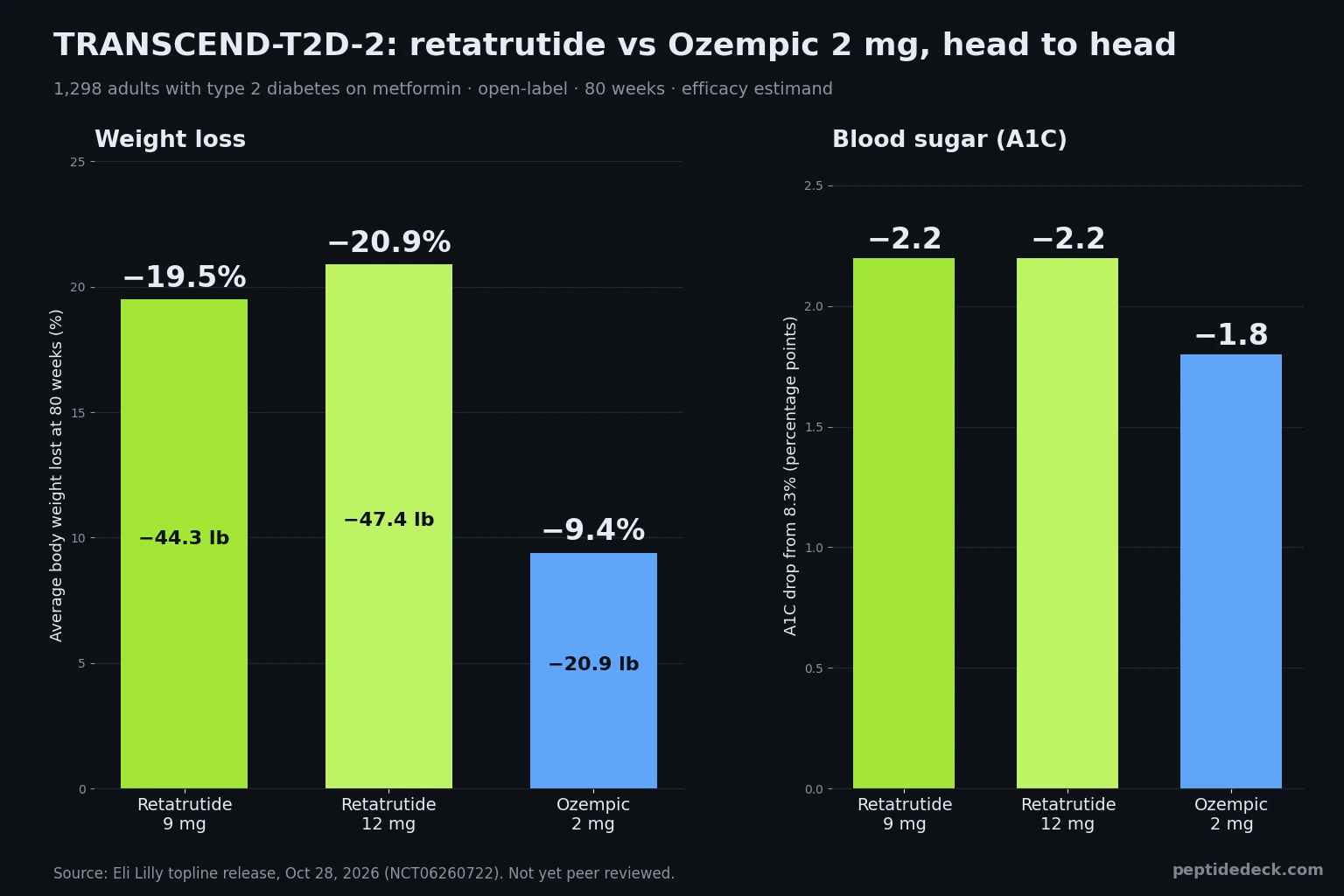
Retatrutide finally faced Ozempic directly. On October 28, 2026, Eli Lilly released the first results from TRANSCEND-T2D-2, a Phase 3 trial that put retatrutide head to head against Ozempic 2 mg, the highest approved dose, in 1,298 adults with type 2 diabetes. After 80 weeks, people on retatrutide 12 mg lost 20.9% of their body weight. People on Ozempic lost 9.4%.
🔑 Key Takeaways
- This is the first time retatrutide has been tested against an approved GLP-1 drug in the same trial
- The weight gap is wider than the blood sugar gap, and that tells you something about the drug
- One common Ozempic complaint was actually less frequent on retatrutide
- More people quit the top dose, and the lower dose may be the smarter one
- The trial has three limits that the headlines skipped
If you have type 2 diabetes, you've probably been told Ozempic is the gold standard. For years, that was fair. Most people on it see their A1C fall and lose some weight, which older diabetes pills rarely managed. Until this week, every retatrutide vs Ozempic comparison had to line up separate trials with different people. TRANSCEND-T2D-2 is the first to put both drugs in one study.
Here's what the topline data show, what they don't show yet, and what it means for you.
What TRANSCEND-T2D-2 Tested
The setup was simple and fair. Adults whose type 2 diabetes was not controlled on metformin, with or without an SGLT2 inhibitor such as Jardiance or Farxiga, were randomly assigned to one of three weekly shots:
- Retatrutide 9 mg, starting at 2 mg and stepping up every 4 weeks
- Retatrutide 12 mg, on the same step-up schedule
- Ozempic (semaglutide) 2 mg, the highest dose approved for diabetes
Randomization was 2:2:1, so for every person on Ozempic, four were on retatrutide. People started with an average A1C of 8.3%, a weight of 225.8 lb (102.4 kg) and a BMI of 36.8. The main question was whether retatrutide 12 mg lowered A1C at least as well as Ozempic by week 80 (NCT06260722).
The trial was open-label. Nobody got a dummy shot, and everyone knew which drug they were taking. We'll come back to why that matters.
Retatrutide vs Ozempic: The Head-to-Head Results
It wasn't close on weight. Both retatrutide doses more than doubled Ozempic's weight loss, and both lowered A1C further.
Lilly reported that retatrutide met the main goal and every key secondary goal. The 12 mg dose was not just as good as Ozempic on A1C, it was better (p<0.001). The weight advantage was also significant for both doses (p<0.001).
Retatrutide also improved non-HDL cholesterol, triglycerides and systolic blood pressure more than Ozempic did. Lilly didn't give the numbers for those, so we can't say by how much.
Why the weight gap is bigger than the A1C gap
Blood sugar has a floor. Weight doesn't, at least not in the same way. Starting from an A1C of 8.3%, both drugs brought most people a long way toward target, so there was less room for a big difference. Weight is where retatrutide's extra glucagon action shows. Ozempic acts on one hormone receptor (GLP-1). Retatrutide acts on three: GLP-1, GIP and glucagon. The glucagon part is thought to raise energy use and burn liver fat, which is why the weight curves pull apart.
The 9.4% on Ozempic is not a bad result, either. People with type 2 diabetes usually lose less weight on GLP-1 drugs than people without it. That's what makes a 20.9% loss in this group stand out.
How It Compares With Tirzepatide's Win Over Semaglutide
Lilly has done this before. In 2021, SURPASS-2 pitted tirzepatide (Mounjaro) against semaglutide 1 mg in 1,879 adults with type 2 diabetes. Tirzepatide won on both A1C and weight (Frías et al., NEJM 2021, PMID 34170647). Putting the two head-to-heads side by side shows where retatrutide adds something new.
On blood sugar, retatrutide's edge over semaglutide (about 0.4 points) is close to what tirzepatide managed (0.45 points). On weight, retatrutide's edge is more than twice as large. Treat this as a rough guide, not a ranking: the trials ran for different lengths, used different semaglutide doses and were run five years apart. The direct retatrutide vs tirzepatide answer will come from TRIUMPH-5, which is still running. Our retatrutide vs tirzepatide guide covers what we know so far.
Side Effects: Retatrutide vs Ozempic
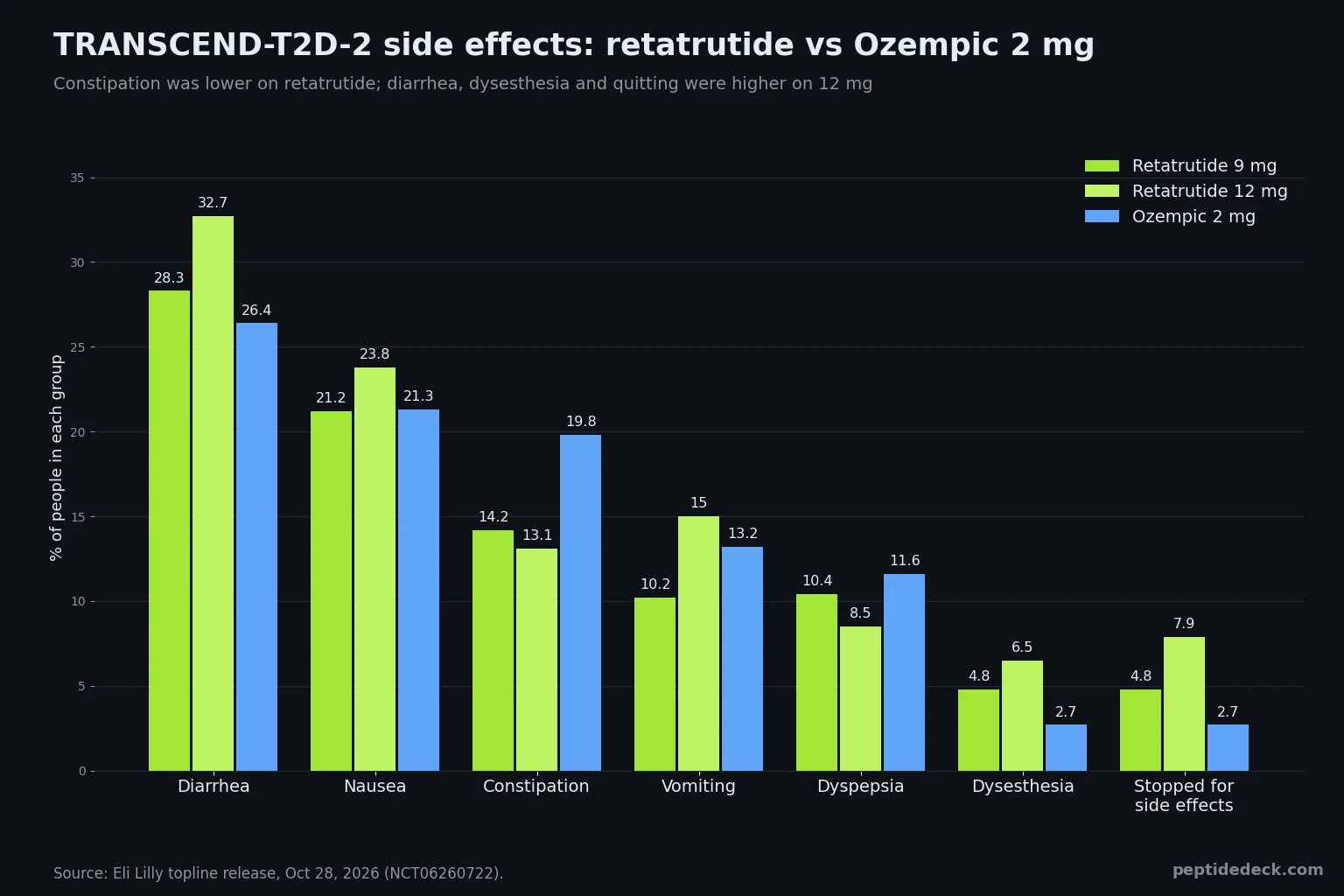
The side effects were familiar. Stomach problems led the list for all three groups, and most were mild to moderate and went away during treatment, according to Lilly.
Three things stand out:
- Constipation was less common on retatrutide. 13.1% to 14.2% versus 19.8% on Ozempic. If constipation is what's making Ozempic hard for you, that's a real difference.
- Diarrhea and vomiting were higher on 12 mg. Diarrhea hit 32.7% on 12 mg and vomiting 15.0%, versus 26.4% and 13.2% on Ozempic. The 9 mg dose was much closer to Ozempic.
- Dysesthesia showed up on both drugs. This is an odd skin sensation, like tingling, burning or sensitivity to touch, that's been linked to retatrutide since its first Phase 3 results. It affected 6.5% on 12 mg and 4.8% on 9 mg, but also 2.7% on Ozempic. That last number is new, and it suggests some of the effect may come with fast weight loss itself.
The number to watch is who quit. 7.9% stopped retatrutide 12 mg because of side effects, nearly three times the 2.7% on Ozempic. On 9 mg it was 4.8%. Since 9 mg delivered the same A1C drop and only 1.4 points less weight loss, many doctors may end up seeing 9 mg as the better trade-off for people with diabetes. Our retatrutide side effects guide compares rates across all the Phase 3 trials.
What the Headlines Left Out
The result is strong. It's also incomplete. These are the limits worth knowing before you quote the 20.9% to anyone:
None of these erase the gap. A difference this large in weight loss is unlikely to vanish once the full paper is out. But the final numbers will be a little smaller, and the side-effect picture may shift.
When Could Retatrutide Be Available?
Not before 2027. Retatrutide has no FDA approval for any use. In September, Lilly said it plans to file for FDA approval in the first quarter of 2027, and a decision usually follows about a year after filing. TRANSCEND-T2D-2 is the sixth positive Phase 3 readout in that package, after the obesity, sleep apnea, knee osteoarthritis and diabetes trials covered in our retatrutide Phase 3 results overview and the TRIUMPH-2 results. For the full calendar, see when retatrutide could be approved.
Until then, no pharmacy can fill a prescription for it. Any retatrutide sold online today comes from peptide vendors, not from Lilly, and it isn't the product used in this trial. If you're comparing retatrutide for sale across vendors, insist on a recent third-party certificate of analysis for the exact batch you'd receive.
About 650 people from TRANSCEND-T2D-2 are staying on retatrutide for another 24 weeks, so longer-term data are coming. If you want to get the drug through a trial instead, our list of retatrutide clinical trials shows what's still enrolling.
What This Means If You're on Ozempic Now
Don't stop or switch anything because of this. Ozempic is approved, its long-term safety is known, and it lowers the risk of heart attack and stroke in people with diabetes and heart disease. Retatrutide has none of those things on paper yet.
What the trial does give you is a better question for your next appointment. Three are worth asking:
- Is my weight still the main problem? If your A1C is at target but your weight isn't moving, today's step up is usually tirzepatide (Mounjaro). It has its own head-to-head win over semaglutide.
- Is constipation or nausea holding me back? The side-effect profile differs between these drugs, and dose changes can help.
- What would I need to change if I lost a lot of weight? Fast weight loss can drop blood sugar and blood pressure, so insulin, sulfonylureas and blood pressure pills may need adjusting.
For the bigger comparison beyond this one trial, see our retatrutide vs Ozempic guide and the retatrutide vs semaglutide breakdown.
Frequently Asked Questions
Sources
- Eli Lilly and Company. Lilly's retatrutide delivered greater A1C reduction and more than double the weight loss of Ozempic's highest approved dose in head-to-head trial. PR Newswire, October 28, 2026.
- ClinicalTrials.gov. NCT06260722: retatrutide compared with semaglutide in adults with type 2 diabetes on metformin with or without an SGLT2 inhibitor (TRANSCEND-T2D-2).
- Frías JP, Davies MJ, Rosenstock J, et al. Tirzepatide versus semaglutide once weekly in patients with type 2 diabetes (SURPASS-2). N Engl J Med. 2021;385:503-515. PMID 34170647.
- Eli Lilly and Company. TRIUMPH-2 full results and FDA filing plans. PR Newswire, September 29, 2026.
- AJMC. Retatrutide tops semaglutide on A1C, weight in head-to-head trial. October 28, 2026.
Medical Disclaimer: This article is for informational purposes only and does not constitute medical advice. Retatrutide is an investigational medicine without FDA approval, and the results above come from a clinical trial under medical supervision. If you take Ozempic or another diabetes medicine, talk to your doctor before changing any treatment.