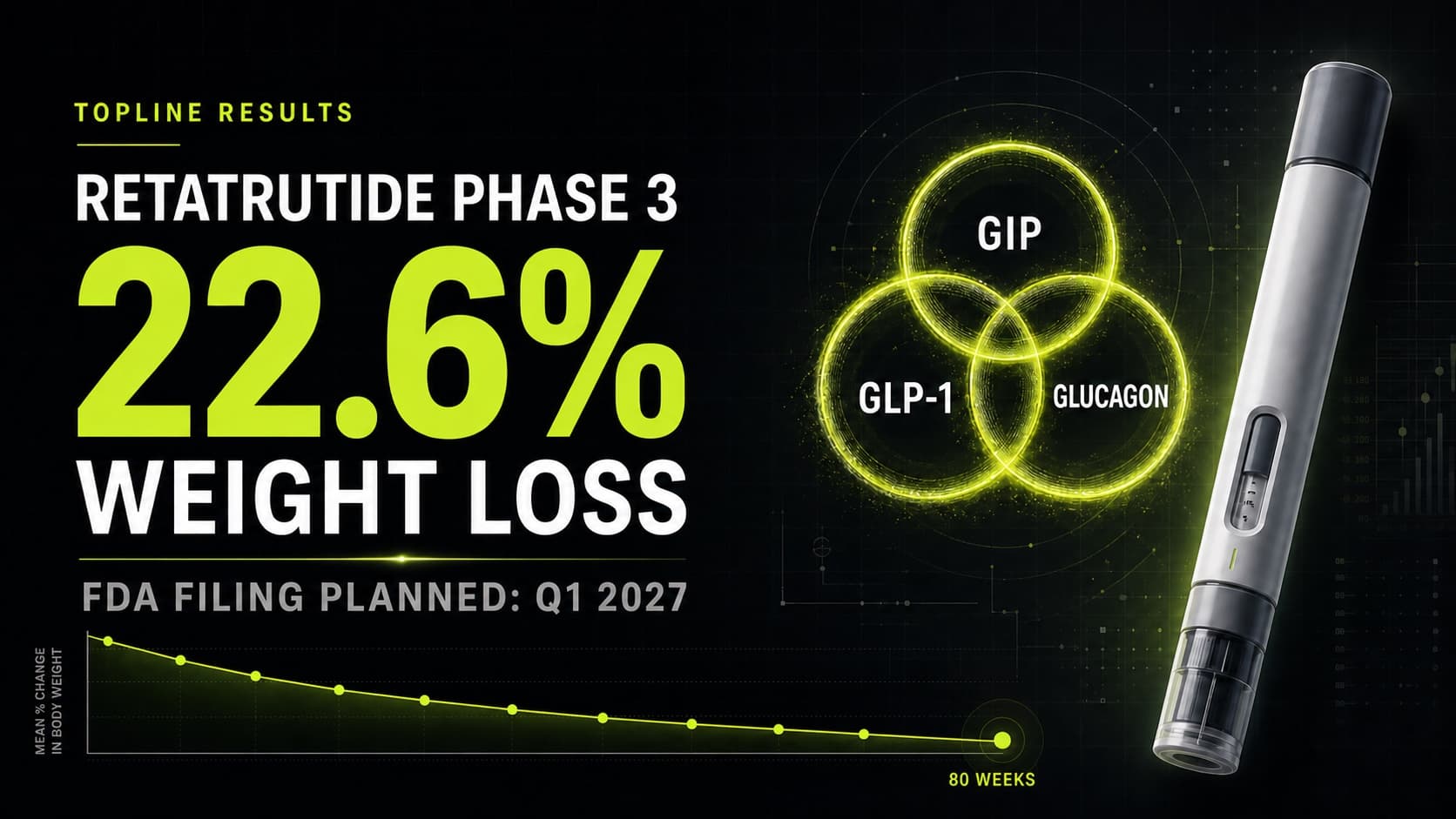
Updated October 19, 2026 (first published July 24, 2026): Eli Lilly has reported positive topline findings from two more pivotal studies of retatrutide. In TRIUMPH-2, people with obesity or overweight and type 2 diabetes lost up to 20.8% of their starting weight on average at 80 weeks. In TRIUMPH-3, people with severe obesity and established cardiovascular disease lost up to 22.6%. Lilly now says it plans to submit a Biologics License Application to the U.S. Food and Drug Administration in the first quarter of 2027.
Those are major results, but the timing and evidence need careful wording. The retatrutide phase 3 results announced on July 23 are company-reported topline data. Since then, the full TRIUMPH-2 results were published in The Lancet (alongside the full TRIUMPH-1 paper in the New England Journal of Medicine) on September 29, 2026; the TRIUMPH-3 figures below remain company-reported topline data. The planned U.S. application has not yet been filed, and retatrutide does not have FDA approval. This article separates what Lilly reported from what remains unknown.
Key takeaways
- Lilly announced the TRIUMPH-2 and TRIUMPH-3 topline findings on July 23, 2026.
- TRIUMPH-2 enrolled 1,152 adults with type 2 diabetes and obesity or overweight. Average weight loss ranged from 12.7% at 4 mg to 20.8% at 12 mg at week 80 under the efficacy estimand.
- TRIUMPH-3 enrolled 1,949 adults with severe obesity and established cardiovascular disease. Average weight loss reached 22.6% at 12 mg at week 80 under the same type of estimand.
- The cardiovascular event analysis in TRIUMPH-3 was inconclusive. Event counts were low and the confidence intervals included the possibility of benefit and harm.
- Gastrointestinal events were common. Treatment discontinuation due to adverse events reached 13.5% in the 12 mg TRIUMPH-3 group.
- Lilly plans a U.S. submission in Q1 2027 after it completes the required Chemistry, Manufacturing, and Controls data package. A planned filing is not the same as an FDA decision.
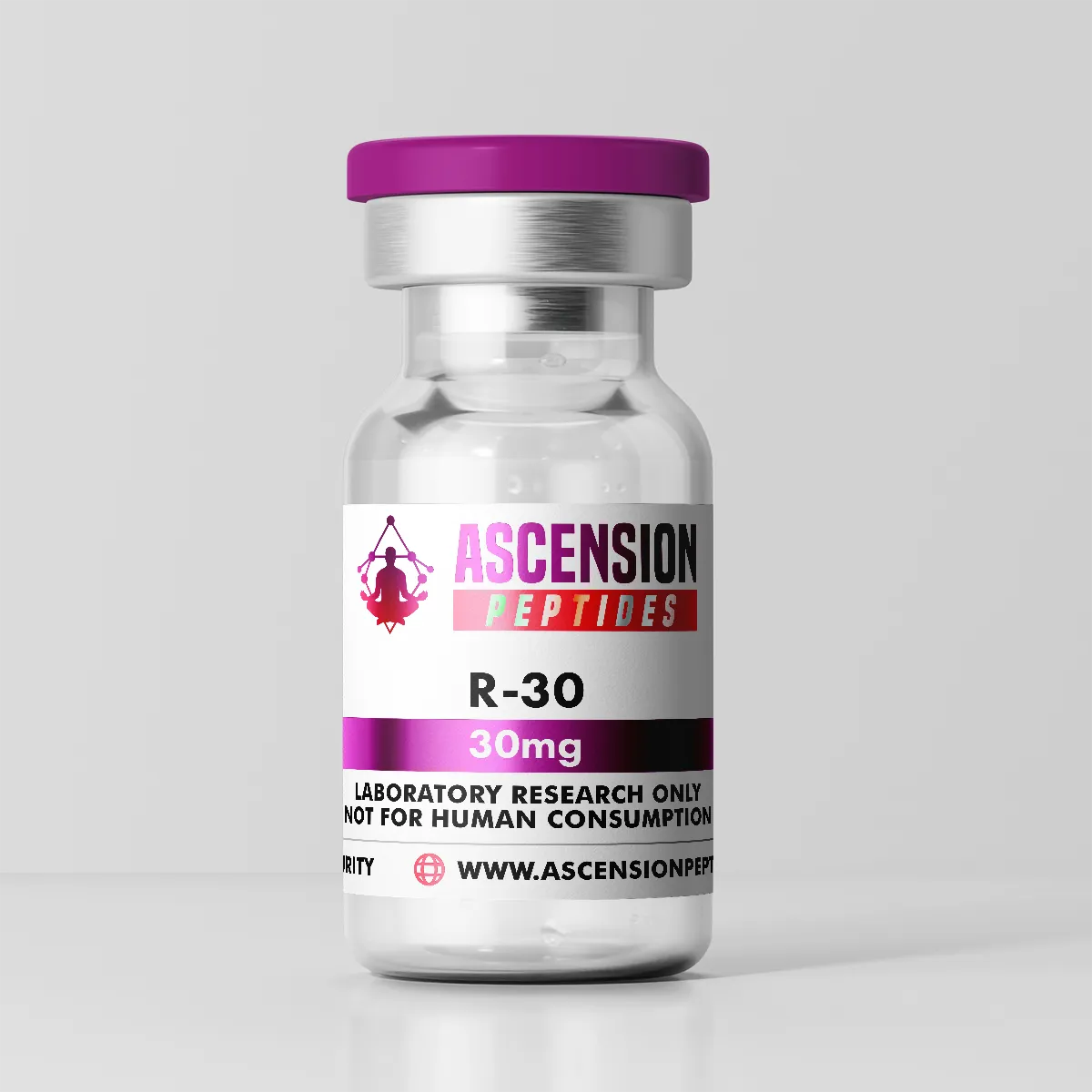
Status check: Retatrutide remains investigational as of October 19, 2026. Lilly has announced a future filing target, not an approval. Products sold online under the retatrutide name are not the medicine used in Lilly's controlled clinical trials. Those vials are often labelled GLP-3.
Retatrutide Phase 3 Results: What Lilly Announced
The July 23 release covers two pivotal obesity trials
Lilly's latest announcement adds TRIUMPH-2 and TRIUMPH-3 to a sequence of positive late-stage readouts for its once-weekly triple receptor agonist. The two studies were designed for populations that often have more difficulty losing weight and face higher medical risk than participants in a general obesity trial.
TRIUMPH-2 focused on adults with obesity or overweight plus type 2 diabetes. TRIUMPH-3 focused on adults with severe obesity and established cardiovascular disease, with or without type 2 diabetes. Both studies ran for 80 weeks and compared retatrutide with placebo. Neither was a head-to-head trial against semaglutide or tirzepatide.
These are topline findings, not the final published papers
A topline release gives the main efficacy and safety figures before a complete manuscript is available. Lilly says detailed TRIUMPH-2 and TRIUMPH-3 data will be presented at future medical meetings and submitted to peer-reviewed journals. That later reporting should provide fuller information about missing data, treatment-policy analyses, participant subgroups, severe adverse events, laboratory measures and the timing of cardiovascular events. We pulled the safety numbers from every retatrutide trial onto one page: is retatrutide safe.
The announcement is still meaningful. Pivotal trials are designed to contribute to a regulatory package, and Lilly says these results complete the clinical data package it expects to use for global submissions involving obesity, knee osteoarthritis pain and obstructive sleep apnea. Yet a news release cannot replace a regulator's independent review.
The headline numbers at a glance
The following table keeps the two trials separate because their participants and dose arms were different. All weight figures below are the efficacy-estimand results at week 80 reported by Lilly.
| Trial | Population | Participants | Retatrutide result | Placebo result |
|---|---|---|---|---|
| TRIUMPH-2 | Obesity or overweight with type 2 diabetes | 1,152 | 12.7% at 4 mg; 19.1% at 9 mg; 20.8% at 12 mg | 4.0% |
| TRIUMPH-3 | Severe obesity and established cardiovascular disease, with or without type 2 diabetes | 1,949 | 21.6% at 9 mg; 22.6% at 12 mg | 3.2% |
“Up to 22.6%” is the correct headline for these two new studies. It should not be presented as a guarantee for an individual. It is a group average under a specific statistical approach, at a specific dose and time point, within a controlled trial.
TRIUMPH-2: obesity and type 2 diabetes
Who participated and how the study worked
TRIUMPH-2 (NCT05929079) was an 80-week, randomized, double-blind, placebo-controlled study. It enrolled 1,152 adults who had type 2 diabetes and either obesity or overweight. Participants were assigned to weekly retatrutide target doses of 4 mg, 9 mg or 12 mg, or to placebo.
People assigned to retatrutide began at 2 mg and moved upward in four-week steps until reaching their target. That schedule describes the study protocol; it is not a personal dosing recommendation. The mean baseline weight was 106.4 kilograms, or 234.6 pounds, and the mean body mass index was 38.2.
Weight loss rose across the three target-dose groups
At week 80, the efficacy-estimand average changes were:
- 4 mg: 12.7% loss, equal to 29.8 pounds on average.
- 9 mg: 19.1% loss, equal to 45.4 pounds on average.
- 12 mg: 20.8% loss, equal to 49.6 pounds on average.
- Placebo: 4.0% loss, equal to 9.3 pounds on average.
The 4 mg weight result was listed as a key secondary endpoint, while the higher-dose comparisons were primary endpoint results. The difference matters when readers assess how a study was powered and how regulators may interpret its hierarchy of endpoints.
A1C fell by as much as 1.6 percentage points
Participants began with a mean A1C of 7.7%. Lilly reported average reductions of 1.4 percentage points at 4 mg, 1.6 points at 9 mg and 1.5 points at 12 mg. The placebo group declined by 0.2 points. The largest mean reduction therefore appeared in the 9 mg arm rather than the 12 mg arm.
That finding supports retatrutide's glucose-lowering activity, but the release did not provide every glycemic outcome a clinician would want to assess. The full paper should clarify the share of participants reaching common A1C targets, use of rescue therapy, hypoglycemia by background medication and outcomes in relevant subgroups.
TRIUMPH-3: severe obesity and cardiovascular disease
A higher-risk population
TRIUMPH-3 (NCT05882045) enrolled 1,949 adults with a BMI of at least 35 and established cardiovascular disease. Participants could have type 2 diabetes, but it was not required. They were randomized to 9 mg, 12 mg or placebo for 80 weeks.
The mean starting weight was 111.4 kilograms, or 245.6 pounds, and the mean BMI was 40.4. As in TRIUMPH-2, participants assigned to retatrutide began at 2 mg and increased in four-week steps. The trial's high-risk population makes its safety and cardiovascular data especially important.
Average weight loss reached 22.6%
At week 80, the efficacy-estimand average was a 21.6% reduction with 9 mg and a 22.6% reduction with 12 mg. Those percentages corresponded to 52.7 and 55.8 pounds, respectively. The placebo group lost 3.2%, or 7.7 pounds.
The 1.0-percentage-point gap between the two retatrutide target doses is smaller than the difference between active treatment and placebo. A future full publication should show confidence intervals and the complete dose-response picture rather than inviting conclusions based on the headline averages alone.
Several cardiovascular risk markers improved
At the 12 mg dose, Lilly reported average reductions of 37.0% in triglycerides, 16.5% in non-HDL cholesterol, 9.3 mmHg in systolic blood pressure, 7.5 inches in waist circumference and 51.2% in high-sensitivity C-reactive protein. These are risk factors or biomarkers; they are not the same as demonstrating fewer heart attacks, strokes or cardiovascular deaths.
Why that distinction matters: Better blood pressure, lipid and inflammation measurements can be encouraging while a trial's clinical cardiovascular-event analysis remains uncertain. Surrogate changes and hard outcomes answer different questions.
Why these percentages differ from TRIUMPH-1
Different populations can produce different averages
PeptideDeck previously covered the TRIUMPH-1 retatrutide results, where a higher average percentage was reported in a broader obesity population without diabetes. The new figures are lower than that study's highest reported average, but this is not evidence that the medicine suddenly performed worse.
People with type 2 diabetes have often shown less average weight loss in incretin-based medication trials than people without diabetes. TRIUMPH-3 also selected people with severe obesity and established cardiovascular disease. Starting characteristics, medical conditions, background treatments, discontinuation and the statistical population can all shift a trial average.
Cross-trial rankings can mislead
It is reasonable to place the studies in one table for orientation. It is not reasonable to treat that table like a direct contest. Only a randomized head-to-head study can control the comparison well enough to answer whether one medicine performs better for the same type of participant under the same conditions.
The same warning applies to the earlier TRIUMPH-4 knee osteoarthritis study. Its population, endpoints and clinical purpose differ from those in TRIUMPH-2 and TRIUMPH-3.
What “efficacy estimand” means
The headline assumes participants remained on assigned intervention
Lilly defines the efficacy estimand as the expected effect if all randomized participants remained on their assigned study intervention, allowing dose interruptions or modifications, without prohibited weight-management treatment. For glycemic endpoints, it also excludes prohibited glycemic rescue treatment.
This approach estimates the medicine's effect under continued use. It does not mean every enrolled participant physically stayed on treatment for all 80 weeks, nor does it describe exactly what happened after every discontinuation.
The treatment-policy result may be more conservative
Many readers also want a treatment-policy estimand, which generally counts outcomes after treatment discontinuation or use of other interventions according to prespecified rules. Lilly's July 23 release foregrounded the efficacy estimand for weight loss. The full papers should make the alternative analyses and missing-data methods easier to compare.
For that reason, PeptideDeck describes the 20.8% and 22.6% figures as efficacy-estimand averages, not as universal outcomes. This is one of the most important details behind the latest retatrutide phase 3 results.
Cardiovascular outcomes were inconclusive
MACE-5 numerically favored retatrutide but did not prove benefit
TRIUMPH-3 included an analysis of MACE-5: cardiovascular death, heart attack, stroke, hospitalization for unstable angina or hospitalization for heart failure. Lilly reported 44 events in the pooled 9 mg and 12 mg retatrutide groups and 52 in the placebo group. The hazard ratio was 0.82, with a 95% confidence interval from 0.55 to 1.22.
A hazard ratio below 1 numerically favors retatrutide. However, the confidence interval crossed 1 and extended from a potentially meaningful benefit to a possible increase in risk. The finding therefore did not establish a cardiovascular benefit.
MACE-3 moved in the other direction
For MACE-3—cardiovascular death, heart attack or stroke—there were 27 events in pooled retatrutide participants and 23 in placebo participants. The hazard ratio was 1.12, with a 95% confidence interval from 0.64 to 1.96.
This point estimate was above 1, but its wide confidence interval also crossed 1. It does not prove harm. Read together, MACE-5 and MACE-3 show that the event data were too imprecise to settle the cardiovascular-outcome question.
Low event counts limit what can be inferred
Lilly said fewer cardiovascular events occurred than anticipated. The company also reported unplanned on-treatment analyses with hazard ratios of 0.73 for MACE-5 and 0.92 for MACE-3. Because those analyses were not prespecified and exclude events occurring more than 35 days after treatment discontinuation, they should be viewed as supportive exploration, not the main result.
Bottom line on the heart data: TRIUMPH-3 reported favorable changes in several risk markers, but it did not establish that retatrutide prevents cardiovascular events. Larger and longer outcome data are needed.
Side effects reported in TRIUMPH-2
Gastrointestinal events were the most common
Diarrhea, nausea, constipation, reduced appetite and vomiting were among the most frequent adverse events in TRIUMPH-2. Several increased with dose, although the pattern was not perfectly linear for every outcome.
| TRIUMPH-2 event | 4 mg | 9 mg | 12 mg | Placebo |
|---|---|---|---|---|
| Diarrhea | 27.4% | 33.5% | 33.6% | 13.2% |
| Nausea | 13.7% | 20.8% | 28.0% | 8.0% |
| Constipation | 14.0% | 16.2% | 16.8% | 9.4% |
| Reduced appetite | 5.8% | 12.3% | 17.1% | 4.5% |
| Vomiting | 5.5% | 10.2% | 15.7% | 4.2% |
| Dysesthesia | 4.5% | 5.6% | 7.3% | 0.7% |
| Urinary tract infection | 3.8% | 6.3% | 8.0% | 6.6% |
Discontinuation did not rise in a simple dose order
Adverse events led to discontinuation in 3.8% of the 4 mg group, 11.6% of the 9 mg group and 7.7% of the 12 mg group, compared with 4.9% for placebo. The higher percentage at 9 mg than at 12 mg is a reminder that trial percentages can be influenced by group size, chance, event mix and participant characteristics. It should not be used to claim that 12 mg is easier to tolerate.
Side effects reported in TRIUMPH-3
The higher-risk trial also showed frequent digestive effects
| TRIUMPH-3 event | 9 mg | 12 mg | Placebo |
|---|---|---|---|
| Diarrhea | 30.1% | 24.4% | 8.7% |
| Nausea | 21.7% | 22.4% | 5.8% |
| Constipation | 18.0% | 15.7% | 7.1% |
| Reduced appetite | 13.5% | 14.5% | 3.0% |
| Hyperglycemia | 3.9% | 3.1% | 13.4% |
| Dysesthesia | 6.4% | 6.4% | 1.3% |
| Urinary tract infection | 6.1% | 7.0% | 5.3% |
Up to 13.5% stopped treatment because of adverse events
Adverse-event discontinuation occurred in 9.8% of the 9 mg group and 13.5% of the 12 mg group, versus 4.8% with placebo. Lilly said dysesthesia and urinary tract infection events were generally mild to moderate and that most resolved during treatment. The release did not provide a full serious-adverse-event table, so the later presentation and publication will be important.
For background on known signals from earlier trials, see PeptideDeck's retatrutide side effects guide. The new findings add useful frequencies, but they do not yet supply the detail of a full regulatory label.
The U.S. filing is now planned for Q1 2027
Lilly says the clinical package is ready
The biggest timing update is Lilly's plan to submit a Biologics License Application in the first quarter of 2027. The company says the positive TRIUMPH-2 and TRIUMPH-3 findings give it the clinical data package needed to support global submissions for potential uses in obesity, knee osteoarthritis pain and obstructive sleep apnea.
This updates earlier expectations that a filing might occur by the end of 2026. Our separate retatrutide FDA timeline explains the sequence from trial completion to filing, FDA acceptance, review and a possible decision.
Manufacturing and quality data come next
Lilly said it is completing the Chemistry, Manufacturing, and Controls package required for the application. CMC information covers how a product is made, tested, controlled and kept consistent. Strong clinical results do not remove the need for a regulator to examine manufacturing quality and the proposed production process.
The application type is a BLA because retatrutide is a peptide biologic. A submission can be delayed if the package is not ready, and FDA review can produce questions or requests for more information. Q1 2027 should therefore be treated as Lilly's current target, not a guaranteed filing date.
Filing, acceptance and approval are three separate events
First, Lilly must submit the application. Next, FDA determines whether it is sufficiently complete to accept for review. Only after the scientific, clinical, safety, labeling and manufacturing review can the agency decide whether the benefit-risk evidence supports approval.
No public FDA vote on retatrutide occurred on July 23 or July 24. The current news is about trial results and Lilly's filing plan. Readers should be cautious with headlines that turn “plans to submit” into “approved” or imply an immediate pharmacy launch.
What five positive Phase 3 readouts mean
The initial TRIUMPH program enrolled more than 5,800 people
Lilly says retatrutide has now produced positive findings across five Phase 3 studies. The initial four-study TRIUMPH registrational program began in 2023 and enrolled more than 5,800 participants across obesity or overweight, obstructive sleep apnea and obesity, and knee osteoarthritis pain.
The fifth positive readout includes the separate TRANSCEND-T2D-1 Phase 3 study in type 2 diabetes. Its peer-reviewed report was published in The Lancet in June 2026. Together, these studies broaden the evidence beyond a single weight-loss population.
Multiple possible indications still require regulatory review
A clinical package may support several proposed indications, but the final language depends on what a regulator accepts. Obesity treatment, obstructive sleep apnea and knee osteoarthritis pain are distinct claims with different endpoints. The label, if retatrutide eventually reaches the market, could be narrower than every condition studied.
How retatrutide works
One molecule activates three hormone receptors
Retatrutide is designed to activate receptors for glucose-dependent insulinotropic polypeptide, glucagon-like peptide-1 and glucagon. These are usually shortened to GIP, GLP-1 and glucagon. The combined action is intended to influence appetite, glucose control and energy metabolism.
It is sometimes informally called a “triple agonist.” The phrase “GLP-3” is inaccurate because there is no GLP-3 receptor in the medicine's mechanism. For a fuller explanation, read what retatrutide is and how it works.
Triple action does not automatically mean triple benefit
Activating more receptor types can produce a different biological profile, but receptor count is not a clinical score. Benefit must be demonstrated through prespecified outcomes, and safety must be assessed across doses and populations. The retatrutide phase 3 results are important because they test the mechanism in large groups rather than relying on a theoretical advantage.
How the new studies fit with earlier data
A study-by-study view
| Study | Population or purpose | Main point | Comparison warning |
|---|---|---|---|
| Phase 2 obesity | Adults with obesity or overweight | Established the initial dose-response and late-stage rationale | Smaller, earlier-stage study |
| TRIUMPH-1 | Obesity or overweight without type 2 diabetes | 28.3% at 12 mg (efficacy estimand; 25.0% counting everyone randomized); full paper in NEJM, Sep 29, 2026 | Different population from TRIUMPH-2 and 3 |
| TRIUMPH-2 | Obesity or overweight with type 2 diabetes | Up to 20.8% average weight loss and up to 1.6-point A1C reduction | Diabetes can affect weight response |
| TRIUMPH-3 | Severe obesity and established cardiovascular disease | Up to 22.6% average weight loss; event analysis inconclusive | Higher-risk cardiovascular population |
| TRIUMPH-4 | Obesity and knee osteoarthritis | Up to 28.7% weight loss at 68 weeks (efficacy estimand) and knee pain down up to 75.8% | Different clinical goal and endpoints |
| TRANSCEND-T2D-1 | Type 2 diabetes inadequately controlled with diet and exercise | Phase 3 glycemic and weight evidence | Diabetes-treatment study, not a general obesity trial |
The most reliable lesson is not that one row “wins.” It is that retatrutide has now produced substantial average weight loss across several clinically different populations, alongside a recurring burden of gastrointestinal side effects and remaining questions that longer safety follow-up must answer.
Viewed together, the retatrutide phase 3 results show consistency across distinct late-stage studies while also showing why population, endpoint and analysis method belong beside every headline percentage.
Does retatrutide beat Zepbound or Wegovy?
No head-to-head answer exists from these trials
TRIUMPH-2 and TRIUMPH-3 used placebo comparators. They did not randomize participants against tirzepatide, the ingredient in Zepbound, or semaglutide, the ingredient in Wegovy. Comparing percentages from separate press releases ignores differences in baseline weight, diabetes status, cardiovascular disease, duration, adherence and estimand.
Mechanistically, retatrutide activates GIP, GLP-1 and glucagon receptors, while tirzepatide activates GIP and GLP-1 receptors and semaglutide activates the GLP-1 receptor. PeptideDeck's retatrutide versus tirzepatide and retatrutide versus semaglutide comparisons explain the evidence without presenting an indirect comparison as a clinical verdict.
What the results mean for patients today
They do not create a new prescription option yet
The latest retatrutide phase 3 results strengthen the case for a future regulatory application. They do not make retatrutide available through ordinary prescribing today. There is no FDA-reviewed label, standardized commercial product, approved dosing schedule or pharmacy launch date.
People considering current obesity treatment should speak with a licensed clinician about medications that are actually authorized and appropriate for their history. PeptideDeck's overview of GLP-1 medications describes existing options and key differences.
Online offers are not substitutes for trial medicine
Lilly's clinical-trial product is manufactured and controlled for its studies. An online seller using the same molecule name does not establish identity, purity, sterility or equivalence. The news does not validate gray-market offers, and it does not provide a safe basis for self-dosing.
Our retatrutide access guide tracks the legal and regulatory status while distinguishing clinical trials from commercial availability.
What is still missing from the topline release?
Full participant flow and alternative estimands
A journal article should show how many participants completed treatment, why they stopped, how missing measurements were handled and how treatment-policy results compare with efficacy-estimand results. Those details help readers judge how closely the headline resembles outcomes in routine practice.
Detailed safety tables
The release lists common events and discontinuations, but a full report should provide severe and serious events, deaths, gallbladder and pancreatic events, hypoglycemia, heart rate, kidney measures and events of special interest. It should also describe timing, duration and dose relationships.
Subgroup and cardiovascular context
TRIUMPH-3's low event count leaves wide uncertainty. More detail is needed on participants with and without diabetes, baseline cardiovascular disease, background therapy and event adjudication. A dedicated cardiovascular-outcomes program may ultimately be more informative than an exploratory analysis within a weight-loss study.
What happens next?
Medical presentation and journal publication
The full TRIUMPH-2 results were presented at EASD and published in The Lancet on September 29, 2026; detailed TRIUMPH-3 findings are still to come. Those releases may refine how clinicians interpret the efficacy estimand, adverse-event profile and cardiovascular findings.
Completion of the CMC package
Manufacturing and quality documentation is the stated task between the current clinical announcement and the planned U.S. filing. Lilly's ability to make a consistent product at scale will be part of the regulatory assessment.
A planned Q1 2027 submission
If Lilly submits on schedule, FDA would then decide whether to accept the application and set a review timeline. The agency could convene an advisory committee, but no such meeting has been announced. PeptideDeck will update this article if a filing, acceptance date, meeting or decision becomes official.
The next major evidence checkpoint for the retatrutide phase 3 results will be the release of the complete TRIUMPH-3 dataset, followed by the planned regulatory submission.
Frequently asked questions
References and primary sources
- Eli Lilly and Company. Lilly's triple agonist, retatrutide, successful in two additional Phase 3 obesity trials. July 23, 2026.
- ClinicalTrials.gov. TRIUMPH-2, NCT05929079.
- ClinicalTrials.gov. TRIUMPH-3, NCT05882045.
- Jastreboff AM, et al. Triple-Hormone-Receptor Agonist Retatrutide for Obesity — A Phase 2 Trial. New England Journal of Medicine. 2023.
- Rosenstock J, et al. Retatrutide, a GIP, GLP-1 and glucagon receptor agonist, for people with type 2 diabetes. The Lancet. 2023.
- Frias JP, et al. Efficacy and safety of retatrutide in TRANSCEND-T2D-1. The Lancet. 2026.
- Effect of retatrutide on blood pressure and lipid levels: a systematic review and meta-analysis of randomized controlled trials. 2026.
- Retatrutide and lipid and metabolite profiles in participants with obesity with or without type 2 diabetes. Journal of Clinical Endocrinology & Metabolism. 2026.
- Comparative efficacy and safety of glucagon receptor agonists on metabolic outcomes. Endocrinology, Diabetes & Metabolism. 2026.
- Incretin-based dual and triple agonists in overweight or obese individuals: a systematic review and meta-analysis. 2026.
Editorial note: This page was written from Lilly's July 23, 2026 release, the registered trial records and peer-reviewed background literature available on July 24, 2026. It was updated on October 19, 2026 to note the September 29, 2026 TRIUMPH-1 (NEJM) and TRIUMPH-2 (The Lancet) papers, and will be updated again when the TRIUMPH-3 paper or regulatory documents become public.
The information in this article is for educational purposes only and does not constitute medical advice. Always consult a healthcare professional before starting any new supplement or compound. Results vary by individual.