Tradipitant might finally make GLP-1 vomiting optional. On October 27, 2026, Vanda Pharmaceuticals reported that its pill tradipitant, sold as Nereus for motion sickness, cut vomiting after a 1 mg semaglutide dose by 27% in a 306-person Phase 3 trial. Bad vomiting dropped far more: 81% fewer people threw up more than ten times. This guide explains what tradipitant for GLP-1 vomiting actually showed, why the trial looked the way it did, and what it means if Ozempic, Wegovy or tirzepatide is making you sick right now.
🔑 Key Takeaways
- The headline 27% undersells what happened to the worst cases
- The trial made people sick on purpose, and that changes how to read it
- The Phase 2 result was bigger, and the reason matters
- Nereus is already in pharmacies, but not for this, and the math is steep
- One group of GLP-1 users should check their liver before asking about it
📰 Latest tradipitant news (October 27, 2026)
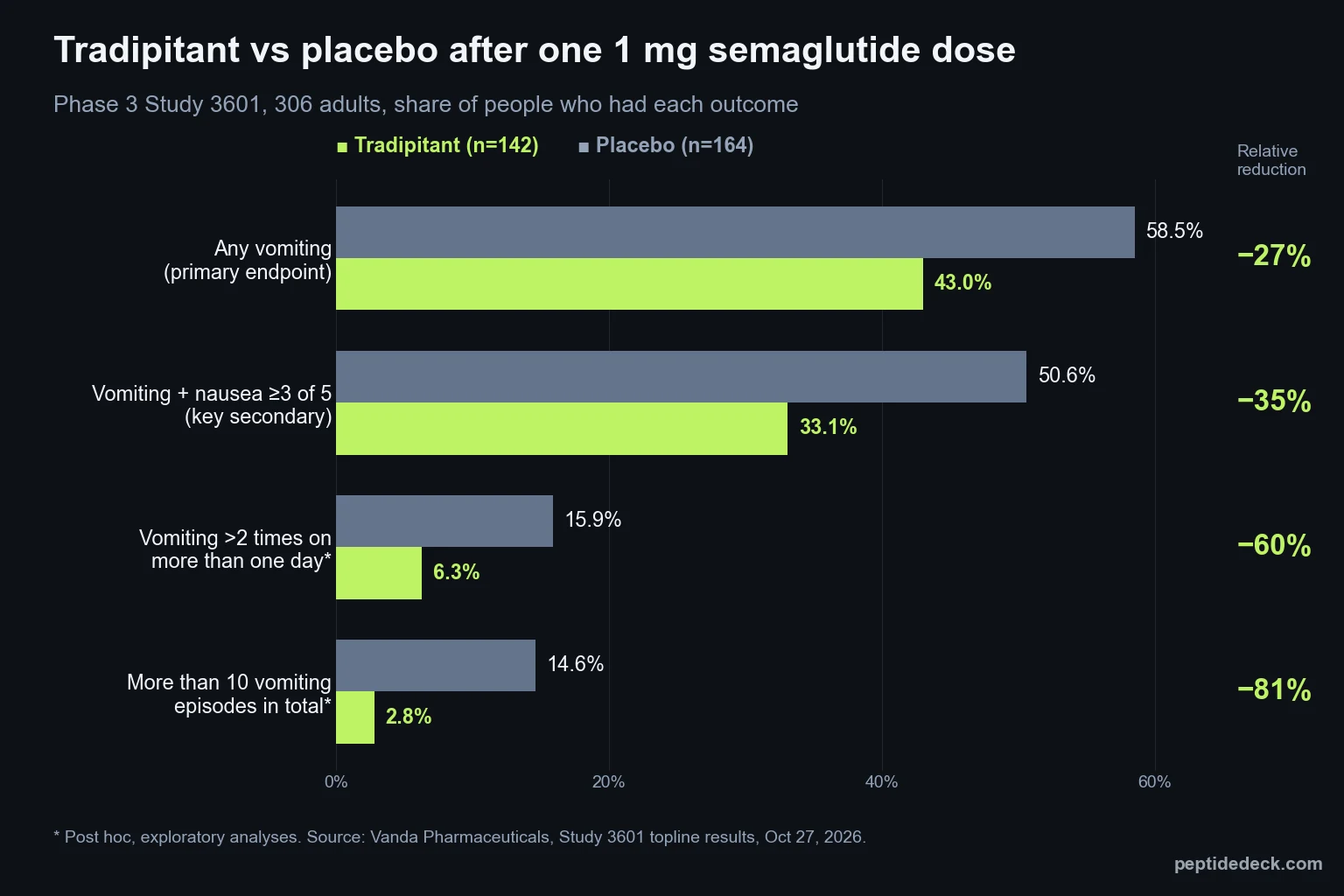
Vanda's Phase 3 Study 3601 met its main goal: 43.0% of people on tradipitant vomited after a single 1 mg semaglutide dose, against 58.5% on placebo (p=0.006). Vanda plans to meet the FDA and file to add GLP-1 vomiting to the Nereus label, with FDA feedback expected during 2027. Full results below.
If you've started a GLP-1, you probably know the pattern. Dose day comes, and for the next day or two food feels like a threat. Some people ride it out. Some quietly skip doses. Some stop the drug altogether, and the weight comes back.
That's the problem Vanda is aiming at. Tradipitant doesn't touch your GLP-1 dose or its weight loss. It blocks the brain signal that tells your stomach to empty itself.
What Is Tradipitant?
It's an anti-vomiting pill. Tradipitant is an oral NK-1 receptor antagonist from Vanda Pharmaceuticals. It blocks substance P, a chemical messenger that switches on the vomiting centre in the brainstem.
It isn't brand new. The FDA approved it on December 30, 2025 as Nereus, for preventing vomiting caused by motion in adults. It was the first new motion-sickness drug in more than 40 years. Nereus went on sale across the US on May 1, 2026.
NK-1 blockers aren't new either. Aprepitant (Emend) has been used since 2003 to stop vomiting from chemotherapy. What's new is aiming one at the side effect millions of GLP-1 users live with every week.
For GLP-1 vomiting specifically, tradipitant is still investigational. The Nereus label covers motion only.
Why GLP-1 Drugs Make You Vomit
The drug works on your brain, too. GLP-1 medicines slow how fast your stomach empties and act on appetite centres in the brainstem. The same brainstem area, the area postrema, also triggers nausea and vomiting.
That's why sickness clusters right after a dose and right after a dose increase. In the Wegovy trials, 44% of people on semaglutide 2.4 mg had nausea and 24% vomited, against 16% and 6% on placebo. Those numbers come with slow, months-long titration built in.
Few people quit the trials over it: 1.8% stopped Wegovy because of nausea and 1.2% because of vomiting. Real life is less tidy. People skip doses, stay on a lower dose than planned, or stall their dose increases, and none of that shows up as "stopped."
For a full breakdown of what's normal and how long it lasts, see our semaglutide side effects guide, or our GLP-1 side effects comparison across semaglutide, tirzepatide and retatrutide.
Tradipitant for GLP-1 Vomiting: Phase 3 Results
It worked, but read the design first. Study 3601 (VP-VLY-686-3601, NCT07446439, also called the Thetis study) took 306 adults with overweight or obesity and gave them tradipitant (142 people) or placebo (164 people). Then everyone got a single 1 mg dose of semaglutide, with no titration.
That last detail is the whole trick. Normally you'd climb to 1 mg over about two months. Jumping straight there makes most people sick, which is exactly what a trial testing an anti-vomiting pill needs.
Almost all vomiting in both groups happened by day 2, peaking on day 1. That's also where tradipitant pulled furthest ahead of placebo. Vanda reported that the drug was generally well tolerated, with no new safety signals, but it hasn't published adverse event counts yet.
The 27% vs the 81%
Here's the part the headlines skip. The 27% counts anyone who vomited even once. If you threw up one time on day 1 and felt fine after, you count the same as someone who spent two days over a toilet.
The heavier the vomiting, the bigger the gap. Repeated vomiting across several days fell by 60%. More than ten episodes fell by 81%, from roughly 1 in 7 people to 1 in 36. For someone on a GLP-1, those are the days that end with a missed dose or a quit drug.
One caution: Vanda labels both of those analyses post hoc and exploratory. They were chosen after the data came in, so they're a strong hint, not proof. Vanda says its Phase 2 trial showed the same pattern, with about an 80% cut in extreme vomiting.
Phase 2 vs Phase 3: Why the Number Shrank
Phase 2 looked better on paper. In a 116-person study announced on November 17, 2025 (VP-VLY-686-2601, NCT06804603), vomiting after a 1 mg Wegovy dose fell from 58.6% on placebo to 29.3% on tradipitant, a 50% cut (p=0.002). Phase 3 landed at 27%.
Placebo vomiting was almost identical in both trials, about 58.5%. So the challenge was just as hard both times. The difference is on the tradipitant side: 29.3% vomited in Phase 2 and 43.0% in Phase 3.
Smaller trials often overshoot, and a 116-person study has wide error bars. Phase 3 is nearly three times larger, so its 27% is the more reliable estimate. Neither trial has been published in a peer-reviewed journal yet.
Vanda's own pooled analysis of both trials found the drop in vomiting held steady across the range of semaglutide blood levels people reached. In plain terms: people with the highest semaglutide exposure still got the benefit.
Why the Trial Vomiting Rates Look So High
58% is not what you should expect. If you read "58.5% vomited on placebo" and wondered why anyone takes these drugs, the answer is titration.
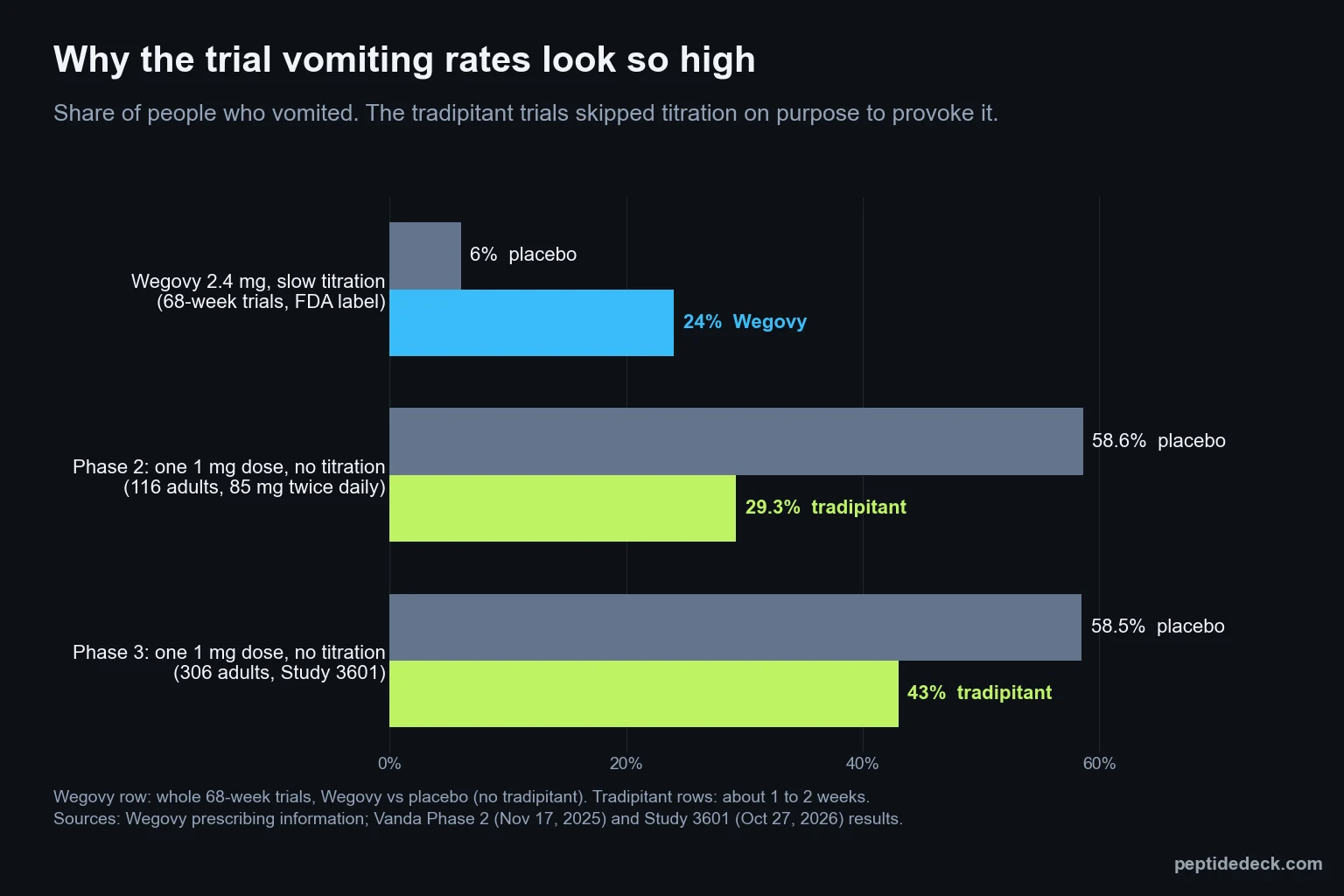
With the normal slow climb, about 1 in 4 Wegovy users vomit at some point over more than a year. Skip the climb and give 1 mg on day one, and nearly 6 in 10 vomit within two days. Vanda designed it that way to test the pill under pressure.
That's also the trial's biggest limit. Nobody starts semaglutide at 1 mg in real life. Whether tradipitant helps as much during a normal titration, or during the step up to 2.4 mg, hasn't been tested yet. Commentators have flagged the same gap.
Does Tradipitant Help With Nausea?
This is the open question. Tradipitant is clearly an anti-vomiting drug. Whether it makes you feel less queasy is less certain.
In the two motion-sickness trials behind the Nereus approval, vomiting fell from 44% to 18–20% and from 38% to 10–18%. But the worst-nausea scores were almost the same on Nereus and placebo (2.4 vs 2.4 in one trial, 2.2–2.5 vs 2.4 in the other), and the FDA label states the differences weren't statistically significant.
The GLP-1 trials' key secondary endpoint combines vomiting with significant nausea, so it can't separate the two. The Phase 3 registry entry also lists the worst nausea score on its own as a secondary outcome. Vanda's October release didn't report it.
If your GLP-1 problem is a constant low-grade queasiness rather than actual vomiting, keep your expectations modest until that number is out.
Can You Get Tradipitant for GLP-1 Vomiting Now?
Nereus is in pharmacies now, but its approval covers motion sickness only. A doctor can legally prescribe an approved drug off-label, but there's no approved GLP-1 dose and the label limits Nereus to one dose in any 24 hours. The GLP-1 trials used it twice a day.
The cost adds up fast. Vanda sells Nereus at $85 per dose cash through nereus.us with a prescription, against a $255 list price. Here's what the Phase 2 schedule would cost at those prices:
For comparison, a month of semaglutide itself can cost less than two weeks of tradipitant at the cash price. If you're still sorting out where to buy semaglutide online, our guide compares brand, cash-pay and compounded options with current prices. Whether insurers would cover Nereus for GLP-1 vomiting depends on an approval that doesn't exist yet.
Tradipitant Side Effects and Who Should Avoid It
Sleepiness is the main one. In the Nereus motion-sickness trials, the side effects seen in at least 5% of people, and more often than on placebo, were:
- Somnolence: 6% on 85 mg and 12% on 170 mg, vs 4–6% on placebo
- Headache: 7% on 85 mg and 10% on 170 mg, vs 5–6% on placebo
- Fatigue: 6% on 85 mg and 8% on 170 mg, vs 2–3% on placebo
Those numbers come from single doses. The GLP-1 trials gave it twice a day for about two weeks, and Vanda hasn't published those adverse event rates yet.
The label also flags a few groups:
- Any liver impairment: the label says to avoid Nereus in mild, moderate or severe liver impairment, because it hasn't been studied there. Fatty liver disease is common in people starting GLP-1 drugs, so this is worth raising with your doctor first.
- Severe kidney impairment: avoid.
- Strong CYP3A4 inhibitors (such as some antifungals and HIV drugs) can raise tradipitant levels and side effects.
- Alcohol and sedatives can add to the drowsiness. Don't drive until you know how it affects you.
- Food: take it on an empty stomach. A high-fat meal raised peak blood levels about 4.7-fold at 85 mg.
Tradipitant has a long half-life, about 34 hours, so one dose stays in your system for days.
When Could Tradipitant Be Approved for GLP-1 Vomiting?
Not before 2027. Vanda says it will discuss the results with the FDA and file a supplemental application (sNDA) to add GLP-1 vomiting to the Nereus label. Its own forward-looking statements put the FDA meeting and feedback during 2027.
A standard FDA review of a supplement like this takes about 10 months after filing. A realistic best case is a decision in late 2027 or 2028. The FDA could also ask for another trial, for example one that uses normal titration.
Vanda's history with the FDA is bumpy. The agency turned down tradipitant for gastroparesis in September 2024, and Vanda has fought that decision. The motion-sickness approval in December 2025 shows the drug can clear the bar when the trials are clean.
What You Can Do About GLP-1 Vomiting Now
You don't have to wait for Vanda. Most GLP-1 vomiting is driven by dose and food, and both are adjustable. Things to raise with your prescriber:
- Slow the climb. Staying on a dose for an extra month before stepping up is one of the most common fixes. Some people use smaller split doses; see our semaglutide microdosing guide for how that works.
- Eat smaller and stop earlier. Your stomach empties more slowly on a GLP-1. A normal-sized meal can sit there for hours.
- Go easy on fat and alcohol in the two days after your shot, when symptoms peak.
- Ask about an anti-nausea prescription for dose days. Doctors already prescribe existing anti-sickness drugs for this.
- Know the red flags. Vomiting that won't stop, severe stomach pain, or signs of dehydration need medical care the same day. These can point to pancreatitis, gallbladder problems or kidney injury.
The goal is the same one Vanda is chasing: getting you through the first weeks so the drug can do its job. If your side effects are bad enough that you're thinking of quitting, that's a conversation for your prescriber, not a reason to stop on your own. Our GLP-1 medications guide covers how the different drugs compare if switching is on the table.
The Bottom Line
Tradipitant works, with limits. In 306 adults pushed to vomit by an untitrated 1 mg semaglutide dose, it cut vomiting by 27% and the worst vomiting by up to 81%. That's a real effect on the episodes that make people quit.
The limits are just as real. Nobody has tested it during normal titration. Its effect on nausea alone is unproven. Two weeks of it costs more than most people pay for the GLP-1 itself. And the earliest it could carry a GLP-1 label is late 2027.
If you're on a GLP-1 and vomiting regularly, the fixes that work today are slower titration, smaller meals and a talk with your prescriber. Tradipitant is one to watch.
Frequently Asked Questions
Sources
- Vanda Pharmaceuticals. Vanda Pharmaceuticals Announces Positive Results from Study 3601 of NEREUS (tradipitant) for Prevention of GLP-1-Induced Vomiting. October 27, 2026.
- ClinicalTrials.gov. NCT07446439: The Thetis Study, tradipitant on nausea and vomiting after GLP-1R agonist administration (VP-VLY-686-3601).
- ClinicalTrials.gov. NCT06804603: Proof-of-concept study of tradipitant on nausea and vomiting after GLP-1R agonist administration (VP-VLY-686-2601).
- Vanda Pharmaceuticals. Vanda Pharmaceuticals Reports Positive Results for Tradipitant in Preventing GLP-1 Induced Nausea and Vomiting. November 17, 2025.
- U.S. Food and Drug Administration. NEREUS (tradipitant) capsules prescribing information. December 2025.
- Vanda Pharmaceuticals. Vanda Pharmaceuticals Announces U.S. Commercial Availability of NEREUS (tradipitant). May 1, 2026.
- U.S. Food and Drug Administration. WEGOVY (semaglutide) injection prescribing information, adverse reactions table.
Medical Disclaimer: This article is for informational purposes only and does not constitute medical advice. Tradipitant (Nereus) is approved only for preventing vomiting caused by motion; its use for GLP-1-related vomiting is investigational, and the results described come from company-reported trials that have not yet been peer reviewed. Talk to your doctor before changing your GLP-1 dose or adding any medication.