Retinol wins on evidence, and peptides win on comfort. That's the honest summary of peptides vs retinol, but they work in different ways, suit different skin, and you don't have to pick just one. Below are the human trial numbers for retinol, prescription tretinoin and the main skincare peptides side by side, plus who should start with which and how to use both.
🔑 Key Takeaways
- "Retinol" and "tretinoin" are not the same thing, and the gap between them is bigger than the gap between retinol and peptides
- The one trial that pitted a peptide routine against tretinoin had a catch worth knowing before you quote it
- "Peptides" covers three very different ingredients, and only one of them is meant to build collagen
- Copper peptides have two pairing rules that plain peptides don't
- Neither one was tested on loose skin after weight loss, and the tretinoin label says so plainly
Every trial number links to its source, and prices were checked on November 5, 2026.
Peptides vs Retinol: The Short Answer
Pick based on your skin, not the hype. If your skin tolerates it and you're not pregnant, a retinoid has far more proof for fine lines and sun damage. If you're sensitive, reactive or pregnant, peptides are gentler, with smaller and less certain results.
Here's how they compare.
The middle column is the one most comparisons skip. Tretinoin is prescription retinoic acid, the form your skin actually uses; retinol has to be converted first, which is why it's gentler and slower.
How Retinol and Tretinoin Work
Both end up as the same molecule. Your skin converts retinol to retinaldehyde and then to retinoic acid, which is tretinoin. Retinoic acid binds retinoic acid receptors (RARs) in the cell nucleus, a family of receptors that switch genes on and off, according to a review of retinoids in skin aging.
That shows up in three ways:
- More collagen. In the original tretinoin work, treated skin showed new collagen in the upper dermis, new blood vessels and a thicker outer layer that replaced thin, sun-damaged skin (Kligman, 1986).
- Less collagen breakdown. Retinol blocks the UV-triggered enzymes (MMPs) that break collagen down, but it is about 20 times less potent than tretinoin and only works after conversion.
- Faster cell turnover. Retinoids clear clogged pores and even out pigment.
Retinol does the same things, just less. In a 4-week comparison, both thickened the epidermis and raised collagen I and III, with retinol's changes smaller (Kong, 2016). That study was run by a skincare company, Amway, with University of Michigan dermatologists.
How Topical Peptides Work: Three Different Jobs
"Peptides" on a label can mean three things. None of them touch the retinoid receptors, so they aren't weaker retinol. They are a different tool.
- Signal peptides. Palmitoyl pentapeptide-4 (Matrixyl, also written pal-KTTKS) was designed to tell skin cells to make more collagen. Our Matrixyl guide covers the four Matrixyl versions and its own retinol comparison.
- Carrier peptides. GHK-Cu is a three-amino-acid peptide bound to copper. It carries copper into skin and is linked to wound repair and collagen remodelling. Our GHK-Cu cream guide explains how to read its label strength.
- Neurotransmitter-inhibiting peptides. Argireline (acetyl hexapeptide-8, also called acetyl hexapeptide-3) interferes with the SNARE protein complex that nerves use to make muscles contract. The idea is a much weaker, topical version of what Botox does (Blanes-Mira, 2002). Read more in our Argireline guide.
Getting into the skin is the weak point. GHK-Cu is highly water-loving (log D about −2.4), which makes crossing the oily outer skin layer hard (Badenhorst, 2016). Other label names are in our cosmetic peptides list.
What the Human Trials Show
The evidence gap is large and real. Tretinoin has double-blind trials going back to the 1980s and passed FDA review for fine wrinkles. Peptides mostly have one or two small trials each, usually from the ingredient maker.
Three things are easy to miss.
- Higher strength isn't better. Over 48 weeks, tretinoin 0.025% worked as well as 0.1%, with less irritation (Griffiths, 1995).
- The plain cream does a lot. In the Renova trials, 39% improved on a plain moisturizer plus sunscreen. Any product you try is riding on that baseline, so keep the sunscreen (Renova label). In a separate study of 107 people with darker skin, fewer improved on Renova (29%) than on the plain cream (43%), which the label puts down to the small study size.
- The peptide trials are thinner than they look. The palmitoyl pentapeptide-4 trial was run by Procter & Gamble at 3 ppm in a moisturizer (Robinson, 2005). The GHK-Cu facial trial is known only from a 2002 conference abstract, summarized in a review by the scientist who discovered GHK (Pickart, 2018). The Argireline trial lasted 4 weeks (Wang, 2013).
Retinol sits in between: two vehicle-controlled trials (Kafi, 2007; Randhawa, 2015), one of them a full year long.
The main limitation: nearly every peptide trial measured a branded formula against its own base, over 4 to 12 weeks, with the sponsor's staff involved. None of them has been repeated by an independent group at the same strength, so treat the exact percentages as best-case numbers.
Has Anyone Tested Peptides Against Tretinoin Head to Head?
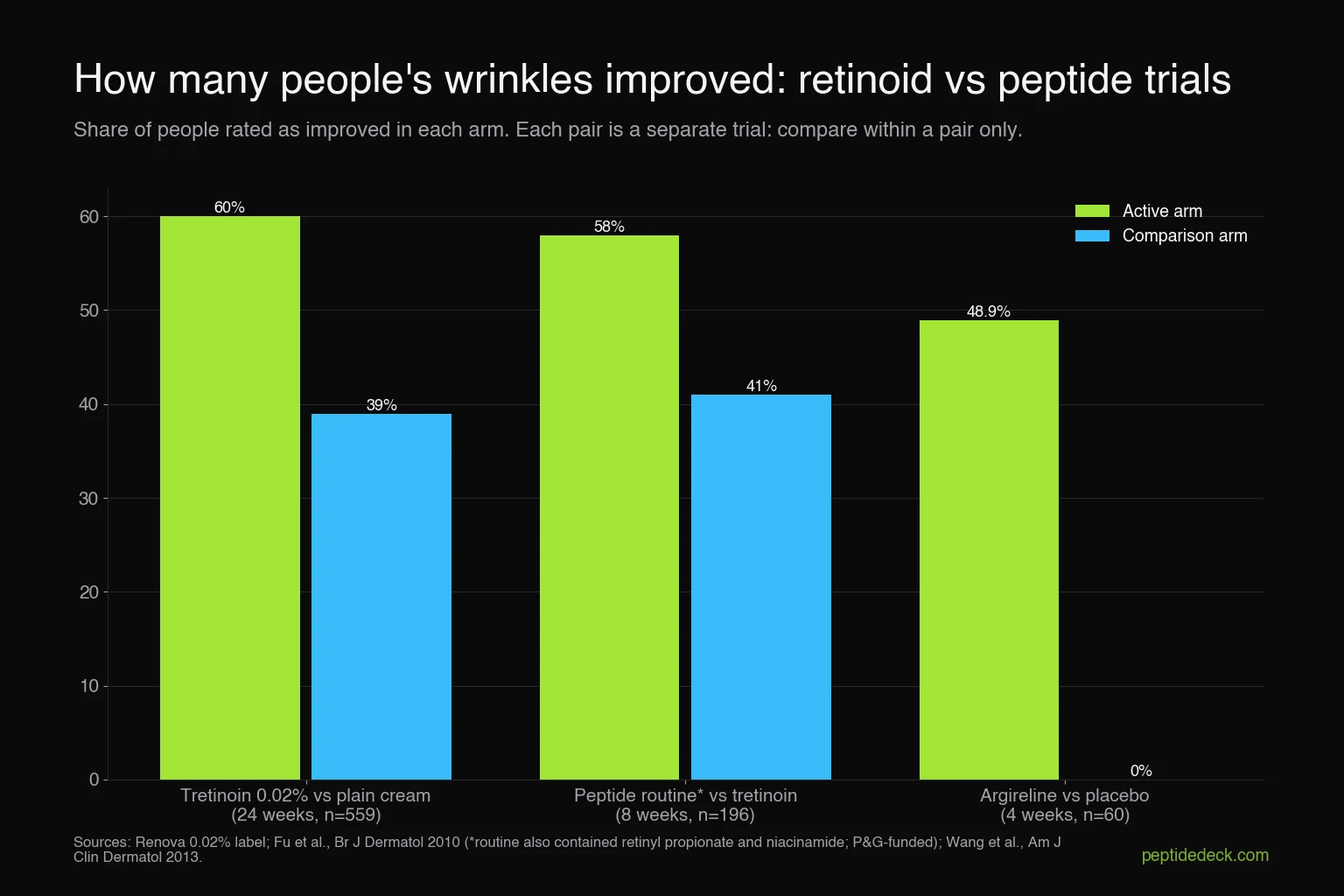
Yes, once, and the result needs care. In an 8-week randomized trial, 196 women with eye-area wrinkles used either a three-product cosmetic routine or prescription tretinoin 0.02% with sunscreen (Fu, 2010).
- 58% on the cosmetic routine were judged to look better, vs 41% on tretinoin.
- 28% vs 13% had a substantial improvement.
- Wrinkle area fell 17% vs 11%, a difference that just missed statistical significance (P = 0.06).
- In the 25-person groups that carried on to 24 weeks, results were comparable, and the cosmetic routine was better tolerated by every measure through week 8.
Now the catch. The cosmetic routine combined two palmitoyl peptides (including palmitoyl pentapeptide-4) with 5% niacinamide and 0.3% retinyl propionate, which is itself a retinoid. Procter & Gamble, which made the products, funded it, and participants knew what they were using. The fair reading is "a peptide-plus-retinoid routine matched low-dose tretinoin over 8 weeks with less irritation," not "peptides beat tretinoin."
For copper peptides there's one pilot study. On thigh skin, GHK-Cu cream improved collagen production in 70% of women at 12 weeks, vs 50% with vitamin C cream and 40% with tretinoin, per the 2018 GHK-Cu review. It measured collagen, not wrinkles, and not on the face.
Peptides or Retinol for Wrinkles: Who Should Pick Which
Your skin type decides this more than the evidence. Here's a practical split.
Start with a retinoid if fine lines, rough texture, sun spots or acne are your main concern, your skin handles actives, and you aren't pregnant or trying to be. Begin with retinol, or ask a doctor about tretinoin.
Start with peptides if any of these apply:
- Sensitive skin, eczema or rosacea. The Renova label says not to use it on sunburned skin or if you have eczema or another chronic skin condition of the face.
- Pregnancy or trying to conceive. The Renova label says it should not be used during pregnancy. A meta-analysis of 654 pregnancies exposed to topical retinoids found no major rise in birth defects or miscarriage, but its authors said the data are not strong enough to justify using them in pregnancy (Kaplan, 2015). Peptides have no pregnancy safety data either way, so check with your doctor.
- You take photosensitizing medicines. The label lists thiazides, tetracyclines, fluoroquinolones, phenothiazines and sulfonamides as reasons not to use tretinoin.
- You've tried retinoids and quit. A product you'll use daily beats one you abandon.
Peptides vs tretinoin specifically
Tretinoin is an FDA-approved drug for fine facial wrinkles; peptides are cosmetics. Even so, the tretinoin 0.02% label says it does not eliminate wrinkles or reverse photoaging, and can take up to 6 months to work. It's still the benchmark, and peptides make sense alongside it, or instead of it when irritation is the problem.
What to ask your doctor: Which strength of tretinoin would you start me on, and how often? Is my redness rosacea, and does that rule out retinoids? I'm pregnant or planning to be: what can I use instead? Do any of my medicines make my skin more sun-sensitive?
Can You Use Peptides and Retinol Together?
Yes, and that's often the best answer. The head-to-head trial above used peptides and a retinoid ester in one routine, and it was better tolerated than tretinoin. They work on different pathways, and no study has shown either cancels the other.
A simple way to run both:
- Retinoid at night. The tretinoin label says to apply it once a day in the evening, 20 to 30 minutes after washing, using a pearl-sized amount (about 5 mm) for the whole face.
- Ease in. The 0.4% retinol trial applied it up to 3 times a week. Two or three nights a week is a sensible start before building up.
- Peptide after, or in the morning. Use a peptide moisturizer after your retinoid, or a peptide serum under morning sunscreen.
- Sunscreen every morning. Retinoids raise sun sensitivity, and the label says to avoid sunlight.
Copper peptides are the exception
GHK-Cu needs more spacing than signal peptides do.
- Vitamin C. In a lab chemistry test, copper bound to GHK reacted with ascorbate (vitamin C) and generated hydroxyl radicals, more than the other copper-peptide complexes tested (Guilloreau, 2007). Keep vitamin C in the morning and copper peptides at night.
- Acids. GHK-Cu stayed stable between pH 4.5 and 7.4, but broke down under oxidative stress and, to a lesser extent, acidic stress (Badenhorst, 2016). Put glycolic or salicylic acid on a different night.
- Retinol. No trial has tested GHK-Cu and retinol in the same step. Alternate nights, so if irritation starts you know which product caused it.
For a ready-made option, our copper peptide serum guide covers strengths and how to apply one. If you'd rather mix your own serum from powder, price and purity vary a lot between sellers, so check our guide to where to buy GHK-Cu before you order.
Retinol vs Peptides for Sagging Skin After Weight Loss
Neither cream will lift loose skin. After major weight loss, including on GLP-1 drugs like semaglutide or tirzepatide, the change people notice in the face is mainly lost facial fat and skin laxity, according to a 2026 review. That's a volume problem, and creams work on the surface layers.
The tretinoin label is blunt: Renova has "NOT DEMONSTRATED A MITIGATING EFFECT" on skin laxity or deep wrinkling. The only peptide laxity claim is the 71-woman GHK-Cu abstract, which wasn't about weight loss.
A retinoid or peptide can improve texture and fine lines on the skin you have. Real sagging needs procedures such as fillers or energy-based devices, and the same review found no device yet proven in people who lost weight on GLP-1 drugs. Our Ozempic side effects guide covers the "Ozempic face" changes in more detail.
Side Effects and What to Expect
Irritation is the main retinoid trade-off. In the Renova trials, almost everyone had some peeling, dryness, burning or redness, and about 4% stopped altogether. Irritation usually fades as your skin adjusts (Ellis, 1990), and it's worse with higher strengths.
Peptides rarely cause trouble. Palmitoyl pentapeptide-4 was well tolerated in the 93-woman trial, and Argireline's developers reported no primary irritation even at high doses.
Give peptides 8 to 12 weeks and a retinoid 3 to 6 months before you judge, and take a photo in the same light before you start. For which peptide fits which skin goal, see our peptides for skin guide.
Frequently Asked Questions
Sources
- Weiss JS, et al. Topical tretinoin improves photoaged skin. A double-blind vehicle-controlled study. JAMA. 1988. PubMed 3336176
- Ellis CN, et al. Sustained improvement with prolonged topical tretinoin (retinoic acid) for photoaged skin. J Am Acad Dermatol. 1990. PubMed 2229490
- Griffiths CE, et al. Two concentrations of topical tretinoin (retinoic acid) cause similar improvement of photoaging but different degrees of irritation. Arch Dermatol. 1995. PubMed 7544967
- Kligman AM, et al. Topical tretinoin for photoaged skin. J Am Acad Dermatol. 1986. PubMed 3771853
- RENOVA (tretinoin cream) 0.02% prescribing information, Bausch Health, rev. 11/2025. DailyMed
- Kafi R, et al. Improvement of naturally aged skin with vitamin A (retinol). Arch Dermatol. 2007. PubMed 17515510
- Randhawa M, et al. One-year topical stabilized retinol treatment improves photodamaged skin in a double-blind, vehicle-controlled trial. J Drugs Dermatol. 2015. PubMed 25738849
- Kong R, et al. A comparative study of the effects of retinol and retinoic acid on histological, molecular, and clinical properties of human skin. J Cosmet Dermatol. 2016. PubMed 26578346
- Mukherjee S, et al. Retinoids in the treatment of skin aging: an overview of clinical efficacy and safety. Clin Interv Aging. 2006. PubMed 18046911
- Robinson LR, et al. Topical palmitoyl pentapeptide provides improvement in photoaged human facial skin. Int J Cosmet Sci. 2005. PubMed 18492182
- Pickart L, Margolina A. Regenerative and protective actions of the GHK-Cu peptide in the light of the new gene data. Int J Mol Sci. 2018. PubMed 29986520
- Blanes-Mira C, et al. A synthetic hexapeptide (Argireline) with antiwrinkle activity. Int J Cosmet Sci. 2002. PubMed 18498523
- Wang Y, et al. The anti-wrinkle efficacy of argireline, a synthetic hexapeptide, in Chinese subjects: a randomized, placebo-controlled study. Am J Clin Dermatol. 2013. PubMed 23417317
- Fu JJ, et al. A randomized, controlled comparative study of the wrinkle reduction benefits of a cosmetic niacinamide/peptide/retinyl propionate product regimen vs. a prescription 0.02% tretinoin product regimen. Br J Dermatol. 2010. PubMed 20374604
- Kaplan YC, et al. Pregnancy outcomes following first-trimester exposure to topical retinoids: a systematic review and meta-analysis. Br J Dermatol. 2015. PubMed 26215715
- Guilloreau L, et al. Redox chemistry of copper-amyloid-beta: the generation of hydroxyl radical in the presence of ascorbate is linked to redox-potentials and aggregation state. ChemBioChem. 2007. PubMed 17577900
- Badenhorst T, et al. Physicochemical characterization of native glycyl-l-histidyl-l-lysine tripeptide for wound healing and anti-aging: a preformulation study for dermal delivery. Pharm Dev Technol. 2016. PubMed 25384620
- Cho CH, et al. Energy-based devices for GLP-1 receptor agonist-associated facial aging: a tissue-specific safety framework. Clin Cosmet Investig Dermatol. 2026. PubMed 42893183
- Product prices: The Ordinary Retinol 0.5% in Squalane, Argireline Solution 10% and Multi-Peptide + Copper Peptides 1% product pages (theordinary.com, US), checked November 5, 2026.
Medical Disclaimer: This article is for informational purposes only and does not constitute medical advice. Tretinoin is a prescription drug, and topical peptides are cosmetics whose evidence comes mainly from small, industry-funded trials. Patch test new products, stop if irritation develops, and talk to a dermatologist before starting a retinoid, especially if you are pregnant, planning a pregnancy, breastfeeding, have a facial skin condition, or take medicines that increase sun sensitivity.