Most copper peptide serums look alike on the shelf. They're thin, often blue, and nearly all of them promise firmer skin. But one copper peptide serum on our list holds about 30 mg of GHK-Cu per bottle and another holds 1,200 mg, for roughly twice the price. This guide compares eight serums on price per mL and stated strength, explains what "1%" actually means, shows what the human trials found, and covers how to fit a serum into a routine with vitamin C, acids and retinol.
🔑 Key Takeaways
- The cheapest serum per mL turns out to be the most expensive per milligram of copper peptide
- The word "complex" next to a percentage changes what that number tells you
- In the best serum trial, the plain serum with no copper also smoothed wrinkles
- No study has compared 1% with 4%, so a bigger number is not proof of a better serum
- Vitamin C and acids need their own slot, and there's a chemical reason why
Prices and strengths below were checked on each brand's own product page on November 5, 2026. Every study claim links to its source at the end.
What Is a Copper Peptide Serum?
It's a water-based serum carrying GHK-Cu. GHK-Cu is a small peptide of three amino acids (glycine, histidine and lysine) holding a copper ion. Your body makes it, and levels in plasma decline with age, according to a 2015 review.
On an ingredient list it usually appears as "copper tripeptide-1". In most serums it shares the bottle with other actives such as hyaluronic acid or signal peptides. For the background on the molecule itself, see our GHK-Cu copper peptide guide, and for how it fits with other skin peptides, our peptides for skin overview.
What "1%" Means on a Serum Label
The percentage is easy to convert into milligrams. A water-based serum weighs about 1 gram per mL, so 1% works out to roughly 10 mg of GHK-Cu in every mL.
- 1% in a 30 mL bottle is about 300 mg of GHK-Cu.
- 4% in 30 mL is about 1,200 mg. Neurogan prints this directly: 1,200 mg per 30 mL bottle, which it describes as 40 mg per mL.
- 0.10% in 1 fl oz is about 30 mg, forty times less than the 4% bottle.
Then there's the word "complex". A label that says "1% copper tripeptide complex" or "1% pure GHK-Cu complex" may be describing an ingredient that arrives already dissolved, so the share of actual GHK-Cu in the bottle can be lower than the number suggests. The brand pages we checked don't say either way. If the label only gives a "complex" figure, ask the brand for the GHK-Cu content in mg per mL.
What % works? Nobody has tested it. No published trial compares a 1% serum with a 4% one, and the 2016 serum trial below didn't publish its GHK-Cu strength at all. In cell work from the same team, collagen output went down as the GHK-Cu dose went up. 1% is the most common stated strength, and that's a reasonable default, not a proven optimum.
Best Copper Peptide Serums Compared
Price per mL varies almost ninefold here. We picked serums that show up most in current search results and buying guides, then checked each on the brand's site.
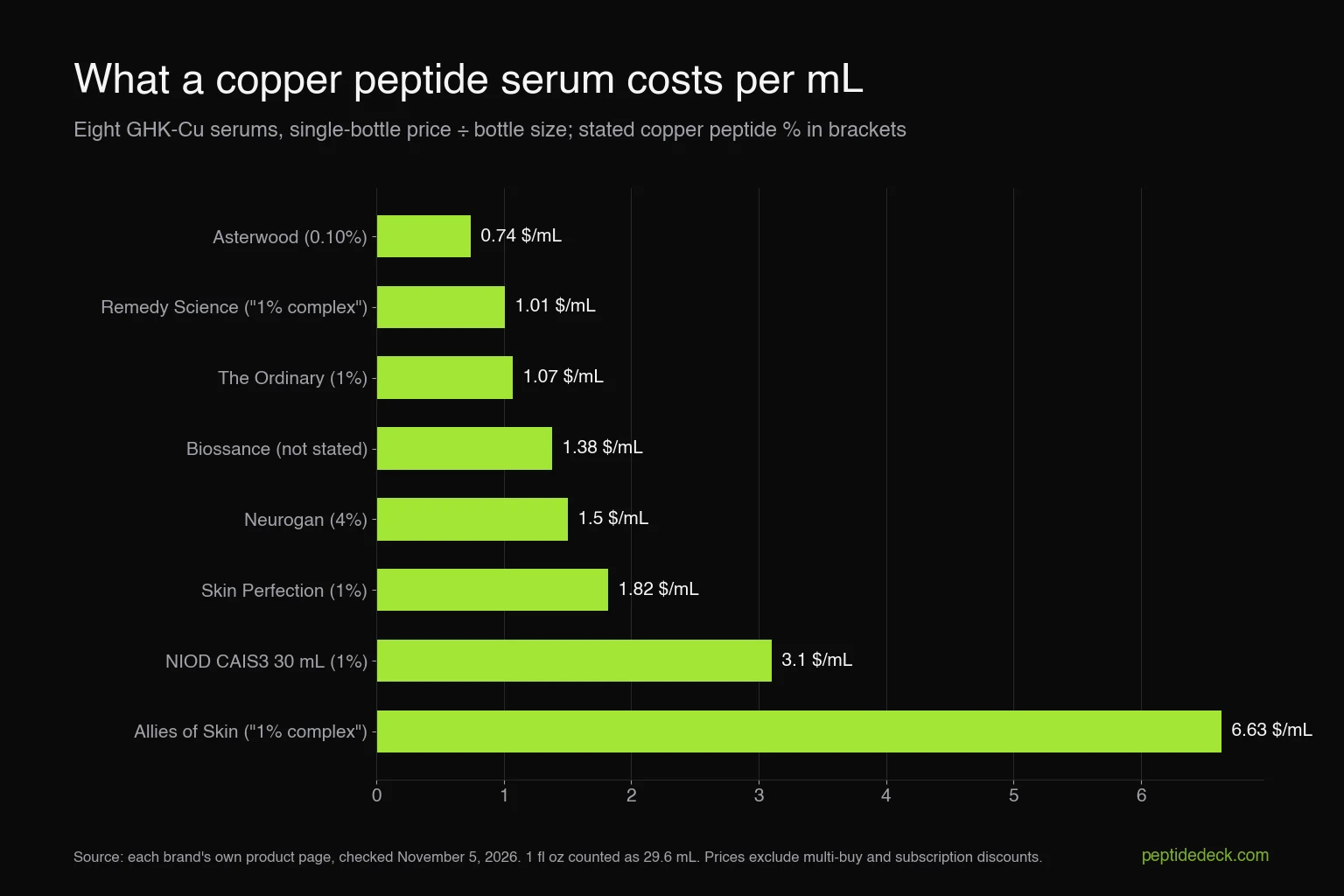
Sorting by milligrams of copper peptide turns the list upside down. Among the serums that state a plain GHK-Cu percentage, here's what 10 mg of GHK-Cu costs:
- Neurogan (4%): about $0.38
- The Ordinary (1%): about $1.07
- Skin Perfection (1%): about $1.82
- NIOD CAIS3 (1%, 30 mL): about $3.10
- Asterwood (0.10%): about $7.44
So the cheapest bottle is the most expensive way to buy copper peptide. That only matters if more GHK-Cu means better results, which, as above, hasn't been shown. What the table does tell you is what you're paying for. NIOD and Allies of Skin charge for multi-peptide formulas and brand positioning, and The Ordinary pairs copper with Matrixyl and other signal peptides. Skin Perfection is the plainest formula on the list: water, GHK-Cu and a preservative.
Watch the extras if your skin is reactive. Neurogan's serum also contains kojic acid and lemon peel oil, and Remedy's contains acetyl hexapeptide-8 and plant extracts. None of that is a problem for most people, but it's more to rule out if you get irritation.
Copper Peptide Serum Benefits: What the Human Trials Show
The serum evidence comes down to one trial. In 2016, a University of Auckland team ran a randomised, double-blind, split-face study in 40 women aged 40 to 65. Each woman applied a GHK-Cu serum in a lipid nano-carrier to one side of her face twice a day for 8 weeks, and either the plain serum base or a Matrixyl 3000 product to the other side.
The headline figures from the Auckland study were a 55.8% greater reduction in wrinkle volume than the plain serum and 31.6% more than the Matrixyl product. Those are relative differences. The raw numbers are more useful: the copper side lost 24.1% of its wrinkle volume, and the side with the plain serum, no copper, lost 15.0%.
Read this before you buy: a good part of the visible change in the best GHK-Cu serum trial came from the serum base itself. Hydration plumps fine lines. Copper peptide added a measurable extra on top, but it was an extra, not the whole effect.
The other trials are weaker. In a 2006 study of CO2 laser resurfacing, 13 patients completed a randomised comparison of skin care with or without GHK-Cu. Blinded evaluators found no difference in redness, wrinkles or overall skin quality, although patients using GHK-Cu were more satisfied.
The often-quoted facial results (71 women, 12 weeks, thicker and firmer skin) were presented as abstracts at a 2002 dermatology meeting. They're known mostly through reviews by Loren Pickart, who discovered GHK and founded a company that sells copper peptide products. Those were cream trials, which our cream guide covers.
A 2026 systematic review in Aesthetic Surgery Journal included only two randomised trials of GHK-Cu used on its own for aesthetic skin outcomes. Its authors called the clinical evidence limited by methodological variability and too few well-designed trials. That's the fair summary: promising, small, and mostly paid for by companies with a product to sell. The Auckland trial, for example, was funded by the maker of the serum it tested.
Does the peptide get into skin? A lab study on human skin samples found copper applied as GHK-Cu passed through over 48 hours and left a reserve in the tissue. A 2025 review notes GHK-Cu is fairly water-loving, so it crosses the skin's outer layer only to a limited degree. That's why some brands encapsulate it.
How to Use Copper Peptide Serum
Apply it to clean skin, before anything thicker. NIOD tells users to apply its serum as the first step after cleansing, and The Ordinary places its serum after cleansing and before moisturizer. The Auckland trial used its serum morning and evening.
- Patch test first. Try a few drops on your jawline or behind the ear for two or three days.
- Use a few drops, once or twice a day. Pat it onto damp or dry skin after cleansing, let it absorb, then moisturize.
- Keep vitamin C in a different slot. The Ordinary advises against using its copper serum with vitamin C, direct acids or retinoids. The chemistry backs this up: vitamin C (ascorbic acid) reduces copper ions and can turn the pair into a pro-oxidant combination. Use vitamin C in the morning and copper peptide at night, or the other way round.
- Separate it from exfoliating acids. The Ordinary's copper serum is formulated at pH 6.00 to 7.00. In lab solutions below about pH 5, some of the copper no longer sits on the peptide. Use AHA or BHA products on different nights.
- Alternate nights with retinol. There's no published evidence that retinol and copper peptide cancel each other out. The reason to split them is irritation. Biossance suggests its copper serum in the morning and retinol at night, and Skin Perfection suggests alternating nights. If you're weighing one against the other, see our peptides vs retinol comparison.
- Wear sunscreen every morning. Sun damage is what these serums were tested on, and it keeps happening without protection.
Give it time. The Auckland serum trial measured at 4 and 8 weeks, and NIOD's own testing in 32 people ran to 12 weeks. Take a photo in the same light before you start and again at week 8.
Side Effects and the "Copper Uglies"
Mild irritation is the realistic risk. In the Auckland trial, 39 of 40 women tolerated the products for 8 weeks. One had minor skin reactions on both sides of her face, stopped, and recovered without treatment.
Then there's the "copper uglies". It's an online term for skin that looks duller, rougher or looser after weeks of heavy use of strong copper products. A PubMed search for the term returned no results on November 5, 2026, so it has never been measured in a published study. The usual explanation is that GHK-Cu affects enzymes that break down collagen as well as those that build it. A 2015 review notes that it stimulates both the synthesis and the breakdown of collagen. That makes the idea plausible, not proven.
If your skin looks worse after a few weeks, drop to once a day or every other day, and check what else changed in your routine. Over-exfoliation or a new retinoid is a more common cause. If it doesn't settle, stop. Our GHK-Cu side effects guide covers the full list.
What to ask your doctor or dermatologist:
- Is a copper peptide serum safe with my prescription retinoid, azelaic acid or other treatments?
- I have rosacea, eczema or very reactive skin. Should I patch test for longer?
- I have Wilson's disease or a known copper allergy. Should I avoid it?
- I'm pregnant or breastfeeding. There's no safety data either way, so is it worth the risk?
Copper Peptide Serum vs Cream
Choose by texture and routine, not by evidence. The trials don't show that one format works better. A serum is thin, layers under moisturizer and sunscreen, and suits oily or combination skin. A cream doubles as your moisturizer, which suits dry skin and simpler routines.
The only GHK-Cu trial with a serum vehicle is the Auckland study, while most of the older results come from creams. If you'd rather use a cream, our GHK-Cu cream guide compares creams by price per 100 mg of GHK-Cu.
Making a Serum From GHK-Cu Powder
It's possible, but it's not the easy route. GHK-Cu dissolves readily in water, so 100 mg of powder in 10 mL of distilled water gives about 1%, or 10 mg per mL.
The catch is spoilage. Water with no preservative is a good place for microbes to grow, which is why the shop-bought 1% serum on our list still contains one. If you try it, mix small batches, keep them in the fridge in a clean dropper bottle, and throw them out after about two weeks. The cream guide has the full mixing maths for a cream base.
If you're pricing powder, check for a batch-matched certificate of analysis before you look at cost. Our guide to where to buy GHK-Cu compares vendors on price and testing.
Frequently Asked Questions
Sources
Every study claim above links back here.
- Badenhorst T, Svirskis D, Merrilees M, Bolke L, Wu Z. Effects of GHK-Cu on MMP and TIMP expression, collagen and elastin production, and facial wrinkle parameters. J Aging Sci. 2016;4:166. Abstract and full text (funded by Snowberry New Zealand)
- Miller TR, Wagner JD, Baack BR, Eisbach KJ. Effects of topical copper tripeptide complex on CO2 laser-resurfaced skin. Arch Facial Plast Surg. 2006;8(4):252-9. PubMed 16847171
- Mokhtar J, et al. The regenerative potential of GHK-Cu in aesthetic medicine. Aesthet Surg J. 2026. PubMed 42619529
- Pickart L, Margolina A. Regenerative and protective actions of the GHK-Cu peptide in the light of the new gene data. Int J Mol Sci. 2018;19(7):1987. PubMed 29986520
- Pickart L, Vasquez-Soltero JM, Margolina A. GHK peptide as a natural modulator of multiple cellular pathways in skin regeneration. Biomed Res Int. 2015;2015:648108. PubMed 26236730
- Hostynek JJ, Dreher F, Maibach HI. Human skin retention and penetration of a copper tripeptide in vitro as function of skin layer. Inflamm Res. 2010;59(11):983-8. PubMed 20703511
- Ogórek K, et al. Are we ready to measure skin permeation of modern antiaging GHK-Cu tripeptide encapsulated in liposomes? Molecules. 2025;30(1):136. PubMed 39795193
- Buettner GR, Jurkiewicz BA. Catalytic metals, ascorbate and free radicals: combinations to avoid. Radiat Res. 1996;145(5):532-41. PubMed 8619018
- Bossak-Ahmad K, Wiśniewska MD, Bal W, et al. Ternary Cu(II) complex with GHK peptide and cis-urocanic acid as a potential physiologically functional copper chelate. Int J Mol Sci. 2020. PubMed 32867146
- Product prices, sizes, strengths, ingredients and usage directions: The Ordinary, NIOD, Neurogan Health, Asterwood Naturals, Skin Perfection (naturalorganicskincare.com), Remedy Science, Biossance and Allies of Skin product pages, checked November 5, 2026.
Medical Disclaimer: This article is for informational purposes only and does not constitute medical advice. Copper peptide serums are cosmetics, and the evidence for them comes mainly from small, often industry-funded trials. Patch test before use, stop if irritation develops, and talk to a dermatologist about any skin condition or before combining a copper peptide serum with prescription treatments.