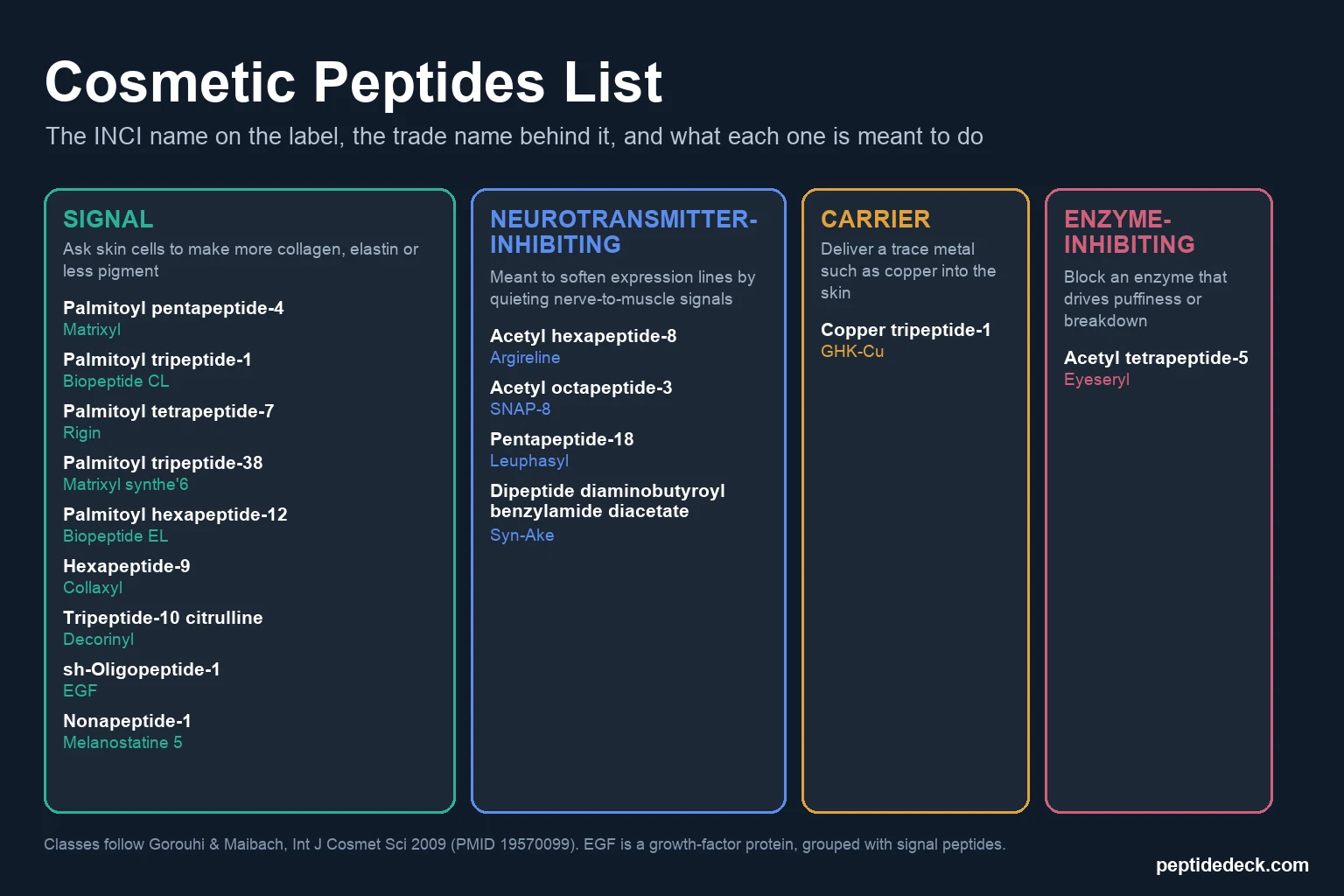
Your serum lists a peptide you cannot pronounce. Palmitoyl tripeptide-1. Acetyl tetrapeptide-5. Dipeptide diaminobutyroyl benzylamide diacetate. The front of the bottle says "peptide complex" and promises firmer skin, but it never tells you which peptide does what, or whether anyone has tested it on a real face. This cosmetic peptides list covers the 15 you are most likely to find on a label. For each one you get the INCI name, the trade name behind it, what it is meant to do, and the largest human study we could find on PubMed.
🔑 Key Takeaways
- The four jobs a cosmetic peptide can do, and how to spot each one from its name.
- The two peptides with the strongest placebo-controlled trials, and the famous one whose trial found no measured difference.
- Four old INCI names that still show up on labels, and the new names that replaced them.
- Where most peptides actually end up after you apply them, according to a 2026 skin-imaging study.
- A goal-by-goal table: which ingredient to look for and how strong its evidence is.
You already know skincare marketing runs ahead of the science. You also know some peptide products do make skin look smoother, because you have used one. Both things are true. The trick is telling the well-tested ingredients from the ones that ride on their name. That is what this directory is for.
What are cosmetic peptides?
They are short chains of amino acids. Most cosmetic peptides are 2 to 9 amino acids long, which is small enough to make cheaply and stable enough to sit in a cream. Many copy a piece of a larger skin protein, such as collagen, elastin or the nerve protein SNAP-25. The idea is that skin cells recognise the fragment and react as if the full protein were there.
A skin peptide gets two names. The INCI name (International Nomenclature of Cosmetic Ingredients) is what the law requires on the ingredient list. The trade name is what the supplier sells it as, and it often appears on the front of the bottle. "Matrixyl" on the box is palmitoyl pentapeptide-4 on the back.
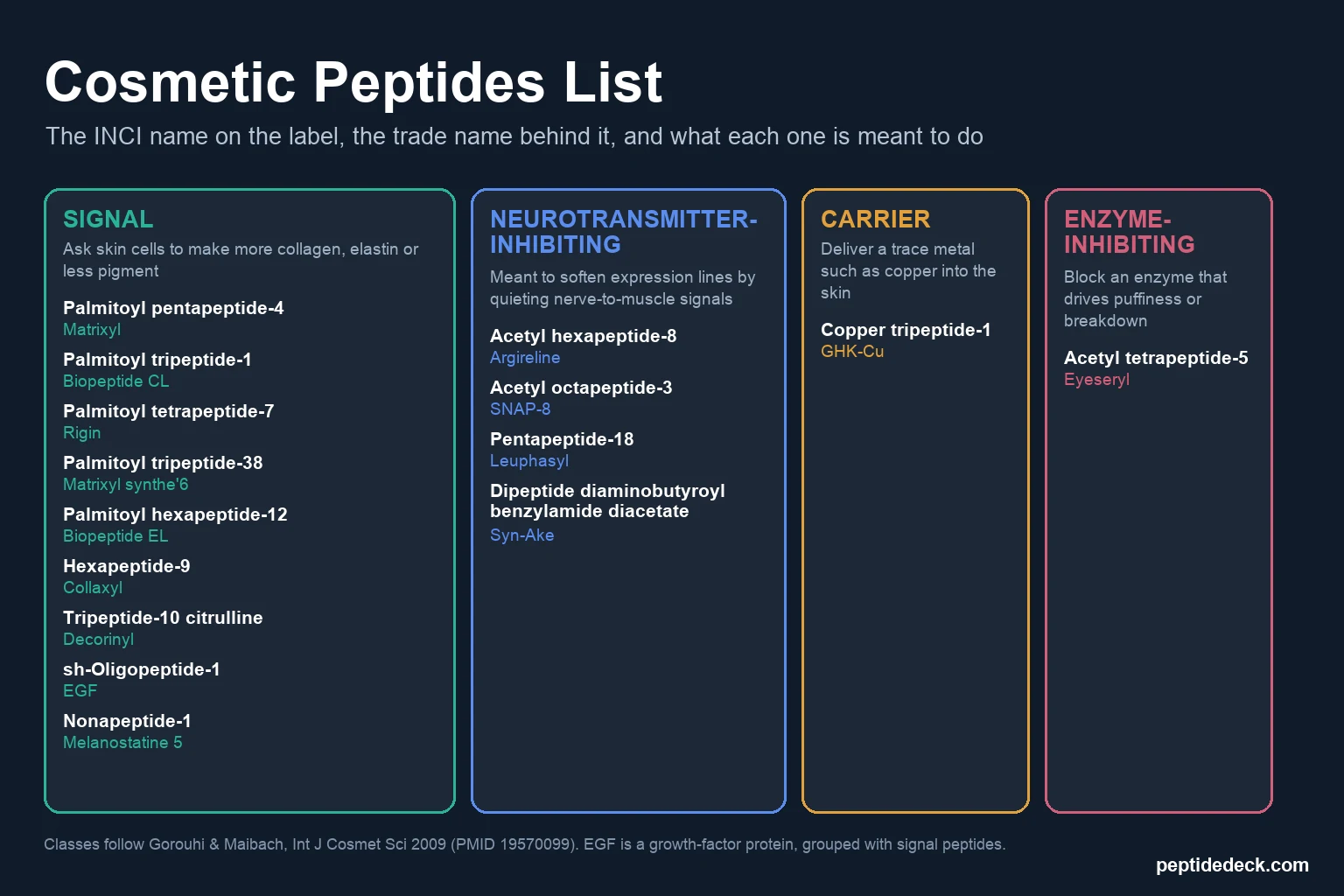
Dermatologists Farzam Gorouhi and Howard Maibach sorted topical peptides into four classes in a 2009 review, and the same four groups are still the usual way to sort them (Gorouhi & Maibach, Int J Cosmet Sci 2009):
- Signal peptides tell skin cells to make more collagen, elastin or other support proteins. Most "palmitoyl" peptides belong here.
- Neurotransmitter-inhibiting peptides are meant to quiet the nerve-to-muscle signal behind expression lines. These are the "Botox-like" ones.
- Carrier peptides deliver a trace metal into skin. Copper tripeptide-1 (GHK-Cu) is the main example.
- Enzyme-inhibiting peptides block an enzyme that breaks down skin or drives swelling.
If you are not sure what a peptide is in the first place, our what are peptides explainer covers the basics. If you want a ranked shortlist rather than a directory, see our best peptides for skin guide.
The cosmetic peptides list at a glance
Here is the whole list in one table. "Best human evidence" is the strongest published study we found for that ingredient, checked on PubMed in October 2026. "Maker-run" means the company that sells the ingredient or the finished product ran the trial.
Three patterns stand out. First, most of these ingredients have only been tested inside finished products that also contained other actives, so you cannot tell which ingredient did the work. Second, the trials are small, often under 40 people. Third, the two peptides with the cleanest human evidence are also the oldest: palmitoyl pentapeptide-4 and acetyl hexapeptide-8.
How to read a peptide on an ingredient label
Start with the name itself. The prefix tells you a lot:
- "Palmitoyl" means a fatty acid has been attached to the peptide. That makes it more oil-friendly, so it can mix into the skin's outer fats more easily.
- "Acetyl" means a small cap on one end, which makes the peptide harder for skin enzymes to break down.
- The number ("-1", "-7", "-38") is a catalogue number, not a strength. Palmitoyl tripeptide-38 is not stronger than palmitoyl tripeptide-1. It is a different peptide.
- "Di-", "tri-", "tetra-", "penta-", "hexa-" give the chain length: 2, 3, 4, 5 or 6 amino acids.
Some names have changed over the years, so older products and older studies can use a different name for the same molecule:
Position on the list matters too. Ingredient lists run from highest to lowest concentration, but anything under 1% can be listed in any order. Peptides are usually used at a few parts per million. The palmitoyl pentapeptide-4 trial used 3 ppm, and the palmitoyl tripeptide-38 serum used 5 ppm (PMID 18492182, PMID 33103342). So a peptide near the end of the list is normal. What you cannot tell from the label is the exact amount, and most brands do not publish it.
Signal peptides: the collagen and elastin group
This is the biggest group. Nine of the 15 peptides on this list are signal peptides, and they are the ones behind most "firming" and "collagen" claims.
Palmitoyl pentapeptide-4 (Matrixyl)
The best-tested signal peptide. It is a fragment of type I collagen (sequence Pal-KTTKS). In a 12-week split-face trial, 93 women aged 35 to 55 used a moisturiser with 3 ppm on one side and the same moisturiser without it on the other. The peptide side showed significantly fewer wrinkles and fine lines on image analysis and expert grading (Robinson et al., Int J Cosmet Sci 2005). The trial was run by Procter & Gamble, which used the peptide in its own products.
An independent 8-week trial in 21 Indonesian women compared it with acetyl hexapeptide-8 and placebo for crow's feet. Palmitoyl pentapeptide-4 did best of the three, though the authors called it an initial study that needs a larger sample (Aruan et al., J Clin Aesthet Dermatol 2023). Our Matrixyl guide covers the four Matrixyl variants and how they compare with retinol.
Palmitoyl tripeptide-1 and palmitoyl tetrapeptide-7 (Matrixyl 3000)
These two are usually sold together, as Matrixyl 3000. Palmitoyl tripeptide-1 is Pal-GHK, the same GHK sequence as the copper peptide but without the copper. Palmitoyl tetrapeptide-7 (Pal-GQPR, sold alone as Rigin) is designed, in the supplier's words, to "restore cytokine balance" in older skin.
The human evidence is thin. In a 12-week eye-cream study, 37 women used a cream that contained both peptides plus a yeast ferment and N-acetylneuraminic acid. Hydration rose 28%, elasticity 19% and ultrasound collagen density 55% (Yang et al., Skin Res Technol 2024). There was no placebo group, and the cream maker ran the study, so you cannot credit the peptides alone.
A 2026 skin-imaging study adds a useful detail. Researchers at the University of Nottingham applied a Matrixyl 3000 serum to three volunteers and traced both peptides through the outer skin layer. Both were found in every layer of the stratum corneum, but only around the cells, not inside them (Trzaska et al., Int J Pharm 2026). That tells you they get in. It does not tell you how much reaches the living skin below.
Palmitoyl tripeptide-38 (Matrixyl synthe'6)
Sequence Pal-Lys-Met(O2)-Lys. The supplier, Sederma, says it boosts six skin-matrix components, including collagens I, III and IV and hyaluronic acid, and markets it for deep wrinkles and fuller lips. The one published human study tested it inside a vitamin C and E serum: 35 women over 40 used it once a day for 56 days, and skin roughness fell 8% to 9% (Lintner et al., J Cosmet Dermatol 2020). It was open-label with no placebo, and all three authors were consultants for Alumier Labs. With 15% vitamin C in the same bottle, the peptide's share of the result is unknown.
Palmitoyl hexapeptide-12 (Biopeptide EL)
A fragment of elastin (VGVAPG), the sequence that repeats most often in the elastin protein. A 2025 study on human skin samples, co-run by Estée Lauder, showed it passes into the outer and epidermal layers and forms a gel there that helped the barrier recover after it was stripped of fats (Ligorio et al., ACS Appl Bio Mater 2025). No published trial has measured wrinkles or elasticity in people using it.
Hexapeptide-9 (Collaxyl)
A repeat of a collagen fragment (Gly-Pro-Gln-Gly-Pro-Gln). The maker's data claim large rises in collagen and hyaluronic acid. We found no published human trial of hexapeptide-9 as sold.
There is a trial of a cousin. A ring-closed version, called CHP-9, was tested against retinol and a plain serum in 96 adults for 56 days. At 0.002%, CHP-9 reduced the number, area and roughness of crow's feet and forehead lines, and beat retinol at the same strength on most measures (Chang et al., J Cosmet Dermatol 2025). The authors work for Shanghai Chicmax, a Chinese cosmetics company. CHP-9 is also a different molecule from the hexapeptide-9 on most labels, so do not read this trial as evidence for Collaxyl.
Tripeptide-10 citrulline (Decorinyl)
A copy of the part of decorin that binds collagen. Decorin keeps collagen fibres even and orderly, and skin makes less working decorin with age. The supplier, Lipotec, designed this peptide in the lab to keep fibres thinner and more uniform, aiming at collagen quality rather than quantity (Puig et al., Int J Cosmet Sci 2008).
An independent team in Athens then tested it in 24 volunteers over 60 days, alone and with acetyl hexapeptide-8. Used alone, it improved skin surface roughness measures more than the cream with neither peptide, and the authors describe this as clinical evidence for its anti-wrinkle effect (Raikou et al., J Cosmet Dermatol 2017). With four groups, each arm had about six people, so treat it as a promising signal, not proof.
sh-Oligopeptide-1 (EGF)
This one breaks the pattern. It is a 53-amino-acid copy of human epidermal growth factor, made by bacteria or plants, and it is closer to a small protein than a peptide. In an open-label study, 29 women aged 39 to 75 used a barley-grown EGF serum twice daily for 3 months. Fine lines, texture, pore size and pigmentation improved, with the first changes in month one (Schouest et al., J Drugs Dermatol 2012). A 2026 pilot RCT in 20 women compared a recombinant EGF serum with a human-derived growth-factor serum. The recombinant one scored better on texture and firmness, while wrinkle severity barely moved in either group (Abud et al., J Cosmet Dermatol 2026). Neither study had a placebo.
Nonapeptide-1 (Melanostatine 5)
A fragment of α-MSH, the hormone that tells pigment cells to make melanin. Nonapeptide-1 sits on the MC1R receptor and blocks that signal. The maker reports about a third less melanin in cell tests. We found no published trial of nonapeptide-1 on dark spots in people. If uneven tone is your main concern, ingredients with human trials, such as vitamin C or niacinamide, are on firmer ground.
Neurotransmitter-inhibiting peptides: the "Botox-like" group
These four target the lines that appear when you frown, squint or smile. They aim at the same nerve-to-muscle signal that Botox blocks, but from the skin surface and far more weakly. A 2025 review of acetyl hexapeptide-8 notes the open question for the whole group: it is a large, water-loving molecule, and whether enough reaches the muscle to matter is still unclear (Zdrada-Nowak et al., Int J Mol Sci 2025).
Acetyl hexapeptide-8 (Argireline)
The best-tested peptide in this group. It copies the end of SNAP-25, a protein nerves need to release their signal. In the original 2002 study, a cream with 10% of the peptide reduced wrinkle depth by up to 30% after 30 days (Blanes-Mira et al., Int J Cosmet Sci 2002). A later independent trial in 60 Chinese adults used it or a placebo around the eyes twice daily for 4 weeks. Graders rated 48.9% of the peptide group improved, against 0% on placebo, and skin-replica roughness fell only in the peptide group (Wang et al., Am J Clin Dermatol 2013). Concentrations, side effects and how it compares with Botox are in our Argireline guide.
Acetyl octapeptide-3 (SNAP-8)
Argireline made two amino acids longer, sold on the claim of a stronger effect. Its only published human study put it in a dissolving microneedle patch with vitamin C and a lipid, worn overnight under one eye with a plain patch under the other, in 24 people. The active side improved more over 28 days (Shin et al., Ann Dermatol 2024). Microneedles push the ingredients past the skin barrier, so this says little about a cream. We compare it head to head in our SNAP-8 guide.
Pentapeptide-18 (Leuphasyl) and Syn-Ake
Leuphasyl mimics enkephalin, a natural signal that calms nerves. Syn-Ake, INCI name dipeptide diaminobutyroyl benzylamide diacetate, is modelled on a peptide from temple viper venom and is meant to block the signal at the muscle's receiving end. Leuphasyl's published work is cell and computer-model studies (2026 in-silico and in-vitro study). Syn-Ake's best human data come from a L'Oréal serum that also held acetyl hexapeptide-8, gluconolactone and niacinamide: static wrinkle scores improved 35% to 69% in 50 people over 12 weeks, and dynamic lines 10% to 13% in a second group of 42 (Zhu et al., Int J Cosmet Sci 2026). That is a product result, not a Syn-Ake result. Both peptides, plus Vialox, are covered in our Botox-alternative peptides guide.
Carrier and enzyme-inhibiting peptides
Copper tripeptide-1 (GHK-Cu)
GHK occurs naturally in human blood, falls with age, and binds copper tightly. Reviews by its discoverer's group list skin benefits from tighter skin to fewer fine lines (Pickart et al., Biomed Res Int 2015). The one randomised trial we found is less flattering. After CO2 laser resurfacing, 13 patients used aftercare with or without GHK-Cu for 12 weeks. Blinded graders and computer analysis found no difference in redness or wrinkles, but the GHK-Cu group rated their skin quality higher (Miller et al., Arch Facial Plast Surg 2006).
Most copper peptide creams do not say how much GHK-Cu they hold. That is why some people buy the powder and mix it into a plain moisturiser at a known strength, and why price per 100 mg varies so much between sellers. Our guide on where to buy GHK-Cu compares vendors and prices (PeptideDeck earns a commission on some vendor links). The GHK-Cu cream guide explains what 1%, 2% or 4% on a label means.
Acetyl tetrapeptide-5 (Eyeseryl)
Sequence Ac-βAla-His-Ser-His. It is aimed at under-eye bags. The supplier says it reduces fluid build-up by making tiny blood vessels less leaky and slows glycation, the sugar damage that stiffens collagen. Its own testing reports smaller eye bags in 70% of volunteers within 28 days. In a Chinese cell study it was tested for activity against ACE, an enzyme involved in blood-vessel tone, and was part of a peptide mix that protected skin cells from oxidative damage (Wu et al., Skin Pharmacol Physiol 2021). No independent human trial is published.
How much evidence each cosmetic peptide really has
Put the studies side by side and the gap between marketing and data is easy to see.
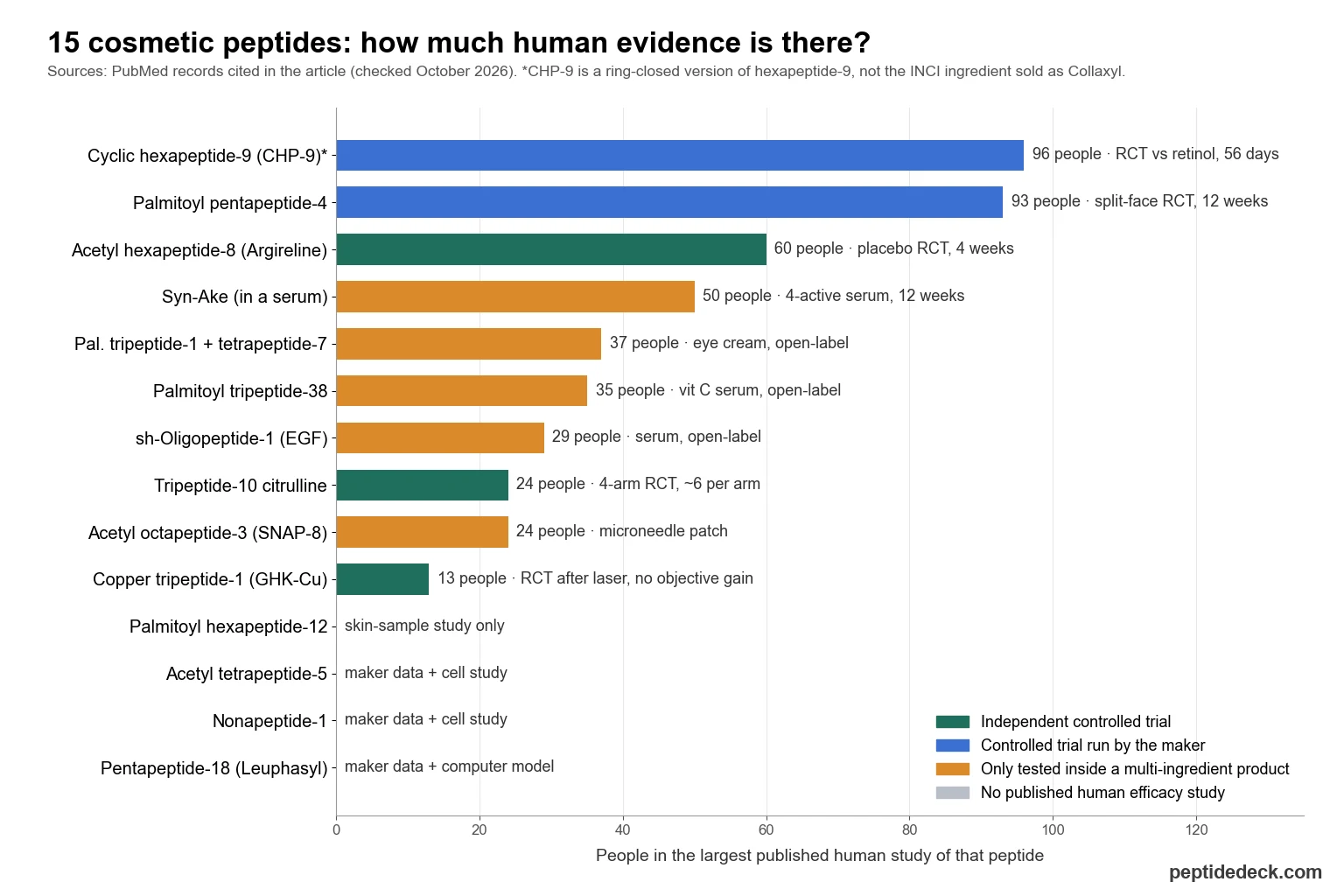
Two honest caveats apply to almost every study here. Most were paid for or run by the company selling the ingredient or the finished product. And most measured skin with instruments over 4 to 12 weeks, so they tell you about smoother texture and shallower lines, not about what happens over years.
Does that mean peptides do nothing? No. Palmitoyl pentapeptide-4 and acetyl hexapeptide-8 both beat placebo in controlled trials. It means that "peptide serum" on a bottle is not a promise. The specific ingredient, and how much of it is in there, is what counts.
Which cosmetic peptide for which skin goal
If you are shopping for a result rather than an ingredient, start here.
Peptides also play well with other actives. Several of the trials above tested them in formulas that already contained vitamin C, gluconolactone or niacinamide, without irritation problems being reported. Give any new product 8 to 12 weeks before judging it, because that is how long the positive trials ran.
Are cosmetic peptides safe?
On the evidence so far, yes for most people. The trials above reported few or no skin reactions: palmitoyl pentapeptide-4 was "well tolerated" in 93 women, and the 96-person CHP-9 trial recorded no adverse events. A 2026 safety framework from Procter & Gamble scientists screened several cosmetic peptides for toxin and allergen likeness and found that palmitoyl hexapeptide-12 and palmitoyl pentapeptide-4 resemble ordinary skin proteins, without the warning signs it found in real toxins (Bjerke et al., Curr Res Toxicol 2026).
A few sensible steps still apply:
- Patch test any new product on the inner arm or behind the ear for a few days first.
- If you have a history of skin cancer, ask your dermatologist before using growth-factor serums (sh-oligopeptide-1), since EGF makes skin cells divide.
- If you are pregnant, peptides are a common swap for retinoids, but check any product with your doctor or midwife.
- Keep using sunscreen. No peptide in this list protects against UV, and sun damage undoes the gains.
FAQ
Sources
- Gorouhi F, Maibach HI. Role of topical peptides in preventing or treating aged skin. Int J Cosmet Sci. 2009;31(5):327-45. PMID 19570099
- Robinson LR, et al. Topical palmitoyl pentapeptide provides improvement in photoaged human facial skin. Int J Cosmet Sci. 2005;27(3):155-60. PMID 18492182
- Aruan RR, et al. Double-blind, randomized trial on the effectiveness of acetylhexapeptide-3 cream and palmitoyl pentapeptide-4 cream for crow's feet. J Clin Aesthet Dermatol. 2023;16(2):37-43. PMID 36909866
- Yang F, et al. Comprehensive evaluation of the efficacy and safety of a new multi-component anti-aging topical eye cream. Skin Res Technol. 2024;30(7):e13790. PMID 38932444
- Trzaska AH, et al. Permeation behaviour of cosmetic actives into the human stratum corneum. Int J Pharm. 2026;705:127447. PMID 42790608
- Lintner K, Gerstein F, Solish N. A serum containing vitamins C & E and a matrix-repair tripeptide reduces facial signs of aging. J Cosmet Dermatol. 2020;19(12):3262-3269. PMID 33103342
- Ligorio C, et al. Noninvasive monitoring of palmitoyl hexapeptide-12 in human skin layers. ACS Appl Bio Mater. 2025;8(3):2340-2355. PMID 39964201
- Chang H, et al. Novel cyclized hexapeptide-9 outperforms retinol against skin aging: a randomized, double-blinded, active- and vehicle-controlled clinical trial. J Cosmet Dermatol. 2025;24(7):e70290. PMID 40586182
- Puig A, Antón JM, Mangues M. A new decorin-like tetrapeptide for optimal organization of collagen fibres. Int J Cosmet Sci. 2008;30(2):97-104. PMID 18377618
- Raikou V, et al. The efficacy study of the combination of tripeptide-10-citrulline and acetyl hexapeptide-3. J Cosmet Dermatol. 2017;16(2):271-278. PMID 28150423
- Schouest JM, Luu TK, Moy RL. Improved texture and appearance of human facial skin after daily topical application of barley produced, synthetic, human-like epidermal growth factor (EGF) serum. J Drugs Dermatol. 2012;11(5):613-20. PMID 22527430
- Abud B, et al. A randomized, double-blinded pilot study comparing synthetic versus human-derived topical epidermal growth factor for facial rejuvenation. J Cosmet Dermatol. 2026;25(5):e70927. PMID 42152512
- Blanes-Mira C, et al. A synthetic hexapeptide (Argireline) with antiwrinkle activity. Int J Cosmet Sci. 2002;24(5):303-10. PMID 18498523
- Wang Y, et al. The anti-wrinkle efficacy of argireline, a synthetic hexapeptide, in Chinese subjects: a randomized, placebo-controlled study. Am J Clin Dermatol. 2013;14(2):147-53. PMID 23417317
- Zdrada-Nowak J, et al. Acetyl hexapeptide-8 in cosmeceuticals: a review of skin permeability and efficacy. Int J Mol Sci. 2025;26(12):5722. PMID 40565185
- Shin JY, et al. Clinical safety and efficacy evaluation of a dissolving microneedle patch having dual anti-wrinkle effects. Ann Dermatol. 2024;36(4):215-224. PMID 39082657
- Integrative in silico and in vitro evaluation of Vialox and Leuphasyl pentapeptides for antiaging applications. Chem Biodivers. 2026. PMID 42116636
- Zhu M, et al. The effect of a serum containing acetyl hexapeptide-8, dipeptide diaminobutyroyl benzylamide diacetate and gluconolactone on skin biomarkers, wrinkles and skin texture. Int J Cosmet Sci. 2026;48(5):913-925. PMID 41668671
- Pickart L, Vasquez-Soltero JM, Margolina A. GHK peptide as a natural modulator of multiple cellular pathways in skin regeneration. Biomed Res Int. 2015;2015:648108. PMID 26236730
- Miller TR, et al. Effects of topical copper tripeptide complex on CO2 laser-resurfaced skin. Arch Facial Plast Surg. 2006;8(4):252-9. PMID 16847171
- Wu Y, et al. Protective and anti-aging effects of 5 cosmeceutical peptide mixtures on hydrogen peroxide-induced premature senescence in human skin fibroblasts. Skin Pharmacol Physiol. 2021;34(4):194-202. PMID 33849044
- Bjerke DL, et al. A framework for the safety evaluation of peptides in cosmetics. Curr Res Toxicol. 2026;10:100291. PMID 41953401
- Cosmetic Ingredients Guide (ci.guide): ingredient entries for sequences, trade names and former INCI names. ci.guide/peptides (read October 2026). Maker efficacy figures quoted on this page come from these supplier summaries and are unpublished.
Medical Disclaimer: This article is for educational purposes only and is not medical advice. Cosmetic peptides are skincare ingredients, not medicines, and are not intended to diagnose, treat or prevent any disease. Many of the studies cited are small or were funded by the companies that sell these ingredients. If you have a skin condition, a history of skin cancer, or are pregnant, talk to a dermatologist before starting a new product, and do not stop any prescribed treatment because of what you read here.