Most peptide transformation photos prove very little. Not because the people in them are lying, but because a single photo can't tell you which peptide did the work, how much was lighting, and how much was the diet that started the same week. This guide sorts peptides before and after results by what the human evidence actually supports, so you know what your own "after" is likely to look like, and when.
🔑 Key Takeaways
- Only one group of peptides has before-and-after results large enough to see in any photo, taken in any light
- The "muscle" in many growth hormone transformations isn't what it looks like
- One of the best-proven fat-loss results happens where no camera can see it
- The healing peptide with the loudest fans has a human evidence base you could fit in one small room
- What you do in the week you stop matters as much as the week you start
You've probably scrolled through dozens of these photos already. Some look incredible. Some look like the same person on a better day. Both reactions are reasonable, and by the end of this page you'll be able to tell which is which.
Peptides Before and After: What a Photo Can and Can't Show
Peptides change three kinds of things.
Some changes are visible: fat on the waist, face and arms, or skin texture in a close-up. Some you feel but can't photograph: joint pain, sleep depth, appetite, recovery between workouts. And some only show up on a test: IGF-1 on a blood panel, visceral fat on a scan, blood sugar on an A1c.
Here's the problem. Most peptides sold for "transformation" work mainly in the second and third groups. So when a photo shows a dramatic visual change, you should ask what else changed during those weeks. Usually it's a calorie deficit, a new training plan, or a GLP-1 medication running quietly in the background.
A 2026 review in Sports Medicine covering BPC-157, CJC-1295, ipamorelin, GHK-Cu, MOTS-c and other peptides made the same point from the medical side. It found that rigorous human safety data for most unapproved peptides are scarce, and it discussed the placebo effect as a driver of reported results, amplified by social media (PubMed 41966639). That doesn't mean nothing works. It means you need to know which results come from trials and which come from forums.
The Evidence Ladder: Which Before-and-After Results Hold Up
Not every result is built on the same ground.
The table below ranks the peptides people most often post about by the strongest human data behind them, then tells you what a photo can realistically show. The last column links to our full before-and-after page for each one, so you can go deeper on the peptide you actually care about.
Notice the pattern. The top three rows are the incretin drugs, and they are the only peptides here whose before-and-after photos you can take mostly at face value. Everything below them needs a second look.
Weight Loss Before and After: The Results You Can Actually See
This is where the big photos come from.
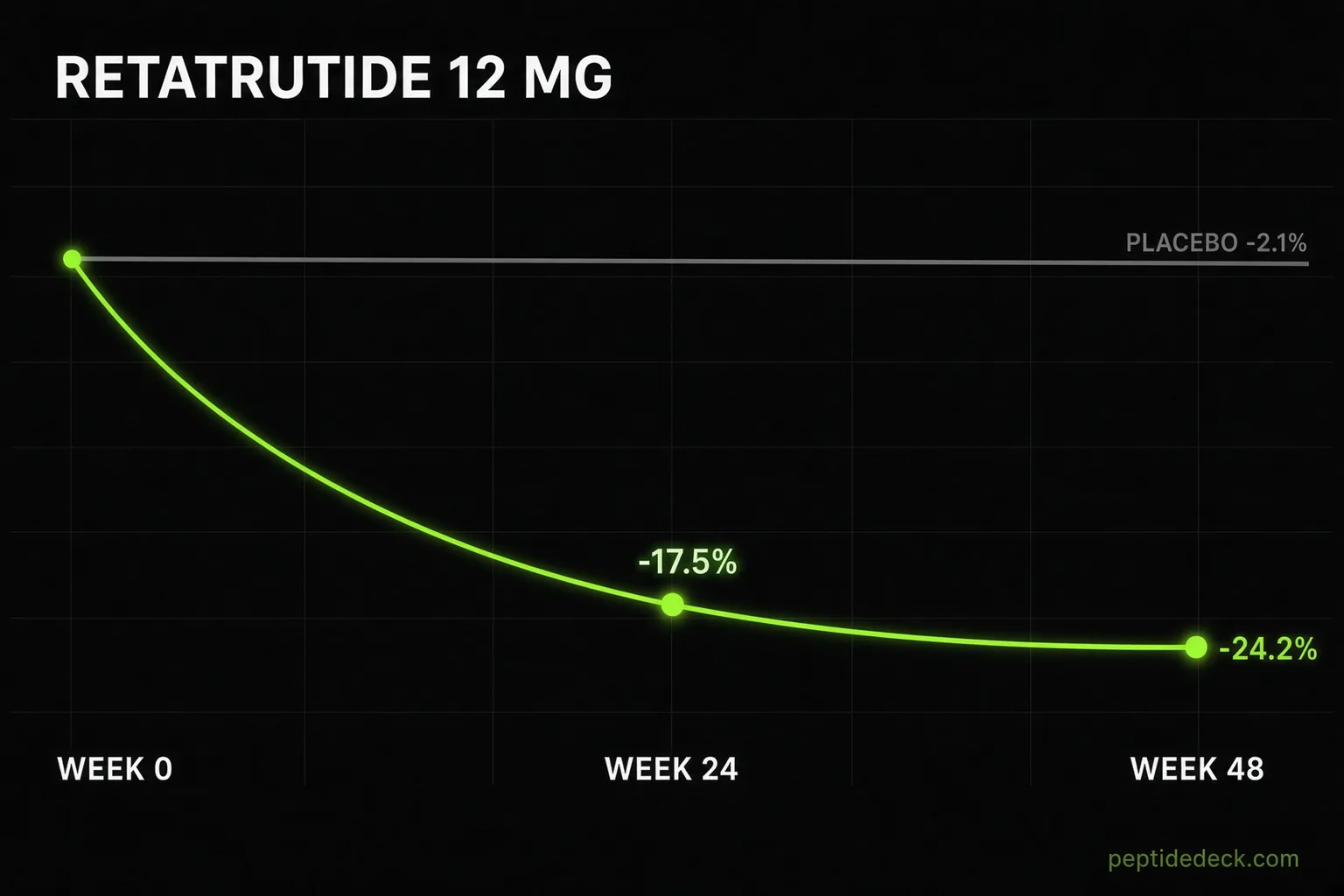
If you've been fighting the same 30 or 40 pounds for years, you already know how rare a real, lasting change is. The incretin peptides are the first drugs that deliver one on average, not just for the lucky few. In the phase 2 retatrutide trial, 100% of people on the 12 mg dose lost at least 5% of their body weight by week 48, and 83% lost 15% or more (NEJM 2023).
The timeline matters as much as the finish line. By week 24, the 12 mg group was already down 17.5%. The next 24 weeks added less than 7 more points. So most of what you see in a strong "month 6" photo is already there, and the second half is slower refinement.
What changes first
- Weeks 1 to 4: appetite and "food noise" drop before the mirror moves. Photos taken now mostly show less bloating.
- Months 2 to 4: for most people the face and waist show it first. This is usually when friends start asking.
- Months 6 to 12: the dramatic side-by-side. Tirzepatide's 15 mg group averaged 20.9% at 72 weeks, and 57% of them lost 20% or more (NEJM 2022). Semaglutide 2.4 mg averaged 14.9% at 68 weeks (NEJM 2021).
For month-by-month detail, see our GLP-1 before-and-after timeline.
The part the photos hide
Not all of that weight is fat.
In a scan substudy of the tirzepatide trial, about 75% of the weight people lost was fat and about 25% was lean mass (Diabetes Obes Metab 2025). That split was the same on placebo, so it's how weight loss usually works, not a flaw unique to the drug. But it explains why some "after" photos look smaller yet softer. The people who look leaner and more defined were almost always lifting weights and eating enough protein through the whole cut.
Where these drugs stand in the US: semaglutide (Wegovy, Ozempic) and tirzepatide (Zepbound, Mounjaro) are prescription-only, so the legitimate route is a doctor or a telehealth prescriber. Retatrutide is not approved anywhere yet. The only regulated way to get it is a clinical trial, which you can search on ClinicalTrials.gov. The retatrutide in most online transformations came from peptide vendors.
That last point deserves honesty. Retatrutide has the strongest photos in this whole guide, but it also has real downsides. Stomach side effects were dose-related in the trial, and heart rate rose with dose, peaking around week 24 before it eased. Those are the trade-offs you sign up for with the most powerful option on this list. For many people the result is still worth it, but go in knowing both halves.
The Variable Nobody Photographs: What's in the Vial
Two people can run the same plan and get different results.
Trials use pharmaceutical-grade product at a known dose. Online transformations use whatever arrived in the mail. If a vial labeled 10 mg actually holds 6 mg, your "after" looks like a lower dose, because it is one. If the product is degraded, you may get nothing at all and blame the peptide.
That's why the sourcing step belongs in any honest before-and-after plan. When you compare peptides for sale, the price per milligram matters less than whether each batch comes with a third-party certificate of analysis showing identity, purity and actual content. Our guide on how to read a peptide COA shows you the three numbers to check before you inject anything.
Peptides for Muscle Growth Before and After: The Honest Version
This is where most transformations mislead.
The growth hormone peptides (CJC-1295, sermorelin, ipamorelin, MK-677) work by raising your own GH and IGF-1. That part is real. A single CJC-1295 injection raised GH 2 to 10 times for six days or more and IGF-1 1.5 to 3 times for 9 to 11 days in healthy adults (JCEM 2006). What's missing is proof that the higher hormone levels turn into muscle you can see.
What "lean mass" really means
Lean mass is everything that isn't fat. That includes muscle, but also water, organs and connective tissue.
A systematic review of growth hormone itself, not even the weaker peptides that release it, found that young, fit adults gained 2.1 kg of lean mass on GH, but their strength and exercise capacity did not improve. They also had more fluid retention (Ann Intern Med 2008). If full GH can't make you stronger in a trial, a peptide that nudges GH upward is unlikely to deliver the shredded "after" shot on its own.
The MK-677 data tell the same story. Over 12 months in healthy older adults, fat-free mass rose 1.1 kg, but body weight rose 2.7 kg, limb fat went up, and fasting blood sugar climbed (Ann Intern Med 2008). In a mirror, that can look like "gains." On a scan, part of it is water and fat.
Sermorelin-type peptides have the smallest dataset. In 19 adults aged 55 to 71 who injected a GHRH analog nightly for 16 weeks, skin thickness increased in both sexes, but lean body mass rose in men only (JCEM 1997).
What you can realistically expect from GH peptides:
- Weeks 1 to 4: many users report deeper sleep (the small sermorelin-analog trial above found no change in sleep quality) and a "fuller" look, much of it water.
- Months 2 to 3: better recovery between sessions if you're training hard.
- Months 4 to 6: a modest shift in body composition at best, most likely in people over 40 whose GH has already dropped.
So why do the bodybuilding photos look so good? Because some of them come from people also using testosterone or other anabolic drugs, and the peptide gets the credit. If you're weighing testosterone itself, our TRT before-and-after timeline shows what a prescribed dose does on its own. For the peptide side, see IGF-1 LR3 results as well.
Healing Peptides Before and After: Felt, Not Seen
You can't photograph a tendon getting better.
If an old knee or shoulder injury has been slowing you down for months, you already know the feeling you're hoping for: the stairs stop hurting, the warm-up stops being a negotiation. That's the result people chase with BPC-157 and TB-500, and it's the hardest one to prove.
The human data for BPC-157 are thin. The best-known report followed 16 people with knee pain who got injections into the joint. Of these, 14 said their pain improved, but there was no control group and no follow-up imaging (Altern Ther Health Med 2021). That's encouraging, and it's also exactly the kind of study where the placebo effect can do a lot of work. Blends like KLOW stack BPC-157 with other peptides; see KLOW before and after for how that plays out in user reports.
Make your own "before" measurable: rate your pain from 0 to 10 on the same movement every morning for a week before you start. Note how far you can bend, lift or run before it hurts. Six weeks later, repeat the exact same test. That's the only before-and-after a healing peptide can give you.
Skin Peptides Before and After: Slow and Close-Up
Skin changes are real but small.
GHK-Cu has the best skin data of any peptide people post about. In a 12-week study, a GHK-Cu facial cream used by 71 women with sun-damaged skin increased skin density and thickness and reduced fine lines and wrinkle depth. In a separate 12-week test on thigh skin, GHK-Cu improved collagen production in 70% of women, against 50% for a vitamin C cream and 40% for retinoic acid (review, Int J Mol Sci 2018).
Twelve weeks is the key number. If someone shows a dramatic skin change in 10 days, it's usually a different light, a fresh moisturizer or a filter. The GLOW blend adds BPC-157 and TB-500 to GHK-Cu; our GLOW before and after page covers what users report at each stage.
Belly Fat, Energy and Longevity: The Invisible Results
Some of the best results never show up in a photo.
Tesamorelin is the clearest example. In its phase 3 trial, visceral fat dropped 15.2% in 26 weeks while it rose 5.0% on placebo, and triglycerides fell too (NEJM 2007). But visceral fat wraps your organs, underneath the abdominal wall. A CT scan picks it up. A mirror mostly doesn't. Tesamorelin is a prescription drug (Egrifta) in the US, approved for people with HIV who carry excess abdominal fat.
The same goes for the energy and longevity peptides. MOTS-c and NAD+ are taken for stamina, metabolic health and "feeling younger," and the result, if you get one, is a feeling rather than a picture. Our pages on MOTS-c before and after and NAD+ results go through what users actually report. PT-141 is similar: the approved version, bremelanotide (Vyleesi), treats low sexual desire in premenopausal women, and the result is felt, not seen (PT-141 results).
How to Spot a Misleading Peptide Transformation
The same body can look like two different people.
Light from directly overhead carves shadows into the abdomen. Flat light from the front erases them. Add a pump from a quick workout, a morning with no food, a slight lean back and a tan, and a single body gives you a "before" and an "after" in the same afternoon.
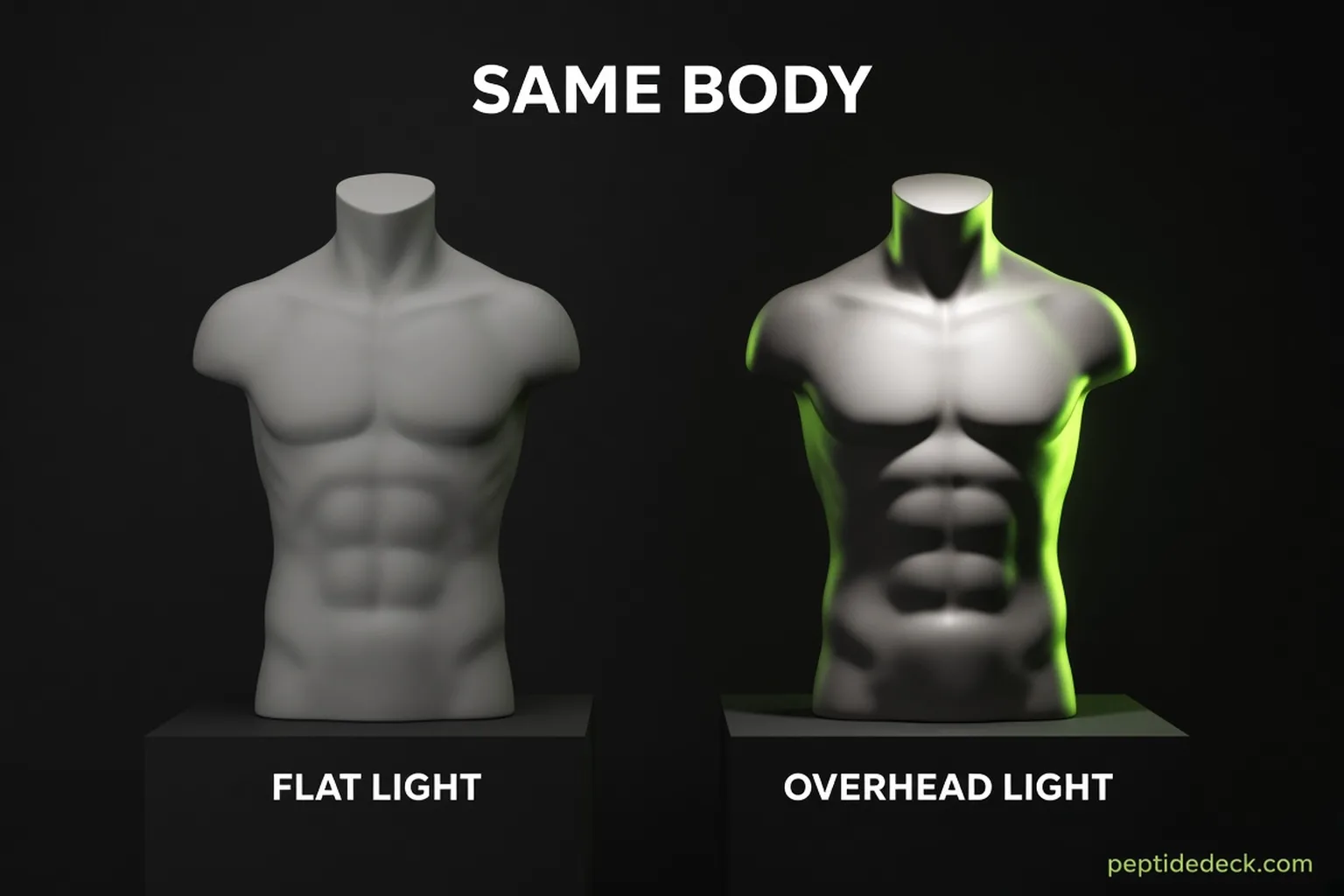
Before you trust any transformation, check these five things:
- Same light, same angle, same time of day? If the "after" is brighter or shot from above, discount it.
- What else started? A new diet, a trainer, a GLP-1 or testosterone changes everything. Honest posters list it all.
- How long? Any skin or muscle change in under three weeks is almost certainly water, lighting or a filter.
- Any numbers? A weight, a waist measurement or a scan result beats any photo.
- Is someone selling something? A discount code under the photo doesn't make it fake, but it does mean the best shot was chosen.
How to Document Your Own Before and After
Your own results are the only ones that count.
- Photos: front, side and back, same spot, same lamp, first thing in the morning, before food. Take them every 4 weeks, not every day.
- Tape measure: waist at the navel, hips, chest, and one arm and thigh. Waist tells you more than weight.
- Blood work: IGF-1 if you're using a GH peptide, and fasting glucose or A1c if you're on MK-677 or a GLP-1. A rising IGF-1 tells you the peptide is doing something even before you can see it.
- A scan if you can: a DXA scan at the start and at month 6 separates fat from lean mass and settles the "is it muscle or water" question.
- A simple log: dose, injection day, sleep, training and side effects. When results stall, this is where you'll find why.
For how quickly each class of peptide typically starts working, see our guide to how long peptides take to work.
What Happens to Your "After" When You Stop
This is the question almost no one answers.
For the incretin drugs, the data are clear. In the STEP 1 extension, people who had lost 17.3% on semaglutide regained 11.6 percentage points within a year of stopping, leaving them just 5.6% below where they began. Their blood pressure, blood sugar and cholesterol drifted back toward baseline too (Diabetes Obes Metab 2022). The weight comes back because the appetite does.
That doesn't mean you need these drugs forever. It means you need a plan for the exit: keep the strength training, keep protein high, and taper with your prescriber instead of stopping cold. People who hold their results usually built the habits while the drug made them easier.
For the GH peptides, results fade as hormone levels return to your own baseline, and there are no good long-term data on how fast. For healing peptides, nobody knows yet whether the relief lasts, because no one has followed users long enough to find out.
Frequently Asked Questions
Medical Disclaimer: This article is for informational purposes only and does not constitute medical advice. Several of the peptides discussed are prescription drugs in the US, and others are not approved for human use by the FDA. Results in clinical trials do not guarantee individual results. Talk to your doctor before starting, stopping or combining any peptide or medication.