

The scale is the last thing to move.
That surprises almost everyone who starts tirzepatide, because the photos they have seen show the end point and none of the middle. You are expecting a number to drop. What actually happens first is quieter and stranger, and if you do not know it is coming you will spend the first month convinced the medication is not working.
This is a tirzepatide before and after guide built from the trial data rather than from a highlight reel. It tells you what changes in the first week, what changes by week twelve, where the big numbers come from, and the point at which almost everyone's line goes flat. It also covers the changes nobody photographs, because several of them matter more than the number.
🔑 Key Takeaways
- The first change is not weight. It is a specific shift in how food occupies your attention, and most people notice it within the first week.
- Early scale results are modest by design, because the first two months are spent on starter doses that exist for tolerance rather than fat loss. Judging the drug at week 6 is judging it before it has started.
- The headline trial numbers are real, but they describe a 72-week average on the maximum dose. Where you land depends on three things, and only one of them is the drug.
- Almost every before-and-after curve bends at the same place. Knowing where that is in advance is the difference between a plateau and a panic.
- Some of the most important "after" changes never show up in a photo, and they happen early.
Two pages sit alongside this one. The dosage chart covers the schedule that produces this timeline, and tirzepatide plateau covers what to do when the curve goes flat.
Week one: what changes before the scale does
Food gets quieter.
That is the phrase people reach for, and it is more precise than it sounds. The constant low-level background noise of thinking about the next meal, the snack you might have, whether there is something in the cupboard — it drops in volume. You still get hungry. You just stop being nagged.
Alongside that, meals end sooner. You reach a point of "enough" that arrives earlier and holds longer, so the plate does not get finished and the second helping does not happen. Neither of these is willpower. They are the drug acting on appetite signalling and gastric emptying, and they typically show up within the first three to seven days of the 2.5 mg starting dose.
The scale in week one usually shows a pound or two, most of it water. That is fine. The appetite change is the real week-one result, and it is the thing that produces every later number on this page.
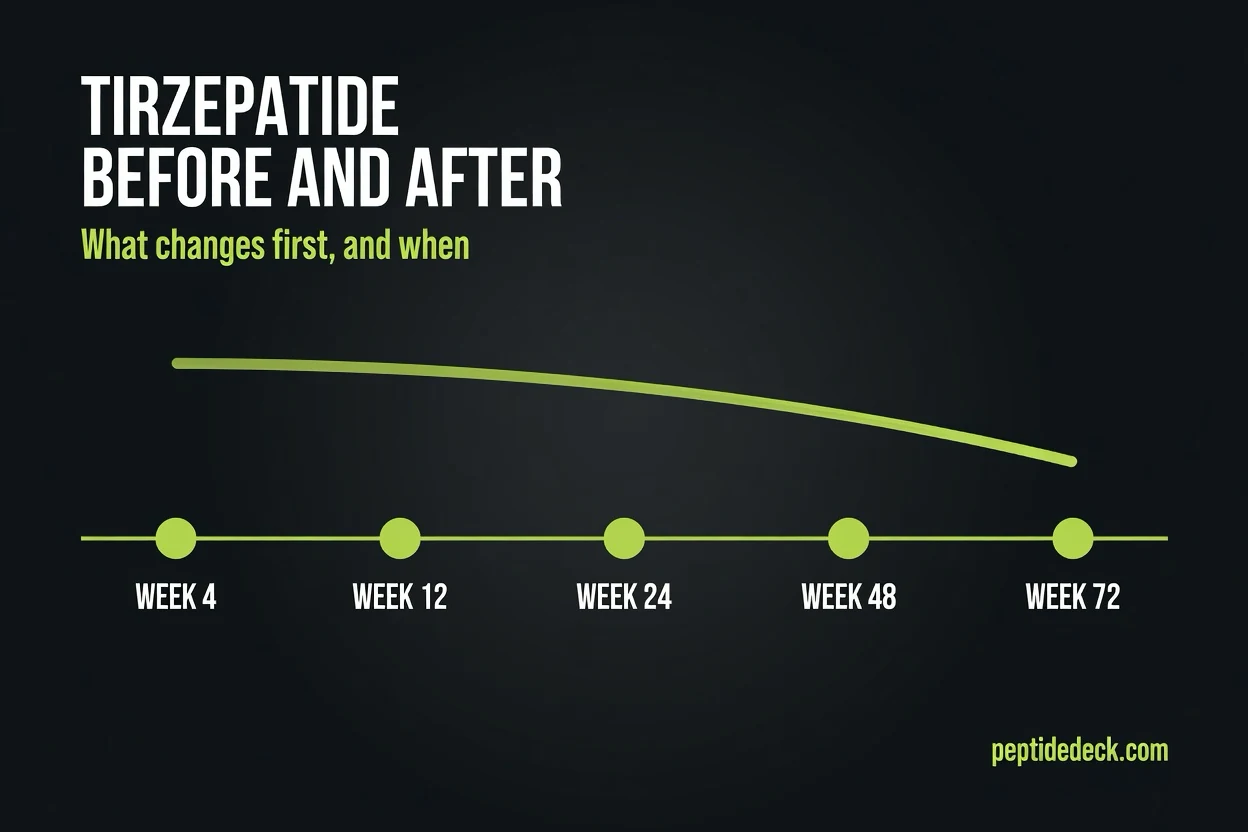
Tirzepatide before and after, month by month
The slow start is deliberate, and this is where people quit too early.
Tirzepatide is dosed on a ladder: 2.5 mg for four weeks, then 5 mg, then increases in 2.5 mg steps no faster than every four weeks. The 2.5 mg dose is explicitly a tolerance dose. It is there to let your gut adjust so that nausea stays manageable, not to produce fat loss. By week twelve most people are on 5 mg or 7.5 mg and have only recently reached a dose that was meant to do the work.
Realistic expectations for this window, drawn from the SURMOUNT-1 trajectory:
The percentages are averages of averages. Roughly a third of people on the 15 mg dose in SURMOUNT-1 lost 25% or more of their body weight, and a smaller group lost under 5%. The spread is wide, and the reasons for it are the subject of the next section.
What decides where you land
Three things, and only one is the drug.
- Dose reached. The single biggest predictor. The difference between 5 mg and 15 mg at 72 weeks was six percentage points of body weight in the trial. People who stall on a middle dose because of side effects, or because a prescriber never escalated, get middle results.
- Starting weight. Percentages scale. Twenty percent of 250 lb is 50 lb; twenty percent of 180 lb is 36 lb. Higher starting weights tend to produce larger absolute numbers and slightly larger percentages.
- What you do with reduced appetite. The drug removes the pull toward food. It does not choose what you eat when you do. People who use the quiet to eat protein and keep training preserve muscle and keep the loss on the curve. People who simply eat less of the same things lose more muscle and stall sooner.
Whether the tirzepatide was brand, compounded or otherwise also matters, because a mislabelled vial produces a mislabelled result. The routes and their trade-offs are covered in compounded tirzepatide.
The changes nobody photographs
Some of the biggest ones show up early.
- Alcohol loses its appeal. Widely reported and increasingly studied. Many people find they simply stop wanting the second drink, or the first.
- Blood sugar steadies. Tirzepatide was developed for type 2 diabetes first. Even in people without it, the post-meal spikes and crashes flatten, which is part of why the afternoon energy dip often disappears.
- Sleep changes. Partly from weight loss reducing apnoea, partly from eating less late in the evening. The trial programme includes a dedicated sleep apnoea study for a reason.
- Blood pressure and lipids move. Systolic pressure typically drops several points across the trial period, and triglycerides fall.
The unglamorous side is real too. Nausea in the first weeks of each dose step, constipation, and for some people a flatness of mood or energy that tends to improve once eating stabilises. Those are covered properly in tirzepatide side effects.

Reading before-and-after photos honestly
Most of them are selected, not representative.
The photo that is worth trusting
Shows a date range, names the dose reached, mentions what else changed, and includes the loose skin. That combination is rare, and when you find it the result is usually close to the trial averages rather than far above them.
A photo with none of those four is the top of the distribution presented as the middle.
The photos that circulate are the upper tail: high starting weights, full dose reached, 12 to 18 months in. They are real, and they are also the top third of the distribution presented as the middle. A few things to check before treating one as your forecast:
- The time gap. Six months and eighteen months produce very different afters. Many photos do not say.
- The dose. A result on 15 mg is not a forecast for someone who will stay on 5 mg.
- What else changed. Training, protein, alcohol, and sleep all move in the same period for most people who post results.
- Loose skin. Rarely shown, common after large losses, and worth expecting rather than being surprised by.
The trial data is the honest baseline. The photos are what the top of the range looks like when it goes well.
Frequently Asked Questions
Medical disclaimer. This article is informational and does not replace individual medical advice. The timelines and percentages above are drawn from published clinical trial averages and describe populations, not individuals; your own results will depend on dose, starting weight, health history and what you do during treatment. Tirzepatide is a prescription medicine that should be started, escalated and stopped under the supervision of a clinician, particularly if you have a history of pancreatitis, thyroid disease, gallbladder disease or an eating disorder, or if you are pregnant or planning to be.