

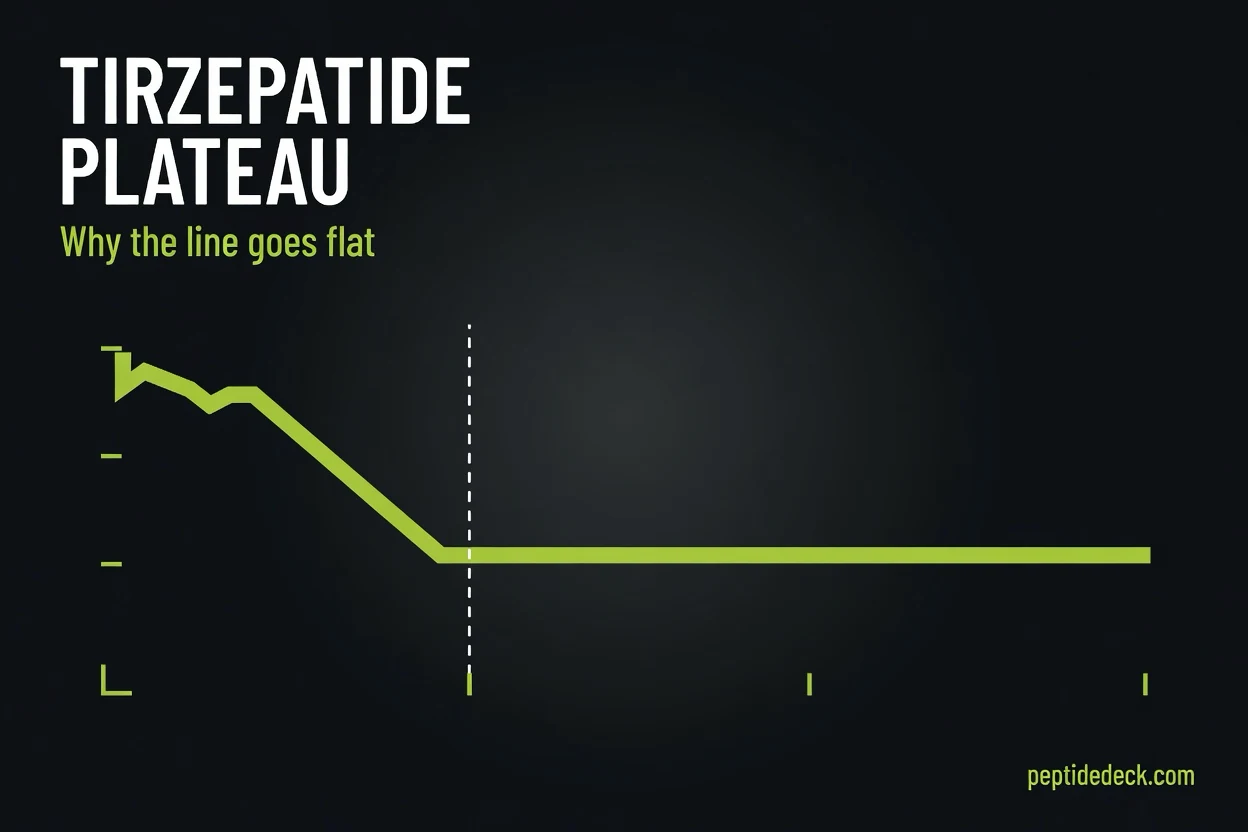


The line went flat and you did nothing wrong.
You have been losing steadily for months. The dose is where it should be, the eating has not changed, and for the last three or four weeks the scale has parked on the same number. Every forum thread you read tells you something different, and half of them are selling you a fix.
A tirzepatide plateau is not a malfunction. It is what the drug's own trial curves look like when you get far enough along them. This page explains why the line flattens, how to tell a real plateau from a pause, and what is actually worth doing about it, in the order that makes sense.
🔑 Key Takeaways
- Every tirzepatide weight curve flattens eventually. The trials show it clearly, so a stall after months of loss is the expected shape, not a sign the drug quit.
- Most "plateaus" reported in the first six months are not plateaus. They are one of two specific things, and both are fixable without changing anything about the medication.
- The single most common cause is a dose that never reached where it was meant to go, and it is worth checking before anything else.
- There is a quiet way intake rises during a stall that has nothing to do with willpower and everything to do with the drug working as designed.
- Switching drugs is on the list, and it is last for a reason.
If you are still early, the before and after timeline shows what a normal curve looks like month by month. This page picks up where that one leaves off.
Is it actually a tirzepatide plateau?
Four weeks, same number, then it counts.
Weight moves a few pounds day to day on water, salt, glycogen and what is in your gut. A week without loss is normal. Two weeks after a dose increase is normal, because nausea and constipation both shift water. The bar for a genuine plateau is four consecutive weeks with no downward trend in the weekly average, on a stable dose.
Two situations get mistaken for a plateau constantly and are neither:
- You are in the first three months. The 2.5 mg and 5 mg doses are tolerance steps. Loss on them is modest by design. That is a slow start, not a plateau.
- You just went up a dose. Constipation is common for the first two weeks after an increase, and it holds weight on the scale. Give a new dose a month before judging it.
If neither applies and the weekly average has been flat for a month, read on.
Why the line flattens: the three real causes
Almost every stall traces to one of these.
1. The dose stopped climbing. Tirzepatide's approved ladder runs 2.5, 5, 7.5, 10, 12.5 and 15 mg. In SURMOUNT-1 the gap between staying on 5 mg and reaching 15 mg was six percentage points of body weight at 72 weeks. A large share of people who stall are sitting on a middle dose, either because side effects at the next step put them off or because a prescriber never moved them. If you are on 5 or 7.5 mg and flat, the dose is the first thing to look at, not the last.
2. Intake crept back. This is the one that hides. Tirzepatide suppresses appetite, and appetite suppression is strongest in the first months. As your body adapts, the "food noise" comes back a little, portions grow a little, a snack reappears. None of it feels like overeating, because you are still eating far less than before you started. But the deficit that was driving loss has quietly closed. This is not a failure of discipline. It is the drug's effect settling, and it is why tracking intake for two weeks during a stall is so often the whole diagnosis.
3. Metabolic adaptation. A smaller body burns fewer calories at rest, and after substantial loss your body also becomes somewhat more efficient than its new size alone would predict. An intake that produced a deficit at your starting weight may be maintenance now. This is the cause that is genuinely built into the biology, and it is why the trial curves flatten even for people on the top dose who are doing everything right.
How to tell which one you have
On a middle dose? Cause one, until proven otherwise.
On 15 mg, and honestly not sure what you ate last Tuesday? Cause two. Two weeks of logging will tell you.
On 15 mg, logging, still in a real deficit on paper, and flat? Cause three. This is the true plateau, and it is the one the trial data predicts.
What to do, in order
Cheapest and most likely first.
- Check the dose against the ladder. If you are below 15 mg and tolerating the current step, the next step is the highest-yield change available. Escalation is a prescriber decision, and side effects at each step are the usual reason it stalls, so that conversation is about managing nausea, not just asking for more.
- Log intake for fourteen days. Not forever. Two weeks, everything, honestly. Most people find the number is higher than they assumed, and the fix is obvious once it is visible.
- Protein and resistance training. Rapid loss takes muscle with it, and muscle is what keeps resting metabolism up. Enough protein and two or three sessions a week of lifting is the intervention with the best evidence for keeping the loss on the curve and holding on to what you have lost.
- Sleep and alcohol. Both blunt the drug's effect on appetite. Poor sleep raises hunger the next day, and alcohol is calories that bypass satiety entirely.
- Accept the new floor, for a while. If you are on the top dose, in a logged deficit, training, and flat for eight weeks, you may have reached where this drug takes you for now. Holding a 20% loss is itself the outcome the trials measure. Maintenance is not failure.
- Only then, talk about switching. Retatrutide is the obvious candidate and its trial numbers are higher than tirzepatide's, but it is a different drug with its own escalation and side-effect profile, and a switch resets the tolerance clock. It belongs at the end of this list, not the start. Our retatrutide vs tirzepatide comparison covers what that switch actually involves.

Things that do not work, despite what you read
Three ideas circulate in every plateau thread.
- Skipping a dose to "reset" the drug. There is no receptor reset. A missed dose lets appetite return for a week, which usually means a week of higher intake. It moves the problem backward.
- Splitting the weekly dose into daily microdoses. Some people do this for side-effect reasons, and that is a legitimate conversation. As a plateau breaker it changes nothing, because the total weekly dose is the same. Our microdosing guide covers when it does make sense.
- Adding a second GLP-1. Stacking semaglutide on tirzepatide adds side effects and no additional mechanism. Adding a different class, like an amylin analogue, is a real strategy being tested in trials, and it is a prescriber decision, not a forum tip.
Frequently Asked Questions
Medical disclaimer. This article is informational and does not replace individual medical advice. Dose changes, adding or switching medications, and decisions about stopping treatment should all be made with the clinician managing your prescription, who can weigh your history, bloodwork and side effects. A stall in weight loss can occasionally have a medical cause unrelated to the medication, including thyroid changes and new medications that promote weight gain, and persistent unexplained changes are worth raising rather than troubleshooting alone. Anyone pregnant, planning pregnancy, or with a history of pancreatitis, thyroid cancer or an eating disorder should not adjust GLP-1 treatment without medical supervision.