TB-500 capsules promise recovery without a needle. The pitch is simple: swallow a pill instead of mixing a vial. The problem is that nobody has shown TB-500 survives the trip through your gut, and many capsules don't even hold the same molecule as the vials sold next to them. This guide covers what's inside TB-500 capsules, what the evidence says about oral TB-500, what a milligram costs in a capsule versus a vial, and when the needle-free option makes sense.
🔑 Key Takeaways
- "TB-500" on a capsule label can mean one of three different molecules
- One seller states outright that its TB-500 capsules and vials hold different compounds
- Human studies of thymosin beta-4 used IV drips, eye drops and wound treatments, never pills
- Per milligram, capsules aren't always the cheap option
- There's one narrow case where a swallowed thymosin might do something, and it isn't tendons
Prices below were checked on the seller's own pages on November 5, 2026. Every study claim links to its source at the end.
What Is in TB-500 Capsules?
Start with the label, not the marketing. "TB-500" is a trade name, not a single defined drug, and sellers use it for different things.
Thymosin beta-4 (Tβ4) is a natural protein made of 43 amino acids. It helps cells move by holding on to actin, the protein that forms their internal scaffolding. When doping labs in Belgium analysed a product sold as TB-500, they found it was not the whole protein. It was a seven-amino-acid piece, Ac-LKKTETQ, copied from positions 17 to 23 of Tβ4, the stretch that binds actin.
That's the strict meaning of TB-500. But plenty of vials sold as "TB-500" contain full-length Tβ4, and some capsules sold as a "TB4 fragment" contain a third molecule, Ac-SDKP, from the very start of the chain. Our TB-500 peptide guide covers what the injectable form is studied for; this page sticks to the oral question.
Molar masses are from the seller listings and PubChem. Sequence positions are from the human Tβ4 entry in UniProt.
Check the CAS number, not the name. SwissChems' own FAQ says its TB-500 capsules and TB-500 vials "contain different compounds": the capsules hold the 7-amino-acid fragment (CAS 885340-08-9), while its "TB-500 (Thymosin Beta-4)" vials hold full-length Tβ4 (CAS 77591-33-4). If your capsule and your friend's vial are both called TB-500, you may not be comparing the same thing.
If you're looking at Ac-SDKP capsules, that's a different product with its own data. Our page on thymosin beta-4 fragment capsules covers it. Oral Ac-SDKP has been tested in diabetic mice, where it reduced kidney scarring, but there are no human oral studies.
Can Oral TB-500 Survive Your Stomach?
Your gut is built to break peptides down. That's its job: proteins in food are chopped into amino acids before you absorb them.
Whether it comes as TB-500 tablets, pills or capsules, a swallowed peptide faces three hurdles. Stomach acid, then digestive enzymes in the small intestine, then a gut wall that lets very little through. A 2026 review of oral peptide delivery lists the usual reasons peptides fail here: they're large, charged, water-loving and easily cut by enzymes, so the share that reaches the blood is low.
The best-known success story shows how hard this is. Oral semaglutide (Rybelsus) is a peptide pill that took years of drug development and comes with an absorption booster called SNAC. Even so, the FDA label puts its absolute bioavailability at about 0.4% to 1% for the 3, 7 and 14 mg tablets. You have to take it on an empty stomach with a small sip of water, every day, to make it work. Our oral vs injectable semaglutide comparison shows how those doses line up.
Semaglutide also has an unusual advantage. A second 2026 review points out that it lasts about a week in the body, so a little absorbed each day builds up over time. Peptides that combine low absorption with a short life in the blood fail, the author argues, however clever the capsule.
TB-500 looks like the second kind. A 2024 study from the Korea Institute of Science and Technology's doping control centre tracked how TB-500 is broken into smaller pieces in human serum and by common enzymes in lab tests. In lab animals, the main breakdown product was a two-amino-acid piece, Ac-LK. That work looked at blood, not the gut, and a swallowed capsule meets stomach acid and digestive enzymes first.
What a typical capsule doesn't say. SwissChems' capsule page doesn't mention an enteric coating, an absorption booster like SNAC, or any blood-level data. Without those, there's no reason to assume a TB-500 pill gets past your gut wall intact.
Does Oral TB-500 Work? What the Evidence Shows
Short answer: nobody has tested it. Not in people, and not in any published study we could find that measured TB-500 in the blood after swallowing it.
We searched PubMed and ClinicalTrials.gov on November 5, 2026. The registered human trials of Tβ4 use eye drops, wound treatments and IV injections. None tests it by mouth. Here's what each kind of evidence covers, graded plainly.
- Human, IV, full Tβ4 (safety only). A placebo-controlled phase 1 trial gave 40 healthy volunteers 42 to 1,260 mg of synthetic Tβ4 by IV, once and then daily for 14 days. Side effects were infrequent and mild or moderate. A Chinese phase 1 trial of a recombinant Tβ4, with 54 healthy people in its single-dose part, found the same reassuring tolerability. Neither tested healing, the TB-500 fragment, or a pill.
- Human, eye drops, full Tβ4. A small randomised trial in 9 people with severe dry eye found less discomfort and less corneal damage than with placebo drops. That's a local effect on the eye surface.
- Mice, the TB-500 fragment itself. In aged mice, the seven-amino-acid LKKTETQ peptide helped skin wounds heal about as well as full Tβ4. Not swallowed, and not in people.
- Mice, swallowed full Tβ4, gut only. A 2026 study gave recombinant human Tβ4 by mouth to mice with chemically induced colitis. It eased gut inflammation and scarring. That points to a possible effect on the gut lining itself. It doesn't show the protein reached the bloodstream, and it used full Tβ4, not TB-500.
That last study is the narrow case worth knowing about. If anything swallowed does something, the gut lining is where you'd expect it, because that's where the peptide actually touches tissue. A tendon in your shoulder is a different story.
The main limitation runs through all of this. The human trials were small, short and built to test safety, and none used TB-500 as sold. A 2026 review in the Journal of the American Academy of Orthopaedic Surgeons put it bluntly: TB-500 is "frequently conflated with full-length" Tβ4 without any proven equivalence, and routine clinical use "cannot be currently recommended."
TB-500 Capsules vs Injection: Side by Side
Here's how the two routes compare. The prices are SwissChems' list prices on November 5, 2026, and every row is something you can check.
Notice the gap in the first row. The injection doesn't win because it's proven for healing. It wins only because an injection skips the gut, which is the step most likely to destroy a peptide. Our general oral vs injectable peptides guide explains which peptides are exceptions, and why BPC-157 is often treated differently from TB-500.
TB-500 Pills vs Vials: Cost Per mg
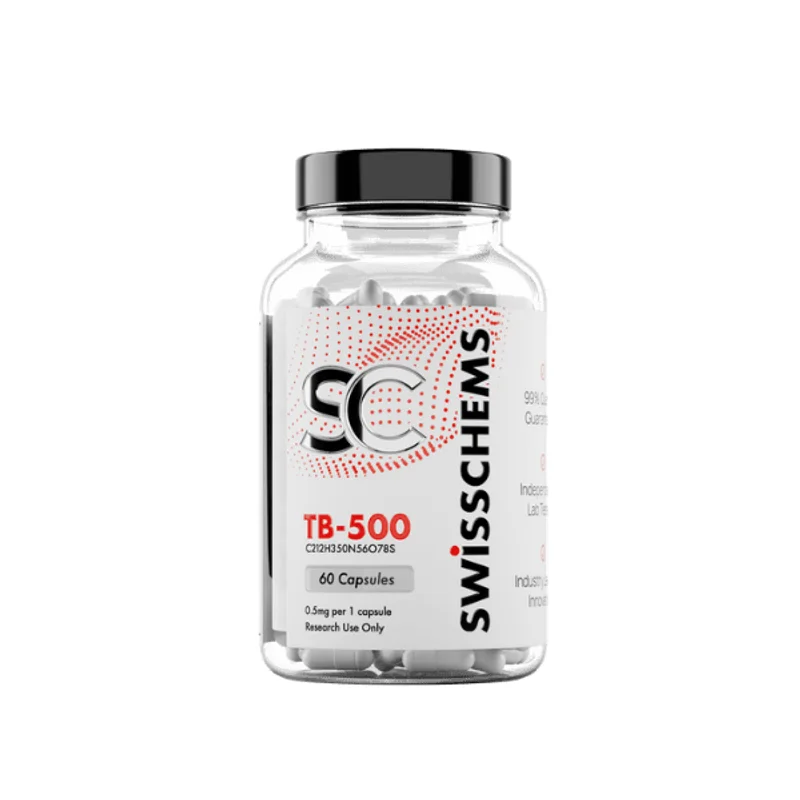
Capsules look cheaper per bottle. Per milligram, it depends on which vial you compare them with.
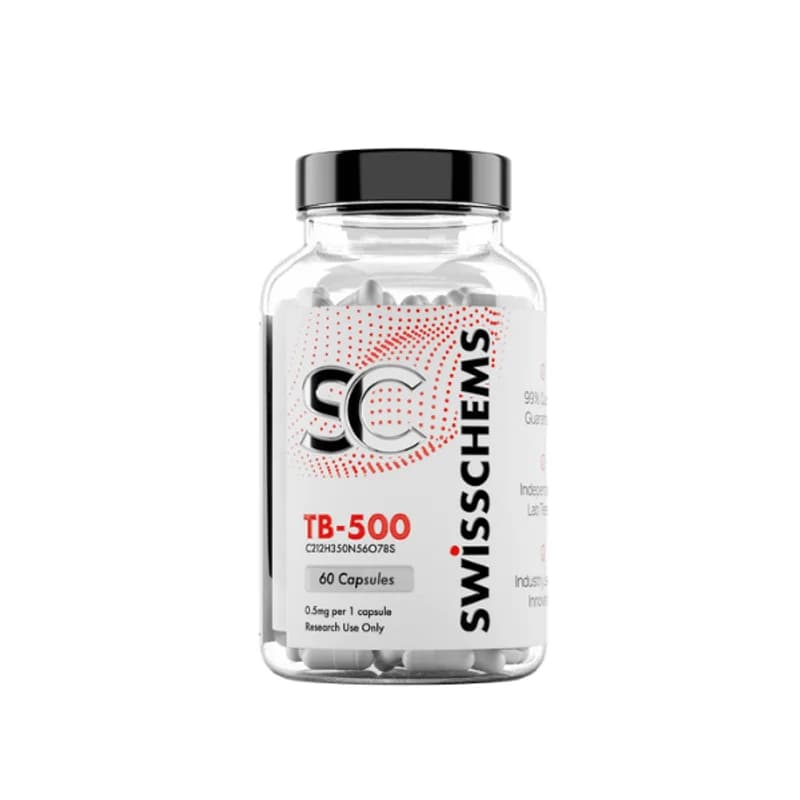
SwissChems' 60-capsule bottle holds 30 mg of the TB-500 fragment for $149.99, so you pay $5.00 per mg. Its vials of the same 7-amino-acid fragment cost $48.95 for 5 mg and $96.95 for 10 mg, which works out to $9.79 and $9.70 per mg. So for the identical molecule, the capsules cost about half as much per milligram.
Its full-length Tβ4 vials are a different picture. They were $23.96 for 2 mg, $35.16 for 5 mg and $42.36 for 10 mg, or $11.98, $7.03 and $4.24 per mg. The 10 mg vial is the cheapest milligram on the page.
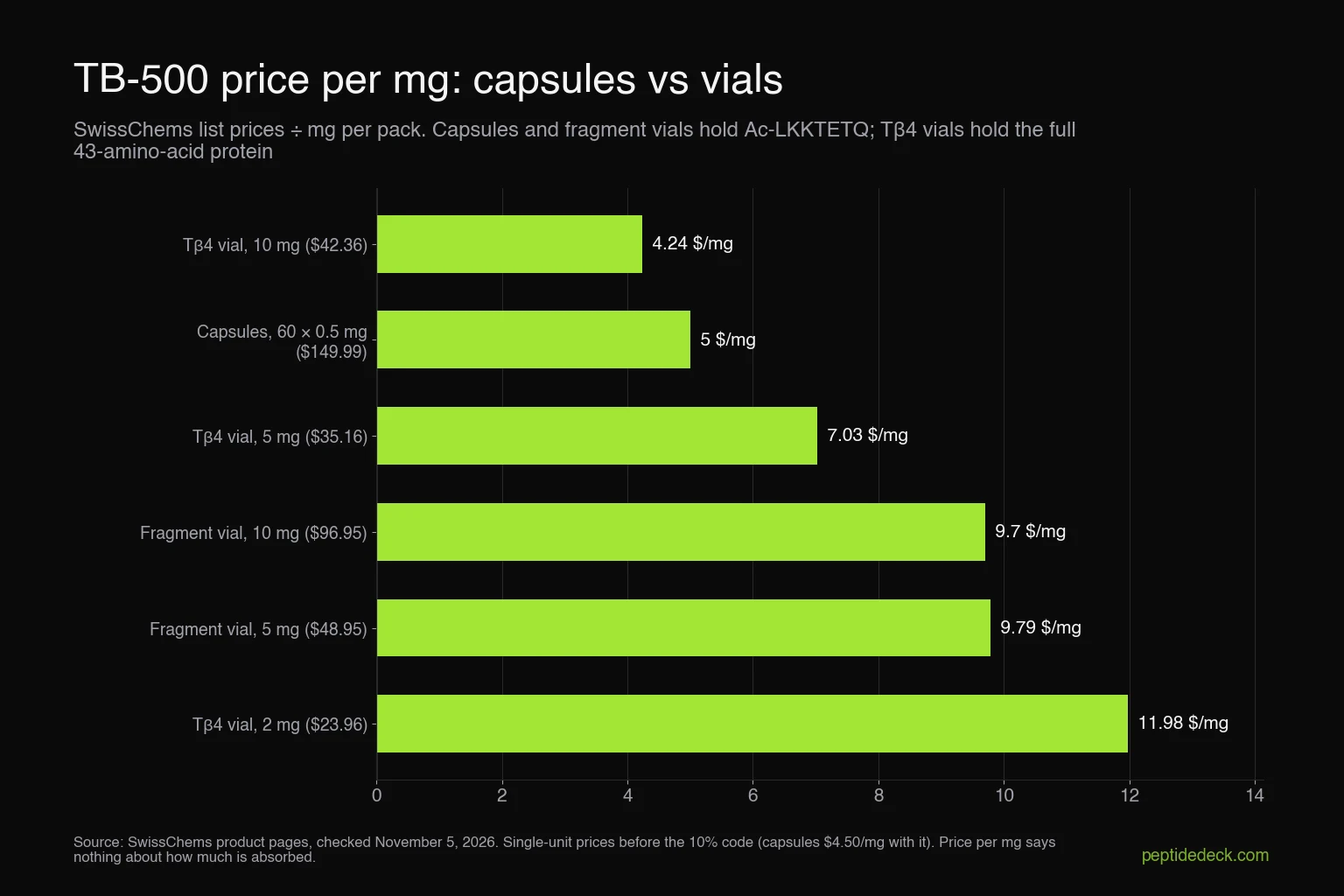
Two caveats before you compare. First, the fragment is about a fifth the size of full Tβ4 (889 vs about 4,693 g/mol), so a milligram of fragment holds roughly five times as many molecules. Milligram prices across the two aren't like for like.
Second, a price per milligram only matters for the milligrams you absorb. If a capsule behaved like oral semaglutide, which it may not, 1% absorption would make that $5.00 milligram cost $500 per milligram that reaches your blood. That's an illustration, not a measured figure, because nobody has measured TB-500 absorption at all.
Is Oral TB-500 Safe and Legal?
Safety data for swallowed TB-500 don't exist. That's different from saying it's dangerous, but it means nobody can tell you what's normal.
- FDA. The FDA lists "Thymosin beta-4, fragment (LKKTETQ), also known as TB-500" among bulk substances that may present significant safety risks in compounding. It cites possible immune reactions and impurities, and says it has "not identified any human exposure data." TB-500 is not approved by the FDA for any use.
- Sport. The 2026 WADA Prohibited List names "Thymosin-ß4 and its derivatives e.g. TB-500" under S2.3, a class banned at all times, in and out of competition. The listing doesn't depend on the route, so a capsule is no loophole.
- Product quality. The 2026 orthopaedic review flags identity, purity, dose and sterility concerns with commercial TB-500. A capsule that's never tested in blood can't show you whether the label matches what you absorb.
For what's reported with injected TB-500, see our TB-500 side effects guide.
What to ask your doctor. If you're dealing with a tendon, ligament or muscle injury, bring these questions:
- Is there an approved treatment, such as physical therapy or an injection, with real data for my injury?
- Could any supplement I'm taking affect a drug test I'm subject to through sport, the military or work?
- Do I have a history of cancer or a condition where blood-vessel growth is a concern?
- If I've already taken TB-500, which symptoms should make me stop and call you?
Buying TB-500 Capsules: Price and What SwissChems States
If you still want capsules, check the details first. Here's what SwissChems' product page showed on November 5, 2026.
- Product: TB-500 (0.5 mg/capsule), 60 capsules, 30 mg of Ac-LKKTETQ in total.
- Price: $149.99, which is $2.50 per capsule or $5.00 per mg. The code jqrlsday takes 10% off, bringing it to about $134.99, or $2.25 per capsule and $4.50 per mg. PeptideDeck earns a commission if you buy through the SwissChems link on this page.
- Testing claims: the page says "99% purity guaranteed" and "independently third-party HPLC-tested; COA available per batch." Unlike its TB-500 vial page, which lists dated HPLC, heavy-metal, contamination and endotoxin reports, the capsule page showed no dated batch report when we checked. Ask for the certificate for your batch before you buy.
- Labelling: SwissChems sells it for laboratory use only and says it is not a drug, food or cosmetic. It ships free in the US over $100 and accepts returns on unopened products within 30 days.
If you've decided injection is the more defensible route, our guide to TB-500 for sale compares vial sellers, prices and testing. For how injected TB-500 is typically measured and scheduled, see the TB-500 dosage guide.
The Verdict on TB-500 Capsules
Capsules are convenient, but convenience isn't evidence. Here's where that leaves you.
- If your goal is a tendon, joint or muscle: there's no data showing a swallowed TB-500 reaches it. The injected form has no proven human healing benefit either, but at least it skips the gut.
- If your goal is the gut itself: one 2026 mouse study gives a sliver of logic to a swallowed thymosin acting on the gut lining. It used full Tβ4, not the TB-500 fragment, and nothing has been tested in people.
- If you're drug-tested: skip it in any form. WADA bans Tβ4 and TB-500 at all times.
- If you buy anyway: match the CAS number to what you think you're getting, ask for a batch certificate, and treat any effect you notice with caution. A 2026 sports medicine review points to the placebo effect, amplified by social media, as a driver of how well people think peptides work.
Frequently Asked Questions
Sources
- Esposito S, Deventer K, Goeman J, et al. Synthesis and characterization of the N-terminal acetylated 17-23 fragment of thymosin beta 4 identified in TB-500, a product suspected to possess doping potential. Drug Test Anal. 2012. PubMed 22962027
- UniProt. Thymosin beta-4, human (P62328). UniProt P62328
- Rahaman KA, Muresan AR, Min H, et al. Simultaneous quantification of TB-500 and its metabolites by UHPLC-Q-Exactive orbitrap MS/MS (title shortened). J Chromatogr B. 2024. PubMed 38382158
- Khalid NU, Rivera-Delgado E, von Erlach T. Navigating the complexity of oral peptide delivery. Front Drug Deliv. 2026. PubMed 41953894
- Niazi SK. Oral delivery of peptides and proteins: pharmacokinetic boundaries, negative selection, and route triage. Front Drug Deliv. 2026. PubMed 41939723
- Rybelsus (oral semaglutide) prescribing information, section 12.3. DailyMed
- Ruff D, Crockford D, Girardi G, Zhang Y. A randomized, placebo-controlled, single and multiple dose study of intravenous thymosin beta4 in healthy volunteers. Ann N Y Acad Sci. 2010. PubMed 20536472
- Wang X, Liu L, Qi L, et al. A first-in-human, randomized, double-blind, single- and multiple-dose, phase I study of recombinant human thymosin β4 in healthy Chinese volunteers. J Cell Mol Med. 2021. PubMed 34346165
- Sosne G, Dunn SP, Kim C. Thymosin β4 significantly improves signs and symptoms of severe dry eye in a phase 2 randomized trial. Cornea. 2015. PubMed 25826322
- Philp D, Badamchian M, Scheremeta B, et al. Thymosin beta 4 and a synthetic peptide containing its actin-binding domain promote dermal wound repair in db/db diabetic mice and in aged mice. Wound Repair Regen. 2003. PubMed 12581423
- Zhao TR, Hu EB, Wang MW, et al. Recombinant human thymosin β4 ameliorates experimental colitis and intestinal fibrosis through suppression of mineralocorticoid receptor signaling. Mol Biomed. 2026. PubMed 42606759
- Nitta K, Shi S, Nagai T, et al. Oral administration of N-acetyl-seryl-aspartyl-lysyl-proline ameliorates kidney disease in both type 1 and type 2 diabetic mice. Biomed Res Int. 2016. PubMed 27088094
- Tham A, Hodgkins CW, Kennedy JG. Investigational peptides in orthopaedic practice: evidence, safety, and patient counseling for BPC-157, thymosin beta-4, and TB-500. J Am Acad Orthop Surg. 2026. PubMed 42937313
- US Food and Drug Administration. Certain bulk drug substances for use in compounding that may present significant safety risks (content current as of April 22, 2026). FDA
- World Anti-Doping Agency. 2026 Prohibited List, section S2.3. WADA
- Mendias CL, Awan TM. Safety and efficacy of approved and unapproved peptide therapies for musculoskeletal injuries and athletic performance. Sports Med. 2026. PubMed 41966639
- ClinicalTrials.gov search for "thymosin beta 4" and "TB-500", November 5, 2026. ClinicalTrials.gov
- Product names, contents, CAS numbers, prices and testing statements: SwissChems product pages for TB-500 (0.5mg/capsule) 60 Capsules, TB-500 (Thymosin Beta-4) and TB-500 Fragment (17-23), checked November 5, 2026. Ac-SDKP molar mass: PubChem CID 65938.
Medical Disclaimer: This article is for informational purposes only and does not constitute medical advice. TB-500 and thymosin beta-4 are not approved by the FDA for any use, no human study has tested them by mouth, and products sold under these names vary in what they contain. Talk to a doctor before using any unapproved peptide, especially if you have a history of cancer, are pregnant or breastfeeding, or are subject to drug testing.