Three o'clock hits and you are done.
Not sleepy exactly. Just flat — the kind of flat where you read the same paragraph twice and still have no idea what it said. You have already tried the obvious things. Better sleep, less alcohol, more water, a second coffee that only made it worse.
Somewhere in that search you found NAD+, and then you found out what getting it properly costs: a clinic chair, a needle, and three to eight hundred dollars a session. Which is roughly where most people stop.
That is why NAD+ nasal spray gets attention. No needle, no appointment, two pumps and you are out the door. The question is whether anything actually gets in — and that is the part every page selling one skips.
🔑 Key Takeaways
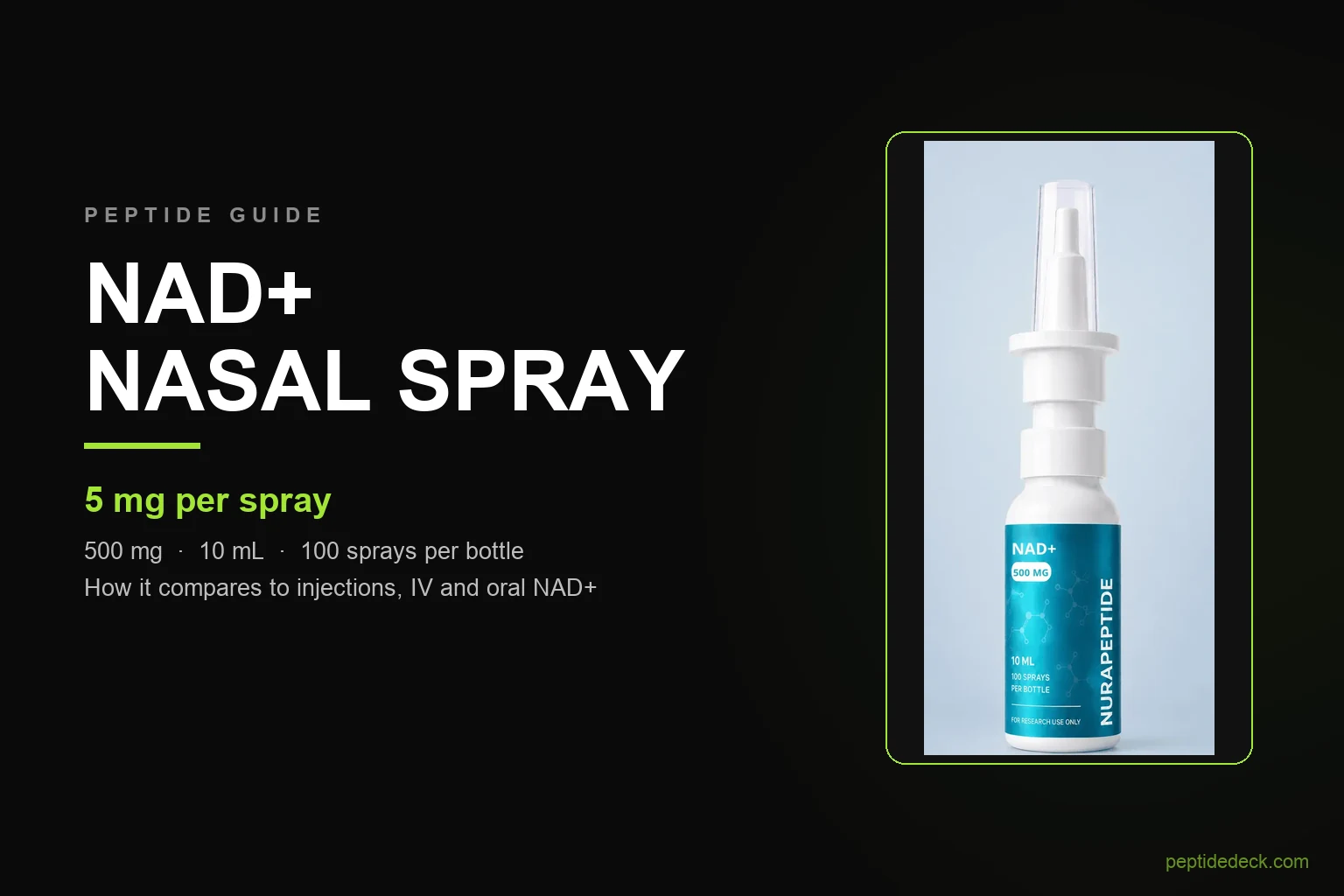
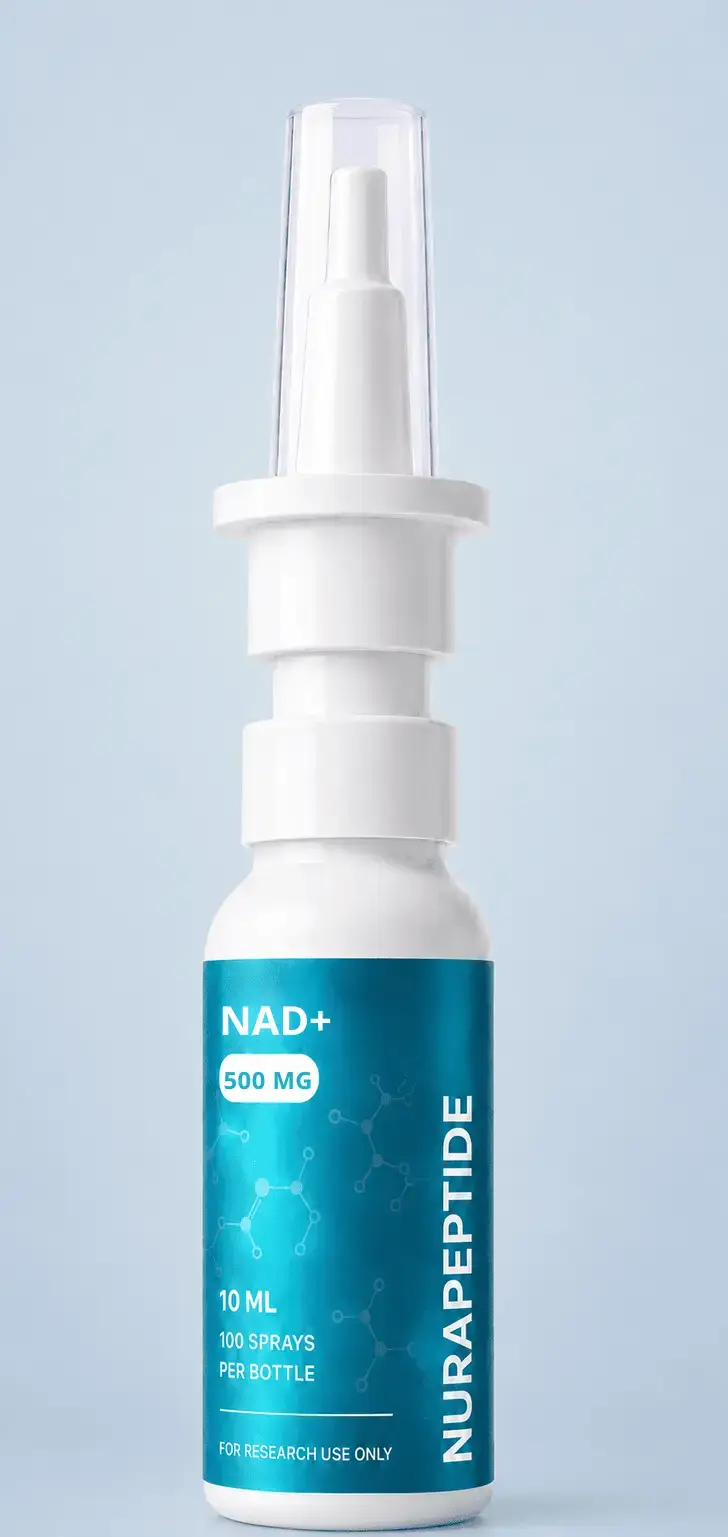
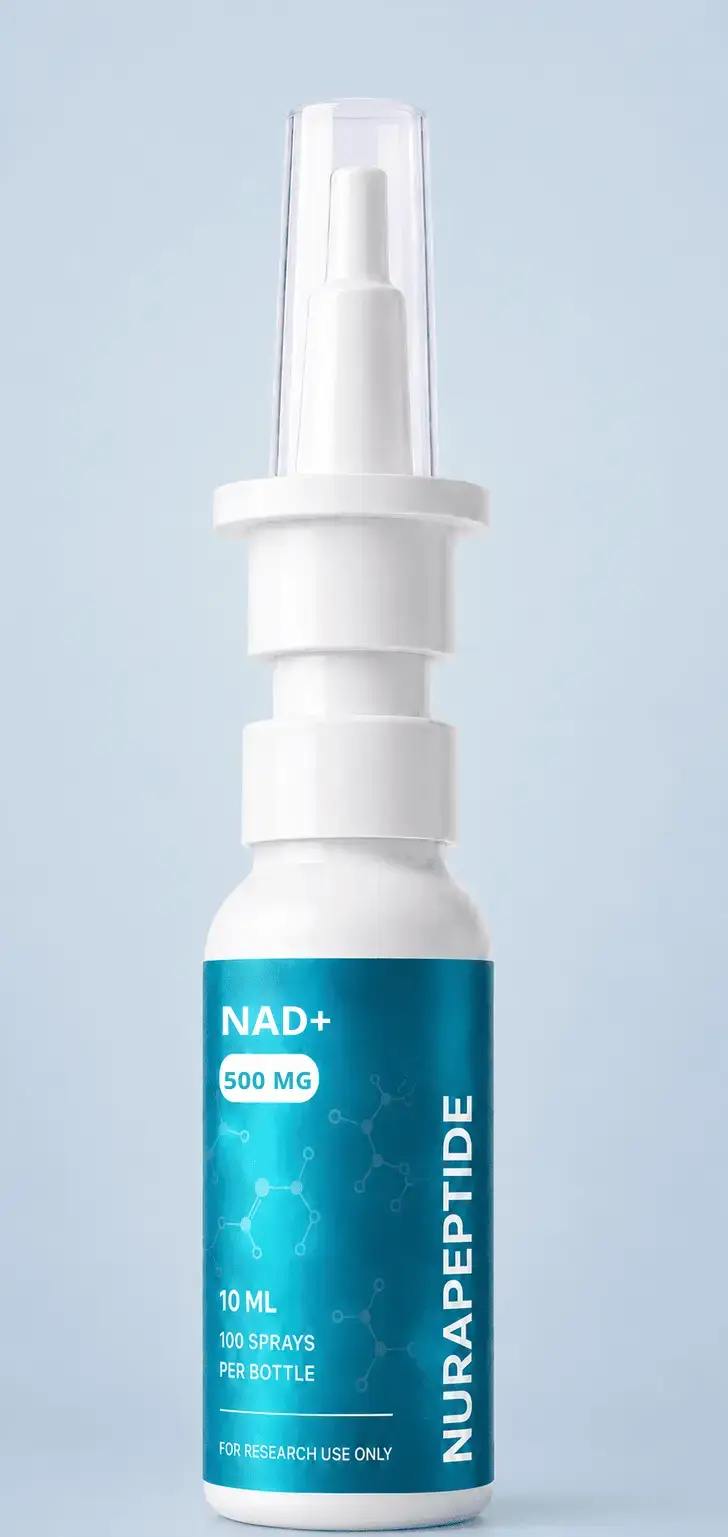
- A 500 mg bottle in 10 mL delivers about 5 mg of NAD+ per spray. Every dosing decision on this page comes out of that one calculation, and you can run it yourself on any bottle.
- Nasal NAD+ is not a cheaper IV drip. A normal day gives you a small fraction of what a clinic puts in your arm — which changes what you should expect from it, and what it is genuinely good for.
- Nobody has published a human study measuring blood NAD+ after a nasal dose. Any vendor quoting you an absorption percentage made it up.
- The nose has one trick that no needle has, and it is the real reason this format exists. It has nothing to do with how much NAD+ you absorb.
- A large share of sprays sold as "NAD" contain something else entirely. One word on the label tells you which one you are holding.
- Liquid NAD+ has a stability problem that powder does not. It decides how you store the bottle and how fast you should finish it.
This page does the arithmetic the product pages leave out, gives you the honest state of the evidence, and tells you what to check before money changes hands. If you want the wider picture first, start with what NAD+ actually is and come back.
What NAD+ nasal spray actually is
It is NAD+ dissolved in water.
That is genuinely the whole product. Nicotinamide adenine dinucleotide is a coenzyme your cells already run on — it carries electrons through the reactions that turn food into usable energy, and it feeds the repair enzymes that keep DNA and mitochondria in working order. Levels fall as you age. The entire category exists to push them back up.
What separates the formats is not the molecule. It is the route in, and each route solves a different problem:
- Oral NAD+ mostly does not survive. Your gut takes it apart before it reaches the bloodstream, which is why serious oral products sell precursors like NMN or NR instead of NAD+ itself — a distinction worth understanding before you spend anything, and one we untangle in NAD+ vs NMN.
- IV NAD+ skips every barrier and puts the full dose in your bloodstream. It also costs the most and takes hours in a chair.
- Subcutaneous injection is the middle path: most of the dose, at home, for a few dollars.
- Nasal spray aims at the lining inside your nose, which is thin, densely supplied with blood vessels, and drains straight into circulation without passing through the liver first.
The nasal route is not a gimmick. It is how migraine rescue drugs, hormone treatments and overdose reversal medicines get delivered when speed matters and swallowing is not an option. The real question is whether a molecule the size of NAD+ makes it across.
The absorption question nobody answers
Here is where the marketing goes quiet.
Your nasal lining covers roughly 150 square centimetres of surface, one thin cell layer away from a dense bed of capillaries. Small molecules cross it quickly. As molecules get bigger, uptake falls away, and somewhere around 1,000 daltons the route stops being efficient without help.
NAD+ weighs 663 daltons. It is under the line, but not comfortably — and it carries a charge and loves water, both of which work against drifting across a fatty cell membrane. So the honest expectation is: more than you would get from swallowing it, less than you would get from a needle. Where exactly in that range is unknown.
That is not a hedge. No published human study has measured blood NAD+ levels after an intranasal dose. IV NAD+ has been followed in people. Oral precursors have been followed in people. Nasal NAD+ has not. If a product page quotes you "up to 95% absorption", ask which study — there isn't one.
The one thing the nose does that a needle cannot
Nerves running from your nasal cavity into the brain — the olfactory and trigeminal pathways — offer a direct route into the central nervous system that skips the blood-brain barrier entirely. This is established delivery science, not theory: it is why intranasal insulin is studied for memory and cognition when injected insulin would never reach the brain in useful amounts.
Whether NAD+ travels that path in humans has not been demonstrated. But it is the actual reason the nasal format exists, and it explains why people reach for it for mental clarity rather than for total NAD+ load.
Read that box carefully, because it cuts both ways. It is the strongest argument for a nasal spray and it is also unproven in people. Anyone who tells you otherwise is selling.
NAD+ nasal spray dosage: do the per-spray math
Most labels hide the only number that matters.
They print the total in the bottle — 500 mg, 1,000 mg — because a big number sells. What you need is milligrams per spray, and you can work it out in two steps on any product.
A standard nasal pump delivers 0.1 mL per actuation. So:
- Concentration: 500 mg ÷ 10 mL = 50 mg per mL
- Per spray: 50 mg/mL × 0.1 mL = 5 mg per spray
A bottle that claims 100 sprays and holds 10 mL confirms the pump size: 10 mL ÷ 100 = 0.1 mL. When those two figures do not reconcile, the label is guessing, and so is your dose.
Now the daily arithmetic, using a 500 mg / 10 mL bottle at $80:
Start at the top row. Give it two weeks before you change anything, and if you are going to increase, add the second daily dose rather than doubling the sprays — more liquid in one nostril mostly runs down the back of your throat, where it does nothing except taste unpleasant.
Technique matters more than people expect. Tip your head slightly forward rather than back, aim the nozzle at the outer wall of the nostril instead of straight up the middle, and breathe in gently as you press. A hard sniff pulls the spray past the absorbing surface and into your throat. For how these numbers sit against every other format, see the NAD+ dosage chart.
What NAD nasal spray actually does for you
Expectations are where people get burned.
Set them from the dose, not the marketing. Ten to twenty milligrams a day is a steady daily top-up, not a reset. People who use it consistently tend to describe the same cluster of changes, usually in the second or third week:
- The afternoon stops collapsing. Not stimulation — the absence of the drop. Coffee at 3pm becomes optional rather than load-bearing.
- Words come back faster. The specific relief of not groping for a name mid-sentence.
- Fewer stimulants by default. The clearest self-report in this category is reaching for less caffeine without deciding to.
- Training recovery feels shorter. Subtle, and easily confused with sleeping better, which NAD+ users also report.
What it will not do: match an IV session, fix a sleep debt you are actively running, or carry you through a stretch of genuine overwork. If your fatigue has a cause you already know about, this is the wrong tool and an honest vendor would tell you so.
One more caution on the reports themselves. Nobody has run a placebo-controlled trial of nasal NAD+ for energy or focus, so what is described above is user experience, not trial data. It is worth exactly what user experience is worth — real, and unreliable.
Nasal spray vs injection, IV and oral
The formats are not interchangeable.
They differ by an order of magnitude in dose, and by a factor of a hundred in price. Here is the comparison laid out, using the figures from across our NAD+ guides:
Put plainly: a whole month of nasal spray delivers less NAD+ than one IV session. If your goal is maximum NAD+ for the money, subcutaneous injections win and it is not close. If your goal is something you will genuinely do every morning for a year, the spray wins on the only metric that ends up mattering, which is whether you keep doing it.
And if you are weighing the clinic option, read our breakdown of what an NAD+ IV actually costs before booking — the per-milligram maths is unkind.
Side effects and who should skip it
The nose complains first.
Nearly everything reported with nasal NAD+ is local and settles within a few days of consistent use:
- Stinging or burning for a few seconds after spraying, most noticeable in the first week
- A dripping or blocked nose, the same irritation any nasal spray can cause
- An odd taste at the back of the throat, which usually means your technique is sending liquid the wrong way
- Flushing or a brief headache, the same dose-related effects seen with other NAD+ formats and far milder here because the dose is small
Stop and speak to a doctor if you get persistent nosebleeds, pain that does not settle, or any loss of smell. Skip the format entirely if you are pregnant or breastfeeding, if you have had recent nasal or sinus surgery, or if you are mid-infection — irritated tissue absorbs unpredictably and heals slower. Our fuller write-up of NAD+ side effects covers the higher-dose formats, where the effects are considerably less gentle.

What is actually in the bottle
Half this category is mislabelled.
Search "NAD nasal spray" on a marketplace and most of what comes back is not NAD+. It is nicotinamide riboside, or NMN, or plain nicotinamide — precursors that are cheaper, more stable, and not the same thing you searched for. Check these five before buying anything:
- The actual molecule. The label should read nicotinamide adenine dinucleotide. If it says nicotinamide riboside, NMN or NR, you are buying a precursor in a spray bottle.
- Milligrams and volume, both printed. Without the pair, per-spray dose cannot be calculated, and a bottle you cannot dose is a bottle you cannot judge.
- A lot-matched certificate of analysis. Not a generic PDF for a product line. A purity figure tied to the batch you are being shipped.
- Cold-chain instructions. NAD+ in water degrades at room temperature. A vendor who does not mention refrigeration has not thought about what they are shipping.
- A price that makes sense. At 500 mg for $80 you are paying about 16 cents a milligram. Something far cheaper is usually a precursor, a smaller bottle, or both.
Where to buy NAD nasal spray
Two routes exist, and they are not equal.
Compounding pharmacies sell NAD+ nasal spray on prescription through telehealth clinics. That gets you pharmacy oversight and a clinician, at a markup, on their schedule. The direct route skips the consultation and costs less, and puts the labelling checks above squarely on you.
On the direct side, the clearest-labelled option we have found is Nurapeptide's 500 mg spray, which is the bottle every calculation on this page uses. It prints the numbers that let you verify the dose yourself — 500 mg, 10 mL, 100 sprays — and publishes a certificate of analysis in the product gallery showing 99.91% purity for the referenced lot. That combination is rarer in this category than it should be.
The honest limitation
It arrives as a pre-mixed liquid, and liquid NAD+ is less stable than a freeze-dried powder you reconstitute yourself. Heat and time degrade it, so a bottle left on a warm bathroom shelf is worth less at week four than it was on day one.
That is a real drawback and it does not change the verdict, for one reason: at two to four sprays a day you finish the bottle in 25 to 50 days. Keep it refrigerated, keep it out of the light, and the maths works out well inside the window where stability is a question. Buying a larger bottle to save money is the version of this that goes wrong.
Two things worth knowing before you order: their certificate covers the referenced lot, so ask for the one matching your batch if it is not the same, and any damage claim has to be filed within 48 hours of delivery.
Price check as of September 2026: $80.00 for the 500 mg bottle, in stock. Our code PEPTIDEDECK15 takes 15% off at checkout, which brings it to $68.00 — about 13.6 cents per milligram, or $1.36 a day at one spray in each nostril. For the wider vendor picture across every NAD+ format, see where to buy NAD+.
Frequently Asked Questions
Medical disclaimer. This article is informational and does not replace individual medical advice. NAD+ has no approved medical use for energy, cognition or aging, and no human study has measured how much of an intranasal dose reaches the bloodstream. Persistent fatigue and brain fog have causes worth investigating properly — thyroid problems, anaemia, sleep apnoea and depression among them — and a doctor should rule those out before you treat the symptom. Anyone pregnant, breastfeeding, taking prescription medication, or living with a chronic condition should speak to a clinician before starting any NAD+ product.