NAD+ dosage depends entirely on how you take it. Oral supplements need 500mg+ daily because most is destroyed before reaching your cells. Subcutaneous injections bypass that, so 50-100mg two to three times a week is enough. IV therapy goes higher because it is used for acute protocols. Here is exactly how much to take for your goal and delivery method.
🔑 Key Takeaways
- Dosage varies 5-10x between oral and injectable forms. Same molecule, very different delivery math.
- Oral NAD+ has roughly 5-15% bioavailability. NMN is better at 40-60%.
- SubQ injections of 50-100mg, 2-3x/week are where most protocols land, with 100mg as the ceiling for one site. No trial has yet tested injected NAD+ for benefit.
- IV NAD+ therapy usually lands at 250-750mg per session, and it should always be infused slowly.
- More is not always better. Higher doses often add flushing or nausea without clearly better results.
- Start low and titrate up regardless of form.
NAD+ is one of those compounds where delivery method changes everything. If you miss that point, the rest of the dosing conversation gets weird fast.
Most people do not actually need the biggest number on the label. They need the dose that fits the route, the goal, and how well they tolerate it.
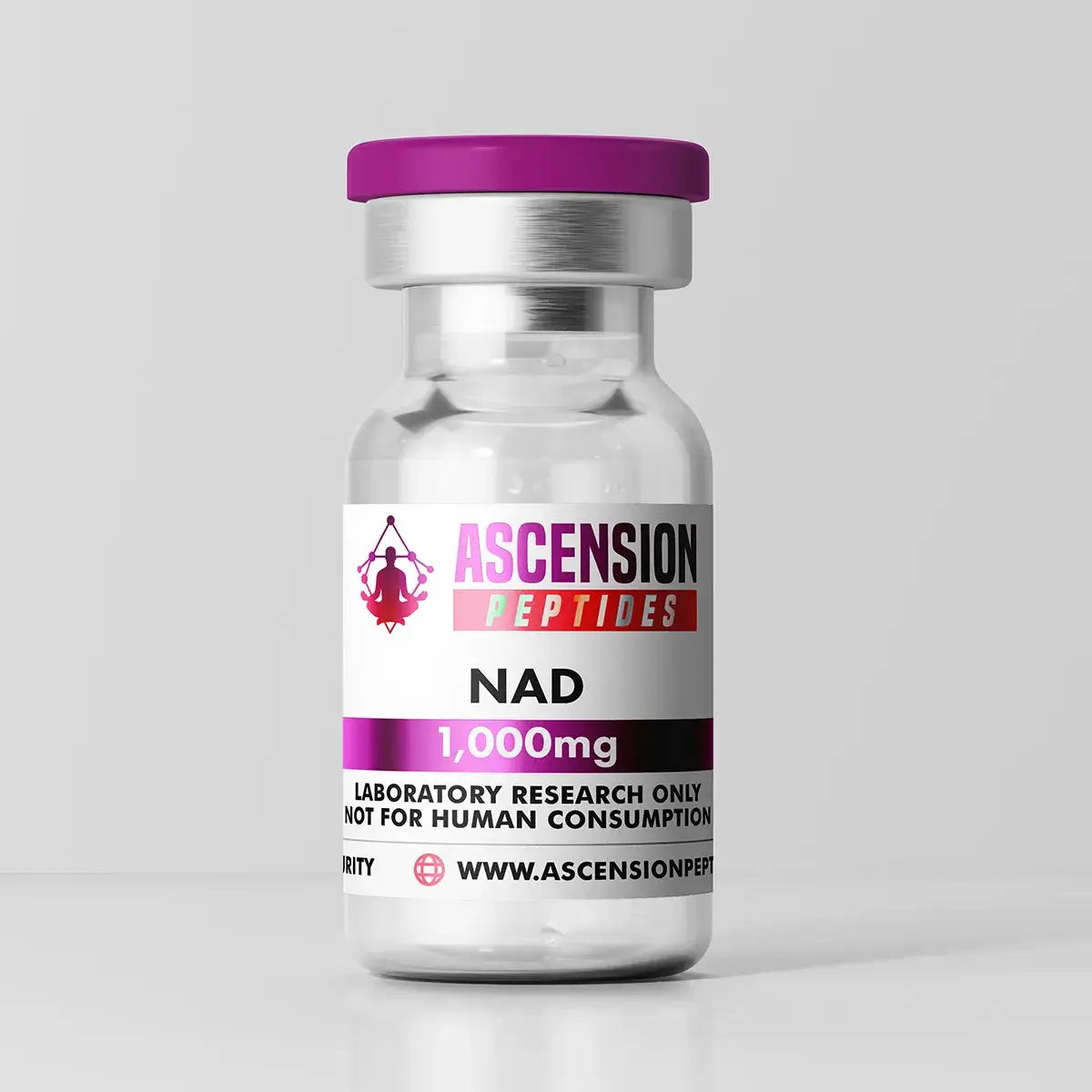
The subcutaneous route below is built around a 1,000mg vial — Ascension stocks it with a batch COA. Mixed to 100mg/mL it holds ten 100mg doses or twenty 50mg doses, so it covers about three weeks at 100mg three times a week and about seven weeks at the more common 50mg.
What NAD+ Does in the Body
NAD+ stands for nicotinamide adenine dinucleotide. Every cell uses it as a coenzyme to turn food into usable energy.
It also serves as a required substrate for two enzyme families: sirtuins and the PARP enzymes involved in DNA repair. Cellular NAD+ levels decline with age, which is the main reason people supplement (Yoshino, Baur and Imai, Cell Metabolism, 2018).
That biology is the rationale behind dosing, not a promise. A higher dose does not repair more DNA or reverse aging, so the goal is a sensible effective dose rather than the largest number you can inject.
Why NAD+ Dosage Differs by Form
The biggest reason NAD+ dosing looks inconsistent is bioavailability. Oral NAD+ gets broken down in the digestive tract before much of it reaches circulation.
That is why oral doses look huge on paper. A 500mg capsule is not remotely comparable to a 500mg injection.
NMN changes the math because it is a precursor. Your body converts NMN into NAD+ inside cells, so oral NMN tends to work better milligram for milligram than oral NAD+ itself.
Injectable NAD+ skips the gut. So the dose can be dramatically lower while still producing a much stronger effect. IV goes one step further because it delivers everything directly into circulation.
NAD+ Dosage Chart by Form
This NAD+ dosage chart shows the effective dose range and rough bioavailability for each form, so you can match the number to your delivery method at a glance.
So yes, one person may take 250mg of NMN daily while another uses 100mg injected NAD+ three times weekly, and both can be following sensible protocols. It only looks contradictory if you ignore absorption.
NAD+ Oral Supplement Dosage
For oral NAD+, the practical range is usually 500-1,000mg per day. Most of the human literature on oral NAD+ pathway support uses daily dosing in the 300-1,000mg range.
For NMN, 250-500mg per day is the evidence-backed sweet spot. Some people go to 1,000mg daily, especially in longevity circles, but that is not where most people need to start.
NR, or nicotinamide riboside, sits in a similar lane. Common dosing is 250-500mg per day, with good tolerability in many studies.
- Oral NAD+: 500-1,000mg/day
- NMN: 250-500mg/day
- NR: 250-500mg/day
Timing matters a little, but not enough to obsess over. Morning with food is usually easiest because it reduces nausea and lines up with the fact that many users report a mild energy lift.
Some people like taking NMN before training. That can make sense if your main goal is energy or workout output, though honestly consistency matters more than perfect timing.
Oral protocols can be used long term. Some people still cycle them 5 days on and 2 days off because they prefer having a weekly break, but there is no universal rule saying you must do that.
If budget matters, this is where oral NMN really stands out. It is usually the cheapest way to get meaningful daily NAD+ support without needles or clinic visits.
For a direct comparison of the two molecules, see our NAD+ vs NMN guide.
NAD+ Injection Dosage (SubQ)
Subcutaneous NAD+ is where dosing becomes much more efficient. Because it bypasses the gut, 50-100mg can feel far more potent than a much larger oral dose.
Most users do best with three injections per week. Morning tends to be easiest because some people feel wired if they inject later in the day.
Use this NAD+ injection dosage chart to match your subcutaneous dose to your goal:
The vial math is simple, with one catch. NAD+ dissolves slowly; compounding pharmacies make 100-200mg/mL with pH adjustment, and 100mg/mL (10mL per 1,000mg) is the mix the site's calculator and chart use. Use 10mL for 100mg/mL: one unit on a U-100 insulin syringe is then one milligram, and 100mg is a full 1mL barrel.
- 25mg = 0.25mL (25 units)
- 50mg = 0.5mL (50 units)
- 100mg = 1mL (100 units, one site)
- 150-200mg = 1.5-2mL, split across two sites; above what most protocols use
Common injection sites are the abdomen, thigh, and upper arm. Rotate sites weekly. That keeps irritation down and makes adherence much easier over time.
If you want help with the math, use the PeptideDeck reconstitution calculator. It saves a lot of second-guessing.
For a broader breakdown of administration, storage, and expectations, read our NAD+ injections guide.
One practical note. Some people feel a brief warmth or pressure sensation even with SubQ use. That does not always mean the dose is too high. It often just means you moved up too fast.
NAD+ IV Therapy Dosage
IV NAD+ uses the highest dose ranges because it is used in clinics for fast systemic exposure. It is also the form where infusion speed matters the most.
A standard wellness infusion is usually 250-500mg per session. Anti-aging clinics often use 250mg monthly for maintenance or 500mg sessions during a short active phase.
For more aggressive protocols, especially addiction recovery settings, doses can reach 750-1,500mg daily for 5-10 days. That is a clinic protocol, not a casual at-home experiment.
If you are considering clinic therapy specifically, this NAD+ IV therapy article goes deeper on cost, experience, and who tends to benefit most.
IV can be useful, but it is not automatically superior for everyone. For steady long-term use, many people get better value from SubQ or oral NMN.
NAD+ Dosage by Goal
The right NAD+ protocol depends on what you are actually trying to change. Energy support, cognitive performance, healthy aging, and recovery do not always need the same dose or delivery route.
If I had to simplify it, I would say this. Use oral NMN if you want affordable daily support. Use SubQ NAD+ if you want stronger effects with lower total milligrams. Use IV when a clinic protocol specifically makes sense.
That sounds obvious, but people often jump straight to IV because it feels premium. Premium is not always practical.
How to Titrate NAD+ Dosage

Start with the lowest effective dose. Then increase every 1-2 weeks if you are tolerating it well and still want more effect.
This matters because NAD+ side effects are often dose-dependent and speed-dependent. If you ramp too fast, you can convince yourself the compound is the problem when the real issue is the protocol.
Oral protocol
Start at 250mg/day. Increase to 500mg/day after about 2 weeks if tolerated.
SubQ protocol
Start at 25mg. Move to 50mg after two sessions, and to 100mg only if 50mg has done nothing after several weeks.
IV protocol
The clinic controls the drip. Report symptoms immediately so infusion speed can be adjusted.
Signs you may need to lower the dose include persistent nausea, excessive flushing, insomnia, and feeling overstimulated after each dose.
Body weight can matter, but not as much as people assume. A lighter person may start at the low end, while a heavier person may tolerate mid-range dosing faster. Still, route of administration matters much more than body weight alone.
- Under 140 lb: start low
- 140-200 lb: standard starting doses usually fit well
- Over 200 lb: you may tolerate faster titration, but do not skip the starter phase
NAD+ Dosage Side Effects by Dose Range
Low doses tend to be easy. Higher doses are not inherently dangerous in healthy users, but they are much more likely to feel unpleasant if you push too fast.
SubQ doses can also cause a temporary surge feeling, but that is usually milder than a fast IV push. If symptoms are intense, reduce the dose or slow the protocol.
Nausea is the most common reason people quit early. In a lot of cases, dropping the dose for a week fixes it.
Frequently Asked Questions
References
- Yoshino J, Baur JA, Imai SI. NAD+ Intermediates: The Biology and Therapeutic Potential of NMN and NR. Cell Metabolism. 2018. PMID: 30146490.
- Irie J, Inagaki E, Fujita M, et al. Effect of oral administration of nicotinamide mononucleotide on clinical parameters and nicotinamide metabolite levels in healthy Japanese men. Endocrine Journal. 2020. PMID: 32049648.
- Liao B, Zhao Y, Wang D, et al. Nicotinamide mononucleotide and nicotinamide riboside in human health and disease. Frontiers in Nutrition. 2021. PMID: 34646659.
- Martens CR, Denman BA, Mazzo MR, et al. Chronic nicotinamide riboside supplementation is well-tolerated and elevates NAD+ in healthy middle-aged and older adults. Nature Communications. 2018. PMID: 29950598.
- Elhassan YS, Kluckova K, Fletcher RS, et al. Nicotinamide riboside augments the aged human skeletal muscle NAD+ metabolome and induces transcriptomic and anti-inflammatory signatures. Cell Reports. 2019. PMID: 31722284.
- Conze D, Brenner C, Kruger CL. Safety and Metabolism of Long-term Administration of NIAGEN, a nicotinamide riboside chloride supplement, in a randomized trial. Scientific Reports. 2019. PMID: 30659109.
The information in this article is for educational purposes only and does not constitute medical advice. Always consult a healthcare professional before starting any new supplement or compound. Results vary by individual.