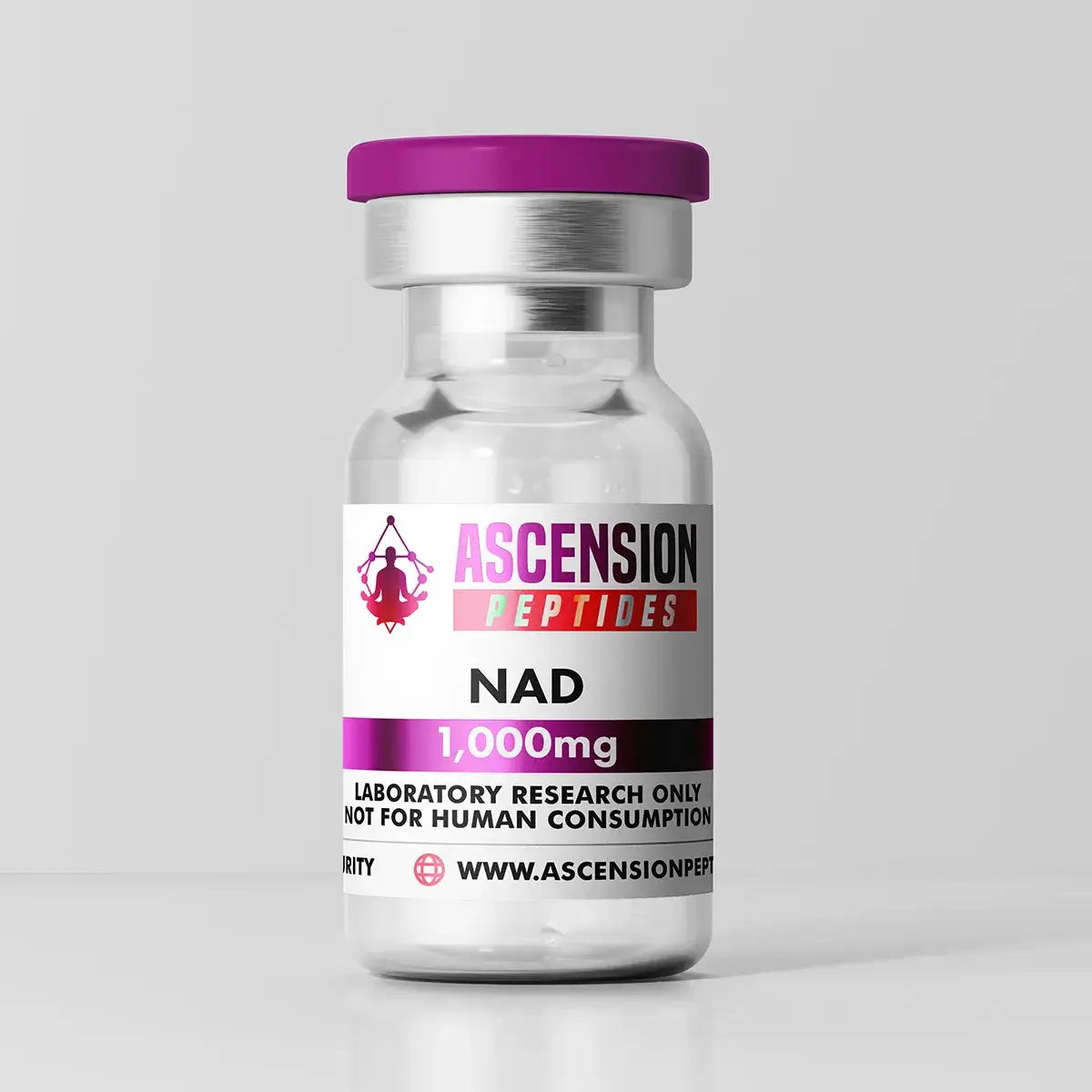

Oral NAD+ supplements barely survive digestion. IV drips cost $500 per session. Subcutaneous NAD+ injections sit in between: bypassing the gut entirely, costing a fraction of IV therapy, and raising blood NAD+ levels within hours.
🔑 Key Takeaways
- What it is: Subcutaneous injection of nicotinamide adenine dinucleotide directly under the skin, bypassing gut absorption entirely
- Bioavailability: Significantly higher than oral supplements (5-15% oral vs near-complete SubQ absorption)
- Dosing range: 25-100mg per injection depending on goal and tolerance
- Speed of effect: Blood NAD+ levels rise within 1-2 hours post-injection
- Cost advantage: $2-8 per 100mg dose at home vs $300-800 per IV session at a clinic
- Self-administered: No clinic visit required once you know the reconstitution and injection process
NAD+ (nicotinamide adenine dinucleotide) is a coenzyme found in every cell of your body. Its levels decline with age, and that decline tracks closely with the metabolic slowdowns associated with aging. The injectable form is simply a way to restore those levels more efficiently than any pill or powder can.
What Are NAD+ Injections?
NAD+ injections deliver the compound directly into subcutaneous tissue (the fat layer just under the skin) or intramuscular tissue. The molecule enters systemic circulation without going through the digestive tract.
Oral NAD+ supplements face a brutal absorption problem. The gut breaks down free NAD+ before it ever reaches the bloodstream. Bioavailability from oral supplementation is estimated at 5-15%. That means most of what you swallow gets destroyed before it does anything.
SubQ injection skips that entirely. The NAD+ absorbs directly into the bloodstream through the capillary network in subcutaneous tissue.
- Available as subcutaneous (SubQ) or intramuscular (IM) injection
- Raises blood NAD+ levels within 1-2 hours post-injection
- Self-administered at home with an insulin syringe
- No clinic required (unlike IV infusions)
- Typically sourced as lyophilized powder, reconstituted with bacteriostatic water before use
The delivery method also matters for dosing. Because SubQ absorption is gradual rather than instantaneous (unlike IV), the peak plasma concentration is lower and the rise is smoother. That can mean fewer side effects like flushing compared to IV at equivalent doses.
NAD+ Injection Benefits
NAD+ is not a single-function molecule. It acts as a substrate and cofactor across multiple cellular pathways. The benefits of injecting it follow from restoring those pathways to higher activity.
Energy and Mitochondrial Function
NAD+ is a required substrate for the electron transport chain, the cellular machinery that produces ATP. Without sufficient NAD+, mitochondria cannot generate energy efficiently. Users consistently report improved energy within days of starting injections.
Cognitive Clarity
NAD+ supports neuronal function by fueling brain cells that are highly ATP-dependent. It also plays a role in BDNF (brain-derived neurotrophic factor) signaling, which supports neuroplasticity. Some users describe a notable sharpening of mental clarity within the first week.
Recovery and Tissue Repair
PARP enzymes (poly ADP-ribose polymerases) consume NAD+ to repair damaged DNA. When NAD+ levels are higher, PARP activity increases. That translates to faster recovery from physical training and tissue damage.
Anti-Aging via Sirtuins
Sirtuins are a family of proteins closely associated with longevity. They require NAD+ as a cofactor to function. Higher NAD+ levels mean more active sirtuins, which regulate inflammation, DNA repair, and metabolic efficiency.
This is the core mechanism behind NAD+'s reputation as an anti-aging compound. It is not a superficial claim. The sirtuin-NAD+ connection is one of the most studied areas in aging biology.
Metabolic Health
NAD+ supports insulin sensitivity and glucose metabolism through its role in the SIRT1 pathway. Studies on NAD+ precursors like NMN and NR show measurable improvements in metabolic markers. Injectable NAD+ delivers the molecule directly, potentially amplifying those effects.
NAD+ Injection Dosage
Dosage depends on your goal: starting protocols begin at 25mg per injection and most settle at 50mg, 2-3x/week, with 100mg as the ceiling for one injection site. For the full protocol broken down by goal, body weight, and delivery form, see the dedicated NAD+ dosage guide.
NAD+ Injections vs IV Therapy vs Oral Supplements
The three delivery methods are not interchangeable. Each has a different cost profile, absorption rate, and practical accessibility. Here is a direct comparison.
IV is the gold standard for maximum delivery but the cost makes it impractical as a regular maintenance tool. Oral NMN and NR are precursors that your body converts to NAD+. They work, but indirectly and inefficiently. SubQ sits between those extremes in the most useful position for most people.
For a detailed breakdown of NAD+ precursors, see our NAD+ vs NMN comparison guide.
How to Do NAD+ Injections at Home
The process is straightforward once you have done it a few times. The reconstitution step is where most beginners make errors, so pay attention to the math.
Supplies You Need

- NAD+ lyophilized powder vial (typically 1,000mg)
- Bacteriostatic water (BAC water) for reconstitution
- Insulin syringe, 29-31 gauge (0.5mL or 1mL)
- Alcohol swabs
- Sharps disposal container
Reconstitute the vial
Add 10mL of bacteriostatic water to a 1,000mg NAD+ vial (or 5mL to a 500mg vial). This gives you 100mg/mL, so one unit on a U-100 syringe is one milligram. NAD+ dissolves slowly; compounding pharmacies make 100-200mg/mL with pH adjustment, and 100mg/mL (10mL per 1,000mg) is the mix the site's calculator and chart use. Swirl gently. Do not shake vigorously.
Draw your dose
At 100mg/mL: 25mg = 25 units (0.25mL), 50mg = 50 units (0.5mL), 100mg = 100 units (a full 1mL). Use the syringe markings to pull the correct volume.
Prepare the injection site
Clean the area with an alcohol swab. Let it dry for 10-15 seconds. Pinch a small fold of skin at the chosen site.
Inject subcutaneously
Insert the needle at a 45-degree angle into the pinched skin fold. Inject slowly and steadily. Withdraw and apply light pressure with the swab.
Rotate injection sites
Alternate between abdomen, upper thigh, and upper arm across sessions. This prevents local tissue irritation and ensures consistent absorption.
Reconstituted NAD+ should be stored in the refrigerator. Most vials remain stable for 2-4 weeks when properly stored with BAC water.
NAD+ Injection Side Effects
Side effects are real but manageable. They are almost entirely dose-dependent, which means starting low resolves most of them before they become a problem.
Common Side Effects
- Flushing: Warmth and redness in the face, neck, or chest. More common at 100mg than at 50mg. Usually fades within 30-60 minutes. Your body adapts over multiple sessions.
- Nausea: Particularly at 100mg if you escalated too quickly. Titrating up slowly over 2-3 weeks largely prevents this.
- Injection site reactions: Mild redness or slight swelling at the injection site is normal and resolves within a few hours.
- Transient fatigue: Some users feel paradoxically tired during the first few sessions. Cells are ramping up metabolic activity. This typically resolves after the first week.
- Headache: Occasional and mild, usually tied to inadequate hydration. Drink water before and after injecting.
Compared to IV NAD+, subcutaneous injections produce milder side effects because the plasma concentration peak is lower and rises more gradually. People who have experienced uncomfortable IV infusions often find SubQ much easier to tolerate.
NAD+ Injection Cost Comparison
Cost is where SubQ injections genuinely shine. The price difference between home injections and clinic-based IV therapy is substantial.
- SubQ NAD+ injection (home): $2-8 per 100mg dose, depending on source and vial size
- IV NAD+ therapy (clinic): $300-800 per session, often requiring a series of 5-10 sessions
- Oral NMN: $1-2 per 250mg dose, but with 5-15% bioavailability the effective cost per unit delivered is higher than it looks
The math is hard to argue with. If you are doing NAD+ injections three times per week at 100mg per session, you are spending roughly $50-100 per month depending on your source. The equivalent IV protocol would cost thousands of dollars monthly.
For a broader look at NAD+ and its precursors, see our full NAD+ peptides guide.
💡 Value Calculation
A 1,000mg NAD+ vial reconstituted at 100mg/mL gives you 20 injections at 50mg or 10 at 100mg. If the vial costs $40-80, that is $2-4 per 50mg injection. Three sessions per week = $24-48 per month at 50mg, or $48-96 at 100mg.
Frequently Asked Questions
References
- Rajman L, Chwalek K, Sinclair DA. Therapeutic Potential of NAD-Boosting Molecules: The In Vivo Evidence. Cell Metab. 2018;27(3):529-547. PMID: 29514063
- Martens CR, Denman BA, Mazzo MR, et al. Chronic nicotinamide riboside supplementation is well-tolerated and elevates NAD+ in healthy middle-aged and older adults. Nat Commun. 2018;9(1):1286. PMID: 29599478
- Yoshino J, Baur JA, Imai SI. NAD+ Intermediates: The Biology and Therapeutic Potential of NMN and NR. Cell Metab. 2018;27(3):513-528. PMID: 29514061
- Birkmayer JG, Vrecko C, Volc D, Birkmayer W. Nicotinamide adenine dinucleotide (NADH): a new therapeutic approach to Parkinson's disease. Comparison of oral and parenteral application. Acta Neurol Scand Suppl. 1993;146:32-5. PMID: 8140328
- Stromsdorfer KL, Yamaguchi S, Yoon MJ, et al. NAMPT-Mediated NAD(+) Biosynthesis in Adipocytes Regulates Adipose Tissue Function and Multi-organ Insulin Sensitivity in Mice. Cell Rep. 2016;16(7):1851-1860. PMID: 27498856
- Mehmel M, Jovanovic N, Spitz U. Nicotinamide Riboside-The Current State of Research and Therapeutic Uses. Nutrients. 2020;12(6):1616. PMID: 32486488
The information in this article is for educational purposes only and does not constitute medical advice. Always consult a healthcare professional before starting any new supplement or compound. Results vary by individual.