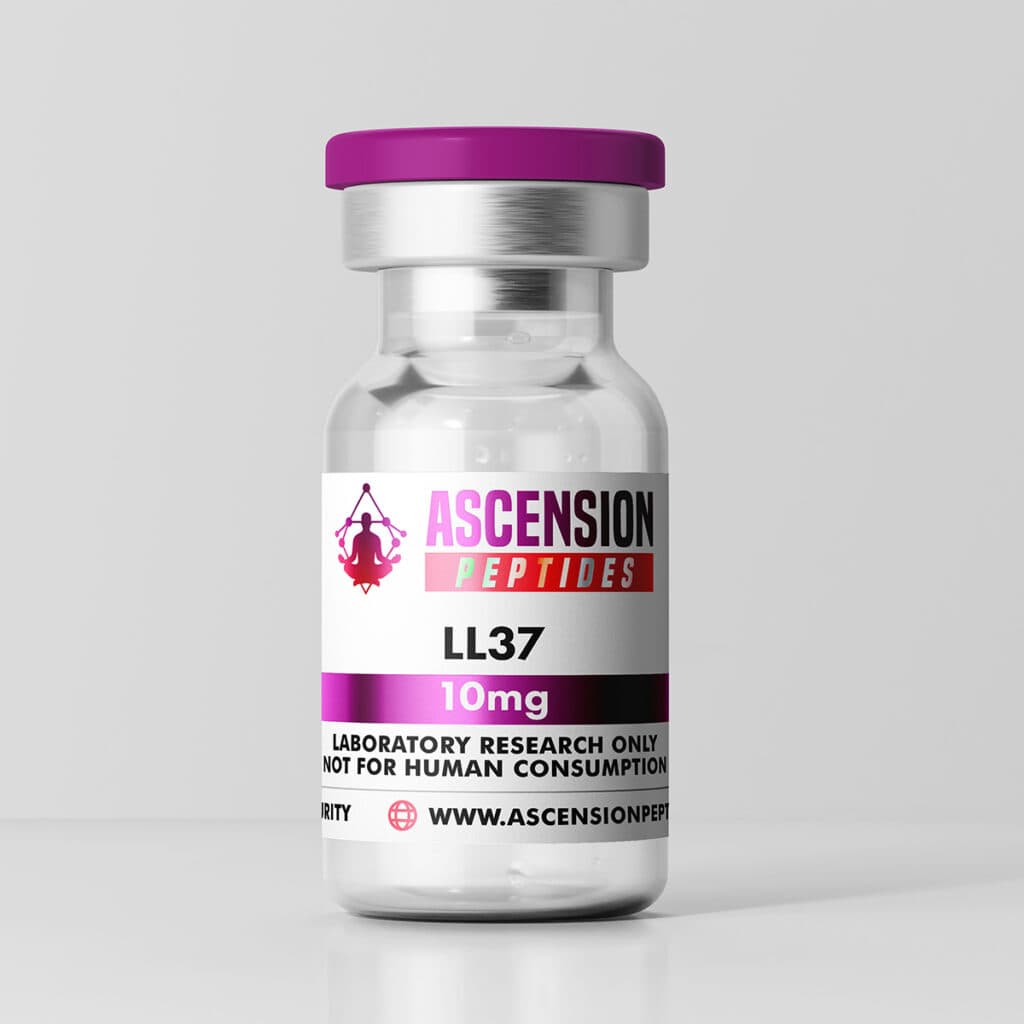
LL-37 is the only cathelicidin antimicrobial peptide made in the human body, a 37-residue, cationic, amphipathic helix released from the precursor protein hCAP18.[1][3] Most LL-37 questions online are really dosing questions: how to reconstitute the lyophilized powder with bacteriostatic water, what route and frequency the research uses, and how long a cycle should run. This guide answers those questions specifically. It walks through the reconstitution math step by step, separates the dosing routes that have actually been tested in humans (topical and intratumoral) from the injectable "research dosing" that circulates in forums, and gives you a clean reconstitution and dosing reference table. For the broader story of what LL-37 is and what it does, see our overview of antimicrobial peptides LL-37 and KPV; this page is the dosing companion to it. Everything here is framed for research context only.
🔑 Key Takeaways
- LL-37 is the single human cathelicidin, a 37-amino-acid peptide of about 4.5 kDa that is cationic (net charge near +6) and folds into an amphipathic alpha-helix once released from hCAP18 by proteolytic cleavage.[1][3]
- The only LL-37 doses ever tested in human trials were topical, applied to wounds at 0.5 to 1.6 mg/mL twice weekly, and intratumoral injections placed directly into melanoma nodules. There is no validated subcutaneous LL-37 protocol.[3][4][5]
- In a Phase I/IIa venous leg ulcer trial, the lower topical concentrations (0.5 and 1.6 mg/mL) sped healing, while the highest (3.2 mg/mL) showed no advantage, a reminder that for LL-37 more is not better.[4]
- Reconstitution is simple division: dose volume equals the dose you want divided by the concentration (mg per mL) you created with bacteriostatic water, then converted to insulin-syringe units.[1]
- LL-37 acts as both antimicrobial and immune modulator, and its effects flip between anti-inflammatory and pro-inflammatory depending on concentration and context, which is one reason injectable dosing is hard to standardize.[2]
- LL-37 is not FDA-approved for any use and is sold for laboratory research only.[3]
What Is LL-37 (Just Enough for Dosing)
LL-37 is the C-terminal active fragment of human cationic antimicrobial protein 18 (hCAP18), the only cathelicidin gene product in people. The 18 kDa precursor is cleaved by proteases to release the mature 37-residue peptide, named for its first two leucine residues.[1][2] Its full sequence is LLGDFFRKSKEKIGKEFKRIVQRIKDFLRNLVPRTES, and that string of lysines and arginines is what makes it strongly cationic with a net charge around +6, folding into an amphipathic alpha-helix with no disulfide bonds.[1][3]
Why does this matter for dosing? Because LL-37 is a relatively large, charged peptide (about 4.5 kDa), it is fragile in solution, so handling and concentration matter. And because it is multifunctional rather than single-target, the same milligram can behave very differently at different concentrations. We keep the biology brief here on purpose; if you want the mechanism and benefits in depth, read our companion piece on antimicrobial peptides LL-37 and KPV and the basics in what are peptides.
What the Human Dosing Evidence Actually Is
This is the most important section, because the honest answer surprises most people: the only LL-37 doses ever studied in humans were delivered topically to wounds or injected directly into tumors, not as a daily subcutaneous shot.
Topical wound dosing (the strongest human data)
A first-in-human Phase I/IIa trial in hard-to-heal venous leg ulcers enrolled 34 patients and applied LL-37 topically to the wound bed at 0.5, 1.6, or 3.2 mg/mL twice weekly for four weeks. The two lower concentrations clearly accelerated healing (mean ulcer area fell about 68 percent at 0.5 mg/mL and 50 percent at 1.6 mg/mL), while the highest 3.2 mg/mL concentration was no better than placebo.[4] A larger Phase IIb study (HEAL LL-37) then treated 148 patients with the 0.5 or 1.6 mg/mL topical doses twice weekly; the drug was well tolerated and safe at both strengths, though the overall efficacy result was mixed and a benefit was strongest in patients with large ulcers.[5]
Intratumoral dosing
The other human route is direct tumor injection. A completed Phase 1 trial injected LL-37 into cutaneous melanoma metastases on a weekly schedule to test its anticancer potential.[3] This is a clinician-administered, image-guided research setting, not anything an individual can replicate at home.
The gap nobody mentions
The "LL-37 dosage" most people are searching for, a reconstituted subcutaneous injection of a few hundred micrograms per day, has never been validated in a human clinical trial. Those numbers come from vendor sheets and community protocols, not from the published research, which used topical and intratumoral routes. Treat any injectable LL-37 dose as an unvalidated experiment, not an established protocol.[3][4][5]
How to Reconstitute LL-37
LL-37 ships as a lyophilized (freeze-dried) white powder that has to be dissolved before it can be measured or used. The diluent of choice is bacteriostatic water, which contains 0.9 percent benzyl alcohol to limit microbial growth across a multi-day vial. Our full bacteriostatic water guide and the step-by-step how to reconstitute peptides walkthrough cover the technique in detail; the short version follows.
The five steps
1. Let both vials reach room temperature, then wipe both stoppers with alcohol. 2. Decide how much bacteriostatic water to add (this sets your concentration, see the table). 3. Draw the water with a syringe and inject it slowly down the inside wall of the peptide vial, never blasting it directly onto the powder. 4. Do not shake. Swirl gently or let it sit until the LL-37 fully dissolves into a clear solution. 5. Label the vial with the date and concentration, and refrigerate.
The math in one line
Concentration equals total peptide mass divided by the volume of water you add. So 5 mg of LL-37 reconstituted with 2 mL of bacteriostatic water gives 2.5 mg/mL, which is the same as 2,500 mcg per mL. To find the volume for a given research dose, divide the dose by that concentration. On a U-100 insulin syringe, 1 mL equals 100 units, so 0.1 mL equals 10 units. If you would rather not do the arithmetic by hand, our peptide unit conversion calculator converts mg, mcg, mL, and U-100 units for you.
Two practical notes. More dilute solutions (more water per milligram) make small research amounts easier to measure, because each syringe unit carries less peptide. And the 250 mcg figure in the table is only a worked example to show the arithmetic, not a recommended dose; swap in whatever amount your research protocol specifies and the division works the same way.
Reported Research Dosing: Route, Frequency, and Cycle Length
Because there is no approved human injectable protocol, the table below separates what the published trials actually used from the anecdotal injectable ranges that circulate online. The clinical rows are evidence-based; the anecdotal row is explicitly not.
Frequency and route in practice
The trial route that worked was topical, applied just twice weekly, which tells you that LL-37 does not need constant exposure to influence a wound. The injectable subcutaneous route many forum protocols describe has no trial behind it, so frequency claims (daily, every other day, and so on) are guesses. If you are weighing injection routes generally, our comparison of subcutaneous versus intramuscular injection for peptides and the practical how to inject peptides guide cover technique, though neither makes LL-37 itself a proven injectable.
Cycle length
There is no established LL-37 cycle. The clinical topical courses ran about four weeks; community injectable "cycles" usually mimic other research peptides with two to four week blocks followed by time off, but that pattern is borrowed, not validated for LL-37. A defensible conservative stance is to treat any self-directed use as short and experimental rather than open-ended, since the dose-response data we do have showed that pushing the concentration higher backfired.[4]
Why higher is not better with LL-37
LL-37 is a double-edged immune modulator. It can suppress pro-inflammatory cytokines and neutralize bacterial endotoxin at some concentrations, yet promote inflammation, mast cell activation, and cell stress at others.[2] That concentration-dependent flip is the likely reason the highest 3.2 mg/mL topical dose lost its benefit in the wound trial, and it is exactly why escalating an unvalidated injectable dose is risky.[2][4]
Storage and Stability
Keep the dry, unreconstituted vial frozen or refrigerated and out of light. Once reconstituted, refrigerate at roughly 2 to 8 degrees Celsius and use within a few weeks, discarding sooner if the solution turns cloudy or shows particulates. Avoid freeze-thaw cycles and never shake it, since agitation and temperature swings degrade fragile peptides. Our guide on how to store peptides so they actually last goes deeper on shelf life and cold-chain handling.
Side Effects and Safety
In the controlled topical wound trials, LL-37 was well tolerated and safe at the 0.5 and 1.6 mg/mL strengths, with adverse events that were mostly mild to moderate and no treatment-related deaths.[5] That reassurance applies to a defined topical formulation under medical supervision, not to homemade subcutaneous injections. Because LL-37 modulates immune signaling in a context-dependent way and can trigger mast cell degranulation and inflammatory responses at the wrong concentration, an unstandardized injectable dose carries unknowns the trials never measured.[2] For a structured look at how injectable peptides can go wrong, see our peptide side effects guide, and for the legal picture read are peptides legal. LL-37 is not FDA-approved and is sold for research use only.[3]
How LL-37 sits next to related peptides
People researching LL-37 for gut or immune reasons often compare it with other compounds. The shorter tripeptide KPV is the usual partner for gut and anti-inflammatory research, BPC-157 is the go-to tissue-repair option, and on the immune side the more clinically developed thymosin alpha-1 offers useful context. None of these change LL-37's own dosing, but they explain why people reconstitute it in the first place.

Frequently Asked Questions
Bottom Line
LL-37 dosing is mostly an exercise in honesty. The real human evidence is a topical wound formulation applied at 0.5 to 1.6 mg/mL twice weekly and an intratumoral melanoma injection, both clinician-administered, with the clear lesson that the highest concentration was not the best.[3][4][5] The reconstitution math itself is straightforward: dissolve the lyophilized vial in bacteriostatic water, and dose volume equals desired amount divided by concentration, then converted to insulin-syringe units.[1] What does not exist is a validated subcutaneous LL-37 protocol, so the daily injectable "dosage" people search for is an extrapolation, not a standard, and one made riskier by LL-37's concentration-dependent flip between calming and stoking inflammation.[2] If you are going to handle it, keep the chemistry careful, treat any self-directed use as short and experimental, and involve a qualified clinician before considering any peptide.
References
- LL-37: Structures, Antimicrobial Activity, and Influence on Amyloid-Related Diseases. (peer-reviewed review) PMC10968335.
- Cathelicidin Host Defense Peptides and Inflammatory Signaling: Striking a Balance. Front Microbiol 2020;11:1902 (10.3389/fmicb.2020.01902).
- Renovation as innovation: Repurposing human antibacterial peptide LL-37 for cancer therapy. Front Pharmacol 2022;13:944147 (PMC9445486).
- Gronberg A, et al. Treatment with LL-37 is safe and effective in enhancing healing of hard-to-heal venous leg ulcers: a randomized, placebo-controlled clinical trial. Wound Repair Regen. 2014 (PMID 25041740).
- Mahlapuu M, et al. Evaluation of LL-37 in healing of hard-to-heal venous leg ulcers: a multicentric prospective randomized placebo-controlled clinical trial. Wound Repair Regen. 2021 (PMC9298190).