If you have ever stared at a vial labeled "5 mg" and a syringe marked in "units" and felt your stomach drop, you are not alone, and the stakes are higher than they look. The single most common cause of serious peptide and GLP-1 dosing errors is not bad math skills, it is the collision of three different measurement systems on one workspace: milligrams (mg), micrograms (mcg), international units (IU), milliliters (mL), and the "units" printed on an insulin syringe. The U.S. Food and Drug Administration has documented hospitalizations from exactly this confusion, including a provider who prescribed "20 units instead of 2 units," giving three patients ten times the intended dose.[1] This guide is a plain-English unit conversion calculator and reference hub: it explains what each unit actually means, gives you the exact formulas, and provides ready-made conversion tables so you can check any peptide dose three ways before you ever touch a needle.
🔑 Key Takeaways
- mg, mcg, and mL measure mass and volume; IU and "units" do not. Milligrams and micrograms measure how much compound there is; milliliters measure liquid volume; international units (IU) measure biological activity; and the "units" on an insulin syringe are just volume marks (1 unit = 0.01 mL).
- The only number that changes with your mixing is the concentration. Concentration (mg per mL) depends entirely on how much bacteriostatic water you add when you reconstitute. Get that wrong and every dose is wrong.
- IU is not a fixed weight. One IU equals a different number of milligrams for every substance, because it is defined by a WHO reference preparation, not by mass.[2] So "1 mg = 3 IU" is true for HGH but meaningless for, say, HCG.
- Insulin-syringe "units" are a volume trap. On a standard U-100 syringe, 1 "unit" mark is 0.01 mL. It tells you nothing about how many milligrams of peptide you drew until you also know the concentration.
- Always cross-check a dose two ways. Confirm both the milligrams you intend and the syringe volume that delivers them. FDA has tied real overdoses, some requiring hospitalization, to people confusing mg, mL, and units.[1]
Why Peptide Unit Conversion Is So Confusing (and So Dangerous)
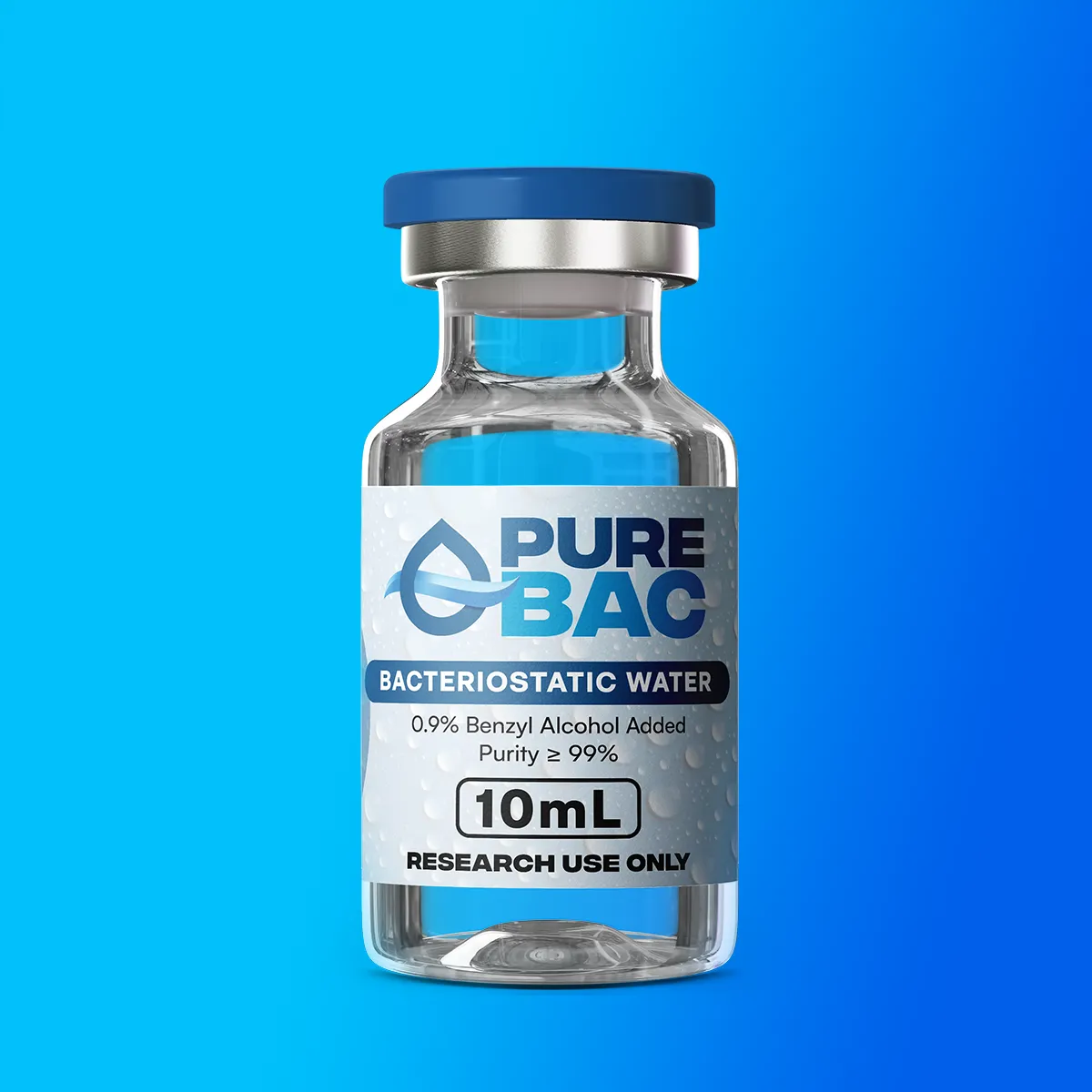
Most prescription drugs come in a finished, fixed dose: one tablet, one pre-filled pen click, one labeled syringe. Research peptides and many compounded products do not. They arrive as a lyophilized (freeze-dried) powder in a vial labeled by mass, for example "10 mg," and you create the liquid yourself by adding bac water for peptides. That single act of mixing is where the confusion starts, because the milligrams in the vial never change, but the concentration (milligrams per milliliter) is whatever your dilution makes it.
The FDA has been explicit that this is a safety problem, not a theoretical one. In its alert on compounded semaglutide, the agency reported adverse events "some requiring hospitalization" that "may be related to overdoses due to dosing errors." It named the root cause directly: "Unfamiliarity with withdrawing medication from a vial into a syringe ... coupled with confusion between different units of measurement (e.g., milliliters, milligrams and 'units') may have contributed to dosing errors."[1] Concrete examples from those reports include a provider who "prescribed 20 units instead of 2 units, affecting three patients who, after receiving 10 times the intended dose, experienced nausea and vomiting," and another who intended "0.25 milligrams (5 units), but prescribed 25 units instead," producing a fivefold overdose and severe vomiting.[1]
The lesson is simple: the units are not interchangeable, and your brain cannot eyeball the conversion. You need the definitions and the formulas. If you want the full mixing walkthrough rather than just the math, our step-by-step guide on how to reconstitute peptides pairs naturally with this page.
The Five Units, Plainly Defined
Before any calculator helps you, you have to know what each label actually measures. They fall into two camps: mass/volume units (these convert with simple arithmetic) and activity units (these do not).
The "unit" vs "IU" trap that causes most errors
An insulin syringe is marked in "units" because it was designed for insulin, which is dosed in international units. But the marks themselves are just a volume scale: on a U-100 syringe, the whole 1 mL barrel is 100 "units," so 1 unit = 0.01 mL, 10 units = 0.1 mL, 50 units = 0.5 mL.[3][4] When you use that same syringe for a peptide, the "units" no longer mean international units of anything. They are only telling you the volume. To know the dose in milligrams, you must multiply that volume by your concentration. People who skip that step are the ones FDA found injecting 10x overdoses.[1]
What an International Unit (IU) Actually Is
An international unit is a measure of biological activity, set by the World Health Organization through its Expert Committee on Biological Standardization. The WHO establishes a highly purified reference preparation (an "International Standard"), and one IU is defined as the activity contained in a fixed quantity of that physical reference, not by any mass. As the UK's National Institute for Biological Standards and Control (NIBSC, which supplies WHO standards) puts it, the IU is used "when physico-chemical determination ... e.g. mass, is not possible or not appropriate," and "is defined by the contents of the ampoule or vial."[2]
This is why you cannot memorize a single "IU to mg" number. The mass equivalent of one IU is different for every substance. For recombinant human growth hormone (somatropin), the WHO Second International Standard assigned a specific activity of 3.0 IU per mg.[5][6] So for HGH, and only HGH, 1 mg = 3 IU. For human chorionic gonadotropin (HCG), potency is "standardized by a biological assay procedure" and labeled in units (a Pregnyl vial holds 10,000 USP units), with no clean per-milligram label conversion, which is exactly why HCG is prescribed in units rather than milligrams.[7][8]
Reference: which peptides use which unit
The Three Conversions You Actually Need
Almost every real-world peptide question reduces to three calculations. Master these and you never need a phone app.
1. mg to mcg (and back)
This is the easy one, pure arithmetic with no concentration involved.
- mg to mcg: multiply by 1000. (0.25 mg = 250 mcg)
- mcg to mg: divide by 1000. (500 mcg = 0.5 mg)
2. Find your concentration (mg per mL)
This is the master number. Everything downstream depends on it.
Concentration (mg/mL) = peptide in vial (mg) ÷ water added (mL)
Example: a 10 mg vial reconstituted with 2 mL of bacteriostatic water gives a concentration of 10 ÷ 2 = 5 mg/mL. Add only 1 mL instead and the concentration doubles to 10 mg/mL, which means every volume you draw now delivers twice the dose. This is the most important sentence on this page.
3. Convert your target dose into a syringe volume
Once you know the concentration, you can turn any milligram (or microgram) dose into the number of "units" on an insulin syringe.
Volume to draw (mL) = desired dose (mg) ÷ concentration (mg/mL)
Syringe "units" = volume (mL) × 100 (on a U-100 syringe)[3][4]
Example: you want 0.5 mg from a vial mixed to 5 mg/mL. Volume = 0.5 ÷ 5 = 0.1 mL. On a U-100 syringe that is 0.1 × 100 = 10 units. So you draw to the "10" mark. For the full conceptual walkthrough with worked examples, see our companion explainer on how to calculate peptide doses.
The 4-step safety check, every single time
1. Read the vial: how many mg of peptide? 2. Note how many mL of water you added, and compute mg/mL. 3. Decide your dose in mg (or mcg, then convert). 4. Divide dose by concentration to get mL, multiply by 100 for syringe units. Then sanity-check: does the volume look reasonable for that syringe? A "dose" that fills most of a 1 mL barrel for a microgram peptide is a red flag, stop and recompute.
Ready-Made Conversion Tables (No Math Required)
Use these as a printable cheat sheet. The first table is universal; the rest are pre-solved for the most common reconstitution concentrations.
Table A: Universal units-to-mL on a U-100 syringe
This table is true for any liquid in a U-100 syringe because it only converts volume.[3][4]
Table B: 5 mg vial + 2 mL water (concentration = 2.5 mg/mL)
Table C: 10 mg vial + 2 mL water (concentration = 5 mg/mL)
Table D: HGH (somatropin) mg and IU equivalents
Because HGH has a fixed WHO specific activity of 3 IU per mg, its mg and IU labels convert cleanly.[5][6] FDA-approved Humatrope cartridges illustrate this exactly: 6 mg = 18 IU, 12 mg = 36 IU, 24 mg = 72 IU.[6]
Weight-Based Dosing: kg and lb
Some peptides and most pediatric or research dosing are expressed per kilogram of body weight, for example "0.006 mg/kg daily." If you only know your weight in pounds, convert first.
- lb to kg: divide by 2.205. (180 lb ÷ 2.205 = 81.6 kg)
- kg to lb: multiply by 2.205. (80 kg × 2.205 = 176 lb)
Worked example: a 0.006 mg/kg dose for an 81.6 kg (180 lb) person = 0.006 × 81.6 = 0.49 mg, which is roughly 490 mcg. Then run that through your concentration to get the syringe volume.
Worked Example, Start to Finish
You bought a 10 mg vial of a peptide and want to take 500 mcg per dose using U-100 insulin syringes.
- Standardize the dose: 500 mcg = 0.5 mg.
- Reconstitute: add 2 mL of bacteriostatic water. Concentration = 10 mg ÷ 2 mL = 5 mg/mL.
- Volume per dose: 0.5 mg ÷ 5 mg/mL = 0.10 mL.
- Syringe units: 0.10 mL × 100 = 10 units. Draw to the "10" mark.
- Doses per vial: 10 mg total ÷ 0.5 mg per dose = 20 doses.
Now change one variable to see the danger: if you had added only 1 mL of water instead of 2 mL, the concentration would be 10 mg/mL, and that same "10 units" (0.1 mL) would deliver 1 mg, double your intended dose. The volume mark looks identical; only the concentration changed. This is precisely the kind of silent error behind FDA's reported overdoses.[1]
How This Hub Differs From Our Drug-Specific Calculators
This page is the generic conversion engine: the units, the formulas, and the universal tables that apply to any peptide. When you want a calculator pre-loaded for one specific drug, with that drug's typical vial sizes and titration schedule baked in, use the dedicated guides instead. For tirzepatide, our tirzepatide dosage in units (mg to U-100 conversion) guide solves the whole chart for you. For storage, stability, and how long a reconstituted vial lasts, see how to store peptides. And for the physical injection technique once your math is done, our subcutaneous injection guide walks through it step by step.
Common Conversion Mistakes to Avoid
- Treating "units" as IU. Syringe units are volume marks (0.01 mL each), not international units.[3] They only become a dose once multiplied by concentration.
- Forgetting that water volume sets the dose. The vial's milligrams are fixed; the concentration is whatever you mixed. Always write down how much water you added.
- Assuming one IU-to-mg number works for everything. 3 IU = 1 mg is HGH only.[5] It is wrong for HCG, insulin, or anything else.
- Slipping a decimal between mg and mcg. 0.25 mg and 250 mcg are the same; 25 mcg is 10x smaller. Convert deliberately.
- Using the wrong syringe. Drawing a U-100 dose with a non-insulin syringe, or vice versa, scrambles the unit marks. FDA links syringe-selection mistakes to serious dosing errors.[1][9]
Frequently Asked Questions
References
- U.S. Food and Drug Administration. FDA Alerts Health Care Providers, Compounders and Patients of Dosing Errors Associated with Compounded Injectable Semaglutide Products.
- National Institute for Biological Standards and Control (NIBSC), WHO. International Standards and International Units (IU).
- U.S. FDA. Humulin R U-100 (insulin human) label: U-100 = 100 units per mL.
- American Diabetes Association. Insulin Basics: U-100 concentration (100 units/mL).
- Bristow AF, et al. The Second International Standard for Somatropin (recombinant DNA-derived human growth hormone): preparation and calibration. PubMed PMID 11580214. Specific activity 3.0 IU/mg.
- U.S. FDA / DailyMed. Humatrope (somatropin) label: 6 mg (18 IU), 12 mg (36 IU), 24 mg (72 IU).
- U.S. FDA. Pregnyl (chorionic gonadotropin, HCG) label: 10,000 USP units per vial, standardized by biological assay.
- Betz D, Fane K. Human Chorionic Gonadotropin. StatPearls, NCBI Bookshelf.
- NIBSC. Somatropin WHO International Standard (98/574), specific activity 3.0 IU/mg.