The needle is the easy part. Injecting sermorelin feels like a quick pinch for most people, and it takes less time than brushing your teeth. What goes wrong is everything around the needle: a half-inch needle in a lean arm, a snack 40 minutes before bed, the same spot on the belly every night. Each of those quietly shrinks the growth hormone pulse you are paying for.
🔑 Key Takeaways
- The one spot on your belly to leave alone, and why the back of the arm is harder than it looks
- Why a half-inch needle can end up in muscle if you are lean, and the length that avoids it
- The bedtime snack that can wipe out most of a sermorelin pulse
- The syringe mistake that makes a 10 mg vial hard to dose accurately
- What a small red bump after the shot means, and the signs that should not wait until morning
This guide covers the injection itself: where, with what, when and how. For how many micrograms to take, the sermorelin dosage chart has the tiers and the weekly schedule. Everything below assumes you already know your dose and want every shot to count.
What Injecting Sermorelin Involves
One small shot, once a night. Sermorelin goes under the skin into the fat layer, not into muscle. It is a subcutaneous injection, the same kind people with diabetes give themselves several times a day with insulin.
The only approved version, Geref, was dosed exactly this way. In the Geref International Study Group trial, 110 children with growth hormone deficiency took 30 mcg/kg under the skin at bedtime, and their average growth rate rose from 4.1 cm a year to 8.0 cm a year by month six. A 1999 review of the drug listed pain at the injection site and brief facial flushing as the most common side effects.
So the method is settled. What decides whether it works well for you are four details: the site, the needle, the timing and the rotation.
What You Need Before the First Shot
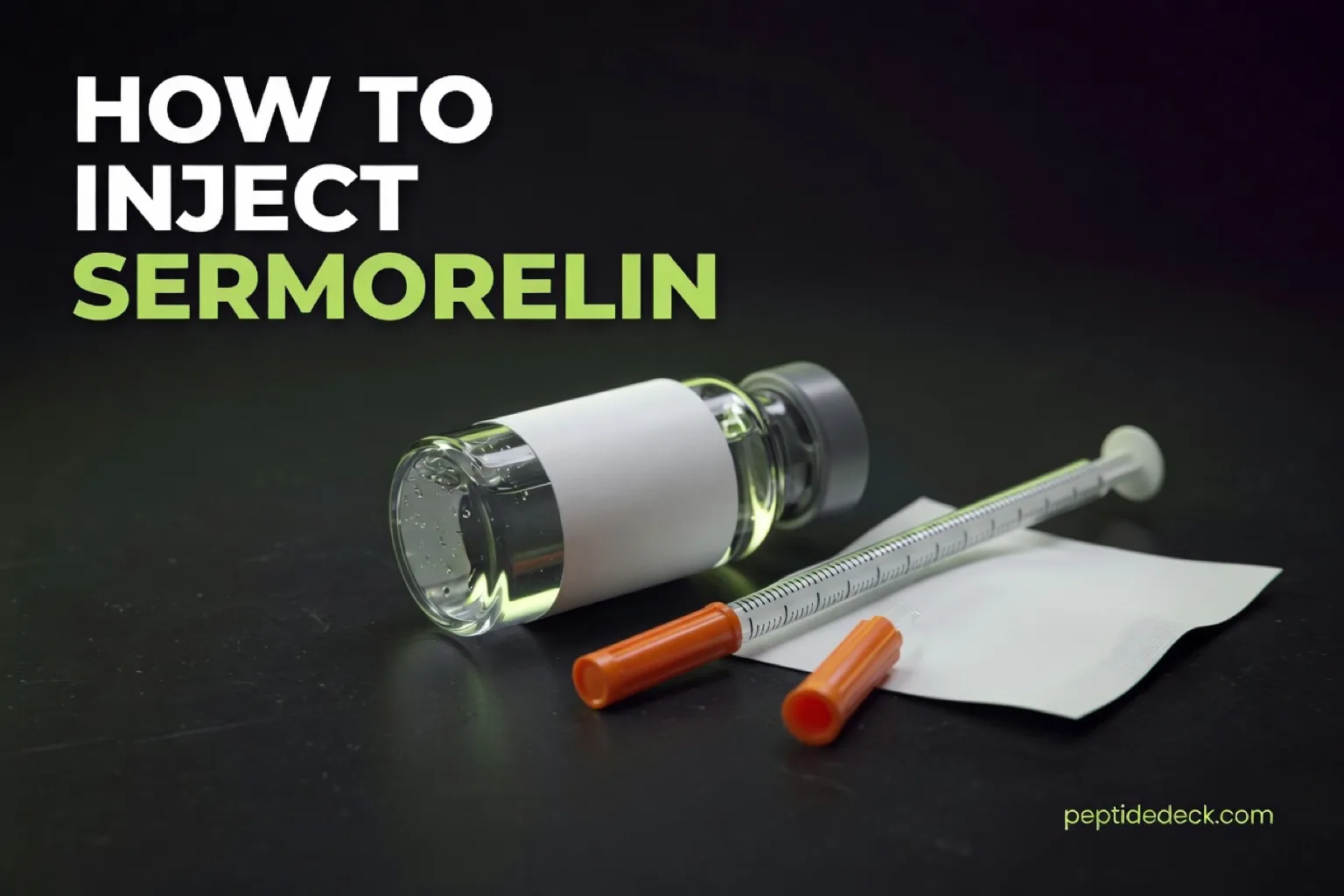
Five things, laid out on a clean surface:
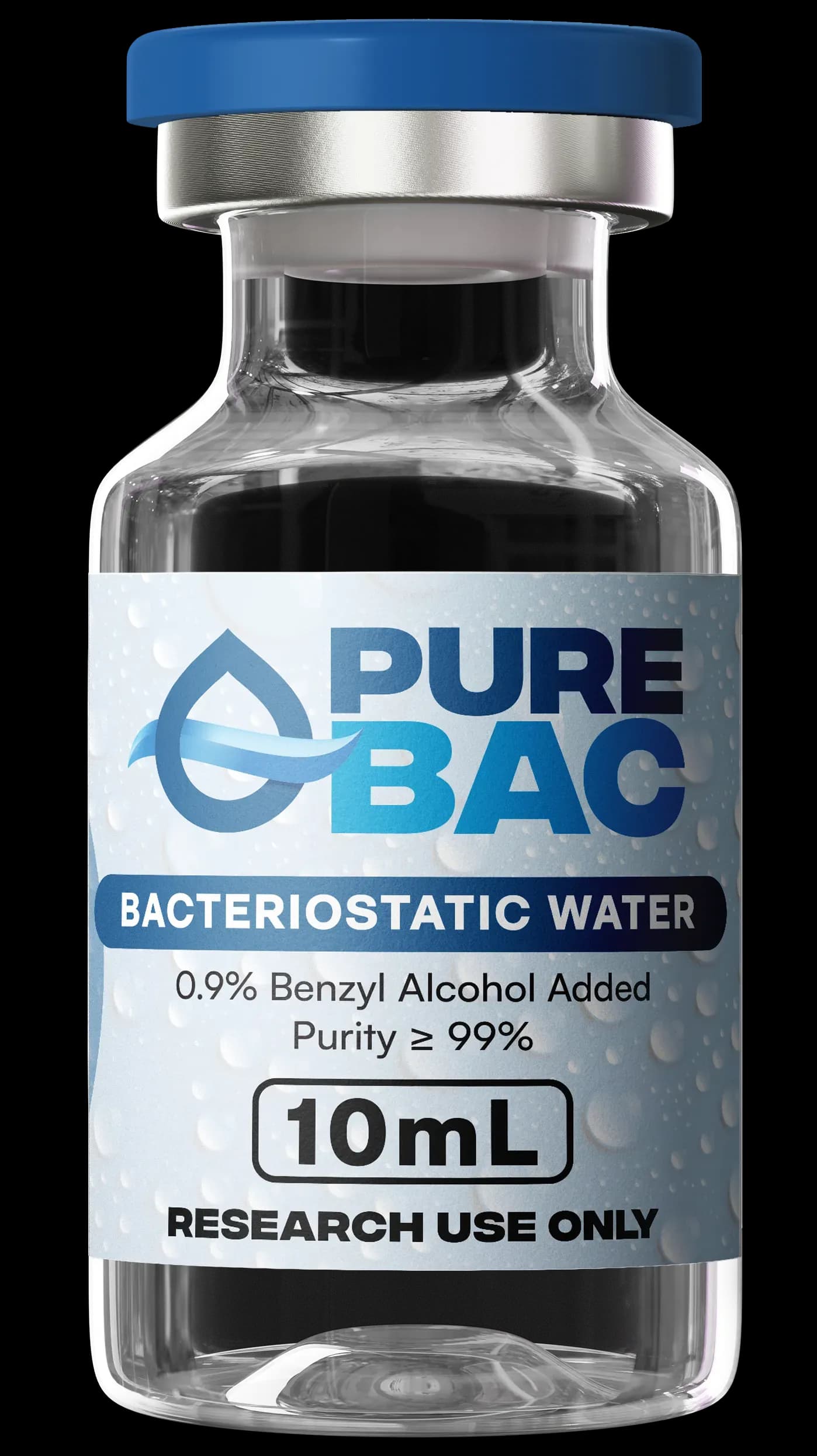
- Your mixed sermorelin vial, taken out of the fridge a few minutes early so it is less cold going in. If it is still powder, mix it first with the steps in how to reconstitute peptides, using bacteriostatic water for a multi-dose vial.
- A new U-100 insulin syringe, 29 to 31 gauge, with the shortest needle you can get (more on that below).
- Two alcohol pads: one for the vial stopper, one for your skin.
- A sharps container, or a thick plastic bottle with a screw cap until you get one.
- A way to log the site: a note on your phone is enough.
Pick the syringe that fits your dose
Every U-100 syringe uses the same scale: 100 units equals 1 mL. The barrel size changes how finely you can read it. That matters more with sermorelin than most people expect, because a 10 mg vial makes a strong solution and your dose ends up at a single-digit number of units.
Worked example: 10 mg sermorelin vial, 300 mcg dose
- Mixed with 2 mL water: 10,000 mcg ÷ 2 mL = 5,000 mcg per mL, so 1 unit = 50 mcg and 300 mcg = 6 units
- Mixed with 3 mL water: 3,333 mcg per mL, so 1 unit ≈ 33 mcg and 300 mcg = 9 units
- On a 1 mL (100-unit) syringe, the marks are 2 units apart, so being one mark off is a third of your dose
- On a 0.3 mL (30-unit) syringe, the marks are 1 unit apart (half-units on some brands), which is why it is the better pick for small draws
Different vial or water volume? The peptide calculator gives you the exact units for any combination.
Where to Inject Sermorelin: The 4 Sites
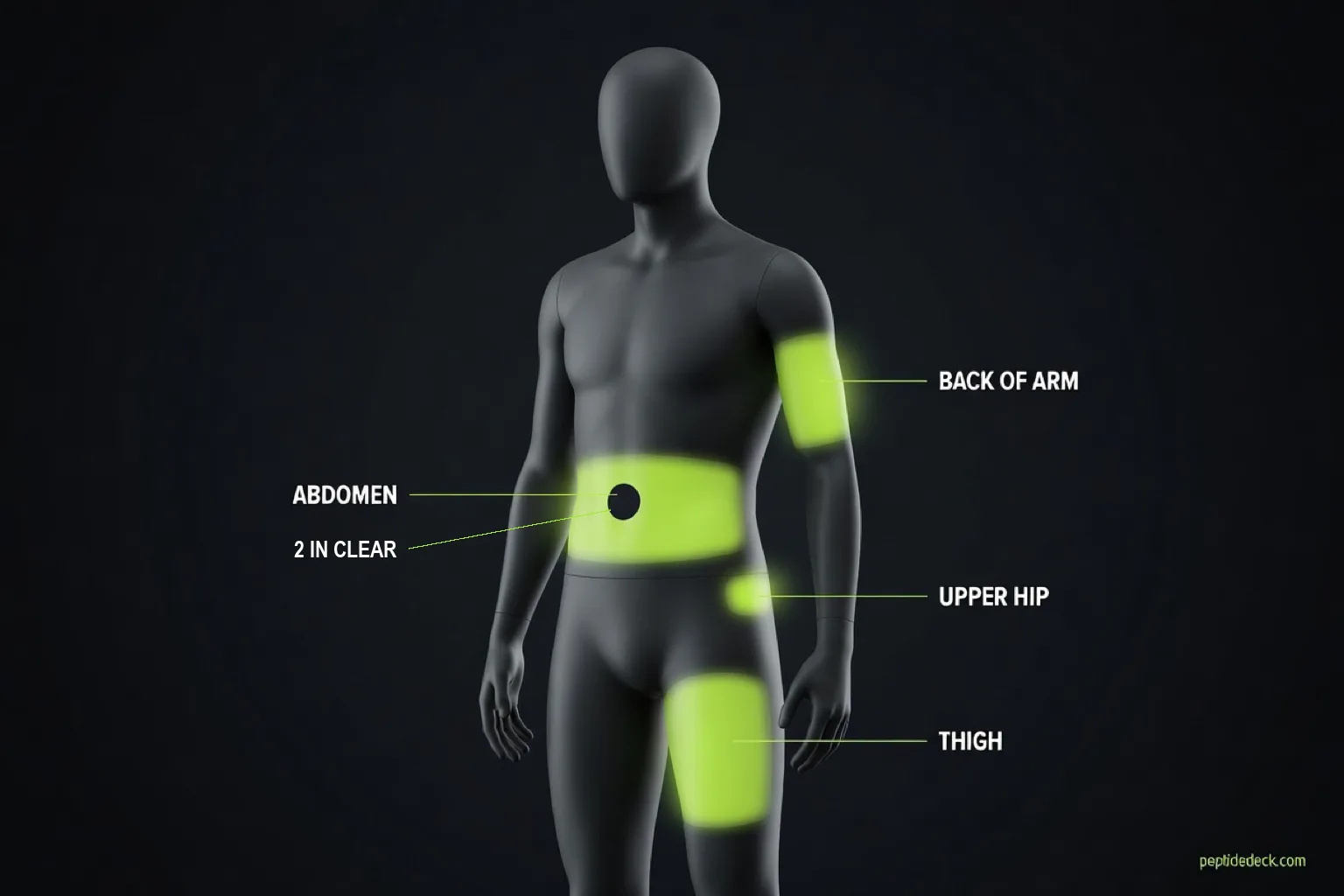
Any spot with a pinchable layer of fat works. MedlinePlus, the US National Library of Medicine's patient guide, names the same areas used for insulin: the belly, the outer thighs and the upper arms. The upper outer hip is the fourth option most clinics add.
1. Abdomen (the default)
Below the ribs, above the hip bones, and at least 2 inches from your belly button. It has the thickest fat layer of the easy-to-reach sites and gives you the most room to rotate. Most people start here and never leave.
2. Outer thigh
The outer side of the upper thigh, a hand's width below the hip and above the knee. You can see what you are doing, which helps on the first few nights. The fat is thinner here, so the needle length matters more.
3. Back of the upper arm
The fleshy area at the back or side, at least 3 inches below the shoulder and 3 inches above the elbow. It is hard to pinch with one hand, which is why many people only use it with a partner's help.
4. Upper outer hip
The fatty area just below the waistline at your side, the "love handle". It often holds fat even in lean people, but you have to twist to reach it.
How these compare, using ultrasound data from 388 US adults with diabetes (average fat thickness per site):
Does the site change your results? We found no study comparing sermorelin absorption by site. For a shot meant to trigger one pulse at bedtime, doing it cleanly every night matters more than which site you pick. Choose the one you can do well, and rotate within it. The same site logic applies to other GH peptides, which is why our CJC-1295 and ipamorelin injection guide lands on the same four areas.
Sermorelin Needle Size: Why Shorter Wins
Your skin is thinner than you think. In the same ultrasound study, skin averaged just 1.9 to 2.4 mm thick at every site, in every body type. A needle only needs to pass that layer to reach the fat.
Longer needles overshoot. The researchers concluded that needles of 8 mm or more, inserted straight in, may often enter muscle in the arms and thighs of men and anyone with a BMI under 25. The 2016 FITTER injection recommendations, written by 183 diabetes experts, went further: the shortest needles (6 mm on a syringe) are safe, effective and less painful, and should be the first choice for everyone.
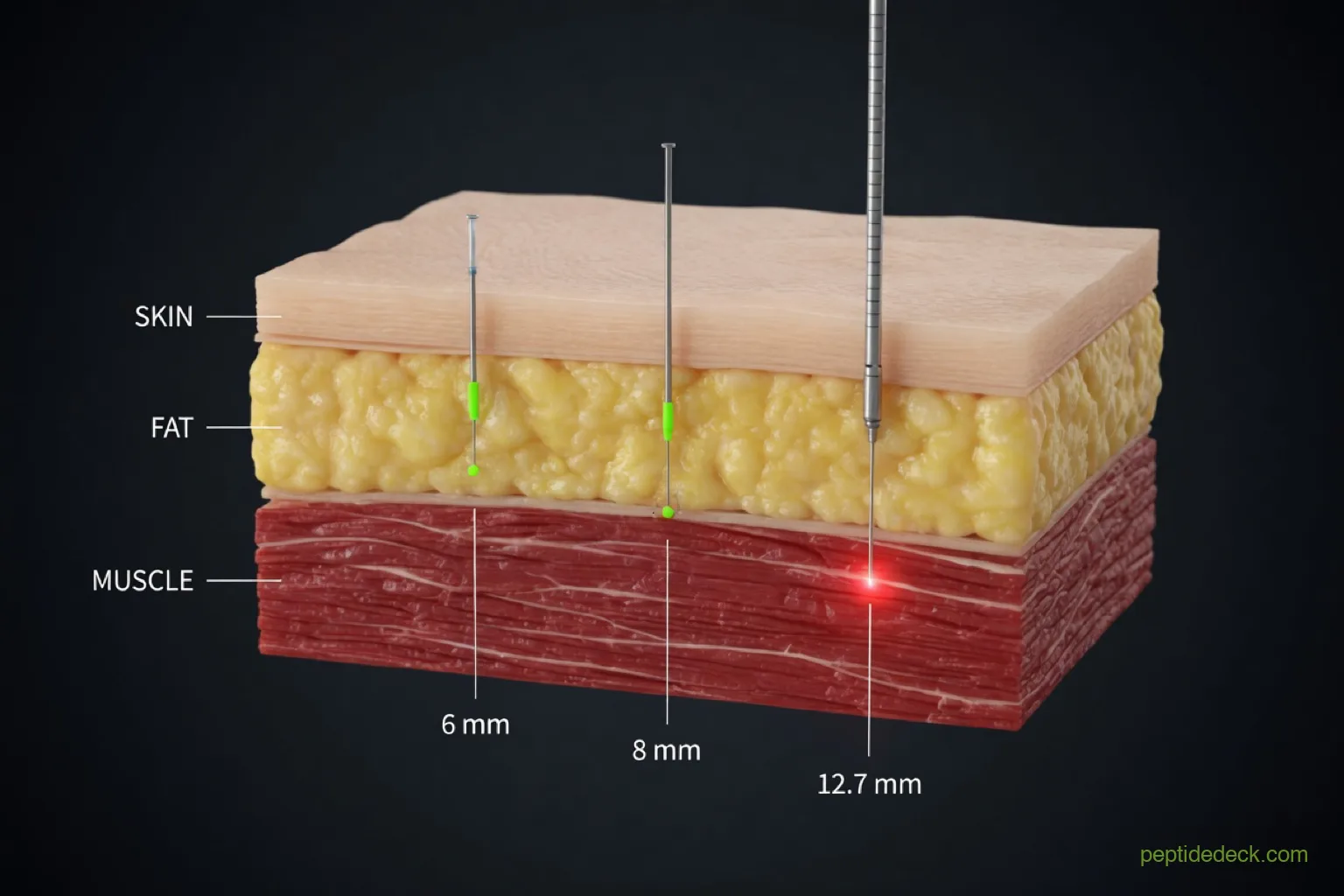
- 6 mm (about 1/4 inch): the best choice for most people and every site.
- 8 mm (5/16 inch): fine on the belly and hip; pinch the skin on arms and thighs.
- 12.7 mm (1/2 inch): the one most often sold by default. Always pinch, and angle to 45 degrees if you are lean.
- Gauge: 29 to 31. A higher number is a thinner needle and a gentler stick.
Landing in muscle by accident is rarely dangerous. It stings more and may change how fast the dose absorbs. If you want the full comparison, see subcutaneous vs intramuscular injection for peptides.
How to Inject Sermorelin, Step by Step
Ninety seconds, start to finish. The first night takes longer because you are reading. By the second week it is automatic.
- Wash your hands with soap and water and dry them on a clean towel.
- Swab the vial stopper with an alcohol pad and let it air-dry.
- Pull air into the syringe equal to your dose, push it into the vial, then turn the vial upside down. This keeps the vial from building a vacuum that makes later draws inaccurate.
- Draw slightly past your mark, tap out any air bubbles, then push back to the exact unit line.
- Pick today's site from your log, at least 1 inch from the last shot. Wipe it with the second pad in a circle moving outward, and let it dry fully. Wet alcohol is a common reason a shot stings.
- Pinch about an inch of skin and fat between your thumb and fingers.
- Insert the needle in one quick motion at 90 degrees, or 45 degrees if there is very little fat to pinch.
- Push the plunger slowly until it stops, count to five, then pull the needle straight out and let go of the pinch.
- Do not rub the spot. A drop of blood is normal; press a clean tissue on it for a few seconds.
- Drop the syringe straight into the sharps container without recapping it, and put the vial back in the fridge.
One rule has no exceptions: one syringe, one shot. A reused needle is duller, hurts more and carries skin bacteria back into your vial. The FDA's sharps guidance covers how to dispose of full containers where you live.
When to Inject: Bedtime on an Empty Stomach
Timing is half the result. Your body releases its largest natural growth hormone pulse early in the night, and sermorelin is meant to amplify that pulse, not replace it.
The clearest human timing data come from a 16-week trial in adults aged 55 to 71 who injected a close sermorelin analog under the skin every night at 9 pm. Growth hormone rose within 10 minutes and stayed up for about 2 hours. IGF-1, the marker most prescribers check, went up within 2 weeks.
Why the empty stomach rule is real
What you eat before the shot matters. In a study in six healthy young adults, a sugar drink taken 45 minutes before a GHRH dose cut the growth hormone response by about 70%. A fat infusion cut it by about 85%. Sermorelin is a GHRH, so the same brake applies.
- Finish your last meal at least 2 hours before the shot, longer if it was large or fatty.
- No carb or fat snack in between. Water is fine.
- Inject 30 to 60 minutes before you plan to fall asleep, then do not eat afterwards.
The honest limitation
One shot a night is the standard, but it is not the whole story. In a 6-week study of 11 older men injecting 2 mg nightly, nighttime growth hormone went up and two strength measures improved, but IGF-1 did not change. The authors concluded single nightly doses were less effective than several doses a day. That does not make bedtime wrong. It means the timeline is measured in months, which is why whether sermorelin works depends so much on staying consistent.
Can you inject in the morning instead? You can, fasted, before breakfast. You lose the overlap with your natural night pulse, so bedtime stays the better default.
Rotating Sites So Every Shot Absorbs the Same
Same spot, every night, is the classic mistake. Repeated injections in one place can build a lump of thickened fatty tissue called lipohypertrophy. A 2026 expert consensus put it at 29% to 76% of people on insulin, named poor site rotation as the strongest risk factor you can change, and noted it makes absorption unpredictable.
A simple rotation that works for a five-nights-a-week schedule:
- Monday: belly, upper left
- Tuesday: belly, upper right
- Wednesday: belly, lower left
- Thursday: belly, lower right
- Friday: outer thigh, alternating sides each week
Within each zone, move at least 1 inch from the last spot. If you feel a firm or rubbery patch, skip it until it softens.
Getting Sermorelin: Prescription or Vendor Vial
Sermorelin is prescription-only in the US. It was approved as Geref, first in 1990 as a diagnostic test and then in 1997 as vials for children with growth hormone deficiency. The maker later stopped selling it, and in 2013 the FDA determined it was not withdrawn for safety or effectiveness reasons.
Today most people get it one of two ways:
- Prescription route: a telehealth or local clinic prescribes it and a compounding pharmacy mixes it. You get lab monitoring and a pharmacy label with your mixing and discard dates. See sermorelin cost and prescription options for what that runs per month.
- Vendor route: freeze-dried 10 mg vials sold online, which list at around $72 and which you mix yourself. Quality varies a lot, so check for an independent certificate of analysis. Our guide on where to buy sermorelin compares the sources we have checked.
Either way, the injection is identical. The difference is who checks your labs and who stands behind the vial.
One thing that does not change the method: sermorelin needs a needle. Pills and lozenges exist, but the evidence behind them is thin, as our look at oral sermorelin explains.
Mistakes That Waste a Sermorelin Dose
Most of them happen before the needle goes in.
- Shaking the vial. Swirl or roll it. Shaking stresses the peptide.
- Eating close to the shot. A late dessert can erase most of that night's pulse.
- Using a 1 mL syringe for a 6-unit dose. One mark off is a third of the dose.
- Skipping the air step. A vacuum in the vial pulls bubbles into the syringe and short-changes you.
- Injecting into a lump, bruise or scar. Absorption from those spots is unpredictable.
- Doubling up after a missed night. Each shot triggers one pulse. Skip it and carry on the next evening.
- Keeping a mixed vial too long. Many pharmacies date a mixed multi-dose vial for 28 days. A 10 mg vial at 300 mcg, five nights a week, lasts about 6.5 weeks, so a smaller vial or a smaller water volume can make more sense. See how to store peptides for fridge rules.
After the Shot: Normal vs Worth a Call
Some reaction is normal. Pain at the site and brief flushing were the most common side effects in the Geref studies, and a small pink bump that fades within a day is typical of any subcutaneous shot.
For the full list of what sermorelin can do beyond the injection site, including headaches and water retention, see sermorelin side effects.
Frequently Asked Questions
Medical Disclaimer: This article is for informational purposes only and does not constitute medical advice. Sermorelin is a prescription medication in the United States, and injection technique, dose and timing should be set with a licensed clinician who knows your health history. Talk to your doctor before starting sermorelin, especially if you have diabetes, a thyroid condition, or a current or past cancer, or if you are pregnant or breastfeeding.