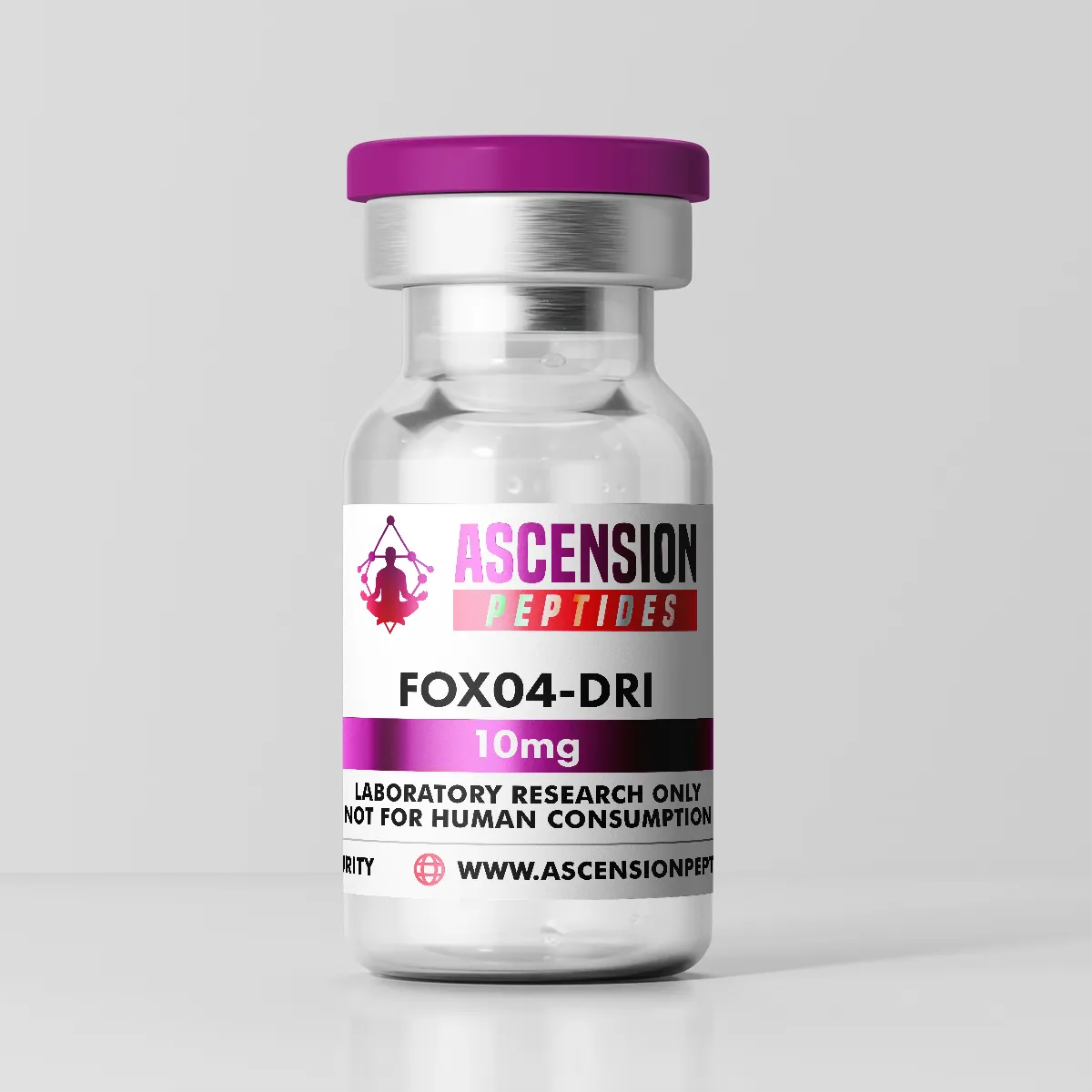
FOXO4-DRI (also written FOXO4 DRI or FOX04-DRI) is a senolytic peptide that clears senescent cells by blocking the FOXO4–p53 bond. In old mice it restored fitness, fur density and kidney function after just three doses given on days 1, 3 and 5 (Baar et al., Cell 2017). As of November 2026 it has never been tested in a human trial.
FOXO4-DRI is one of the most interesting longevity peptides to emerge in the last decade — not because it enhances any function, but because it selectively eliminates a specific type of aging cell that most treatments ignore. It was developed from a 2017 Cell paper and has attracted serious longevity researchers ever since. Here's what it actually does, how to use it, and what the side effects look like.
🔑 Key Takeaways
- FOXO4-DRI is a D-retro-inverso peptide that selectively kills senescent cells ("zombie cells")
- Based on the 2017 Cell paper by Baar et al. — one of the most cited longevity papers of the decade
- Mechanism: disrupts the FOXO4-p53 interaction that protects senescent cells from apoptosis
- Not a daily peptide — used in short, infrequent courses (three injections on days 1, 3 and 5, 1-3x per year)
- Side effects: injection site reactions, mild flu-like response (normal — cellular clearance happening)
- Available from Ascension Peptides at 10mg, no prescription required
- Works differently from NAD+ or rapamycin — removes cells rather than improving cell function
What Is FOXO4-DRI?
FOXO4-DRI is a senolytic peptide — a compound that selectively eliminates senescent cells. Senescent cells are cells that have stopped dividing but refuse to die. They accumulate with age and release a toxic mix of inflammatory signals (called SASP — senescence-associated secretory phenotype) that damages surrounding healthy tissue. These are the "zombie cells" that longevity researchers increasingly see as a root cause of aging.
The science behind it: In healthy young cells, the FOXO4 protein interacts with p53 to suppress apoptosis (programmed cell death) in senescent cells — essentially keeping them alive when they should die. FOXO4-DRI is an engineered peptide that disrupts this FOXO4-p53 interaction specifically in senescent cells, allowing p53 to trigger apoptosis. Healthy cells are not affected because the FOXO4-p53 interaction is only critical for senescent cell survival, not healthy cell survival.
What makes this elegant: healthy cells don't rely on this specific pathway for survival. So FOXO4-DRI kills zombie cells while leaving healthy cells alone.
The "DRI" stands for D-retro-inverso — the peptide is engineered with D-amino acids (mirror image of normal L-amino acids) which makes it resistant to proteases (enzymes that would break it down). This is what allows it to work systemically. Without this modification, the peptide would be rapidly degraded before reaching its target.
FOXO4-DRI Benefits — What the Research Shows
The honest framing here: most of the data is from preclinical mouse models. That's not a dismissal — the mechanisms are well-characterized and the results are striking. But human trials haven't been published yet, so we're working from animal data plus user reports. That's worth keeping in mind.
FOXO4-DRI benefits at a glance (mouse and cell data, checked November 2026)
- Senescent cell clearance: selectively triggered apoptosis in senescent human IMR90 fibroblasts while sparing normal cells (Baar 2017, PMID 28340339).
- Chemotherapy damage: in doxorubicin-treated mice it neutralized the drug's weight loss and the rise in the liver-damage marker AST (Baar 2017).
- Fur density: restored in fast-aging XpdTTD/TTD mice and in naturally aged males (Baar 2017).
- Fitness: fast-aging mice ran more on their running wheels, scored about 18 days after the first dose (Baar 2017).
- Kidney function: lower plasma urea and creatinine in naturally aged mice 30 days after treatment (Baar 2017).
- Testosterone: raised serum testosterone in naturally aged male mice given 5 mg/kg every other day for three doses (Zhang 2020, PMID 31959736).
- Humans: no data. ClinicalTrials.gov lists no FOXO4-DRI trial as of November 2026.
Senescent Cell Clearance
The primary benefit — and the one with the most direct evidence. In the landmark 2017 Baar et al. Cell paper, FOXO4-DRI selectively induced apoptosis in senescent cells both in cell culture and in living mice. Treated animals showed reduced senescence markers in the liver (after doxorubicin), in the kidney and in a whole-body p16 signal.
- FOXO4-DRI selectively induced apoptosis in senescent cells in vitro and in vivo
- In aged and chemotherapy-treated mice, treatment reduced the number of senescent cells in multiple tissues
- Treated mice showed improved physical fitness, fur density, and kidney function
The selectivity is the key thing. Most anti-aging interventions are diffuse — NAD+ precursors help mitochondrial function broadly, rapamycin modulates mTOR signaling across cell types. FOXO4-DRI specifically targets the survival mechanism of senescent cells. That precision is rare.
Physical Performance Restoration
One of the more striking findings from the 2017 paper: aged mice treated with FOXO4-DRI showed measurable improvements in physical performance. Fast-aging mice ran more on their running wheels and responded more to gentle stimuli (the paper did not measure grip strength). The hypothesis is straightforward — clearing senescent cells from muscle tissue removes the inflammatory SASP burden that impairs muscle function and regeneration.
This is different from a performance peptide. FOXO4-DRI isn't stimulating muscle growth or GH secretion. It's removing a drag on existing capacity. Think of it less as adding horsepower and more as fixing what's been slowing you down.
Organ Function
The 2017 paper showed improved kidney function in aged mice after FOXO4-DRI treatment. Kidney tissue accumulates senescent cells with age, and the associated SASP damages nephrons over time. Clearing these cells appears to allow some functional recovery.
Subsequent work has explored effects in liver tissue, testicular function (a 2020 paper showed restored testosterone secretion in aged mice treated with FOXO4-DRI itself; Zhang et al., Aging 2020), and neural tissue. The underlying principle is consistent — SASP accumulation impairs organ function, and removing the source cells allows recovery.
Hair Regrowth and Chemotherapy Recovery
The original paper showed a clear improvement in fur density in fast-aging XpdTTD/TTD mice, which lose hair early, and in naturally aged male mice. The authors were not looking for it; it showed up during the experiments and they then scored it. Clearing senescent cells appears to let the surrounding tissue work normally again.
The chemotherapy finding is separate. In mice given doxorubicin, FOXO4-DRI neutralized the drug's weight loss and liver damage, which attracted considerable attention in the oncology recovery community. Worth noting: chemo-induced senescence is acute and widespread. Age-related senescence accumulates more gradually — the dynamics are different.
Longevity — The Broader Picture
Senescent cell accumulation is formally classified as one of the "hallmarks of aging" — a framework published in Cell in 2013 that now underpins most longevity research. By clearing senescent cells, the theory is you remove a key driver of inflammaging (chronic, low-grade inflammation that accelerates aging across multiple systems).
FOXO4-DRI is one of the very few senolytics that works through a peptide mechanism rather than a small molecule. Dasatinib and quercetin — the most studied senolytic combo — work through BCL-2 pathway inhibition. FOXO4-DRI's FOXO4-p53 mechanism is distinct, which means it potentially clears a different subset of senescent cells, or does so through a complementary route.
FOXO4-DRI Dosage Protocol
FOXO4-DRI is not a daily peptide. This is critical, and it's probably the most common misunderstanding among new users. It's used in short, infrequent courses — typically three injections on days 1, 3 and 5, repeated quarterly or less frequently. Using it daily would be both unnecessary and counterproductive.
Standard Protocol
- Dose: 1–2mg per injection (community convention, not tested in any human study; the mice got 5 mg/kg)
- Frequency: Every other day, three injections: days 1, 3 and 5 (the schedule used in the published mouse studies)
- Then stop and wait (months before repeating)
- Route: Subcutaneous injection
Repeat Frequency
- Most users: 2–4x per year maximum
- Some protocols: once per year (one days-1-3-5 course, higher dose)
- The reasoning: you don't want to clear too many senescent cells at once (see side effects), and you don't need to — the body accumulates them slowly, so infrequent clearance matches the accumulation rate
Reconstitution (10mg vial)
Add BAC Water
Add 2mL bacteriostatic water to the 10mg vial. This gives a concentration of 5mg/mL.
Calculate Your Dose
A 1mg dose = 20 IU on a U-100 insulin syringe. A 2mg dose = 40 IU. A 3.3mg dose = 66 IU. Draw slowly and confirm measurement.
Inject Subcutaneously
Pinch skin at injection site (abdomen or thigh), insert at 45° angle, inject slowly. Rotate sites daily.
Store Properly
Refrigerate reconstituted vial. Use within 28 days. Discard if solution becomes cloudy or discolored.
Dosage Reference Table
The every-other-day schedule (days 1, 3 and 5) is the one used in every published FOXO4-DRI experiment in mice: 5 mg/kg, three doses, every other day (Baar 2017; Zhang 2020). The 1–3.3 mg amounts are a community convention that no human study has tested, and the repeat intervals in the last column have no study behind them either. The FOXO4-DRI dosage chart has the syringe units for each tier.
FOXO4-DRI Side Effects
Side effects are real and expected — because the peptide is doing something. Clearing large numbers of senescent cells triggers an inflammatory response as the body processes and removes the dead cells. This is a normal part of the mechanism, not a danger signal. Understanding this upfront changes how you interpret the experience.
Common (Expected, Not Dangerous)
- Flu-like symptoms: fatigue, mild aching, low-grade fever for 1–3 days after each injection
- Injection site redness and swelling — usually resolves within 24 hours
- Temporary increase in inflammatory markers — this is the SASP from dying cells being cleared
- Fatigue for 24–48 hours after each injection
Less Common
- Nausea (usually mild, related to dose)
- Headache
- Muscle soreness
What to Do During a Protocol
- Rest during the five-day course — this is not a time to train hard
- Stay well hydrated
- Consider anti-inflammatory strategies after completing the protocol (not during — you want the clearance process to complete)
- If symptoms are severe: reduce dose on future protocols
Who Should Avoid FOXO4-DRI
- Anyone with active cancer — senolytics can theoretically affect cancer cell dynamics in ways that are not fully understood
- Anyone on immunosuppressants — without direct medical supervision
- Pregnancy or breastfeeding
FOXO4-DRI vs Other Senolytics
Senolytic therapy isn't a single drug — it's a category. FOXO4-DRI sits alongside dasatinib+quercetin and fisetin as the main options people actually use. Each has different mechanisms, different administration routes, and very different evidence bases.
FOXO4-DRI is unique in that it's the only peptide-based senolytic with direct mechanistic evidence for FOXO4-p53 disruption. Dasatinib+Quercetin is the most studied combination in humans — there are actual human clinical trials for this pair, which FOXO4-DRI currently lacks. Fisetin is the easiest and cheapest entry point but with the weakest evidence base.
The question isn't really which one is best — they likely clear different subsets of senescent cells through different pathways. Some longevity practitioners cycle between protocols across the year rather than picking one exclusively.
Stacking FOXO4-DRI
FOXO4-DRI is typically used as a standalone protocol. Not because it's incompatible with other peptides, but because the three-dose course (days 1, 3 and 5) is designed to be a discrete intervention — you run it, let the clearance happen, then return to normal.
What works well:
- After a FOXO4-DRI course: Follow with regenerative peptides like BPC-157, TB-500, or GHK-Cu to support tissue repair and replacement of cleared cells
- Longevity sequencing: FOXO4-DRI protocol → wait 2 weeks → NAD+ supplementation (energizes the healthy cells remaining after clearance)
- Not combined with other senolytics simultaneously — additive clearance can produce excessive inflammatory response
- Compatible with GH peptides, BPC-157, etc. on non-protocol days
💡 Protocol Sequencing Idea
A common longevity stack sequence: Run FOXO4-DRI on days 1, 3 and 5 → rest for 2 weeks → begin a GHK-Cu or BPC-157 course. The logic: clear the zombie cells first, then support regeneration of the tissue they were occupying. Order matters here.
Where to Buy FOXO4-DRI
Ascension Peptides carries FOXO4-DRI at 10mg per vial — the standard research dose. A single 10mg vial covers one full standard protocol (3 doses at 2mg = 6mg) or one conservative protocol (3 doses at 1mg = 3mg). A mixed vial must be used within 28 days, so the leftover won't keep until your next course months later.
- 3 doses at 2mg on days 1, 3, 5 (6mg) → one complete standard protocol
- 3 doses at 1mg on days 1, 3, 5 (3mg) → one conservative protocol
Price: $190 per vial. US-based, third-party COA. Ascension is one of the few suppliers testing specifically for FOXO4-DRI purity — important because the peptide synthesis is complex and impurities are a real concern with less rigorous sources.
Get FOXO4-DRI from Ascension Peptides →
For a broader look at sourcing options: where to buy peptides online in 2026.
Frequently Asked Questions
Sources
- Baar MP et al. Targeted Apoptosis of Senescent Cells Restores Tissue Homeostasis in Response to Chemotoxicity and Aging. Cell 2017;169(1):132-147. PMID 28340339
- Zhang C et al. FOXO4-DRI alleviates age-related testosterone secretion insufficiency by targeting senescent Leydig cells in aged mice. Aging 2020;12(2):1272-1284. PMID 31959736
- ClinicalTrials.gov search for FOXO4 (checked November 5, 2026)
The information in this article is for educational purposes only and does not constitute medical advice. Always consult a healthcare professional before starting any new supplement or compound. Results vary by individual.