9-Me-BC has never been studied in people. Yet 9-Me-BC (also written 9 Me BC, 9mbc or 9MeBC) is one of the most searched dopamine nootropics, sold in 15 mg capsules and talked up on Reddit as a "dopamine reset". This guide grades every claimed benefit against the studies it comes from, explains the light-sensitivity and neurotoxicity questions in plain terms, and shows where the popular dosing numbers really come from.
🔑 Key Takeaways
- Most of the famous dopamine findings come from cells in a dish, and one result shows the effect flipping at higher amounts
- It is an MAO inhibitor, and the type it blocks most is the one that matters for antidepressant and food interactions
- The sun-sensitivity worry has a real chemical basis, but nobody has tested it on human skin
- Every dose you see online traces back to vendors and forum posts, not to a study
- The scientists who discovered its effects say its tolerability still has to be shown
We read every 9-methyl-β-carboline paper we could find on PubMed, checked the trial registry, and looked at what users and vendors say, so you can see which claims stand on data and which don't.
What Is 9-Me-BC (9-Methyl-Beta-Carboline)?
It's a small lab-made molecule, not a peptide. 9-Me-BC is 9-methyl-β-carboline (CAS 2521-07-5), a member of the β-carboline family. Its relatives turn up in cooked meat, tobacco smoke and coffee, and some are formed in the human body and found in blood, brain and spinal fluid.
That family has a bad reputation. Several β-carbolines are suspected nerve toxins, and higher levels of some have been found in people with Parkinson's disease. So it surprised researchers in Dresden when their 2008 study found that this one methylated version seemed to help dopamine neurons instead of harming them.
Today it's sold as capsules and powder for people chasing motivation, focus and a "reset" after stimulants. It isn't a peptide like the ones in our guide to nootropic peptides, but it's bought by the same readers, which is why we cover it here.
9-Me-BC and Dopamine: What the Research Shows
Nearly all of it happened in dishes. Here's the chain of studies the online claims rest on, in order.
- 2008, cells. Hamann and colleagues treated lab-grown midbrain cells and saw more mature dopamine neurons, less cell death, and higher activity of genes that drive dopamine-neuron development. Dopamine content rose only slightly, and the change wasn't statistically significant.
- 2010, cells. Polanski and colleagues found the compound boosted tyrosine hydroxylase (the enzyme that makes dopamine) in existing neurons, lengthened their branches, calmed immune cells called microglia, and lowered α-synuclein, a protein linked to Parkinson's.
- 2010, lab animals. Wernicke and colleagues first cut striatal dopamine by about half with the toxin MPP+, then pumped 9-Me-BC directly into a brain ventricle for 14 days. Dopamine and dopamine-neuron counts returned to normal.
- 2012, lab animals. Gruss and colleagues found that 10 days of dosing, but not 5, improved learning in a maze, raised dopamine in the hippocampus and grew denser dendrites. This is the study behind the "cognitive enhancer" label.
- 2020, cells. Keller and colleagues measured up to 33% more dopamine neurons in mouse cultures after 48 hours, doubled BDNF gene activity in astrocytes, and showed MAO inhibition.
One detail rarely gets mentioned. In the 2020 paper, cultures with their support cells (astrocytes) removed lost half of their dopamine neurons at 150 µM. The authors suggest astrocytes normally shield neurons from an overdose. More is not simply better, even in a dish.
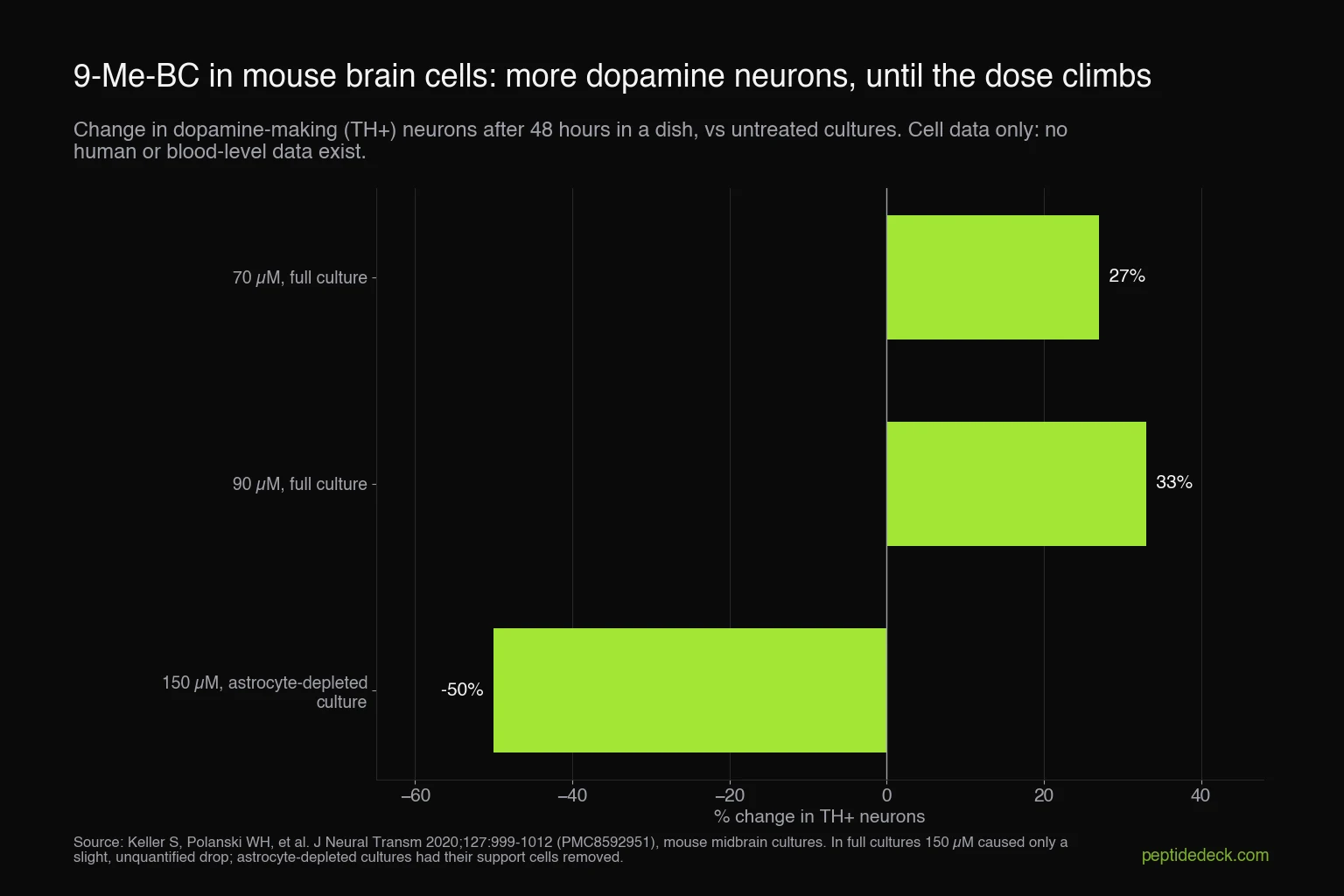
Keep the units in mind, too. These are concentrations in a dish of cells. No one has measured what blood or brain level a 15 mg capsule produces in a person, so none of these numbers can be turned into a capsule dose.
9-Me-BC Benefits: The Evidence Grade for Each Claim
Here's every popular claim, graded honestly. "Cells only" means the result came from tissue in a dish. "Animal only" means lab animals. No row reaches human data.
The pattern is clear. The neuron and growth-factor claims have real, peer-reviewed lab work behind them. The memory claim rests on one animal study. The motivation and mood claims, the ones most buyers care about, have no study at all.
The main limitation: almost every positive study comes from one connected network of mostly German labs (Dresden, Berlin, Jena and Magdeburg). We found no independent repeat of the dopamine-neuron findings outside that network, and none of the studies tested the compound the way people take it: swallowed daily, at capsule doses, for weeks.
Why There Are No Human Trials
It stalled at the lab stage. In 2011 the Dresden team proposed 9-Me-BC as a possible new Parkinson's drug. Nine years later, their own 2020 paper concluded that further studies "have to show the tolerance of 9-me-BC with possible side effects" before it could move forward.
We searched ClinicalTrials.gov for 9-methyl-β-carboline and 9-methylnorharman on November 5, 2026 and found no registered trial. PubMed has no human study either. So there's no human data on dose, blood levels, half-life, side effects or long-term safety.
9-Me-BC Side Effects, Light Sensitivity and the Toxicity Questions
Three concerns come up again and again. Each has a real basis, and each is still unproven in people.
Light sensitivity and UV
The worry is chemical, not anecdotal. β-carbolines absorb ultraviolet light, and a 2013 study describes 9-methyl β-carbolines as known, efficient photosensitizers. It tested three of them, including 9-Me-BC itself (listed as 9-methyl-norharmane), and under UVA light they damaged DNA in a test tube, mostly by oxidizing it. A 2018 study also measured how much reactive singlet oxygen these compounds generate under light.
Here's the uncertainty. That was bare DNA, not skin. When the same lab tested a close relative (9-methyl-harmine) inside living cells, the DNA damage was "considerably smaller" than in a test tube. No one knows how much 9-Me-BC reaches your skin after a capsule. Until someone tests it, sun caution is a sensible precaution, not a proven need.
Could it turn into a neurotoxin?
This is the question behind most of the Reddit unease. The trouble is one more methyl group. A 2006 study found a β-carboline needs methyl groups on both of its nitrogens to become a potent blocker of mitochondrial complex I, part of the cell's energy machinery. 9-Me-BC already has one of the two.
- The doubly methylated version, 2,9-dimethyl-β-carbolinium, behaves like the Parkinson's-causing toxin MPP+ in cells and in lab animals.
- An enzyme called PNMT can add that second methyl group to 9-Me-BC in a test tube, and the same activity was found in human adrenal tissue.
- On the other side, 9-Me-BC protected cells against that very toxin in the 2010 dish study.
Nobody has measured whether people taking 9-Me-BC form the toxic version, or how much. It's a plausible risk with a known pathway, not a demonstrated harm.
What users report as side effects
User reports mention increased skin sensitivity to the sun (one anecdote in the Path of PEDs guide) and effects that fade with time. These are self-reports with no control group, so they can't tell you how common any effect is.
9-Me-BC Interactions: MAOIs, SSRIs and Tyramine
This is the part to take seriously. In a test tube, 9-Me-BC blocked MAO-A at 1 µM and MAO-B at 15.5 µM. That makes it mainly an MAO-A inhibitor, though some guides wrongly call it MAO-B selective. For comparison, the Parkinson's drug rasagiline blocks MAO-B at about 4 nM, thousands of times more strongly.
MAO-A is the type that matters for interactions:
- Antidepressants. The FDA label for sertraline (Zoloft) bans use with MAOIs, or within 14 days of stopping one, because of the risk of serotonin syndrome. A 1998 paper warned about the same danger with harmala β-carbolines, which are 9-Me-BC's MAO-blocking cousins.
- Tyramine-rich food. Blocking MAO-A, or both types, can trigger the "cheese effect", a dangerous blood-pressure rise from tyramine in foods such as aged cheese, according to a 2011 review. Blocking MAO-B alone generally doesn't.
Nobody knows how strongly a 15 mg capsule blocks MAO-A in a human body. That uncertainty cuts both ways. It's why mixing it with an SSRI, SNRI, another MAOI, stimulants, or other serotonin-raising drugs is a gamble nobody has measured.
What to ask your doctor: "I'm thinking about a compound that blocks MAO-A in lab tests. Does anything I take interact with MAO inhibitors?" Bring a full list of everything you take, including antidepressants, stimulants and supplements, and ask whether your blood pressure is a concern.
What 9-Me-BC Users Report on Reddit
Reviews follow a familiar arc. A strong start, then a fade. We read the r/Nootropics posts that rank for "9-Me-BC reddit" (Reddit blocks automated reading, so we worked from the excerpts search engines show). Here's what people describe:
- Motivation. One widely read review reports a "significant boost in motivation", enough to start online courses and a new language.
- A first week that doesn't last. A 14-day report calls the first week "quite amazing", with better mood and less need for modafinil to study. In another post, a user says it "doesnt really feel like anything anymore".
- Vision and light. One thread asks whether others noticed sharper, brighter vision or light sensitivity.
- Worry about toxicity. A 40-day report praises the mood lift but recommends it only if you accept "the eventual Neurotoxic properties".
- Lasting results? A recurring question is whether any effect persists after stopping, or whether it was MAO inhibition all along.
That last question is a good one. A short-term lift from MAO inhibition would look exactly like these reports, and nothing in the published work tells the two explanations apart in people.
9-Me-BC Dosage and Cycling: What's Known and What Isn't
No human dose has ever been tested. Every number online is a vendor or user figure, and they don't agree. We traced the most-quoted ones:
None of these cite a study, because there isn't one to cite. The animal and cell work can't be converted into a human amount, as we explained above. If you see an exact "per kilo" dose for 9-Me-BC, it was invented.
Cycling is equally unsupported. No study has tested any on-off pattern. The 10-day figure people quote matches the 2012 animal finding that effects took 10 days to appear, but that study didn't test breaks. Under-the-tongue and nasal use also get mentioned, with no data on either route. Its half-life in people is unknown.
Is 9-Me-BC Legal?
In the US it sits in a grey zone. It doesn't appear on the DEA's list of controlled substances (checked November 5, 2026), so it isn't a federally scheduled drug. It's also unapproved: the FDA hasn't approved it for any use, and vendors sell it labelled for lab use only, not as a medicine. Rules in other countries vary, so check your local law before ordering across borders.
9-Me-BC Price and Where to Buy
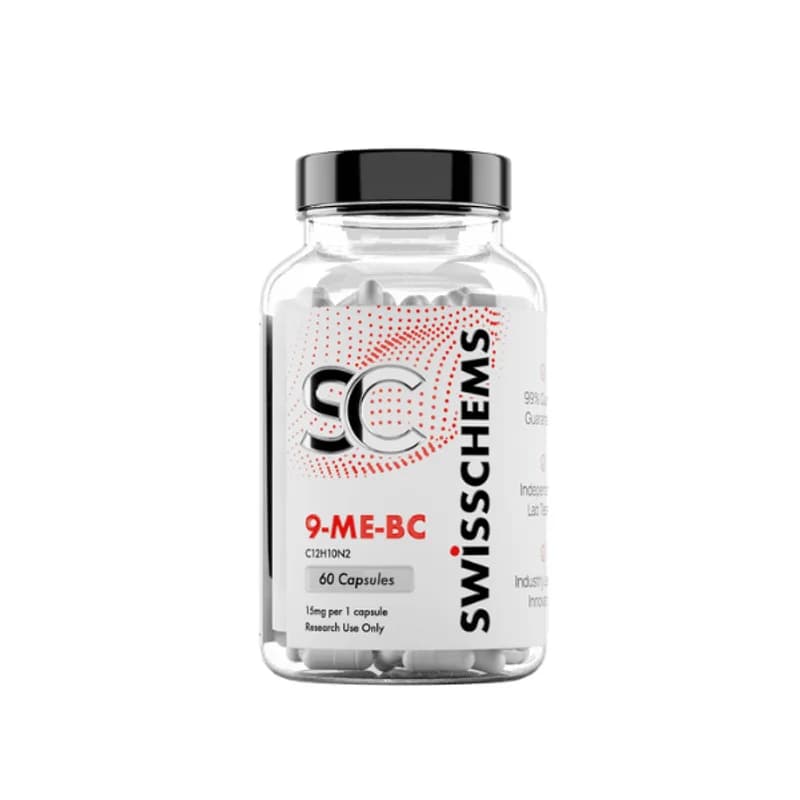
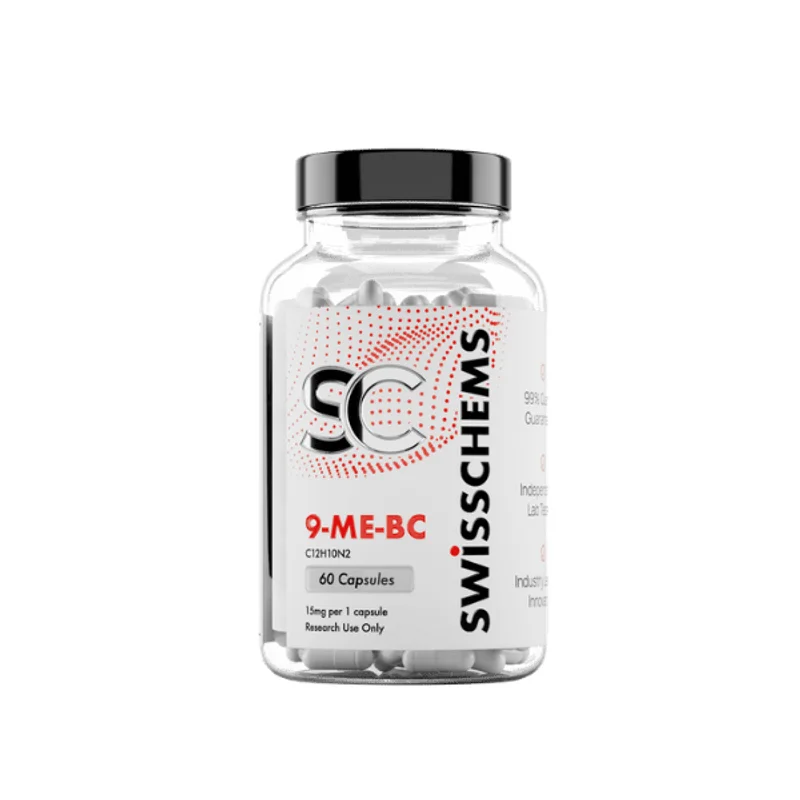
Capsules make the maths simple. The product on this page is SwissChems' 9-Me-BC (9mbc), 15 mg per capsule, 60 capsules, which is 900 mg in total. On November 5, 2026 it was listed at $62.99 and shown as in stock.
- Per capsule: about $1.05, or about $0.94 with the code.
- Per mg: about $0.07, or about $0.063 with the code.
- How long it lasts: 60 days at one capsule a day, 30 days at two.
The code jqrlsday takes 10% off, bringing the price to about $56.69. PeptideDeck earns a commission if you buy through the SwissChems link on this page.
On testing, the product page states "99% Purity Guaranteed" and says the capsules are "Independently third-party HPLC-tested; COA available per batch", with a "Check Lab Report" button and a link to its lab-results page. We couldn't open a 9-Me-BC certificate without the page's scripts, so ask for the one that matches your batch number before you rely on the 99% figure. Capsules also save you from weighing powder: at 15 mg, a powder dose is too small to measure accurately without a milligram scale.
If you're comparing other focus compounds, our Semax guide, Selank guide and Semax vs Selank comparison cover two peptides from the same buyer's shortlist. For a sourcing checklist on the first, see where to buy Semax. Our Dihexa guide covers another memory compound popular with the same readers.
Frequently Asked Questions
Sources
- Hamann J, et al. 9-Methyl-β-carboline up-regulates the appearance of differentiated dopaminergic neurones in primary mesencephalic culture. Neurochem Int. 2008. PubMed 17913302
- Polanski W, et al. The exceptional properties of 9-methyl-β-carboline: stimulation, protection and regeneration of dopaminergic neurons coupled with anti-inflammatory effects. J Neurochem. 2010. PubMed 20374418
- Wernicke C, et al. 9-Methyl-β-carboline has restorative effects in an animal model of Parkinson's disease. Pharmacol Rep. 2010. PubMed 20360614
- Polanski W, Reichmann H, Gille G. Stimulation, protection and regeneration of dopaminergic neurons by 9-methyl-β-carboline: a new anti-Parkinson drug? Expert Rev Neurother. 2011. PubMed 21651332
- Gruss M, et al. 9-Methyl-β-carboline-induced cognitive enhancement is associated with elevated hippocampal dopamine levels and dendritic and synaptic proliferation. J Neurochem. 2012. PubMed 22380576
- Keller S, Polanski WH, et al. 9-Methyl-β-carboline inhibits monoamine oxidase activity and stimulates the expression of neurotrophic factors by astrocytes. J Neural Transm. 2020. PMC8592951 (full text; correction published 2022)
- Vignoni M, et al. Mechanisms of DNA damage by photoexcited 9-methyl-β-carbolines. Org Biomol Chem. 2013. PubMed 23842892
- Vignoni M, et al. Intra- and extra-cellular DNA damage by harmine and 9-methyl-harmine. J Photochem Photobiol B. 2014. PubMed 24602814
- Rasse-Suriani FAO, et al. Photophysical and photochemical properties of normelinonine F and melinonine F alkaloids and structurally related N(2)- and/or N(9)-methyl-β-carboline derivatives. Photochem Photobiol. 2018. PubMed 28741707
- Pavlovic S, et al. 2,9-Dimethyl-β-carbolinium, a neurotoxin occurring in human brain, is a potent inducer of apoptosis as 1-methyl-4-phenylpyridinium. Neuroscience. 2006. PubMed 16517085
- Gearhart DA, Neafsey EJ, Collins MA. Phenylethanolamine N-methyltransferase has β-carboline 2N-methyltransferase activity: hypothetical relevance to Parkinson's disease. Neurochem Int. 2002. PubMed 11900856
- Callaway JC, Grob CS. Ayahuasca preparations and serotonin reuptake inhibitors: a potential combination for severe adverse interactions. J Psychoactive Drugs. 1998. PubMed 9924842
- Finberg JP, Gillman K. Selective inhibitors of monoamine oxidase type B and the "cheese effect". Int Rev Neurobiol. 2011. PubMed 21971008
- Zoloft (sertraline) prescribing information, Contraindications. DailyMed
- US Drug Enforcement Administration. Controlled Substances, Alphabetical Order. DEA Diversion Control Division, checked November 5, 2026.
- ClinicalTrials.gov searches for "9-methyl-beta-carboline" and "9-methylnorharman", November 5, 2026: no registered studies.
- Dosing claims: Nootropicology, Path of PEDs and Wholistic Research 9-Me-BC guides, read November 5, 2026. User reports: r/Nootropics threads linked in the text, as shown in search results on November 5, 2026.
- SwissChems product page, 9-Me-BC (9mbc), 15 mg per capsule, 60 capsules: price, stock and testing statements, checked November 5, 2026.
Medical Disclaimer: This article is for informational purposes only and does not constitute medical advice. 9-Me-BC is an unapproved compound that has never been studied in humans; its effects, safe dose and long-term risks in people are unknown. It inhibits monoamine oxidase in lab tests and may interact dangerously with antidepressants, stimulants and other medicines. Talk to a doctor before taking it, and don't use it if you're pregnant, breastfeeding, or taking any prescription drug without medical advice.