

The HRT ICD 10 code is Z79.890, "Hormone replacement therapy," a billable and specific ICD-10-CM status code that sits in category Z79, long term (current) drug therapy [1]. It has been in effect since the code set launched on October 1, 2015, and it appears unchanged in the 2026 edition that took effect October 1, 2025 [1]. This page is a working reference for clinicians, medical billers, and patients reading a code on their own chart or explanation of benefits. Below you will find the code, when it is billable, which primary diagnoses to pair it with, and every related hormone therapy code in one place. Confirm each code against the current ICD-10-CM edition before you bill [3][4].
| Fact | Detail |
|---|---|
| Code | Z79.890 |
| Billable | Yes (specific) |
| Present on admission (POA) | Exempt |
| In effect since | October 1, 2015 (2026 edition effective October 1, 2025) |
🔑 Key Takeaways
- Z79.890 is the HRT ICD 10 code. It is the ICD-10-CM code for long-term (current) hormone replacement therapy, and it is billable and specific [1].
- It is a status code, never a standalone primary diagnosis. It records that a patient is on hormone therapy; it does not explain why they were seen [2][6].
- Pair it with the code for the underlying condition. For natural menopause, for example, N95.1 is the primary code and Z79.890 is secondary [6].
- SERMs and aromatase inhibitors use different codes. Agents that act on estrogen receptors are coded under Z79.81x, not Z79.890 [1].
What Is the ICD 10 Code for HRT?
The ICD 10 code for HRT is Z79.890. It lives in the chapter of factors influencing health status and contact with health services (Z00 to Z99), inside the Z77 to Z99 block for persons with potential health hazards related to socioeconomic and psychosocial circumstances and family and personal history, and specifically in category Z79, long term (current) drug therapy [1].
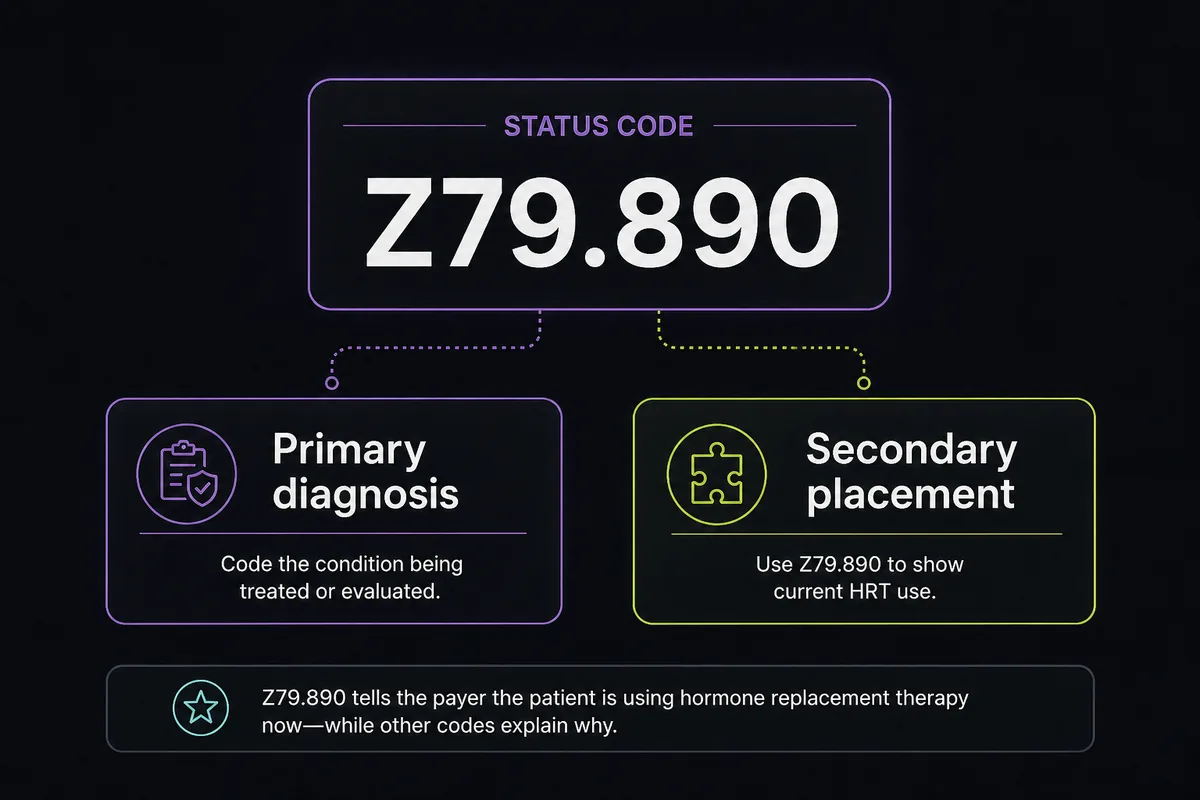
A status code like Z79.890 works differently from a diagnosis code. It documents a fact about the patient, that they are on ongoing hormone replacement, rather than the reason for the encounter. In plain terms, it answers "what treatment is this person on," not "why are they here today." That distinction drives every sequencing rule further down this page.
The official index lists several approximate synonyms that Z79.890 covers, including postmenopausal hormone replacement therapy, long-term testosterone replacement therapy, thyroid hormone replacement therapy, and vaginal estrogen ring therapy [1]. In practice the code applies to estrogen, progestogen, testosterone, and thyroid hormone replacement, and it is not limited to women. That has been true since a 2018 revision removed "(postmenopausal)" from the description, which is covered in the code history section below [1][2].
HRT ICD 10 Quick Reference Table
This is the table no ranking page currently provides: Z79.890 alongside the codes coders most often confuse with it, with the billable status and a plain "use it when" for each.
| Code | Official description | Billable | Use it when |
|---|---|---|---|
| Z79.890 | Hormone replacement therapy | Yes | Patient is on long-term (current) hormone replacement: estrogen, progestogen, testosterone, or thyroid hormone |
| Z79.810 | Long term (current) use of selective estrogen receptor modulators (SERMs) | Yes | Patient is on a SERM such as tamoxifen or raloxifene, which is not HRT |
| Z79.811 | Long term (current) use of aromatase inhibitors | Yes | Patient is on an aromatase inhibitor such as anastrozole or letrozole |
| Z79.818 | Long term (current) use of other agents affecting estrogen receptors and estrogen levels | Yes | Patient is on another estrogen-affecting agent not classified above (for example a GnRH agonist or fulvestrant) |
| Z79.899 | Other long term (current) drug therapy | Yes | Long-term drug therapy that is not hormone replacement and has no more specific Z79 code |
| Z92.23 | Personal history of estrogen therapy | Yes | Patient previously took estrogen therapy but has stopped: history, not current use |
| Z78.0 | Asymptomatic menopausal state | Yes | Documenting menopausal status in a patient who is not on and does not need treatment |
| Z51.81 | Encounter for therapeutic drug level monitoring | Yes | The visit is for lab monitoring of drug levels; the Z79 category directs you to Code Also this when relevant [1] |
The most common error in this list is coding an estrogen-receptor drug as HRT. Selective estrogen receptor modulators (Z79.810), aromatase inhibitors (Z79.811), and other agents affecting estrogen receptors (Z79.818) are not hormone replacement, so they take a Z79.81x code, not Z79.890 [1]. The Z79.81 subcategory carries an Excludes note that separates it from Z79.890, so a SERM or an aromatase inhibitor should not be reported together with the HRT code for the same therapy; confirm the exact Excludes type against the current ICD-10-CM tabular list before you bill [1][6].
ICD 10 HRT Sequencing Rules: Never Bill Z79.890 Alone
The single most important rule for ICD 10 HRT coding is that Z79.890 is a secondary code. Because it is a status code, it must be paired with a primary diagnosis that establishes the medical necessity for the encounter, such as the condition being treated or the reason for a monitoring visit. Claims that list Z79.890 as the only diagnosis are a common denial cause, because on their own they never explain why the patient was seen [2][6].
The Z79 category also carries a Code Also instruction for therapeutic drug level monitoring: when the encounter is for checking drug levels, report Z51.81 (encounter for therapeutic drug level monitoring) in addition to the therapy status code [1]. Sequence these according to the reason for the visit and your payer's policy.
Z79.890 is exempt from present-on-admission (POA) reporting. Long-term therapy is, by definition, already present when a patient is admitted, so the code set flags this family of status codes as POA exempt rather than requiring a POA indicator [1].
Documentation that supports the code
Good documentation is what turns Z79.890 from a denial risk into a clean claim. The record should show the patient's hormonal status (for example perimenopausal, menopausal, postmenopausal, or hypogonadal), the symptoms or condition being treated, the specific drug with its dose and route, relevant lab results, and the follow-up plan. Together these support both the primary diagnosis and the therapy-status code. Payer policies vary, so verify coverage rules and any required modifiers with the specific plan before submitting.
How to Choose the Right ICD 10 for HRT Claims
Choosing the right ICD 10 for HRT claims comes down to identifying the correct primary diagnosis and letting Z79.890 ride as the secondary status code. The pairing table below shows the most common scenarios.
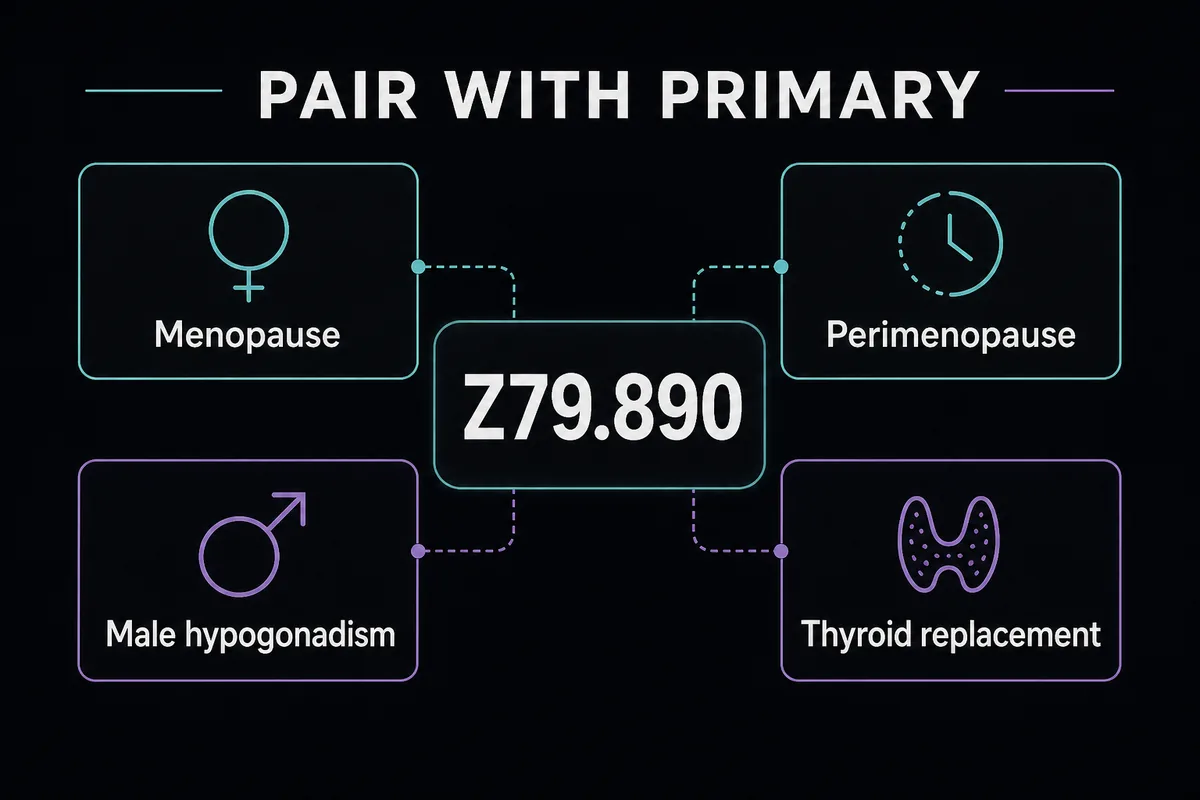
| Clinical scenario | Typical primary code | Secondary code |
|---|---|---|
| Natural menopause | N95.1 Menopausal and female climacteric states | Z79.890 |
| Perimenopause | N95.8 or N95.9 (other or unspecified menopausal and perimenopausal disorders) | Z79.890 |
| Surgical or postprocedural menopause | E89.41 (symptomatic) or E89.40 (asymptomatic) postprocedural ovarian failure | Z79.890 |
| Premature menopause before 40 | E28.310 Symptomatic premature menopause | Z79.890 |
| Male hypogonadism / TRT | E29.1 Testicular hypofunction, E89.5 Postprocedural testicular hypofunction, or E23.0 Hypopituitarism | Z79.890 |
| Thyroid hormone replacement | E03.9 Hypothyroidism, unspecified, or E89.0 Postprocedural hypothyroidism | Z79.890 |
| Gender-affirming hormone therapy | F64.0 (with Z87.890 where applicable) | Z79.890 |
Every pairing above must be verified against the current ICD-10-CM tabular list and the specific payer's policy before billing [3][4].
Natural menopause is the most common pairing: N95.1, menopausal and female climacteric states, as the primary code with Z79.890 secondary [6]. If a patient is starting or continuing treatment for menopausal symptoms, this is usually the pair to reach for; our guide to HRT for menopause symptoms covers the clinical picture behind it.
Perimenopause is coded with N95.8 or N95.9 depending on how specific the documentation is, again with Z79.890 secondary. When symptoms and status are documented in detail, the more specific code applies; you can read more about HRT during perimenopause for context on this stage.
Surgical or postprocedural menopause uses E89.41 for symptomatic postprocedural ovarian failure or E89.40 when it is asymptomatic. Premature menopause before 40 is coded with E28.310, symptomatic premature menopause. Men on testosterone replacement keep Z79.890 as the therapy status, paired with the hypogonadism diagnosis, most often E29.1 (testicular hypofunction), E89.5 (postprocedural testicular hypofunction), or E23.0 (hypopituitarism) depending on the cause; the CMS billing and coding guidance for low testosterone is the reference to confirm which diagnoses a payer treats as covered [5][6]. See our overview of testosterone replacement for men for the clinical background. Thyroid hormone replacement pairs with E03.9 (hypothyroidism, unspecified) or E89.0 (postprocedural hypothyroidism).
Gender-affirming hormone therapy uses F64.0, the diagnosis code applied to this care in the current edition, with Z87.890 (personal history of sex reassignment) where applicable, and Z79.890 as the therapy-status code. Confirm the current title and any coding updates for these codes against the official ICD-10-CM files before billing [3][4].
Codes That Are Not Z79.890: Common Mix-Ups
A few codes sit close enough to Z79.890 to cause errors, so it helps to name them directly.
Z79.899 (other long term drug therapy) is the catch-all for ongoing drug therapy that has no more specific Z79 code. When the long-term drug is hormone replacement, use Z79.890 rather than the generic Z79.899.
Z92.23 (personal history of estrogen therapy) is for therapy that has already ended. Z79 codes describe current therapy only, so once a patient is no longer taking estrogen you switch from Z79.890 to Z92.23; our guide to stopping HRT explains what that transition looks like clinically.
Z78.0 (asymptomatic menopausal state) documents menopausal status in someone who is not on treatment. It is the wrong code for anyone actively on HRT, because those patients need the therapy-status code plus a primary diagnosis, not a status-only code.
Why the Code No Longer Says Postmenopausal
Z79.890 has not always read the way it does now. The table below tracks the changes.
| Edition year | Change |
|---|---|
| 2016 | New code Z79.890 added |
| 2018 | Description revised: "(postmenopausal)" removed, making it "Hormone replacement therapy" |
| 2019 to 2026 | No change to the code or its description |
| 2026 edition | Effective October 1, 2025 (through September 30, 2026) |
When the code was created it read "Hormone replacement therapy (postmenopausal)." The 2018 revision dropped the "(postmenopausal)" qualifier, which broadened the code to any long-term hormone replacement rather than a menopause-only status [1]. That single edit is why the current synonym list spans estrogen, testosterone, and thyroid hormone therapy, and why men on testosterone replacement and patients on thyroid hormone replacement now share the same status code as postmenopausal women on estrogen [1][2].
Frequently Asked Questions
If you arrived here from your own chart or an explanation of benefits, the code itself is only part of the picture. Hormone replacement therapy replaces hormones such as estrogen and progesterone that decline around menopause [7]; you can read what hormone replacement therapy involves and our fuller hormone replacement therapy guide for the treatment side. To understand the billing that sits behind this code, see what HRT costs with and without insurance, and if you are starting treatment, getting HRT through an online provider explains how telehealth prescribing works.
References
- ICD10Data. Z79.890 Hormone replacement therapy. 2026 ICD-10-CM. Accessed 2026. https://www.icd10data.com/ICD10CM/Codes/Z00-Z99/Z77-Z99/Z79-/Z79.890
- AAPC. ICD-10 code Z79.890, Hormone replacement therapy. Accessed 2026. https://www.aapc.com/codes/icd-10-codes/Z79.890
- Centers for Medicare & Medicaid Services. ICD-10 Codes (official code files). Accessed 2026. https://www.cms.gov/medicare/coding-billing/icd-10-codes
- CDC National Center for Health Statistics. International Classification of Diseases, Tenth Revision, Clinical Modification (ICD-10-CM). Accessed 2026. https://www.cdc.gov/nchs/icd/icd-10-cm/index.html
- CMS Medicare Coverage Database. Billing and Coding article on treatment of males with low testosterone; locate and confirm the exact article in the MCD before publishing. https://www.cms.gov/medicare-coverage-database/
- LegalClarity. Hormone Replacement Therapy ICD-10: Z79.890 Coding and Billing. Accessed 2026. https://legalclarity.org/hormone-replacement-therapy-icd-10-z79-890-coding-and-billing/
- MedlinePlus. Hormone Replacement Therapy. U.S. National Library of Medicine. Accessed 2026. https://medlineplus.gov/hormonereplacementtherapy.html
Disclosure: this article contains affiliate links to Gala Health. If you start care through them, we may earn a commission at no extra cost to you.