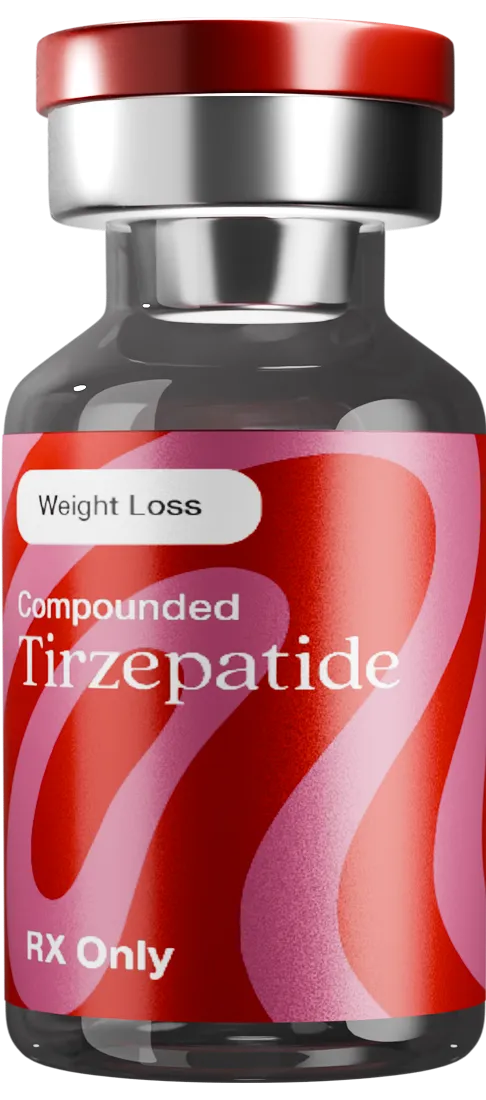
Tirzepatide with B12 is two ingredients in one shot. It pairs compounded tirzepatide, the same dual GIP and GLP-1 drug sold as Mounjaro and Zepbound, with vitamin B12 (and sometimes B6, glycine, niacinamide or L-carnitine) in the vial. The vitamins do not make you lose more weight. Tirzepatide does that on its own.
Quick Answer
Compounded tirzepatide with B12 pairs the active weight-loss drug with a B-vitamin in one injection. Pharmacies add B12 for two reasons: it lets them market the shot as something extra, and after the tirzepatide shortage ended it helped the formula qualify as a legal "non-copy" of brand Mounjaro and Zepbound. The catch arrived in March 2026, when Eli Lilly published an open letter and a funded preprint claiming that B12 reacts with tirzepatide to form a larger molecule never tested in people. The compounding industry disputes the claim. B12 itself is extremely safe, but it does not boost fat loss, so for most people a cheap oral B12 does the same job without the controversy.
🔑 Key Takeaways
- The vitamins are passengers, not the engine. B12, B6, glycine, niacinamide and L-carnitine do not increase weight loss. Tirzepatide drives the result.
- The real reason B12 got added is regulatory. Once the shortage ended, adding a vitamin helped pharmacies sell a formula that is not a straight copy of brand tirzepatide.
- Lilly says the mix is risky; compounders say it is fine. A March 2026 Lilly-funded study flagged a new impurity. The Alliance for Pharmacy Compounding called the letter "more questions than answers."
- B12 is safe even at 100 times the daily requirement. The additive most likely to cause harm is high-dose B6, which can damage nerves over time.
- You probably do not need it in the vial. If your B12 is low, an oral supplement or a separate B12 shot does the same thing for a few dollars.
Why pharmacies add B12, B6, glycine and more
The short answer is part biology, part loophole.
On the biology side, tirzepatide suppresses appetite by acting on the GLP-1 and GIP receptors, and long-term use plus reduced food intake can nudge B12 lower. Folding a B-vitamin into the shot is pitched as a way to keep energy up and head off a deficiency before it starts. B6 (pyridoxine) gets added because it has a mild anti-nausea reputation. Glycine and niacinamide are usually there as buffering or stabilizing agents. L-carnitine is sold on the unproven idea that it helps the body burn fat.
The bigger driver is regulatory. The FDA declared a tirzepatide shortage in late 2022, which legally let compounding pharmacies make copies. That shortage was declared resolved in October 2024, with wind-down deadlines of March 2025 for 503A pharmacies and May 2025 for larger 503B outsourcing facilities, and a North Dakota federal court upheld the FDA in May 2025. Once plain compounded tirzepatide became hard to justify, adding an ingredient like B12 let pharmacies argue they were making a different, clinically tailored product rather than a banned copy. We cover the current rules in our tirzepatide compounding pharmacy explainer and the broader FDA crackdown on compounded GLP-1s.
Decode the label: what the slash names mean
Telehealth menus love confusing names.
When you see a compound name with a slash, the first word is the drug and the rest are the add-ins. Here is how to read the most common ones:
- tirzepatide/cyanocobalamin equals tirzepatide plus the synthetic, most stable form of vitamin B12.
- tirzepatide/methylcobalamin equals tirzepatide plus the "active," body-ready form of B12 that some clinics prefer.
- tirzepatide/pyridoxine equals tirzepatide plus vitamin B6.
- tirzepatide/levocarnitine equals tirzepatide plus L-carnitine.
- tirzepatide glycine b12 equals tirzepatide with both glycine (a buffer) and B12 in the same vial.
None of those slash names change what tirzepatide does. They only tell you which extras are floating in the solution.
Additive-by-additive breakdown
Each ingredient earns its own look.
Vitamin B12 (cyanocobalamin, methylcobalamin, hydroxocobalamin)
B12 keeps red blood cells and nerves healthy, and a true deficiency causes megaloblastic anemia. Absorbing it normally requires a stomach protein called intrinsic factor. Compounded vials carry roughly 250 to 1,000 mcg (0.25 to 1 mg) of B12 per injection, which is about 100 times the adult RDA of 2.4 mcg, according to the NIH Office of Dietary Supplements. Cyanocobalamin is the cheapest and most shelf-stable form, methylcobalamin is the active form, and hydroxocobalamin lasts longest in the body. For weight loss specifically, B12 does nothing unless you were deficient to begin with.
Vitamin B6 (pyridoxine)
B6 is added for its mild anti-nausea reputation, which matters because nausea is the most common tirzepatide complaint. The trouble is the ceiling. The daily B6 requirement is only 1.3 to 1.7 mg, the tolerable upper limit is 100 mg per day, and chronically high doses can cause sensory peripheral neuropathy, meaning numbness, tingling and unsteadiness in the hands and feet. Compounded amounts vary by pharmacy and are not standardized, so B6 is the additive to watch if you also take a B-complex.
Glycine
Glycine is a simple amino acid your body already makes. In these vials it usually works as a buffering and stabilizing excipient rather than a therapeutic dose, so the amount is small. There is no credible evidence that the glycine in your shot adds to weight loss.
Niacinamide (vitamin B3)
Niacinamide, also called nicotinamide, is the non-flushing form of vitamin B3. Pharmacies use it in modest amounts to help stabilize the formula. The daily requirement is 14 to 16 mg, and there is no good reason to expect a "tirzepatide niacinamide dosing chart" to show a fat-burning dose, because no such effect exists. It is a formulation helper, not a weight-loss agent.
L-carnitine (levocarnitine)
L-carnitine shuttles fatty acids into your cells to be burned for energy, which is why marketers attach it to weight-loss shots. Your body makes its own carnitine, and oral supplement studies show little to no meaningful fat loss in people who are not deficient. Typical oral doses run 500 to 2,000 mg per day, but injectable compounded amounts are not standardized and are rarely disclosed. Treat any "levocarnitine burns fat" claim as marketing, not data.
Additive dosing comparison
One table settles the dose question.
The numbers below put each additive next to its daily requirement and its safety ceiling, so you can see at a glance how far above "normal" these megadoses sit and which ones actually carry a risk.
Requirement and ceiling figures come from the NIH Office of Dietary Supplements. The pattern is clear: every additive is either a vitamin you need only in tiny amounts or a substance with no proven fat-loss effect.
Does adding B12 boost weight loss? No
This is the question that sells the product.
The honest answer is that none of these additives move the scale. In the SURMOUNT-1 trial, tirzepatide alone, with no vitamin add-on, produced roughly 15% to 21% mean body-weight reduction across the 5, 10 and 15 mg doses over 72 weeks. That is the engine. Adding B12 to a person with normal B12 levels does not raise energy expenditure, does not suppress appetite further, and does not change how the drug works. If you feel more energetic after a B12 shot, that is the placebo effect plus, occasionally, the correction of a real deficiency, not extra fat burning. For a realistic timeline, see our breakdown of tirzepatide weight-loss results.
The Eli Lilly B12 impurity warning explained
This is the part the SERP is built around.
On March 12, 2026, Eli Lilly published an open letter warning that compounded tirzepatide mixed with B12 can form a new impurity that has never been studied in people. The claim rests on a Lilly-funded medRxiv preprint posted on March 9, 2026, which is not yet peer reviewed. Mass spectrometry in that study showed the tirzepatide-plus-B12 reaction product is a larger molecule than tirzepatide alone, which could in theory change how the drug is absorbed, distributed and cleared. As reported by MedPage Today, Lilly's testing also found some compounded samples contained as little as 43% of the labeled tirzepatide dose, along with bacterial contamination and high endotoxin levels in certain lots, and it named glycine, pyridoxine, niacinamide and carnitine as other untested additives.
Now the other side, because a one-sided page is not honest. The Alliance for Pharmacy Compounding pushed back hard. Its CEO, Scott Brunner, noted that prescriber-authorized tirzepatide with B12 had been compounded for about four years with "no alarming trend of patient adverse events," and said Lilly's letter "raises more questions than answers," as covered by Everyday Health. Critics also point out that a manufacturer competing directly with compounders funded the study, and that "a bigger molecule on mass spec" is not the same as proof of patient harm. You can read Lilly's actual document in its open letter filed with the Kentucky Board of Pharmacy.
What this means for you
Two things are true at once. The impurity has not been shown to harm patients, and it also has not been proven safe. The potency and contamination findings are the more concrete worry, and they point to vendor quality, not to B12 itself. The low-drama move is to use a vetted pharmacy for plain tirzepatide and, if you want B12, take it separately where the dose is known and clean.
Is tirzepatide with B12 safe? Side effects to know
Most risk comes from the drug, not the vitamin.
Tirzepatide's own side effects, mainly nausea, diarrhea, constipation and reflux, are covered in our tirzepatide side effects guide. The additives add their own small list. Very high single B12 doses rarely cause headaches, nausea, diarrhea, vomiting or flushing, a point Johns Hopkins physician Dr. Yuval Pinto made in coverage of the Lilly warning. B6 is the real outlier: sustained high intake can cause sensory peripheral neuropathy, so people already taking a B-complex should tell their prescriber. Call your provider if you notice new numbness or tingling, signs of infection at the injection site such as spreading redness, fever or pus, or any reaction that feels out of proportion to a normal sore spot.
Who actually benefits from the B12
A few people genuinely gain from it.
B12 in the vial is worth something if you are already low or at risk of becoming low. Lab benchmarks generally read under 200 pg/mL as low, 200 to 300 as borderline, and above 400 as normal. The groups most likely to need it are long-term GLP-1 users who eat much less than before, vegans and strict vegetarians, people over 60, anyone with pernicious anemia or low intrinsic factor, and those on metformin or long-term acid-reducing medication. If you fall into one of those groups, B12 is a smart add. If your levels are normal and your diet includes meat, eggs or dairy, the extra B12 mostly leaves your body in your urine. Our GLP-1 daily habits guide goes deeper on B12 and protein while on these medications.
Vial or supplement: bake it in or take it separately
Here is the practical fork.
You do not need B12 baked into your injection to get its benefits. Because GLP-1 medications can lower B12 over months, keeping your level up is reasonable, but an oral B12 tablet or a standalone B12 shot does the same job at a known, clean dose for a few dollars. Baking it into the tirzepatide vial bundles two variables into one liquid, which is exactly the situation Lilly's impurity claim targets. Keeping them separate also lets you adjust your B12 without touching your tirzepatide titration. If the only reason a compounded vial appeals to you is the vitamin, that reason does not hold up.
How to store and draw it
Storage rules do not change with B12 added.
Keep compounded tirzepatide refrigerated at 36 to 46 degrees Fahrenheit (2 to 8 degrees Celsius) and never freeze it. A multi-dose vial typically carries a beyond-use date of 28 to 42 days once it has been accessed, so label the date you first drew from it. Standard titration starts at 2.5 mg weekly for four weeks, then increases by 2.5 mg every four weeks up to a 15 mg maximum, and common compounded concentrations are 5, 10 or 20 mg/mL, which means you have to do unit-conversion math to draw the right volume. Our tirzepatide reconstitution guide and the reconstitution calculator handle that math so you do not under or overdose. Compounded tirzepatide with B12 has historically run about $150 to $500 per month versus a brand Zepbound list price north of $1,000, and you can compare current options on our cheapest tirzepatide page or read how telehealth access works in our how to get tirzepatide walkthrough.
Frequently Asked Questions
References
- Jastreboff AM, et al. Tirzepatide Once Weekly for the Treatment of Obesity (SURMOUNT-1). New England Journal of Medicine. nejm.org.
- A Novel, Widespread Impurity in Mass-Compounded Tirzepatide/B12 (preprint, posted March 9, 2026). medRxiv. medrxiv.org.
- Eli Lilly and Company. Open letter warning of potential patient safety risks from compounded tirzepatide with vitamin B12 (March 12, 2026). pharmacy.ky.gov.
- Impurity in Some Compounded Tirzepatide 'Potentially Dangerous,' Eli Lilly Says. MedPage Today. medpagetoday.com.
- Lilly Says Compounded Tirzepatide With Added Vitamin B12 Contains Impurities. Everyday Health. everydayhealth.com.
- Vitamin B12: Fact Sheet for Health Professionals. NIH Office of Dietary Supplements. ods.od.nih.gov.
- Vitamin B6: Fact Sheet for Health Professionals. NIH Office of Dietary Supplements. ods.od.nih.gov.
- FDA Clarifies Policies for Compounders as National GLP-1 Supply Begins to Stabilize. U.S. Food and Drug Administration. fda.gov.