Melanocortin Peptides
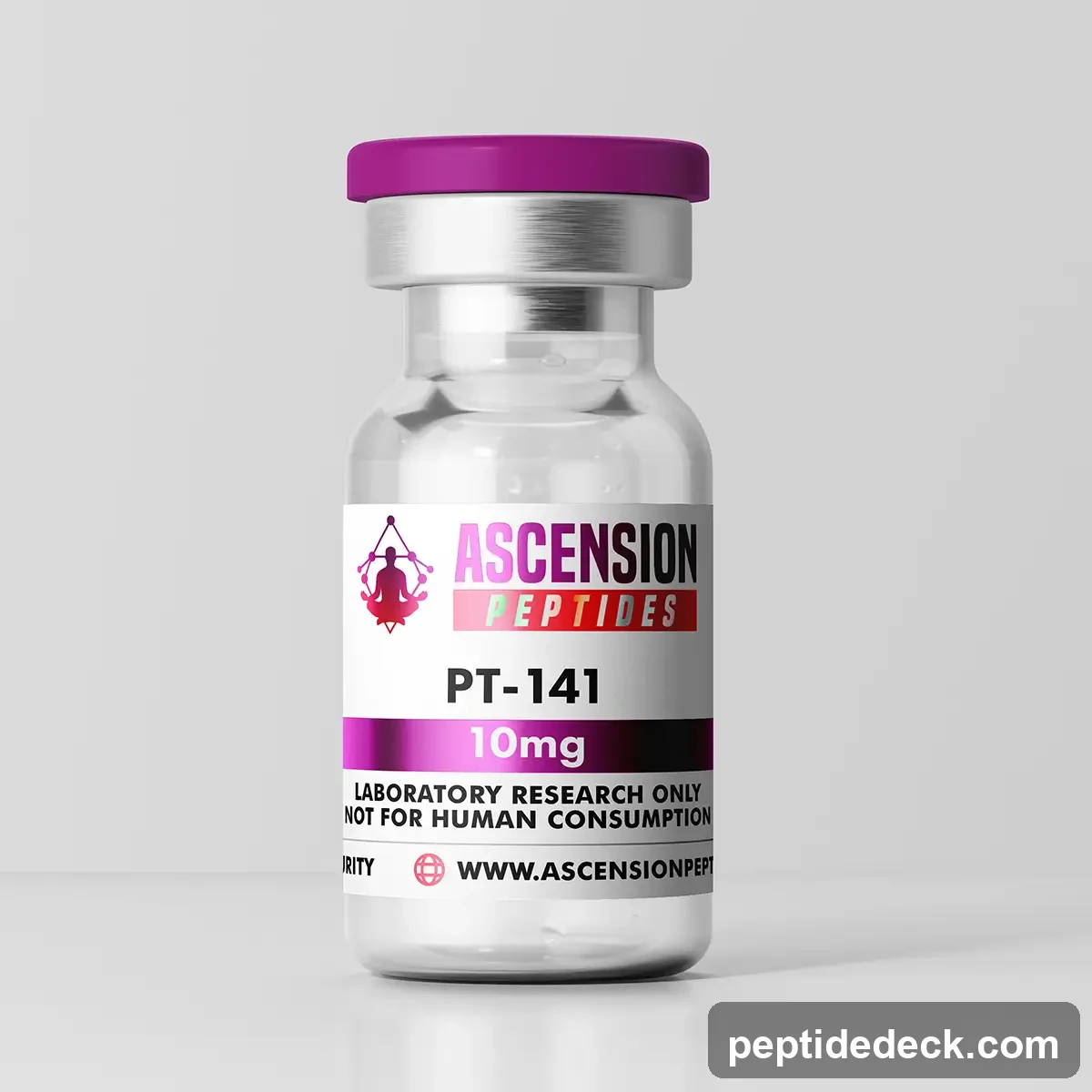
PT-141 (Bremelanotide) 10mg — Where to Buy, Price & COA
with codePEPTIDEDECKat checkout· list $59.99
- Purity
- 99.263%
- Vial
- 10mg
- Form
- Lyophilized powder, sealed vial
- Half-life
- Extended vs linear alpha-MSH analogues due to cyclic structure
PT-141 (Bremelanotide) for sale at PeptideDeck, a synthetic cyclic heptapeptide analogue of alpha-MSH with selective activity at central melanocortin receptors. Supplied as 99%+ pure lyophilized powder in a sealed 10mg vial. If you are looking for where to buy PT-141 online with verified purity, a batch COA, and tracked US shipping, this is the listing we recommend.
Lab certificate for this batch
Kovera Labs report KVR-2026-E6F074, batch 28-05260628, certified 23 May 2026
- Purity
- 99.263%
- Net content
- 10.96 mg in a 10 mg vial
- Method
- RP-HPLC, C18 column, DAD at 214 nm
- Endotoxin
- Pass, under 0.5 EU/mL
- Sterility
- No growth
- Heavy metals
- Arsenic, cadmium, lead and mercury all negative
What a 10mg vial costs elsewhere
Single-vial list prices at the vendors ranking for PT-141, 15 September 2026. Ours is the price after the code.
About PT-141
Looking to buy PT-141 with confidence in purity, identity, and supplier integrity? PeptideDeck lists PT-141 for sale in a 10mg research vial at 99%+ purity, with pricing calibrated to what legitimate buyers expect when comparing PT-141 vendors in 2026. This PT-141 price reflects direct sourcing from a vetted US supplier, batch-level HPLC verification, and same-day fulfillment from a domestic warehouse. If you have been searching "PT-141 for sale", "buy PT-141 10mg", "Bremelanotide for sale", "PT-141 price USA", or "where to buy PT-141 online", this page is where that search ends. Every PT-141 10mg order ships with a published certificate of analysis, discreet packaging, tracked delivery, and secure checkout.
PT-141, known by the International Nonproprietary Name Bremelanotide, is a synthetic cyclic heptapeptide analogue of alpha-melanocyte-stimulating hormone. It was developed from the broader melanocortin research program at the University of Arizona and Palatin Technologies as a metabolite of Melanotan II with reduced pigmentary activity and a receptor profile shifted toward the central melanocortin 4 receptor. The cyclic disulfide-bridged structure improves enzymatic stability relative to linear melanocortin peptides, giving PT-141 the reproducible pharmacology needed for rigorous research. In preclinical and human clinical trials, PT-141 has been studied in sexual response circuitry, hemorrhagic shock physiology, and central nervous system melanocortin signaling, with FDA approval granted in 2019 for a clinical indication under the brand Vyleesi. This listing is strictly for in-vitro laboratory research.
Where to Buy PT-141
PeptideDeck connects research buyers with a vetted US supplier listing PT-141 10mg at a competitive 2026 price, backed by per-lot certificates of analysis and third-party identity verification. When researchers ask us where to buy PT-141 online without the uncertainty of anonymous grey-market listings, this is the source we direct them to. Because the supplier ships from a US warehouse, domestic research buyers avoid customs delays and the seizure risk associated with international melanocortin shipments. The buy button above opens Ascension Peptides' own listing, where you confirm live stock and check out. If you are comparing PT-141 prices across vendors, match listings on purity (99%+), dose (10mg per vial), and documentation (per-lot COA) before comparing numbers, because "PT-141 for sale" listings without those quality signals are not equivalent products. Researchers ordering multiple PT-141 vials at once commonly qualify for tiered volume discounts through partner checkout.
Quality Assurance & COA
Every vial of PT-141 10mg sold through this listing is backed by per-lot quality documentation. Purity is verified by reverse-phase HPLC at 99% or higher, with identity confirmed by mass spectrometry matching the expected molecular weight of the cyclic Ac-Nle-Asp-His-D-Phe-Arg-Trp-Lys structure. The supplier publishes certificates of analysis per lot covering peptide content, residual solvent, and microbial testing, with independent third-party laboratory verification on representative lots as a cross-check of in-house HPLC results. Manufacturing occurs under cGMP-aligned practices in a controlled-environment facility, with end-to-end lot tracking from synthesis through vialing. Researchers who want to inspect the COA for a specific lot before buying PT-141 can request it through the partner vendor. This documentation chain is what separates credible PT-141 suppliers from generic powder listings and is why we recommend this source to buyers searching for PT-141 with evidence they can cite in a laboratory record.
How to verify PT-141 before you use it
PT-141 is among the more commonly substituted peptides, partly because it sells well and partly because the effects are subjective enough that a weak vial can pass unnoticed. Four checks cover most of the risk.
Read the certificate first. It should show HPLC purity above 98%, mass spectrometry confirming bremelanotide's molecular weight of 1025.2 Da, and a batch number that matches the one printed on your vial. A mismatched molecular weight or a purity figure under 95% is a reason to stop.
Inspect the vial. Lyophilised PT-141 is a white to off-white powder or cake. Yellow or brown discoloration means it has degraded. The stopper should carry an intact aluminium crimp and a label with lot information.
Watch it dissolve. Add bacteriostatic water and the powder should go into solution within a few minutes of gentle swirling. A cloudy solution, visible particles, or powder that will not dissolve points to a degraded or badly made batch.
Compare against a known baseline. At a normal 1 to 2 mg dose, effects appear within about an hour. If a 1.5 mg dose from a vial produces nothing at all, not even mild flushing or nausea, and you have used a good vial before, treat the new one as suspect.
Red flags when buying PT-141 online
Oral tablets and nasal sprays are the clearest warning. Bremelanotide has poor bioavailability by both routes, so those products are almost always underdosed. Subcutaneous injection is the route the clinical work used.
Pre-mixed "ready to inject" vials are the second. Peptides ship lyophilised because the dry powder is stable; a pre-mixed liquid has an unknown history and an unknown content.
Anything sold as "herbal" or "natural" PT-141 is not PT-141, which is a synthetic peptide with a defined sequence. A 10 mg vial priced under about $25 before any discount is also worth questioning, because the synthesis is not cheap and the saving has to come from somewhere.
Finally, look at the certificate and the shelf around it. A vendor who cannot produce a COA, or produces one with no batch number or from a lab nobody can identify, has told you what you need to know. So has a shop selling PT-141 next to "liquid Viagra" and "testosterone drops".
What PT-141 is
PT-141, or bremelanotide, is a synthetic cyclic peptide of seven amino acids, derived from the melanocortin research programme that produced Melanotan II. It acts centrally on melanocortin receptors rather than on blood flow, which is what separates it from the PDE5 drugs. The FDA approved it in 2019 as Vyleesi.
For the mechanism, the trial evidence, the dosing research and the side-effect profile, read the full PT-141 guide linked below rather than a product page.
PT-141 and Viagra solve different problems
These two get compared constantly, and the comparison usually misses the point: they act in different places on different parts of the response.
Sildenafil and tadalafil work peripherally, inhibiting PDE5 to improve blood flow. They do nothing for desire and they need arousal to already be happening. Both lower blood pressure and both are dangerous alongside nitrates.
PT-141 works centrally, on melanocortin receptors in the brain, and its primary effect is on desire itself. It has no nitrate interaction and only a slight transient effect on blood pressure. Onset is similar at roughly 30 to 60 minutes, though the window is shorter, about 2 to 6 hours with some residual effect after. It is the only one of the three with a female indication behind it, approved as Vyleesi.
The practical read: a purely mechanical problem points to a PDE5 inhibitor, while low desire, SSRI-related flattening, or arousal that no longer arrives the way it used to points to PT-141.
What a vial costs per use
A 10 mg vial lists at $49 and costs $24.50 with the PEPTIDEDECK code. At a typical 1.5 mg dose that is about six to seven uses per vial, which works out near $3.75 a use after the code, or roughly $7.50 at list price.
The comparison worth making is Vyleesi, the branded FDA-approved bremelanotide auto-injector, which runs about $900 for four 1.75 mg doses. That is around $225 per use for the same molecule.
Reconstitution & Dosing Reference
For laboratory reconstitution, PT-141 is typically dissolved in bacteriostatic water containing 0.9% benzyl alcohol or sterile saline. A common research reconstitution is 2 mL of diluent added to a 10mg vial for a 5 mg/mL stock. Published clinical research on Bremelanotide used subcutaneous administration at defined clinical doses; some preclinical literature also examines intranasal routes because the original PT-141 development program explored a nasal spray formulation before pivoting to subcutaneous delivery. Note that nasal and subcutaneous research routes have different pharmacokinetics and different absorbed fractions, which is why published studies carefully distinguish administration mode. For in-vitro laboratory work, reconstitution volume is a design choice based on assay concentration needs. Swirl gently after adding diluent, allow the solution to clarify, and do not shake. These reconstitution values are research reference information only. They are not a human-use protocol, and this listing supplies PT-141 strictly for laboratory research applications.
Storage & Handling
Store lyophilized PT-141 at minus 20 degrees Celsius, protected from light and moisture, for long-term stability. Under these conditions, an unopened vial retains specification for 24 months or more. Short transit periods at ambient temperature do not meaningfully degrade the cyclic peptide, which is one of the pharmacological advantages of the lactam-bridged structure. Once reconstituted with bacteriostatic water or sterile saline, PT-141 solution should be refrigerated at 2 to 8 degrees Celsius and used within 30 days. Avoid repeated freeze-thaw cycles on reconstituted material, since cycling promotes aggregation and reduces bioactivity in assay work. Keep the vial upright, protect the rubber stopper from contamination, and wipe with 70% isopropyl alcohol before each withdrawal. Minimize headspace exposure during repeated withdrawals.
Research Benefits
99%+ purity lyophilized PT-141 (Bremelanotide) verified by HPLC
10mg per vial, sealed under vacuum
Cyclic heptapeptide alpha-MSH analogue with MC4 selectivity
Studied in central sexual response and motivation research
Investigated in autonomic, inflammatory, and shock physiology models
Enzymatic stability from lactam-bridged cyclic structure
Per-lot certificate of analysis with independent verification
Ships same-day from a US warehouse with tracked delivery
Product Specifications
| Molecular Weight | ~1025.18 g/mol |
| Sequence | Ac-Nle-cyclo[Asp-His-D-Phe-Arg-Trp-Lys]-OH |
| Half-Life | Extended vs linear alpha-MSH analogues due to cyclic structure |
| Purity | 99%+ (HPLC verified) |
| Form | Lyophilized powder, sealed vial |
| Storage | Lyophilized at -20°C; reconstituted at 2-8°C, use within 30 days |
Frequently Asked Questions
Scientific References
International Journal of Impotence Research · 2004
Obstetrics and Gynecology · 2019
Expert Review of Clinical Pharmacology · 2019
European Journal of Pharmacology · 2004
European Urology · 2007
References provided for informational research context only. PeptideDeck does not imply clinical application or endorse any human use.
You May Also Like
View all →
Melanocortin Peptides
Melanotan II
Cyclic Alpha-MSH Analogue Research Peptide, 10mg Vial For Sale
Growth Factor Peptides
IGF-1 LR3
Long R3 Insulin-like Growth Factor-1, 1mg vial
Growth Hormone Releasing Hormone (GHRH) Analogues
CJC-1295 (No DAC)
Modified GRF (1-29) GHRH Analogue, 5mg Lyophilized Vial
Copper Peptides
GHK-Cu
GHK-Cu For Sale: 50mg 99%+ Purity Copper Tripeptide
Research Use Only. All products sold by PeptideDeck are strictly for in-vitro laboratory research and are not intended for human or veterinary use, diagnosis, or treatment. Not for resale.