Thymalin peptide is not one peptide. That changes everything.
If you've read about thymalin, you've probably seen it described as a thymus peptide that resets your immune system and helps you live longer. You've also seen the same name on online vials next to a neat amino acid sequence. Those two things don't match. The real thymalin is a Russian prescription medicine made from calf thymus, a mix of many small peptides. What's printed on many vials is something else, and the studies everyone quotes were done on the extract, not on the vials.
🔑 Key Takeaways
- Thymalin is an extract, not a single sequence. One popular vendor vial lists the sequence of a completely different thymus hormone.
- Its best-known human study reported a death rate cut by half or more in older adults. The abstract leaves out the details you'd need to trust that number.
- The Russian label dose is short and intense: daily shots for days, not weeks, then a long break.
- The label lists one side effect. That tells you less about safety than you'd think.
- Thymogen, thymulin and thymosin alpha-1 sound alike. Only one of them has trials outside Russia.
Below, we cover what thymalin actually is, grade every benefit claim by the study behind it, set the Russian label dose against online protocols, list the side effects and cautions, and compare it with the three thymus peptides it gets confused with.
What Is Thymalin Peptide?
Start with the thymus.
The thymus is a small gland behind your breastbone where T cells, the immune cells that recognize infected and abnormal cells, learn their job. It is largest in childhood and shrinks with age, which is one reason older people fight off infections less well. Most people already know that their immune system isn't what it was at twenty. Thymalin was built on that idea.
Soviet researchers Morozov and Khavinson, working in Leningrad (now St. Petersburg), extracted a fraction of small peptides from calf thymus using a mild acid process. They called the product thymalin (Russian: Тималин) and put it to use as an "immunocorrector" for people with weakened immunity. The first clinical reports indexed in PubMed date from 1981.
Thymalin is still a registered medicine in Russia. The current registration (ЛП-005867, issued June 2024, holder Samson-Med) describes it as:
- Active ingredient: 10 mg thymus extract per vial, taken from the thymus glands of calves and young cattle under one year old
- Filler: 20 mg glycine
- Form: a freeze-dried tablet-shaped cake in a 5 mL glass vial, dissolved in 1 to 2 mL of sodium chloride before injection into the muscle
- Supply: prescription only
Because it is an extract, thymalin has no single sequence or molecular weight. Its developers describe it as a complex of peptides up to about 10 kDa and name three short ones as key active parts: the dipeptides Glu-Trp (also written EW) and Lys-Glu (KE), and the tripeptide Glu-Asp-Pro (EDP). They also say the extract contains many other peptides.
What's actually in a vial labelled "thymalin"?
This is where it gets messy.
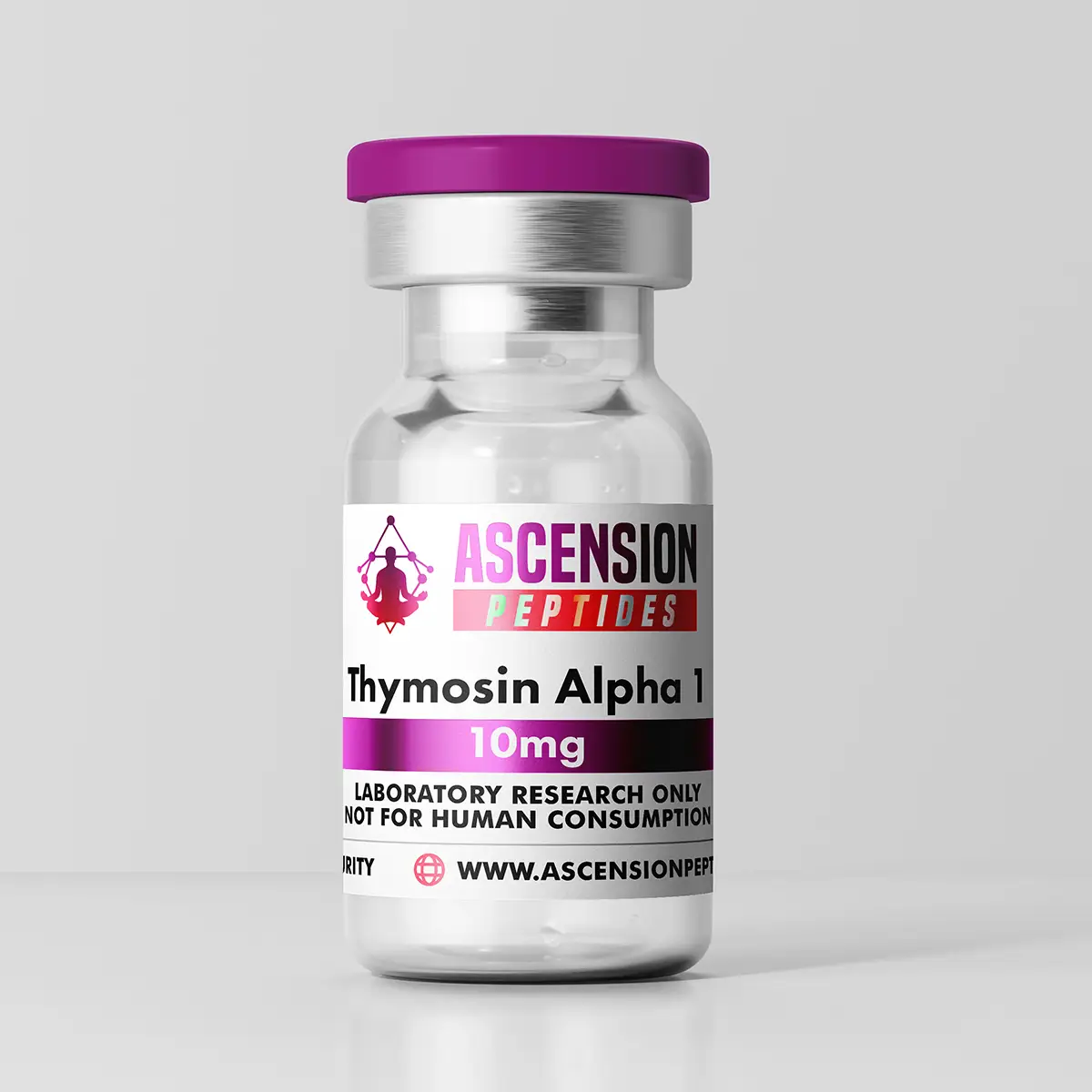
Online vendors sell vials called thymalin, often described as synthesized in the USA. A synthetic copy of an animal extract is a contradiction: you can't synthesize a mixture nobody has fully mapped. So vendors fill the gap in different ways. We checked what three products state about their contents in October 2026.
The vendor A sequence, Pyr-Ala-Lys-Ser-Gln-Gly-Gly-Ser-Asn, is thymulin, a 9-amino-acid hormone that the thymus makes and that needs zinc to work. It is a real thymus peptide, but none of the thymalin studies used it. Some popular blog guides repeat the same mix-up and print thymulin's sequence under the thymalin name.
The practical point: none of the human data in this article transfers to a vial unless you know what is in it, and for most vendor vials you can't.
Thymalin vs Thymogen: Not the Same Drug
Thymogen is thymalin's offspring.
The developers separated thymalin into fractions with liquid chromatography and found that one dipeptide, L-Glu-L-Trp, carried much of the immune activity. They synthesized it and released it as a separate medicine called thymogen (Тимоген). It is a single, defined molecule, made in a lab, not from cattle.
The doses tell you how different they are. A thymogen ampoule holds 100 micrograms of Glu-Trp per mL, and the nasal spray delivers 25 micrograms per puff. Thymalin is dosed at 5,000 to 20,000 micrograms a day. They are not interchangeable, and results from one don't carry over to the other.
If you see "thymalin (Glu-Trp)" on a label, you are looking at thymogen under a different name, or a vendor guessing.
Thymalin Peptide Benefits: What the Studies Show
Most of the evidence is old, Russian and small.
That doesn't make it worthless. It means you have to read it differently from a Western drug trial. Below, each claim you'll see online is matched to the study behind it. "Strength" is our grade: how much the study design lets you trust the result.
Immune support and T cells
This is what the drug is registered for.
The Russian label lists immune deficiency after severe infections, after radiation or chemotherapy, after removal of the thymus, and with slow wound healing. More than 200 PubMed-indexed papers, most of them Soviet and Russian from the 1980s and 1990s, report thymalin in pneumonia, tuberculosis, peritonitis, burns, hepatitis and more. Almost all of them measured immune markers, such as T-cell counts, rather than hard outcomes like recovery time or survival, and few had a proper control group.
The lab work explains why the developers expected an effect. In a 2020 cell study, thymalin pushed human blood stem cells toward mature T cells, raising the CD28 marker 6.8-fold. In a 2023 study using blood cells from four donors, thymalin and its two dipeptides cut inflammatory signals (IL-1β, IL-6, TNF-α) by 1.4 to 6.0 times. Those are mechanisms. They show what the extract can do in a dish, not what it does in your body.
Longevity: the 266-person study
This is the study every thymalin article quotes.
Khavinson and Morozov followed 266 people over 60 for 6 to 8 years. Groups got thymalin, epithalamin (an extract of the pineal gland), both, or neither, during the first 2 to 3 years. Compared with the control group, the abstract reports 2.0 to 2.4 times fewer acute respiratory illnesses and a death rate that was:
- 2.0 to 2.1 times lower with thymalin alone
- 1.6 to 1.8 times lower with epithalamin alone
- 2.5 times lower with both
- 4.1 times lower in a separate group given both every year for 6 years
Those numbers are striking. Here is why they can't carry the weight they're given. The abstract doesn't say how many people were in each group, how they were assigned, whether anyone was blinded, how many died in absolute terms, or what dose was used. PubMed indexes it as a randomized trial, but nothing in the abstract describes randomization. It was run and reported by the developers' own institute, published in two journals with near-identical abstracts, and has never been repeated by an independent group. A death rate halved in a small, unblinded study is a reason to run a proper trial, not proof of a longer life.
COVID-19
Thymalin got a second life in 2020.
In an open-label randomized trial at one St. Petersburg hospital, 92 adults with COVID-19 pneumonia, average age about 60, got standard care with or without thymalin, 10 mg into the muscle daily for 5 days. By the end of treatment, the thymalin group's lymphocyte count had risen 55%, against 12.5% in the control group. Inflammatory and clotting markers fell faster too: IL-6 by 82% vs 29%, C-reactive protein by 90% vs 40%, D-dimer by 82% vs 52%. No one died in either group. Lung scans worsened in 2 thymalin patients and 5 controls.
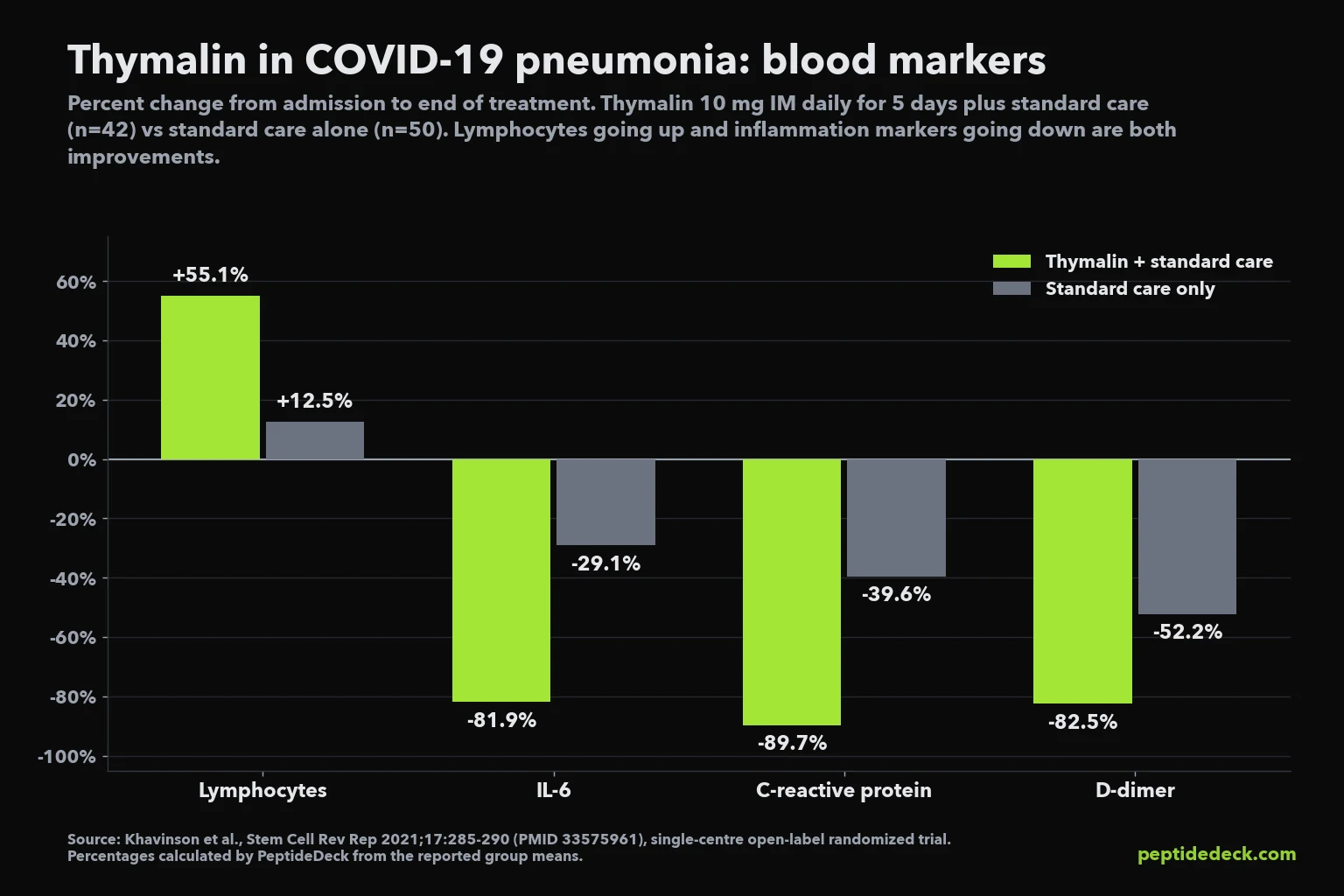
The caveats are real. Nobody was blinded, the groups got different amounts of other drugs (the thymalin group had a shorter dexamethasone course, 2.5 vs 4 days), and the trial measured lab values, not recovery. A second Russian report compared standard care, tocilizumab and thymalin in severe COVID-19 and gave hospital death rates of 40.9% with standard care alone against 20.6% with thymalin. The Russian-language version of the same abstract gives 16.2%, and neither version says how many patients were in each group or how they were assigned.
Cancer and radiation
Here the label goes further than the evidence.
Thymalin is registered for weakened immunity and blood counts after chemotherapy or radiation. The studies behind that are small Soviet reports, such as a 1990 paper in which 35 of 111 women with endometrial cancer got thymalin and showed better immune markers, with no survival data. A Cochrane review of 26 randomized trials (2,736 patients) of other thymus extracts and thymic peptides in cancer found no benefit for survival or tumor response, though the extracts did lower the risk of severe infections during treatment (risk ratio 0.54). Thymalin itself was not in that review.
What has no human data
Plenty of claims you'll read online.
There is no published human data for thymalin and hair regrowth, skin quality, joint repair, fat loss, focus or sleep. The tumor-suppression and lifespan results come from lab animals given the Glu-Trp dipeptide, not people given thymalin. If a page promises any of these, ask which study it means.
Reading Russian peptide studies: most thymalin papers are small, unblinded, decades old, written in Russian with short English abstracts, and come from the group that developed and patented the drug. That combination doesn't mean the results are wrong. It means no one outside that circle has checked them yet.
Thymalin Dosage: The Russian Label vs Online Protocols
The label dose is short and front-loaded.
Here is the exact regimen from the Russian instructions next to what the one modern trial used and what online guides recommend.
Two things stand out. First, the label route is into the muscle, and the label has no under-the-skin option; online protocols that inject under the skin are improvising. Second, every human study used the calf extract. No dose of a synthetic vendor vial has ever been tested in people, so the "5 to 10 mg for 10 days" protocol is borrowed from the extract and applied to something that may not resemble it.
Mixing a 10 mg vial
The math is simple.
The Russian label says to dissolve one 10 mg vial in 1 to 2 mL of sodium chloride 0.9% just before the injection. Online vials are usually mixed with bacteriostatic water instead so they can be used over several days. On a U-100 insulin syringe, 100 units equals 1 mL.
With 1 mL of water, every 10 units is 1 mg, so a 5 mg dose is 50 units. With 2 mL, a 10 mg dose won't fit in a standard 1 mL insulin syringe. If you're new to mixing vials, our guide on how to reconstitute peptides covers the technique, and the peptide calculator does the units for any vial size.
Thymalin Side Effects and Safety
The label lists exactly one side effect.
It's "allergic reactions", with no frequency given. The developers describe thymalin as having "practically no side effects", and the 92-patient COVID-19 trial reported no adverse events. But a short list doesn't prove a clean record. Older drugs registered in the Soviet era often had thin safety reporting, and small trials can't pick up rare problems.
What the Russian label does say:
- Do not use if you are allergic to the extract or glycine, pregnant, or breastfeeding.
- Use with caution if you have a history of allergies. It is a bovine protein product.
- Relative cautions: the days around a period, pituitary adenoma and acromegaly. The label adds that side effects may be more common with severe hormone disorders and in the second half of the menstrual cycle.
- Avoid alcohol during a course.
- Hormone interactions: possible additive effects with growth hormone, LH and estrogens; opposing effects with progestins, androgens and adrenal hormones on lymph tissue and bone marrow.
- No dosing data exist for kidney or liver disease or for older adults.
Beyond the label, three practical risks:
- Injection-site reactions. Pain, redness or a lump where you injected, more likely with muscle shots and with non-sterile vials.
- Autoimmune conditions. The label doesn't list them, and Soviet papers report using thymalin in rheumatoid arthritis and autoimmune thyroiditis. Still, adding a T-cell stimulant when your immune system is already attacking your own tissue is a fair concern. Talk to the doctor managing your condition first.
- Mast cells. If you have mast cell activation, chronic hives or reactive skin, know that many injectable peptides can switch on mast cells directly through a receptor called MRGPRX2, causing flushing or hives that look like allergy. Thymalin hasn't been tested for this, but it's worth a slow first dose.
The largest risk sits with the product, not the molecule. An unregulated vial can hold the wrong peptide, the wrong amount, or bacteria. For a mixture with no fixed sequence, a lab report can't even confirm identity properly.
What to ask your doctor: Is my immune problem one that thymus peptides were ever tested for? Could an immune stimulant worsen my autoimmune, allergic or mast cell condition? Is there an approved option, such as a vaccine, a hepatitis treatment or a referral to an immunologist, that fits better? Don't stop or change any prescribed medication to try thymalin.
Thymalin vs Thymosin Alpha-1, Thymogen and Thymulin
Four thymus peptides, four different things.
People searching thymalin often land on thymosin alpha-1, and the names don't help. Here is how they differ.
The key difference between thymalin and thymosin alpha-1 is definition. Thymosin alpha-1 is one molecule with a fixed sequence, so a vial can be tested for exactly what it should contain, and it has randomized trials outside Russia, including seven in chronic hepatitis B. Thymalin is a mixture whose human data comes almost entirely from its developers. If you want the details, our thymosin alpha-1 guide covers its dosing and trials, and our pages on thymulin and thymopentin, a 5-amino-acid fragment of another thymus hormone, cover the rest of the family.
Thymalin and Epitalon: The Khavinson Pairing
They were designed as a team.
Thymalin and epithalamin, a pineal gland extract, came from the same institute, and the 266-person study tested them side by side. The pair did better than either alone in that study, which is why longevity protocols often run them together. Epitalon is the synthetic 4-amino-acid peptide (Ala-Glu-Asp-Gly) the developers designed to copy epithalamin, so most people stacking them today use epitalon, not the original extract. Note that the human study used epithalamin, not epitalon.
Our epithalon vs thymalin comparison covers which goal each one fits, and the bioregulator peptides for aging guide places both in the wider Khavinson family. For the full list of these short tissue peptides, see our bioregulator peptides overview.
Is Thymalin Legal in the US? How People Get It
It has no FDA approval for any use.
There is no approved US thymalin product. In Russia it is a prescription medicine. That leaves Americans with three routes, none of them simple.
- The Russian medicine. Some people order the Samson-Med vials from overseas pharmacies. This is the real extract, but importing an unapproved prescription drug for personal use is restricted in the US and shipments can be refused. Check the rules before you order.
- Vendor vials labelled thymalin. These are easy to find at roughly $30 to $115 per vial, but as the table above shows, the contents range from thymulin to an undefined "complex". Ask the seller what sequence is in the vial and for a batch lab report that confirms it.
- A different thymus peptide. People who can't source the Russian medicine often look at thymosin alpha-1 instead. It is a different peptide, but it has its own human trials and a fixed sequence that a lab report can verify. Our guide on where to buy thymosin alpha-1 covers vendors, prices and what a good lab report shows.
Is Thymalin Worth It?
It depends on what you can actually get.
If you can get the registered Russian extract, under a doctor's eye, for a short course after a draining illness, you're using it the way it was designed and the way it was studied. The evidence is thin by modern standards, but the label is clear and the course is short.
If you're buying a synthetic "thymalin" vial online, you're not using thymalin in any sense the studies recognize. You're using an unknown peptide at a dose borrowed from a calf extract. For most people chasing immune support, a defined peptide with its own trials, like thymosin alpha-1, is the more honest bet. And if your main goal is longer life, remember that the one human study behind that claim has never been repeated.
Frequently Asked Questions
Sources
- Thymalin (Тималин) prescribing information, Samson-Med, registration ЛП-№(005867)-(РГ-RU), 21 June 2024. Vidal Russia. vidal.ru
- Thymalin instructions for use (dissolution in 1–2 mL sodium chloride, storage). medi.ru
- Thymogen (Тимоген) injection, nasal spray and cream, composition. Vidal Russia. vidal.ru
- Morozov VG, Khavinson VK. Natural and synthetic thymic peptides as therapeutics for immune dysfunction. Int J Immunopharmacol. 1997;19(9-10):501-5. PMID 9637345. PubMed
- Khavinson VKh, Morozov VG. Peptides of pineal gland and thymus prolong human life. Neuro Endocrinol Lett. 2003;24(3-4):233-40. PMID 14523363. PubMed
- Khavinson VKh, Morozov VG. Geroprotective effect of thymalin and epithalamin. Adv Gerontol. 2002;10:74-84. PMID 12577695. PubMed
- Khavinson VK, Kuznik BI, Trofimova SV, et al. Results and prospects of using activator of hematopoietic stem cell differentiation in complex therapy for patients with COVID-19. Stem Cell Rev Rep. 2021;17(1):285-290. PMID 33575961. PMC full text
- Kuznik BI, Shapovalov KG, Smolyakov YN, et al. Morphological compound and indicators of the blood clotting system in severe COVID-19 patients during treatment with tocilizumab and thymalin. Adv Gerontol. 2022;35(3):368-374. PMID 36169363. PubMed
- Khavinson VK, Linkova NS, Kvetnoy IM, et al. Thymalin: activation of differentiation of human hematopoietic stem cells. Bull Exp Biol Med. 2020;170(1):118-122. PMID 33237528. PubMed
- Linkova N, Khavinson V, Diatlova A, et al. The influence of KE and EW dipeptides in the composition of the thymalin drug on gene expression and protein synthesis involved in the pathogenesis of COVID-19. Int J Mol Sci. 2023;24(17):13377. PMID 37686182. PubMed
- Khavinson VKh, Linkova NS, Chalisova NI, Ivko OM. The use of thymalin for immunocorrection and molecular aspects of biological activity. Biol Bull Rev. 2021;11(4):377-382. PMC full text
- Anisimov VN, Khavinson VK, Morozov VG. Immunomodulatory synthetic dipeptide L-Glu-L-Trp slows down aging and inhibits spontaneous carcinogenesis. Biogerontology. 2000;1(1):55-9. PMID 11707921. PubMed
- Bakhidze EV, Bokhman JaV. Application of thymic factor "Thymalin" in complex treatment of endometrial cancer patients. Eur J Gynaecol Oncol. 1990;11(4):251-6. PMID 2245808. PubMed
- Kazantseva IA, Bikbulatov RM. Thymalin in the treatment of herpetic stomatitis in children. Stomatologiia (Mosk). 1994;73(1):40-4. PMID 8191521. PubMed
- Wolf E, Milazzo S, Boehm K, et al. Thymic peptides for treatment of cancer patients. Cochrane Database Syst Rev. 2011;(2):CD003993. PMID 21328265. PubMed
- Goldstein AL, Goldstein AL. From lab to bedside: emerging clinical applications of thymosin alpha 1. Expert Opin Biol Ther. 2009;9(5):593-608. PMID 19392576. PubMed
- Chien RN, Liaw YF. Thymalfasin for the treatment of chronic hepatitis B. Expert Rev Anti Infect Ther. 2004;2(1):9-16. PMID 15482167. PubMed
- You J, Zhuang L, Cheng HY, et al. Efficacy of thymosin alpha-1 and interferon alpha in treatment of chronic viral hepatitis B: a randomized controlled study. World J Gastroenterol. 2006;12(41):6715-21. PMID 17075991. PubMed
- Bach JF, Dardenne M. Thymulin, a zinc-dependent hormone. Med Oncol Tumor Pharmacother. 1989;6(1):25-9. PMID 2657247. PubMed
- Gonser S, Weber E, Folkers G. Peptides and polypeptides as modulators of the immune response: thymopentin, an example with unknown mode of action. Pharm Acta Helv. 1999;73(6):265-73. PMID 10443171. PubMed
- Khavinson VKh. Peptides and ageing. Neuro Endocrinol Lett. 2002;23 Suppl 3:11-144. PMID 12374906. PubMed
- McNeil BD, Pundir P, Meeker S, et al. Identification of a mast-cell-specific receptor crucial for pseudo-allergic drug reactions. Nature. 2015;519(7542):237-41. PMID 25517090. PubMed
Medical Disclaimer: This content is for informational purposes only and does not constitute medical advice. Thymalin has no FDA approval for any use. Always consult a qualified healthcare provider before starting any new medication or treatment. PeptideDeck may earn a commission from affiliate links at no additional cost to you.