One study from 1978 built PRL-8-53's whole reputation. PRL-8-53 (searched as "PRL 8 53" or "PRL 853") is a synthetic memory compound sold online as a nootropic, and almost everything said about it traces back to a single, small word-recall experiment run by the chemist who invented it. This guide shows what that study found by group, why it has never been confirmed, what dose it used, and what nobody knows about safety.
🔑 Key Takeaways
- PRL-8-53 is not a peptide, even though peptide shops sell it
- The famous "doubled memory" figure applies to two subgroups, not to everyone
- People who already had a good memory gained almost nothing
- The 10 mg capsules on sale hold twice the only dose ever tested in people
- Competitive athletes face a specific anti-doping problem with it
Every study claim below links to its source at the end, and prices were checked on the seller's page on November 5, 2026.
What Is PRL-8-53?
It's a small synthetic molecule, not a peptide. PRL-8-53 is methyl 3-[2-[benzyl(methyl)amino]ethyl]benzoate, a substituted phenethylamine with the formula C18H21NO2. It contains no amino acids at all, so it shares nothing structurally with Semax, Selank or other memory peptides.
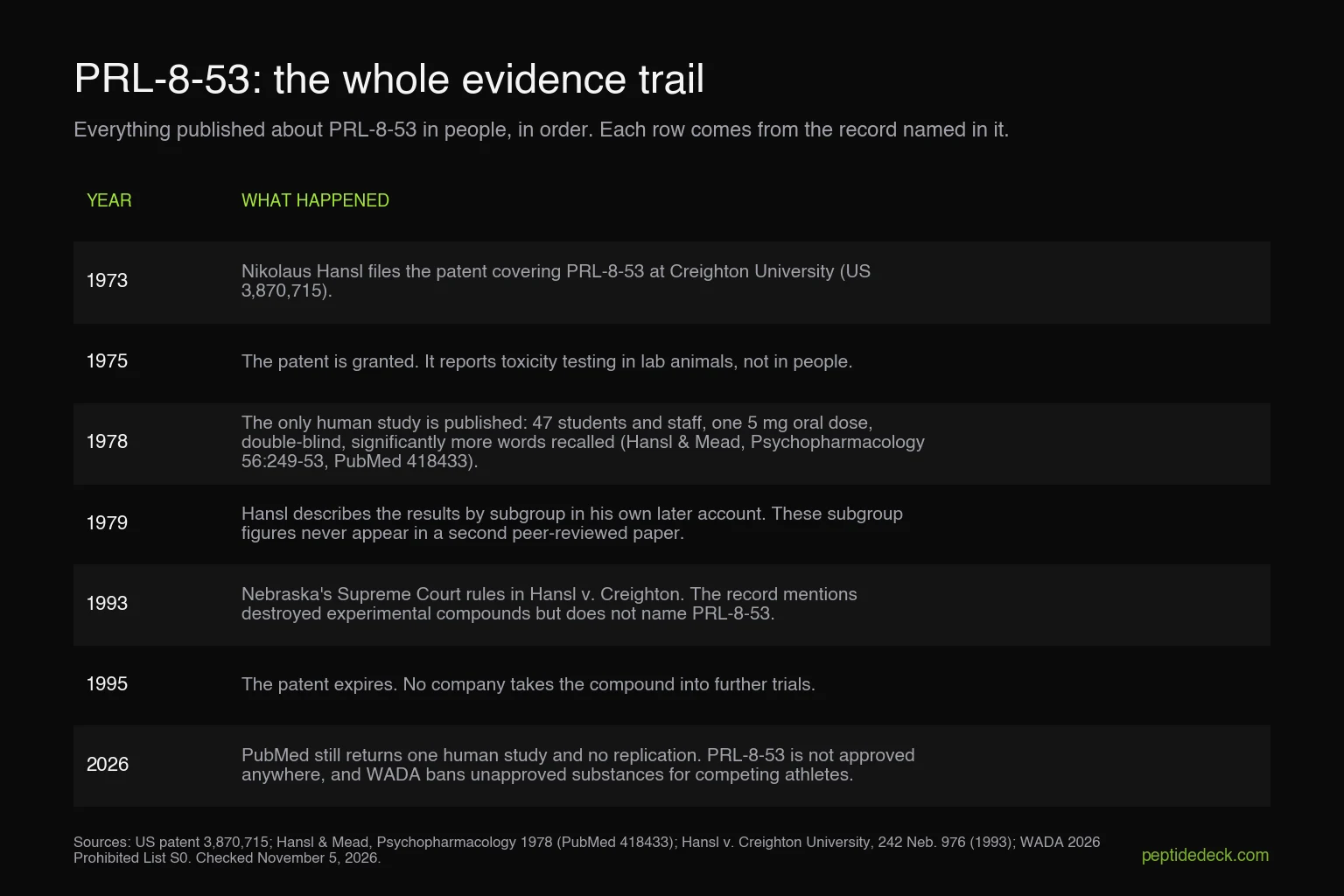
Nikolaus Hansl, a medicinal chemistry professor at Creighton University in Omaha, made it in the early 1970s while working on a family of amino ethyl meta benzoic acid esters. His 1975 US patent (3,870,715, filed in 1973) describes these compounds as spasmolytics, psychotherapeutic agents and "agents facilitating learning". Google Patents lists that patent as expired.
What you buy today is usually the hydrochloride salt (CAS 51352-87-5). That's the same form Hansl used: the 1978 paper names the compound as the methyl ester hydrochloride.
Why development stopped
No published record explains it. What is on record is that Hansl agreed in July 1985 to resign from Creighton in exchange for two years of office and lab space. When he came back from a four-month absence in November 1986, a refrigerator holding his experimental compounds had been unplugged and the compounds destroyed. He sued, and the Nebraska Supreme Court upheld a ruling for the university in 1993. The court record doesn't name PRL-8-53, but no further human work on it was ever published.
The 1978 PRL-8-53 Study: Who, What and How
Here's what the single human trial actually did. Hansl and psychiatrist Beverley Mead published it in Psychopharmacology in 1978, three years after submitting it in 1975.
- Who: 47 healthy university students and faculty members, according to the APA PsycInfo abstract.
- Design: double-blind, with each person's results on PRL-8-53 compared with their own results on placebo.
- Dose: one 5 mg oral dose, given about 2 to 2.5 hours before testing.
- Task: learning 12-item word lists by the serial anticipation method, then recalling the words 24 hours and one week later.
- Other checks: visual reaction time and motor control.
The abstract reports a "slight improvement" in learning the lists, and a statistically significant improvement in how many words people kept, with most P values below 0.01. Reaction time and motor control didn't change significantly compared with placebo.
PRL-8-53 Memory Results by Group
The headline numbers depend on who you look at. The paper split participants by how well they did on placebo and by age, and the gains were very uneven.
The full paper is paywalled. The group figures above come from summaries of the paper that were added to its Wikipedia entry, cross-checked against Hansl's own 1979 description of the over-30 group. In that article, he wrote that this group kept just under 3 of 12 words after 24 hours on placebo, and 5.85 words after taking PRL-8-53, which he gave as a 108% gain at 24 hours and 152% at one week.
Read that carefully if you're deciding whether to try it. "Doubled recall" in the over-30 group means going from about 3 words to about 6. And people who already remembered 8 or more words barely moved, which the researchers put down to a ceiling effect: there wasn't much room left to improve.
Why One PRL-8-53 Study Isn't Enough
Several design problems limit what it can tell you.
- The inventor ran it. Hansl synthesised the compound, held the patent and co-ran the trial at his own university. No independent group has tested it in people since.
- One dose, one sitting. Everyone got a single 5 mg dose. Nothing is known about other doses or about taking it daily for weeks.
- Small subgroups. The striking results come from slices of a 47-person sample. The weaker-baseline group was about 60% of participants, and the summaries don't give the size of the over-30 group.
- A narrow task. Rote recall of short word lists is one type of memory. It doesn't tell you about focus, studying for an exam or memory problems from ageing or illness.
- Never replicated. Nearly 50 years later, a PubMed search for PRL-8-53 still returns only this one paper.
Evidence grade: one small, double-blind human study by the compound's inventor, never repeated. Everything beyond "a single 5 mg dose improved word recall in some people in 1978" is unknown.
PRL-8-53 Benefits: What It Might Do vs What's Unknown
Here's an honest split between the two. If you're an average adult over 30, or you score low on rote recall, the 1978 data are the reason people try it.
What the study suggests it might do:
- Help you keep more words from a list you learned a day or a week earlier, after a single 5 mg dose.
- Help more if your baseline recall is weak, and very little if it's already strong.
- Do this without a significant change in reaction time or motor control, so it didn't behave like a stimulant in that test.
What nobody knows:
- How it works. Hansl described it as boosting the brain's cholinergic (acetylcholine) system, and lab work in animals suggested effects on dopamine and serotonin. None of this was ever confirmed in people.
- Whether the effect lasts with repeated use, or fades.
- Whether it helps anything other than word-list recall, such as focus, mood or brain fog.
Claims you'll see elsewhere about better focus, mood or sleep don't come from human data. If brain fog is your real problem, our guide to peptides for brain fog starts from causes rather than compounds.
PRL-8-53 Dosage: The Only Tested Dose Is 5 mg
Only one dose has human data behind it. The 1978 study gave one 5 mg oral dose of the hydrochloride, roughly two hours before learning the word lists.
- Timing: in the study, the dose came about 2 to 2.5 hours before the task.
- Frequency: unknown. The study used one dose, once. There is no data on daily use, cycling or tolerance.
- Higher doses: untested in people. User reports often mention 10 to 20 mg, which is two to four times the studied dose.
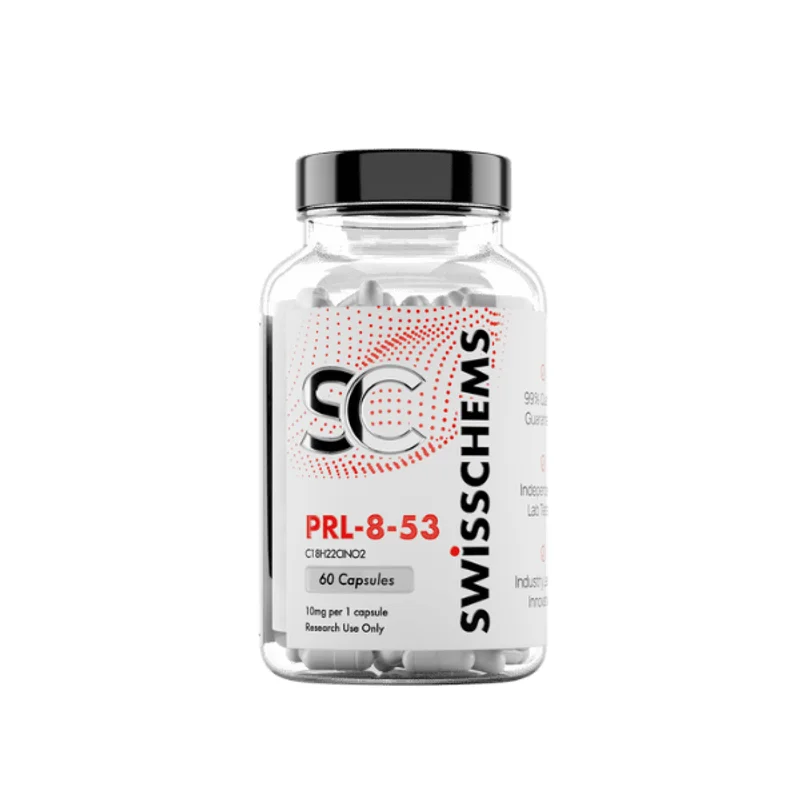
Weighing 5 mg of powder needs a scale that reads to 0.001 g. Most kitchen and jewellery scales can't do that accurately. That's one practical reason some people choose capsules, though the capsules sold now are 10 mg, so they don't match the study dose either.
PRL-8-53 Side Effects and Safety Unknowns
No side effects were reported in the 1978 study. That's a single dose in 47 healthy volunteers, so it tells you very little about regular use, older adults with health conditions, or mixing it with medicines.
Most of the safety picture comes from Hansl's lab work in animals in the 1970s:
- His patent gives an oral lethal dose in mice of about 500 to 700 mg/kg, and says dogs and monkeys tolerated doses as high as 50 mg/kg.
- His 1974 paper, as summarised on Wikipedia, reported brief drops in blood pressure in dogs at doses above 8 mg/kg.
There is no human data on half-life, on how the body clears it, on drug interactions, or on use during pregnancy. One user on a drug-discussion forum described feeling that their OCD got worse after taking it. That is a single anecdote, not evidence, but it shows what nobody has studied.
What to ask your doctor before trying it:
- Could it interact with anything I take, especially antidepressants, ADHD stimulants, blood pressure medicines or drugs that act on acetylcholine?
- Is my memory complaint worth checking for a medical cause first, such as thyroid, B12, sleep apnoea or depression?
- Is there an approved treatment I should try instead?
What PRL-8-53 Users on Reddit Report
Reddit is where most current PRL-8-53 reviews live. On r/Nootropics, one post titled "a glowing report" describes taking 10 to 20 mg and feeling working memory improve sharply. Another post describes better mood, verbal fluency and recall, but the poster was also taking Ritalin several times a day.
Others ask the question this guide keeps coming back to: has anyone studied its safety? The short answer is no.
Treat these reports for what they are. They're uncontrolled, often at doses well above 5 mg, sometimes mixed with stimulants, and from people who expected it to work. They can't tell you whether PRL-8-53 does anything beyond a placebo.
Is PRL-8-53 Legal?
In the US it sits in a grey zone. It isn't approved by the FDA for any use, and Wikipedia lists it as unscheduled, meaning it isn't on the federal controlled-substance schedules. Sellers offer it labelled for laboratory use only, not as a supplement or medicine.
For athletes, the answer is clearer. WADA doesn't name PRL-8-53, but its 2026 Prohibited List bans "at all times" any pharmacological substance that isn't covered elsewhere on the list and has no current approval by any government health authority for human therapeutic use. That class (S0) is where unapproved compounds like this fall. If you're tested in sport, check with your anti-doping organisation before taking it.
Laws differ by country, so check local rules if you're outside the US.
PRL-8-53 vs Nootropic Peptides
People often compare it with peptide nootropics. The difference starts with chemistry: PRL-8-53 is a small molecule swallowed as a capsule or powder, while Semax and Selank are short peptides, commonly used as nasal sprays.
- Semax is the one people usually pick for focus and memory.
- Selank is aimed more at calm and stress, and pairs with Semax in many stacks.
- Dihexa is another memory compound sold alongside PRL-8-53, with its own thin evidence base.
For a ranked look at the peptide options, see our guide to the best nootropic peptides.
PRL-8-53 Price and Where to Buy
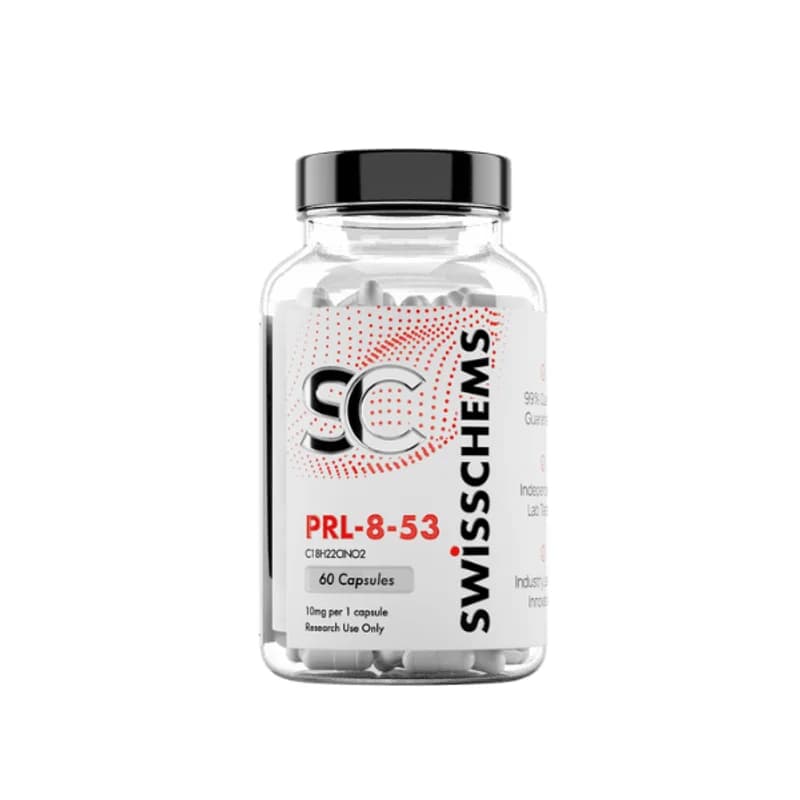
It's cheap per dose, especially as powder. The product card on this page is SwissChems' PRL-8-53, which comes in two forms.
The 500 mg powder at $19.99 works out to about 4 cents per milligram, so 100 doses at the study's 5 mg, if you can weigh them accurately. The capsules are easier to dose but hold 10 mg each, twice the amount tested in 1978.
On testing, SwissChems' product page states a 99% purity guarantee, says every batch is independently HPLC-tested at a US lab, and says certificates of analysis are published on its Independent Test Results page. It also promises to refund the test cost and the order if an independent HPLC test comes back negative. We didn't see a PRL-8-53 batch certificate on the product page itself, so ask for the one matching your batch.
The code jqrlsday takes 10% off at checkout. PeptideDeck earns a commission if you buy through the SwissChems link on this page.
Frequently Asked Questions
Sources
- Hansl NR, Mead BT. PRL-8-53: enhanced learning and subsequent retention in humans as a result of low oral doses of new psychotropic agent. Psychopharmacology (Berl). 1978;56(3):249-253. PubMed 418433 and publisher page (received 1975)
- APA PsycInfo record for the same paper (47 university students and faculty, 5 mg orally). PsycNET 1979-12979-001
- Wikipedia, PRL-8-53, revisions summarising the paper's group results: November 2013 and June 2019; current article (legal status, 1974 lab data)
- Hansl NR, Hansl AB. Learning and memory improvement through chemistry: dream or reality in the offing? Phi Delta Kappan. 1979;61(4):264-265. ERIC EJ211054; over-30 group figures as quoted by Braintropic
- Hansl NR. A novel spasmolytic and CNS active agent: 3-(2-benzylmethylamino ethyl) benzoic acid methyl ester hydrochloride. Experientia. 1974;30(3):271-272. PubMed 4824605
- Hansl NR. Substituted amino ethyl meta benzoic acid esters. US Patent 3,870,715, granted March 11, 1975. Google Patents
- Hansl v. Creighton University, 243 Neb. 21 (Nebraska Supreme Court, 1993). Justia
- World Anti-Doping Agency. 2026 Prohibited List, section S0 Non-Approved Substances. WADA PDF
- PubChem, PRL-8-53 hydrochloride (CID 39988). PubChem
- User reports: r/Nootropics, "Return to PRL-8-53: a glowing report", "The good and bad of PRL-8-53", safety question thread; Bluelight forum thread
- SwissChems PRL-8-53 product page (forms, prices, testing statements), checked November 5, 2026.
Medical Disclaimer: This article is for informational purposes only and does not constitute medical advice. PRL-8-53 is not approved by the FDA for any use, and its only human data come from one small 1978 study of a single dose. Its long-term safety, interactions and effects in people with health conditions are unknown. Talk to a doctor before taking it, especially if you take prescription medicines, are pregnant or breastfeeding, or are being evaluated for memory problems.