NSI-189 was meant to be a new kind of antidepressant. Instead of boosting serotonin, it was picked because it made human brain stem cells grow new neurons in a dish. If you've searched NSI 189 after seeing it on a nootropics forum, here's what actually happened when it was tested in people: two published depression trials, a missed primary endpoint, a sale to a new owner, a second miss, and a fresh trial that won't report until 2027. We also work out what the trial doses mean in capsules, and how much of a "phosphate" capsule is really NSI-189.
🔑 Key Takeaways
- It's not a peptide, and the "new neurons" claim has never been shown in a human brain
- The Phase 2 trial missed its main goal, but one dose kept turning up on patient-rated scales
- The lower dose did better than the higher one, and nobody knows why
- The drug now has a new name and a new owner, and its next result is due in mid-2027
- A 20 mg phosphate capsule holds less than 20 mg of NSI-189 itself
Every trial number below comes from the published papers, ClinicalTrials.gov or company filings with the SEC, all linked in the sources at the end. Prices were checked on November 5, 2026.
What Is NSI-189?
NSI-189 is a small synthetic molecule, not a peptide. Chemically it's a benzylpiperazine-aminopyridine with a molecular weight of 366.5, and its official generic name (INN) is amdiglurax. It takes its name from Neuralstem Inc., the Maryland company that found it.
Neuralstem discovered it by screening a chemical library against a line of human fetal hippocampal stem cells and picking compounds that made them form new neurons. In young adult mice it then increased new-neuron formation in the dentate gyrus and enlarged the hippocampus, the memory and mood region that tends to shrink in long-running depression.
That's the whole basis for the "neurogenic" label. The neurogenesis has only been shown in cells and in mice, and in the one human trial that scanned brains, hippocampal volume didn't change significantly versus placebo. The drug's target still hasn't been published.
Our BDNF peptide guide covers the growth-factor side of the same idea, and our Dihexa guide covers a peptide-derived compound sold with similar claims.
NSI-189 Clinical Trials at a Glance
Eight NSI-189 studies are registered on ClinicalTrials.gov. Leaving out an observational cohort and a 21-person pilot, these are the six that matter, and only two have full peer-reviewed results.
The pattern is clear: the small early trial looked encouraging, the bigger ones missed their main goal, and each time a subgroup or secondary scale gave a reason to keep going.
The Phase 1b Trial: 24 Inpatients, Promising but Tiny
This was mainly a safety study. In this 2016 Molecular Psychiatry trial, 24 adults with recurrent depression stayed on a clinical unit for 28 days: 18 on NSI-189, six on placebo, then followed to day 84.
- Safety: no serious adverse events at any dose, which let the safety board approve escalation to 120 mg a day.
- Depression scores: NSI-189 beat placebo on the self-rated Symptoms of Depression Questionnaire (SDQ) and the Cognitive and Physical Functioning Questionnaire (CPFQ). The clinician-rated MADRS showed a large effect size (0.95) that was not statistically significant.
- Durability: the improvements were still there at day 84, eight weeks after the last dose.
The authors named the limitation themselves: with six people per dose and six on placebo, a false positive is likely. Big effects in tiny trials usually shrink in bigger ones, and that's what happened next.
NSI-189 Phase 2 Results: The Main Goal Was Missed
The Phase 2 trial was the real test. Published in Molecular Psychiatry in 2020 (online January 2019), it randomized 220 outpatients aged 18 to 60 with major depression at 12 US sites to NSI-189 40 mg once a day, 80 mg a day (40 mg twice daily), or placebo for 12 weeks, with no other antidepressant allowed.
To blunt the placebo effect, placebo patients who hadn't improved by week 6 were randomized again for weeks 7 to 12, and both stages were pooled.
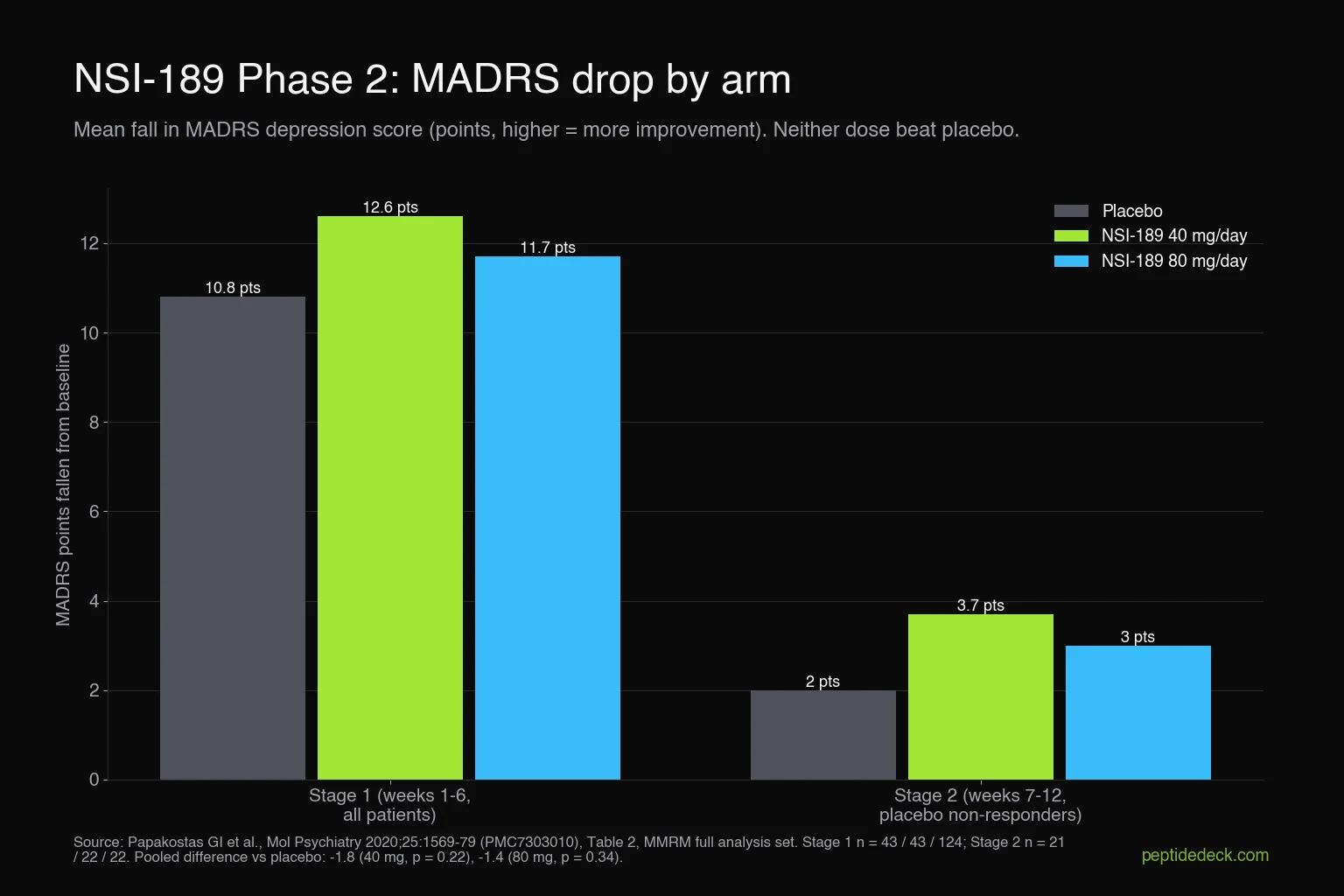
The primary result: neither dose beat placebo on the MADRS. The pooled difference was −1.8 points for 40 mg (p = 0.22) and −1.4 points for 80 mg (p = 0.34). In stage 1, 37% of people on 40 mg responded, against 33% on placebo.
The trial was powered to detect an effect size of 0.5. In stage 1 the 40 mg effect size was 0.17. For context, the authors note that approved antidepressants average about 0.31 against placebo.
So why is NSI-189 still discussed? Because the 40 mg dose did separate from placebo on the patient-rated scales:
- SDQ: 8.2 points better than placebo, pooled (p = 0.04), with gains in mood, anxiety, optimism, decision-making and ability to work.
- CPFQ (self-rated thinking and energy): 1.9 points better (p = 0.03).
- QIDS-SR: better in stage 2 only (p = 0.04).
- Objective cognition: some CogScreen subtests improved, including delayed recall, but the separate Cogstate battery showed nothing.
Two things weaken those signals. The 80 mg dose showed no benefit on any mood scale, and the CogScreen hits came from many subtests, so a few are expected by chance.
A later analysis by the same group found 80 mg beat placebo on a six-item MADRS (p = 0.046) in moderately depressed patients only. It was planned after the trial ended, so it's a hypothesis, not a result.
What Happened to NSI-189 After Neuralstem
The drug has had three corporate homes. Neuralstem renamed itself Seneca Biopharma, licensed NSI-189 out in December 2020, and then merged into Palisade Bio in April 2021. In October 2021 Palisade sold it outright, for about $400,000 up front by Palisade's account ($0.5 million in the buyer's filing) plus up to $4.5 million in milestones.
The buyer turned out to be Alto Neuroscience, which renamed the compound ALTO-100. Its filings show that Alto picked patients using a cognitive biomarker, impaired hippocampus-dependent verbal memory, on the theory that NSI-189 helps the people whose memory is affected.
- October 2024: Alto's Phase 2b trial in 301 adults with major depression missed its primary endpoint. In the 196 biomarker-positive patients, MADRS fell 10.3 points on ALTO-100 and 9.8 on placebo over six weeks (effect size 0.05).
- The subgroup: in 61 patients taking it on top of an existing antidepressant, the effect size was 0.47 (p = 0.09). The subgroup wasn't powered to show significance, and Alto blames the overall miss partly on poor pill-taking: blood tests found the drug in only 56% of the monotherapy group.
- Now: a Phase 2b trial in about 200 people with bipolar depression, taking 40 mg twice a day as an add-on to a mood stabilizer, is recruiting. Alto's August 2026 update put topline results at mid-2027.
That means NSI-189 is an investigational drug with an active owner. It isn't approved by the FDA, or by any other regulator, for any use.
Does NSI-189 Work for Depression?
On current evidence, not convincingly. Here's the honest grade.
- Human randomized trials: three placebo-controlled trials in depression (24, 220 and 301 people). None showed a significant benefit on a clinician-rated depression scale.
- Signals: self-rated mood and thinking improved at 40 mg a day in two of them, and an add-on subgroup looked better in the third.
- Neurogenesis in people: unproven. It has only been shown in cells and in mice, plus mouse models of diabetic nerve damage.
The biggest limitation: every trial was sponsored by the drug's owner, and the positive findings sit on secondary or after-the-fact analyses. Our guide to peptides for depression grades the other compounds people try.
NSI-189 Dosage Used in the Trials
Only trial doses can be quoted with confidence. No regulator has set a dose, and these were the amounts used in people with diagnosed depression under supervision.
- Phase 1b: 40 mg once daily, 40 mg twice daily, or 40 mg three times daily for 28 days.
- Phase 2: 40 mg once daily or 40 mg twice daily (80 mg a day) for 12 weeks. The lower dose did better.
- Alto's current trial: 40 mg tablets twice daily for six weeks.
The Phase 1b blood tests explain the schedules: a half-life of 17.4 to 20.5 hours, peak levels one to two hours after a dose, and steady levels after four to five days. Higher amounts were split to keep peaks down.
Doses below 40 mg a day have never been tested in people, and nothing longer than 12 weeks has been published. Any "microdose" or "cycle" schedule you read about is guesswork, not trial data.
NSI-189 Side Effects and Safety
In the trials, it was generally well tolerated. No one on NSI-189 had a serious adverse event in either published trial.
In the Phase 1b study (18 on the drug, 6 on placebo), the side effects reported more often on NSI-189 were:
- Headache: 50% on NSI-189, but also 50% on placebo
- Dizziness and sleepiness: 28% each, against 17% each on placebo
- Insomnia and vivid dreams or nightmares: 17% each, against none on placebo
- Dry mouth and tingling skin: 11% each
In Phase 2, nobody stopped NSI-189 because of side effects in the first six weeks, while seven placebo patients did. Overall dropout in that stage was 9% on 40 mg, 2% on 80 mg and 19% on placebo. EEG monitoring in Phase 1b found no seizure activity.
What we don't know matters more. There's no safety data beyond 12 weeks, over age 60, in pregnancy, or alongside antidepressants, which Phase 2 excluded. People with mania, psychosis, significant suicidal thoughts or recent substance use were excluded too.
What to ask your doctor: Could my symptoms be treated with an approved option I haven't tried yet? Would an unapproved drug interact with my current medication? If I have a bipolar history, could a new mood drug trigger mania? Is there a clinical trial I could join instead, with proper monitoring?
Athletes should note that WADA's 2026 list bans, at all times, any drug still in clinical development without approval for human use (class S0). An investigational drug like NSI-189 fits that description.
NSI-189 Free Base vs Phosphate
The phosphate is a salt, and salts weigh more. NSI-189 phosphate (molecular weight 464.5) is the free base (366.5) bound to phosphoric acid. It's the form the trials used, and only about 79% of its weight is NSI-189 itself.
So a 20 mg phosphate capsule holds about 15.8 mg of NSI-189 base. The papers describe the doses as "NSI-189 phosphate 40 mg" without saying whether that figure counts the salt or the base, so treat any free-base conversion of a trial dose as an estimate.
The free base is cheapest per milligram of active drug, but no human trial used it, and loose powder needs a milligram scale. Capsules trade cost for a pre-measured amount. Powder prices are list prices; we didn't check whether the code applies to them.
NSI-189 Price and Where to Buy It
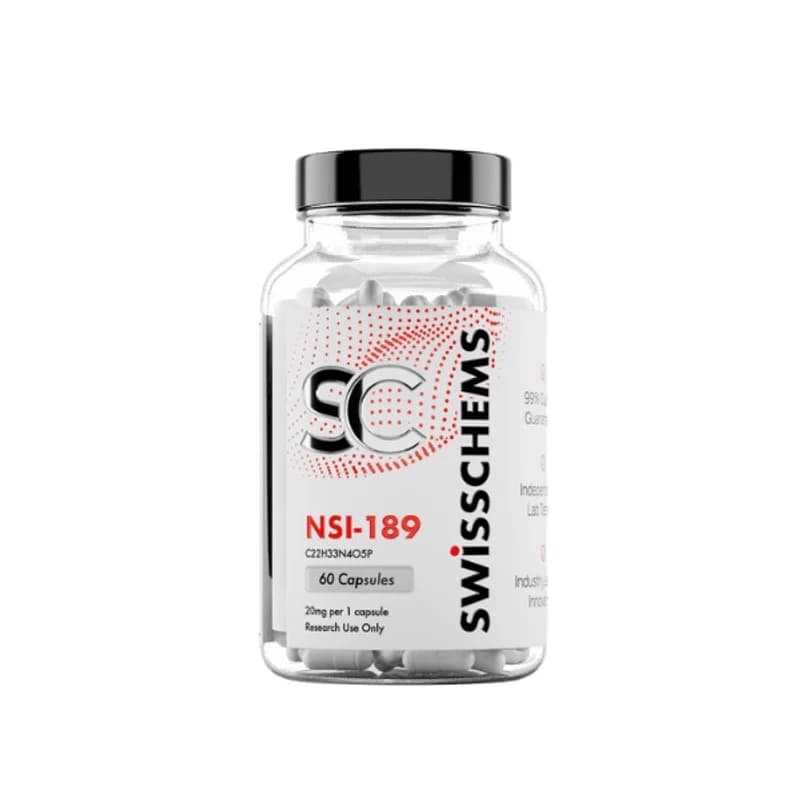
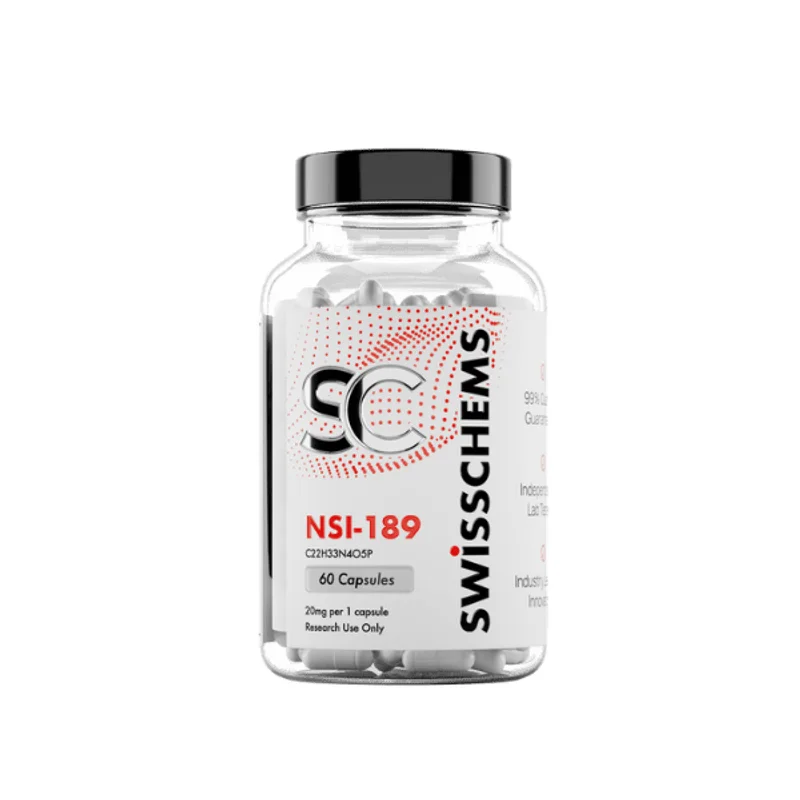
NSI-189 isn't sold as a medicine anywhere. What you'll find online are chemical suppliers, and the card on this page is SwissChems' NSI-189 Phosphate, 60 capsules of 20 mg each (1,200 mg in total), at $39.99.
That works out to $0.67 a capsule and $3.33 per 100 mg of phosphate. With the code jqrlsday for 10% off, it's $35.99, or $0.60 a capsule. PeptideDeck earns a commission if you buy through the SwissChems link on this page.
Here's what the two Phase 2 doses cost in these capsules, assuming the trials' "40 mg" means 40 mg of the phosphate salt, as the papers' wording suggests.
On testing, SwissChems' product page says every batch is independently tested by HPLC, with a certificate per batch, and claims 99% purity. The report linked on that page, from Freedom Diagnostics Testing (lot 3974, reported September 18, 2026), confirms the capsule's identity as NSI-189 by LC-MS and measures 20.66 mg per capsule. It doesn't print a purity percentage, and it doesn't say whether that figure is the salt or the base.
The page also lists 30-day returns on unopened products and says the product is sold for lab use only, not for use in people. For other focus and memory options, see our nootropic peptides roundup and brain fog guide.
Frequently Asked Questions
Sources
- Fava M, et al. A Phase 1B, randomized, double blind, placebo controlled, multiple-dose escalation study of NSI-189 phosphate, a neurogenic compound, in depressed patients. Mol Psychiatry. 2016;21(10):1372-80. PMC5030464
- Papakostas GI, et al. A phase 2, double-blind, placebo-controlled study of NSI-189 phosphate, a neurogenic compound, among outpatients with major depressive disorder. Mol Psychiatry. 2020;25(7):1569-79. PMC7303010
- Johe KK, et al. NSI-189 phosphate, a novel neurogenic compound, selectively benefits moderately depressed patients: a post-hoc analysis of a phase 2 study of major depressive disorder. Ann Clin Psychiatry. 2020;32(3):182-96. PubMed 32722729
- Jolivalt CG, et al. Amelioration of both central and peripheral neuropathy in mouse models of type 1 and type 2 diabetes by the neurogenic molecule NSI-189. Diabetes. 2019. PubMed 31492662
- ClinicalTrials.gov: NCT01310881 (Phase 1 single dose), NCT02695472 (Phase 2), NCT05712187 (ALTO-100 Phase 2b, MDD), NCT06656416 (ALTO-100 Phase 2b, bipolar depression)
- Palisade Bio. Palisade Bio announces sale of Seneca asset NSI-189 (Form 8-K, Exhibit 99.01). October 22, 2021. SEC
- Alto Neuroscience. Asset Transfer Agreement with Palisade Bio, October 18, 2021 (Form S-1, Exhibit 10.14). SEC
- Alto Neuroscience. Annual Report (Form 10-K) for 2025, ALTO-100 section. March 16, 2026. SEC
- Alto Neuroscience. Second quarter 2026 financial results and business highlights (Form 8-K, Exhibit 99.1). August 12, 2026. SEC
- PubChem. NSI-189 (CID 50922681, amdiglurax) and NSI-189 phosphate (CID 50922680). PubChem
- World Anti-Doping Agency. 2026 Prohibited List, section S0 Non-approved substances. WADA
- SwissChems product page and store listing for NSI-189 Phosphate (20 mg/capsule, 60 capsules), NSI-189 Phosphate powder and NSI-189 Free Base powder, with the linked Freedom Diagnostics Testing certificate (lot 3974). Checked November 5, 2026.
Medical Disclaimer: This article is for informational purposes only and does not constitute medical advice. NSI-189 (amdiglurax) is an investigational drug that is not approved by the FDA or any other regulator for any use, and its long-term safety is unknown. Depression is a serious, treatable condition: talk to a doctor or psychiatrist before starting, stopping or combining any treatment, and if you are having thoughts of harming yourself, call or text 988 in the US or contact local emergency services.