Most L-carnitine shots are sold for fat loss. Med spas, IV lounges and telehealth programs sell an L-carnitine injection for $10 to $40 a shot or $100 to $150 a month, pitching it as the fix for poorly absorbed pills. That part is true. What the pitch leaves out is where the carnitine goes after it reaches your blood, what the only approved injection is actually for, and how little of the weight-loss evidence involves a needle at all.
🔑 Key Takeaways
- The approved injection exists for two groups of patients, and weight loss isn't one of them
- A shot fixes absorption, but your muscles still need one extra signal to take carnitine in
- Only one randomized trial we found injected carnitine and measured weight, and it was a fasting study
- Most clinic menus don't tell you how many milligrams you're paying for
- If you're already getting MIC or Lipo-C shots, check how much carnitine is really in them
Every study and label figure below is listed in the sources at the end, and prices were checked on November 5, 2026.
What Is an L-Carnitine Injection?
It's a sterile solution of L-carnitine given by needle. L-carnitine carries long-chain fatty acids into mitochondria, the part of the cell that burns them for energy. Your body makes its own from two amino acids, gets more from meat and dairy, and your kidneys recycle 98% to 99% of what they filter, so most people hold a steady supply without trying.
Three kinds of product get called an "L-carnitine shot":
- Levocarnitine injection (brand name Carnitor). An FDA-approved prescription drug, 1 g in a 5 mL vial, labelled for intravenous use only.
- Compounded L-carnitine. Made by a compounding pharmacy for a prescription, usually at 500 mg/mL, and given into a muscle or under the skin at clinics and through telehealth programs.
- Lipotropic blends. MIC, Lipo-C and similar "skinny shots," where carnitine is one ingredient among several, often at a much lower strength.
Levocarnitine Injection: What the FDA Label Covers
The approved uses are narrow and medical. The current Carnitor injection label lists two:
- Inborn errors of metabolism that cause a secondary carnitine deficiency, treated short or long term.
- Preventing and treating carnitine deficiency in people with end-stage kidney disease on dialysis, because dialysis pulls carnitine out of the blood.
The label doses are weight-based. For dialysis it's 10 to 20 mg per kg of dry body weight, given as a slow 2 to 3 minute IV push into the return line after each session, adjusted by blood levels. For metabolic disorders it's 50 mg/kg, repeated every 3 to 4 hours in a crisis. For an 80 kg adult on dialysis, that starting range works out to 800 mg to 1.6 g per session.
Two details matter if you're comparing clinic shots with the real drug. The label says "for intravenous use only," and the vials are single-dose with no preservative. It also says the injection's effect on symptoms and outcomes in dialysis patients "has not been determined," so even there the proven benefit is a better blood test.
Who the injection is actually for: people with a measured carnitine deficiency, mainly from dialysis or an inherited metabolic disorder. If you don't have a low blood level, the label gives no reason to expect a benefit.
L-Carnitine Injection vs Oral: Where the Dose Ends Up
Absorption is the injection's one clear win. In a review of carnitine pharmacokinetics, oral doses of 1 to 6 g were only 5% to 18% absorbed, and the Carnitor label measured about 15% for its own tablets and liquid. A dose into a vein is, by definition, fully in your blood.
Getting into blood is not the same as getting into muscle, though. When blood carnitine climbs above about 40 to 60 µmol/L, your kidneys start recycling less of it and more spills into urine. On the Carnitor label, about 76% of an IV dose came out in urine within 24 hours.
Muscle is also slow to take it in. In a Nottingham study, 8 healthy men received a 5-hour carnitine infusion on two visits. Muscle carnitine rose only when insulin was held at a high level, from 22.0 to 24.7 mmol per kg of dry muscle, a rise of about 12%. At fasting insulin, the same infusion did nothing. A 2020 Dutch crossover trial in 8 volunteers found a 28 mg/kg infusion raised blood carnitine but didn't change muscle carnitine.
The oral route can raise muscle carnitine too, slowly. In a 24-week trial of 14 healthy men, 2 g of L-carnitine tartrate with 80 g of carbohydrate twice a day lifted muscle carnitine by 21%, while carbohydrate alone did nothing. For the difference between muscle and under-the-skin shots generally, see our guide to subcutaneous vs intramuscular injections.
Do L-Carnitine Injections Work for Weight Loss?
The honest answer is a small maybe. Two meta-analyses of randomized trials found a modest effect, but they pooled supplement trials, not injection trials.
- Pooyandjoo 2016 (Obesity Reviews): 9 trials, 911 adults. People taking carnitine lost 1.33 kg more than controls, and the effect got smaller the longer the trials ran.
- Talenezhad 2020 (Clinical Nutrition ESPEN): 37 trials, 2,292 adults. Carnitine cut body weight by 1.21 kg and fat mass by 2.08 kg versus control, with the clearest effect in adults with overweight or obesity. The dose-response peaked at about 2,000 mg a day taken by mouth. Waist size and body fat percentage didn't change significantly.
The one injection trial we found is small and unusual. In a 7-day, single-blind pilot in China, 30 adults with metabolic syndrome went through a 5-day modified fast. Half got 4 g of IV L-carnitine a day and half got saline. The carnitine group lost 4.6 kg vs 3.2 kg, lost more from the waist, and reported less hunger and fatigue during the fast.
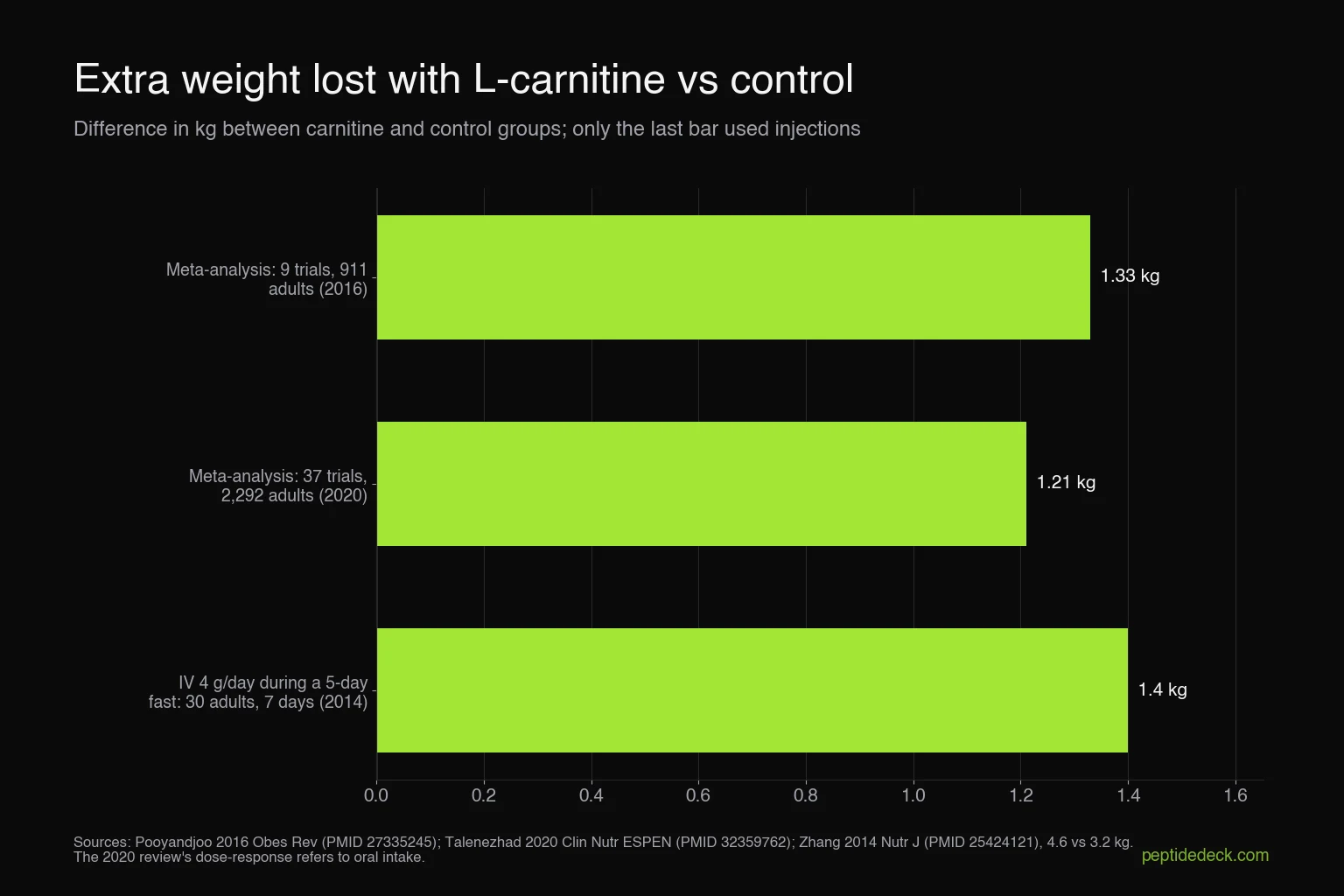
Read those numbers with their limits. The meta-analyses mix short trials of different doses, and the effect fades over time. The IV trial lasted a week on a supervised fast, when much of the loss is water and stored carbohydrate. No trial we found tested weekly clinic-style shots in people eating normally.
Approved weight loss injections produce far larger losses. For the over-the-counter shelf, see whether fat burners work.
L-Carnitine Injection Benefits: Who Might Actually Gain
The benefit depends on whether you're low. Here's how the evidence sorts people.
- Likely to benefit: people on long-term dialysis with low carnitine levels, and people with inherited metabolic disorders, after a blood test.
- Might see a small effect: adults with overweight or obesity, where supplement trials show about 1 to 1.5 kg of extra weight loss. An oral dose reached that in trials, so a shot isn't needed for it.
- Unlikely to notice anything: healthy people with normal levels. Your kidneys dump the excess.
Injectable L-Carnitine Dosage
There's no approved dose for weight loss. These are the only doses we can cite, and where each comes from:
- Approved label, dialysis: 10 to 20 mg/kg IV after each dialysis session.
- Approved label, metabolic disorders: 50 mg/kg IV, with blood-level monitoring.
- Fasting trial: 4 g a day IV for 5 days, under supervision.
- Oral weight-loss trials: about 2,000 mg a day gave the largest effect.
- Clinic-reported, unverified: one Pennsylvania med spa says injectable doses usually run from 500 mg to 2,000 mg, given weekly to a few times a week. No trial has tested that schedule.
One sum puts clinic shots in context. A weekly 500 mg shot delivers 500 mg a week. The oral trials' 2,000 mg a day is 14,000 mg a week, and even at 15% absorption about 2,100 mg of that reaches the blood.
What to ask your doctor: Should my blood carnitine level be checked first? How many milligrams are in each shot, and how often? Is it going into a vein, a muscle or under the skin? Do I take warfarin or have a seizure history? Will it change anything my current weight-loss plan doesn't already do?
L-Carnitine Injection Side Effects
Most reactions are mild, but a few are serious. The Carnitor label lists these:
- Common: temporary nausea and vomiting. Less often, body odor and gastritis.
- Allergic reactions: serious hypersensitivity, including anaphylaxis, throat swelling and bronchospasm, mostly in dialysis patients and sometimes within minutes of an IV dose.
- Seizures: reported with both oral and IV levocarnitine, in people with and without a seizure history. If you have epilepsy, attacks may become more frequent or severe.
- Warfarin: INR increases have been reported, so INR should be monitored after starting.
- Large doses: may cause diarrhea.
In two placebo-controlled dialysis trials on the label, injection-site reactions hit 59% of the placebo group, so much of that comes from the needle, not the carnitine.
The fishy-odor and TMAO issue is mostly an oral one. Gut bacteria turn swallowed carnitine into TMA and then TMAO. In 2,595 people having heart checks, higher blood carnitine predicted heart disease and heart events only in those who also had high TMAO. Injections skip the gut, but we found no study measuring TMAO after carnitine shots.
Compounded shots aren't reviewed by the FDA for safety, effectiveness or quality, and the approved product isn't labelled for muscle or under-the-skin use. If you compete, WADA bans IV infusions or injections over 100 mL in 12 hours outside hospital care, whatever is in the bag.
L-Carnitine With MIC and B12 Shots
Clinics often stack carnitine on top of a lipotropic shot. If you're getting MIC with B12, our MIC B12 injections guide covers what's in it, what it costs and what the evidence says, so we won't repeat it here.
The useful check is strength. A standard compounded Lipo-C formula carries 50 mg of carnitine per mL, beside methionine, choline and dexpanthenol. A 1 mL shot gives 50 mg of carnitine, a tenth of a single 500 mg/mL stand-alone shot and a small fraction of the 2,000 mg daily dose in the oral trials. Our Lipo-C guide breaks that formula down.
How Much L-Carnitine Injections Cost
Prices range more than the products do. Here's what we found on sellers' own pages on November 5, 2026.
Most clinics near you will sell a shot or a subscription, not a dose. Without milligrams per shot, you can't compare a $10 add-on with a $40 lounge shot, so ask before you pay. Compounding pharmacies such as Empower list 500 mg/mL in 30 mL vials, but sell only on prescription and don't publish a price.
Buying an Injectable L-Carnitine Vial
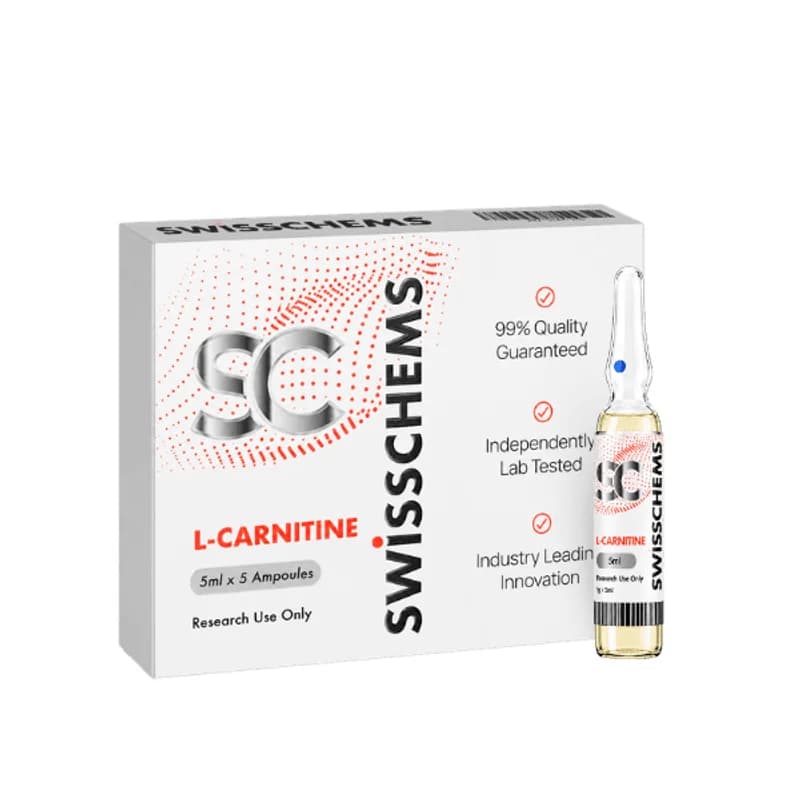
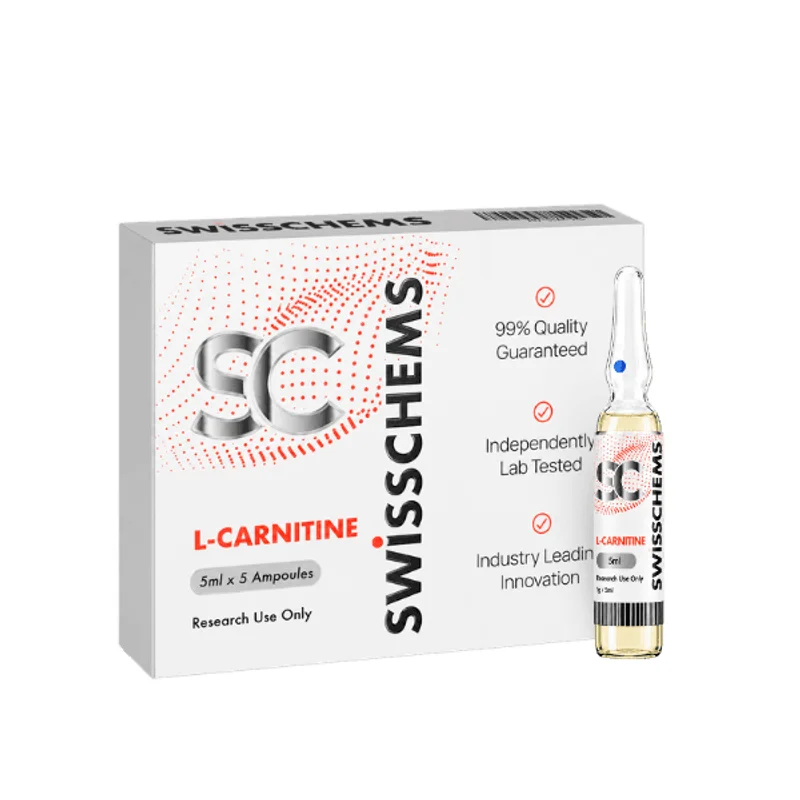
Some people buy injectable L-carnitine directly instead. The product on this page is SwissChems' L-carnitine 25 mL box: five 5 mL ampoules at 1 g per ampoule (200 mg/mL), 5 g in total, for $59.99. That's $12.00 per gram, or $10.80 per gram with code jqrlsday for 10% off ($53.99 a box). PeptideDeck earns a commission if you buy through the SwissChems link on this page.
Be clear about what this is. The strength and box size match the Carnitor injection (1 g in 5 mL, five per carton), but it isn't Carnitor or a pharmacy product. SwissChems sells it as a laboratory chemical, says on the product page that it is not for use in people, and says it is not a drug. The page states 99% purity and says the product is independently third-party HPLC-tested with a certificate of analysis for each batch. We didn't find an L-carnitine report on its public test-results page when we checked, so ask for the batch certificate before buying. Like Carnitor vials, the ampoules carry no preservative, so an opened one isn't meant to be kept.
Frequently Asked Questions
Sources
- CARNITOR (levocarnitine) injection, prescribing information. Leadiant Biosciences. DailyMed, label version November 22, 2023
- Evans AM, Fornasini G. Pharmacokinetics of L-carnitine. Clin Pharmacokinet. 2003. PubMed 12908852
- Stephens FB, et al. Insulin stimulates L-carnitine accumulation in human skeletal muscle. FASEB J. 2006. PubMed 16368715
- Bruls YMH, et al. L-carnitine infusion does not alleviate lipid-induced insulin resistance and metabolic inflexibility. PLoS One. 2020. PubMed 32976523
- Wall BT, et al. Chronic oral ingestion of L-carnitine and carbohydrate increases muscle carnitine content and alters muscle fuel metabolism during exercise in humans. J Physiol. 2011. PubMed 21224234
- Pooyandjoo M, et al. The effect of (L-)carnitine on weight loss in adults: a systematic review and meta-analysis of randomized controlled trials. Obes Rev. 2016. PubMed 27335245
- Talenezhad N, et al. Effects of L-carnitine supplementation on weight loss and body composition: a systematic review and meta-analysis of 37 randomized controlled clinical trials with dose-response analysis. Clin Nutr ESPEN. 2020. PubMed 32359762
- Zhang JJ, et al. L-carnitine ameliorated fasting-induced fatigue, hunger, and metabolic abnormalities in patients with metabolic syndrome: a randomized controlled study. Nutr J. 2014. PubMed 25424121
- Koeth RA, et al. Intestinal microbiota metabolism of L-carnitine, a nutrient in red meat, promotes atherosclerosis. Nat Med. 2013. PubMed 23563705
- World Anti-Doping Agency. Prohibited List, method M2.2. wada-ama.org
- Empower Pharmacy. Carnitine (L) Injection and Lipo-C Injection product pages. empowerpharmacy.com
- New You Skin and Body Spa. L-carnitine injections (clinic-reported dose range). newyouskinandbodyspa.com
- Prices: Reflect Wellness, ELIXR IV Therapy, RenuviaRX, Kora MD, Regenics, SwissChems and Bulk Apothecary product pages, checked November 5, 2026.
Medical Disclaimer: This article is for informational purposes only and does not constitute medical advice. The only FDA-approved L-carnitine injection is a prescription drug for carnitine deficiency in dialysis and inherited metabolic disorders; it is not approved by the FDA for weight loss. Compounded and lab-chemical products are not reviewed by the FDA for safety or quality. Talk to your doctor before using L-carnitine by any route, especially if you take warfarin, have a seizure disorder or have kidney disease.