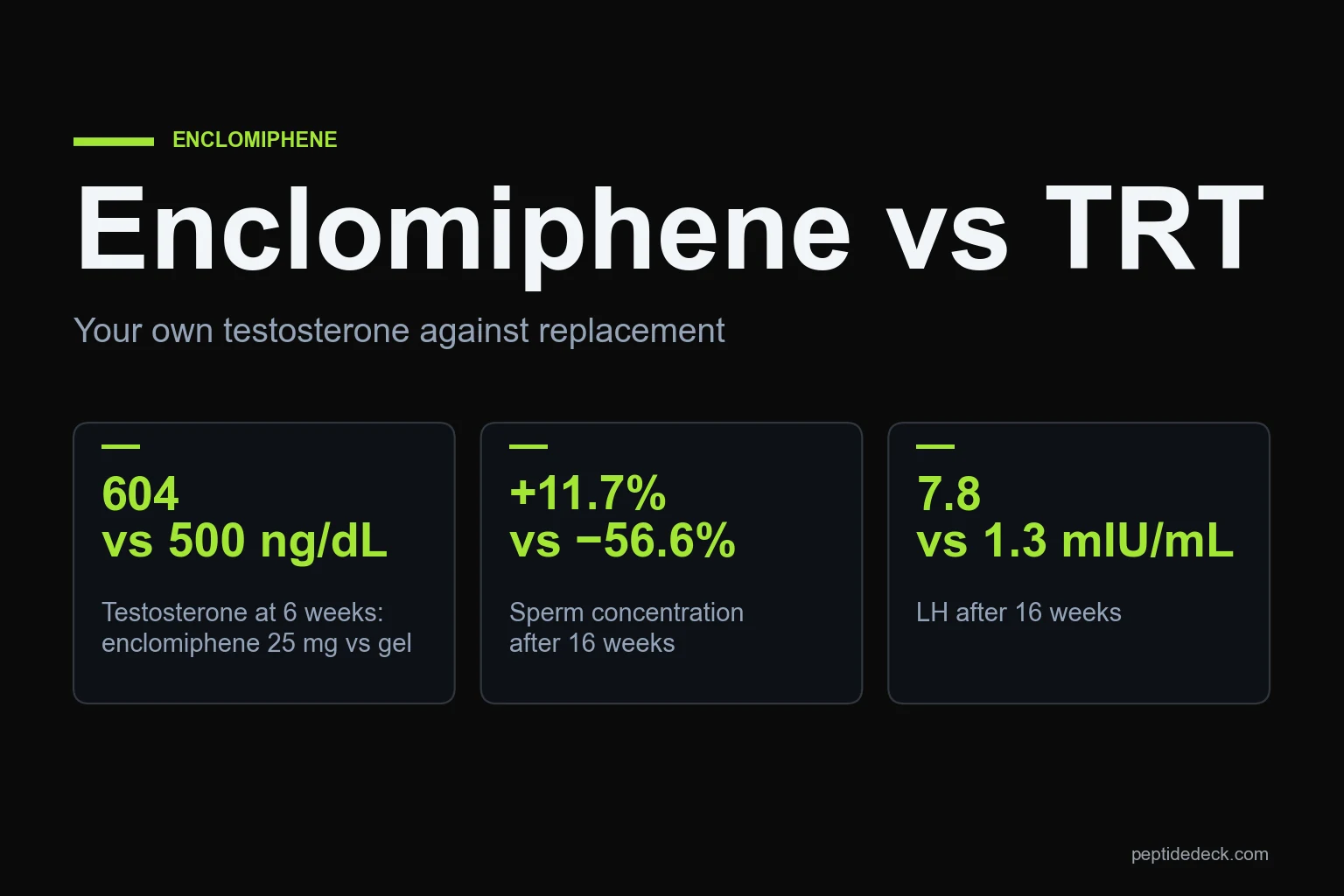
Enclomiphene and TRT raise testosterone in opposite ways. TRT replaces testosterone from outside and shuts down your body's own signal (LH, FSH and sperm production), while enclomiphene pushes your testes to make more of their own and keeps that signal on. In two phase III trials in 256 overweight men, sperm concentration fell 33% to 57% on testosterone gel and held on enclomiphene[1]. The trade-off: enclomiphene has no FDA approval, and only testosterone has approved products and trial evidence that symptoms improve[2][3].
🔑 Key Takeaways
- TRT works whether or not your testes do. Enclomiphene needs a pituitary and testes that can still respond, which means secondary hypogonadism
- On testosterone the two matched in every head-to-head trial. They split on LH, FSH and sperm
- Every trial used a testosterone gel, ran 16 weeks or less and was sponsored by enclomiphene's developer
- Adding enclomiphene to TRT has no controlled trial behind it. Fertility specialists reach for a different drug
- Europe's regulator flagged one risk on enclomiphene that did not show up on testosterone or placebo
If your testosterone is low, the choice is rarely about the lab number alone. It turns on whether you want children, how you feel about needles, and how much weight you put on FDA approval. Every figure below comes from a trial record, a regulator's report or a drug label we opened on November 26, 2026.
Enclomiphene vs TRT: How Each One Works
Both act on one feedback loop. The pituitary releases LH, which tells the testes to make testosterone, and FSH, which supports sperm production. Testosterone, and the estradiol made from it, then tells the brain to ease off.
TRT adds testosterone from outside. The brain reads the level as high and stops asking for more, so LH and FSH fall and sperm production can be suppressed[4]. In 29 healthy men, three weeks of weekly testosterone injections cut LH to 5% of baseline and FSH to 3%; in those given testosterone alone, testosterone inside the testes fell 94%[5].
Enclomiphene works one step upstream. It is a selective estrogen receptor modulator (SERM), the active half of clomiphene (see enclomiphene vs Clomid). It blocks the estrogen signal at the brain, so the pituitary releases more LH and FSH and the testes make more testosterone[6]. Nothing is replaced. That is also its limit: it needs a pituitary and testes that can still respond. Our guide to enclomiphene for men covers the drug on its own.
Enclomiphene vs TRT: What the Head-to-Head Trials Found
The published comparisons share two features. Each used a testosterone gel as the TRT arm, and each was run by Repros Therapeutics, enclomiphene's developer[2]. The phase III pair was published in 2016[7]; the arm-by-arm numbers below come from the European regulator's review of the same data.
Sperm percentages average each man's own change, so they differ from the change in group means. Phase III used 12.5 mg once daily, raised to 25 mg at week 4 if testosterone stayed under 450 ng/dL; our enclomiphene dosage chart sets out the trial arms.
Start with testosterone. Enclomiphene kept pace with gel in every trial. But gel is the mildest test of TRT: in one clinic series of men mostly on injections, testosterone averaged 1,055 ng/dL[10], and we found no trial of enclomiphene against injected testosterone.
Now the rows below it. Gel pushed LH and FSH down to about a third of where they started, while enclomiphene roughly doubled them, and sperm followed. Pooled across phase III, 63.5% of men on enclomiphene finished with normal testosterone and at least 10 million sperm per mL, against 24.7% on gel and 5.8% on placebo[11].
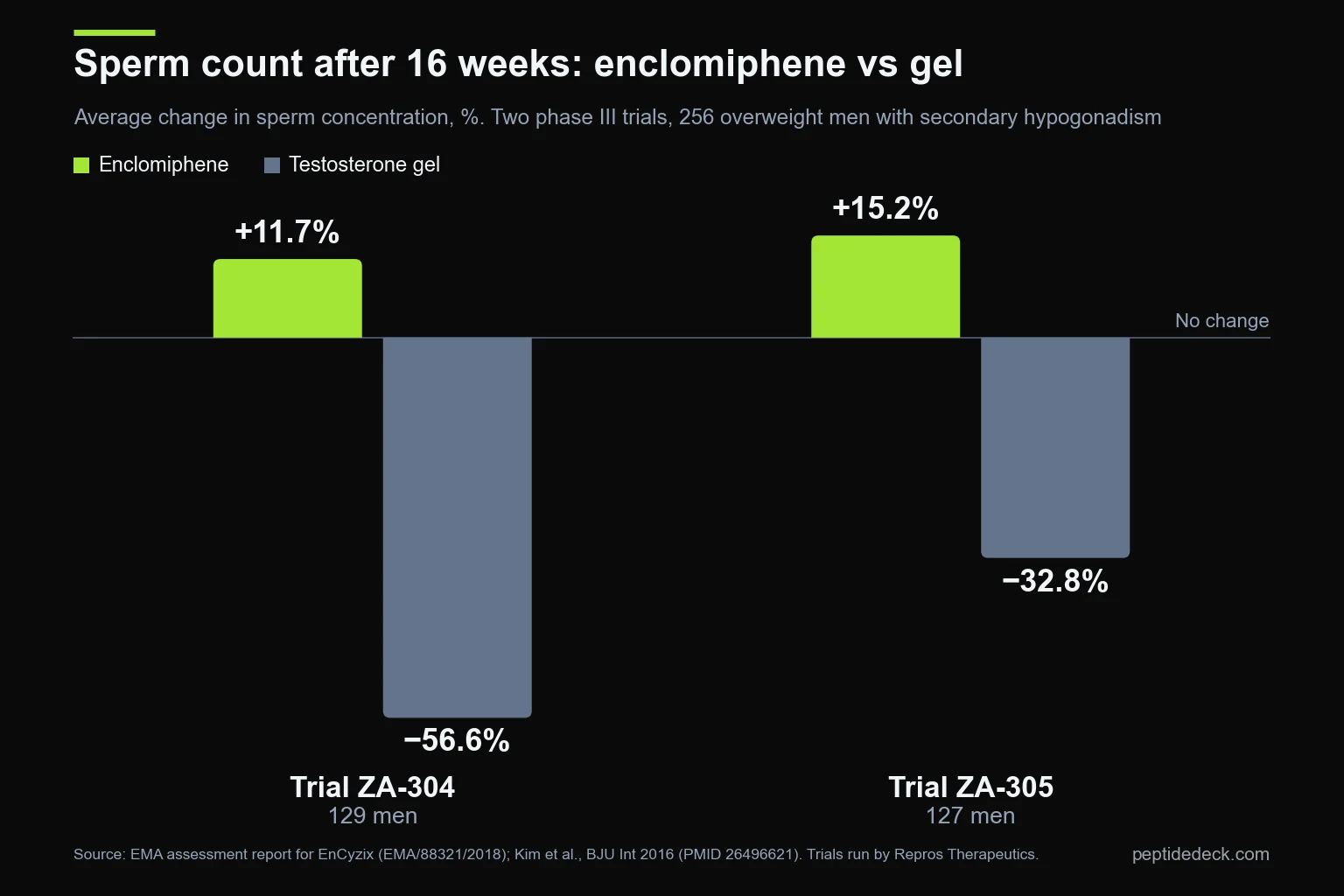
Three limits apply. The trials ran 6 to 16 weeks in overweight men (average BMI about 33) picked by lab values, not symptoms. ZA-203 lost 51 of its 124 men before the end[9]. And the sperm result is a win over gel only: in two further trials against placebo, the EMA called the evidence that enclomiphene preserves sperm concentration inconclusive[1]. What men notice, and when, is on our enclomiphene before and after page.
Enclomiphene vs Testosterone: Side-by-Side Comparison
Here is the whole comparison in one grid. Every row carries its source.
Enclomiphene Limits: Where TRT Still Wins
Four limits decide most cases.
It needs working hardware. Enclomiphene only helps in secondary hypogonadism, where testosterone is low and LH is low or normal. In primary hypogonadism the testes cannot respond and LH is already high. Testosterone is labelled for both types[4].
The FDA did not approve it. On December 1, 2015, Repros received a Complete Response Letter. By its own account, the FDA said the phase III design was "no longer adequate to demonstrate clinical benefit", asked for further phase III work, and raised concerns about entry criteria, titration and a lab method[2]. What clinics prescribe is compounded: enclomiphene citrate is on the FDA's list of bulk substances under evaluation (Category 1), under which the agency does not act against pharmacies compounding it on prescription. That is not a review of any product[16].
Nobody has shown it makes men feel better. The EMA refused it in January 2018 over the same gap: the main trials had no validated measure of libido or erections, and in one supporting study that did, only AndroGel improved libido scores at every time point[1]. Testosterone has that evidence: in 790 men aged 65 or older, a year of gel improved sexual activity, desire and erections against placebo, though not vitality[3].
The clot signal. Four men on enclomiphene had a thromboembolic event, one a fatal stroke; none on testosterone or placebo did. All four had other risk factors and only 116 men took the drug for a year or more, so the size of the risk is unknown[1]. Testosterone labels carry their own clot warning[4]. Everyday effects such as headache and hot flushes are on our enclomiphene side effects page.
Does that sink enclomiphene? No, but it narrows it. For a man with secondary hypogonadism who wants children soon, testosterone is the one drug guidelines say not to start[17], and enclomiphene has randomized sperm data behind it. For most other men, TRT is the better-proven choice.
Can You Take Enclomiphene With TRT?
You can, but there is little reason to. Enclomiphene works by getting the pituitary to send more LH. On TRT the pituitary has been told to stand down, and not only by estrogen: in 22 healthy men whose estrogen production was blocked, testosterone still halved LH by slowing the brain's GnRH pulses[18]. A SERM lifts only the estrogen part of that brake.
The trial record is empty too. We searched PubMed on November 26, 2026 and found no controlled trial of enclomiphene or clomiphene added to ongoing testosterone therapy. The enclomiphene trials excluded men who had used testosterone in the previous six months[1].
What Clinicians Use Instead for Fertility on TRT
The usual add-on is hCG, which acts like LH directly on the testes and so does not need the pituitary. In healthy men on weekly testosterone, low-dose hCG kept testosterone inside the testes in the normal range[5]. In 26 men who took hCG alongside TRT for an average of 6.2 months, semen measures did not change and no man lost sperm entirely[10]. That series is small and retrospective, and stopping testosterone remains the standard advice for men who want children[11]. See enclomiphene vs HCG for how the two compare.
Enclomiphene After Stopping TRT
Here a SERM has some support. In a 12-man randomized trial, men who had stopped testosterone gel went on to enclomiphene or back to gel. Every man on enclomiphene had 75 to 334 million sperm per mL at three and six months; on gel, none of five was above 20 million per mL at three months[13]. In 49 men with no sperm or almost none while on testosterone, hCG combined with clomiphene, tamoxifen, anastrozole or FSH brought sperm back in 95.9%, in an average of 4.6 months[19].
Neither study shows the drugs beat waiting. Among 1,549 healthy men who stopped testosterone-based contraceptive regimens, sperm returned to 20 million per mL in a median of 3.4 months, and in 90% within a year[14]. A recovery plan is a job for a urologist.
Enclomiphene or TRT: Who Each One Suits
Neither wins outright. The pick depends on which line describes you.
- You want children in the next year or two. Enclomiphene is the closer fit, provided your low testosterone is secondary. The Endocrine Society advises against starting testosterone when fertility is planned in the near term[17].
- You have primary hypogonadism. TRT. High LH with low testosterone means the testes are not responding, and enclomiphene has nothing to push.
- You do not want needles. Either. Enclomiphene is a daily capsule, and testosterone also comes as a gel, a patch and oral capsules[12].
- You want an FDA-approved product. TRT. Every enclomiphene prescription is filled by a compounding pharmacy.
- You are already on TRT. Staying on it is reasonable if children are not planned. If they are, ask a urologist about hCG or a supervised stop before adding enclomiphene yourself. Our TRT alternatives page lists the other routes.
What to ask your doctor: Is my low testosterone primary or secondary, and what are my LH and FSH? Should I have a semen analysis before I choose? If I take enclomiphene, which pharmacy compounds it and which labs will you repeat? If I take testosterone, what is the plan should I want children later? Do not stop prescribed testosterone on your own.
Enclomiphene vs TRT Cost
The drugs cost about the same. At one online clinic that sells both, compounded enclomiphene runs $99 to $116 a month and testosterone cypionate injections start at $133, with enclomiphene labs billed at $115 per session[15]. Our enclomiphene cost page lists prices by provider, and our best TRT online comparison covers testosterone clinics.
If you are comparing where to buy enclomiphene, capsules are also sold online without a prescription: SwissChems lists 60 capsules of 12.5 mg at $71.07, less 10% with code jqrlsday. That product has no FDA approval and comes with no prescriber or lab checks, so ask for a certificate of analysis first. PeptideDeck earns a commission on purchases through our links.
Frequently Asked Questions
Sources
- European Medicines Agency. EnCyzix (enclomifene): assessment report on the refusal of the marketing authorisation. EMA/88321/2018, CHMP opinion January 25, 2018. EMA
- Repros Therapeutics Inc. Form 10-K for fiscal year 2015, filed March 14, 2016. SEC EDGAR
- Snyder PJ, et al. Effects of testosterone treatment in older men. N Engl J Med. 2016;374(7):611-24. PMID 26886521. PubMed
- AndroGel (testosterone gel) 1.62%, FDA-approved prescribing information, revised July 2025. DailyMed
- Coviello AD, et al. Low-dose human chorionic gonadotropin maintains intratesticular testosterone in normal men with testosterone-induced gonadotropin suppression. J Clin Endocrinol Metab. 2005;90(5):2595-602. PMID 15713727. PubMed
- Wiehle R, et al. Testosterone restoration by enclomiphene citrate in men with secondary hypogonadism: pharmacodynamics and pharmacokinetics. BJU Int. 2013;112(8):1188-200. PMID 23875626. PMC full text
- Kim ED, McCullough A, Kaminetsky J. Oral enclomiphene citrate raises testosterone and preserves sperm counts in obese hypogonadal men, unlike topical testosterone: restoration instead of replacement. BJU Int. 2016;117(4):677-85. PMID 26496621. PubMed
- Wiehle RD, et al.; ZA-203 Clinical Study Group. Enclomiphene citrate stimulates testosterone production while preventing oligospermia: a randomized phase II clinical trial comparing topical testosterone. Fertil Steril. 2014;102(3):720-7. PMID 25044085. PubMed
- ClinicalTrials.gov. NCT01270841 (ZA-203), posted results. Sponsor: Repros Therapeutics Inc. ClinicalTrials.gov
- Hsieh TC, et al. Concomitant intramuscular human chorionic gonadotropin preserves spermatogenesis in men undergoing testosterone replacement therapy. J Urol. 2013;189(2):647-50. PMID 23260550. PubMed
- Hochu G, Geyer-Kim I, Kim E. Preserving spermatogenesis in testosterone deficiency: innovations in replacement and stimulatory therapies. Transl Androl Urol. 2025;14(12):3975-3987. PMID 41522318. PMC full text
- U.S. Food and Drug Administration. FDA issues class-wide labeling changes for testosterone products. February 28, 2025. FDA
- Kaminetsky J, et al. Oral enclomiphene citrate stimulates the endogenous production of testosterone and sperm counts in men with low testosterone: comparison with testosterone gel. J Sex Med. 2013;10(6):1628-35. PMID 23530575. PubMed
- Liu PY, et al. Rate, extent, and modifiers of spermatogenic recovery after hormonal male contraception: an integrated analysis. Lancet. 2006;367(9520):1412-20. PMID 16650651. PubMed
- GobyMeds. Enclomiphene and testosterone plan prices, checked November 26, 2026. GobyMeds
- U.S. Food and Drug Administration. Bulk Drug Substances Nominated for Use in Compounding Under Section 503A (updated May 14, 2026; enclomiphene citrate in Category 1) and Interim Policy guidance, January 2025. FDA list
- Bhasin S, et al. Testosterone therapy in men with hypogonadism: an Endocrine Society clinical practice guideline. J Clin Endocrinol Metab. 2018;103(5):1715-1744. PMID 29562364. PubMed
- Pitteloud N, et al. Inhibition of luteinizing hormone secretion by testosterone in men requires aromatization for its pituitary but not its hypothalamic effects. J Clin Endocrinol Metab. 2008;93(3):784-91. PMID 18073301. PubMed
- Wenker EP, et al. The use of HCG-based combination therapy for recovery of spermatogenesis after testosterone use. J Sex Med. 2015;12(6):1334-7. PMID 25904023. PubMed
Medical Disclaimer: This article is for education only and is not medical advice. Enclomiphene has no FDA approval for any use, and the doses mentioned (12.5 mg and 25 mg once daily) are those used in clinical trials, not a recommendation. Testosterone is a prescription-only controlled substance. Talk to a doctor before starting, stopping or changing any medication.