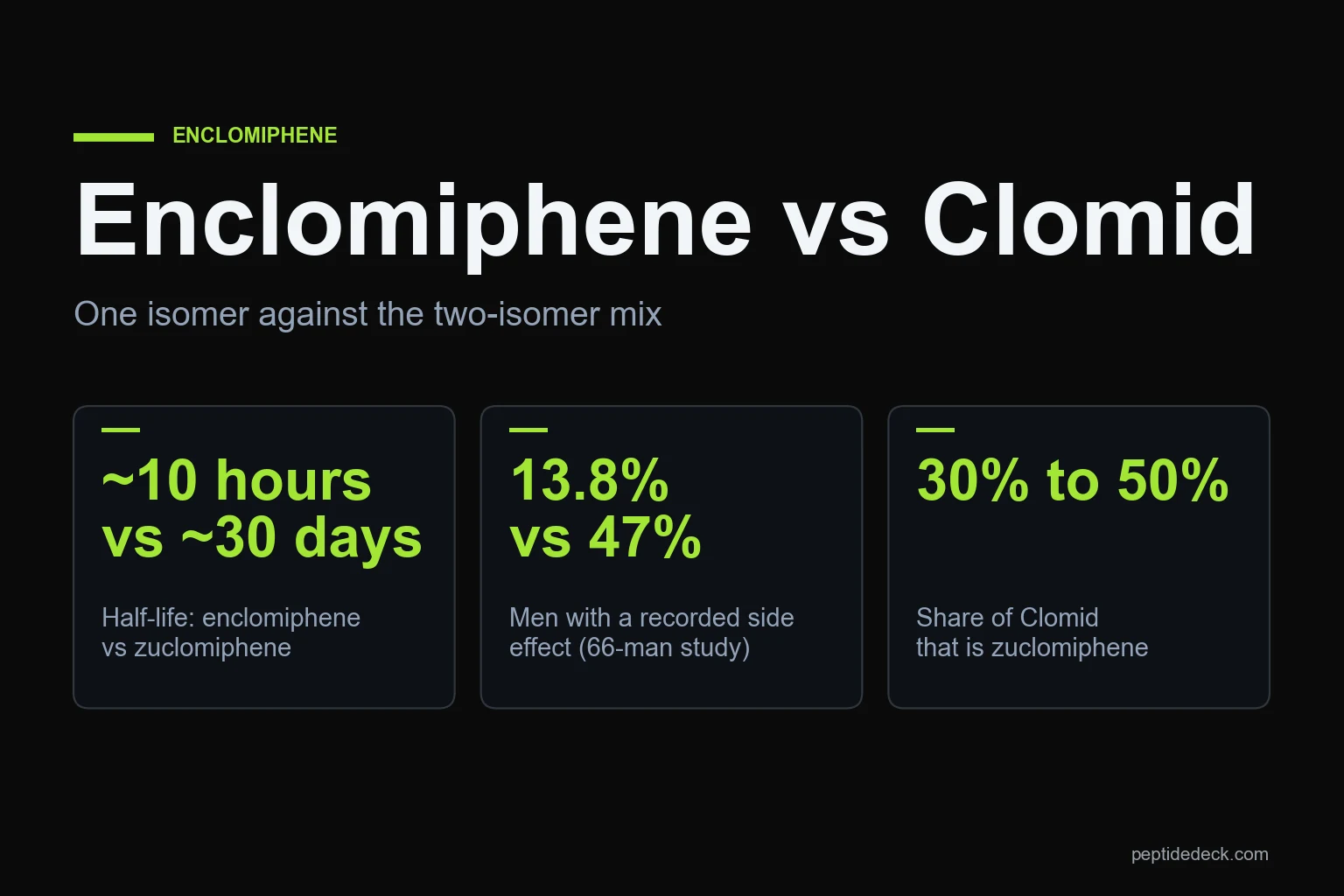
Enclomiphene is one of Clomid's two isomers. Clomid (clomiphene citrate) mixes it with a second isomer, zuclomiphene; enclomiphene is that mix with the zuclomiphene left out [1]. In the two studies that compared them in men, testosterone rose about as much on either and fewer side effects were recorded on enclomiphene, but only Clomid is FDA-approved, and that approval covers ovulation in women, not low testosterone in men [2][3].
🔑 Key Takeaways
- Same mechanism, different contents: Clomid holds two isomers, enclomiphene is one of them [1]
- Testosterone rose by a similar amount on both in the two comparison studies; no randomised trial exists [2][3]
- Fewer side effects were recorded on enclomiphene, in men who had already chosen to leave Clomid [2]
- On estradiol, the two studies point in opposite directions
- Clomiphene is an FDA-approved generic used off-label in men; enclomiphene has no FDA approval and is compounded [4][5]
You have probably heard the pitch: enclomiphene is the cleaner Clomid. It is half right. Here is what the label, the two comparison studies and FDA records say, each checked against its source on November 26, 2026.
Enclomiphene vs Clomid: What Is the Difference?
The difference is one isomer. Clomiphene citrate, the drug in Clomid, is a mixture of two geometric isomers: enclomiphene (trans) and zuclomiphene (cis). The FDA label puts zuclomiphene at 30% to 50% of the mixture [1]. Enclomiphene citrate is the trans isomer made and sold by itself.
They do not act alike. Enclomiphene blocks estrogen receptors in the brain, so the pituitary releases more LH and FSH and the testes make more testosterone. Zuclomiphene acts more like an estrogen; the label says data suggest it "has greater estrogenic activity than enclomiphene" [1][6].
They also clear at different speeds. Enclomiphene's half-life is about 10 hours; zuclomiphene's is about 30 days [6]. In 12 healthy men who took clomiphene for 30 days, zuclomiphene stayed detectable in urine for 121 to more than 261 days [7]. That lingering isomer is the whole case for taking enclomiphene alone.
Both work only when the pituitary and testes can still respond (secondary hypogonadism). Our guide explains what enclomiphene is and how it works in men.
Enclomiphene vs Clomiphene: Side by Side
Here is the whole comparison in one table. Each row names its source.
Enclomiphene vs Clomid Head to Head: What the Studies Found
Only two studies compare them in men. Both are retrospective chart reviews. No randomised head-to-head exists: the 10 randomised trials pooled in a 2025 meta-analysis (819 men) each tested one of the drugs against placebo, testosterone gel, hCG or anastrozole, never against the other [10], and our PubMed search on November 26, 2026 found none.
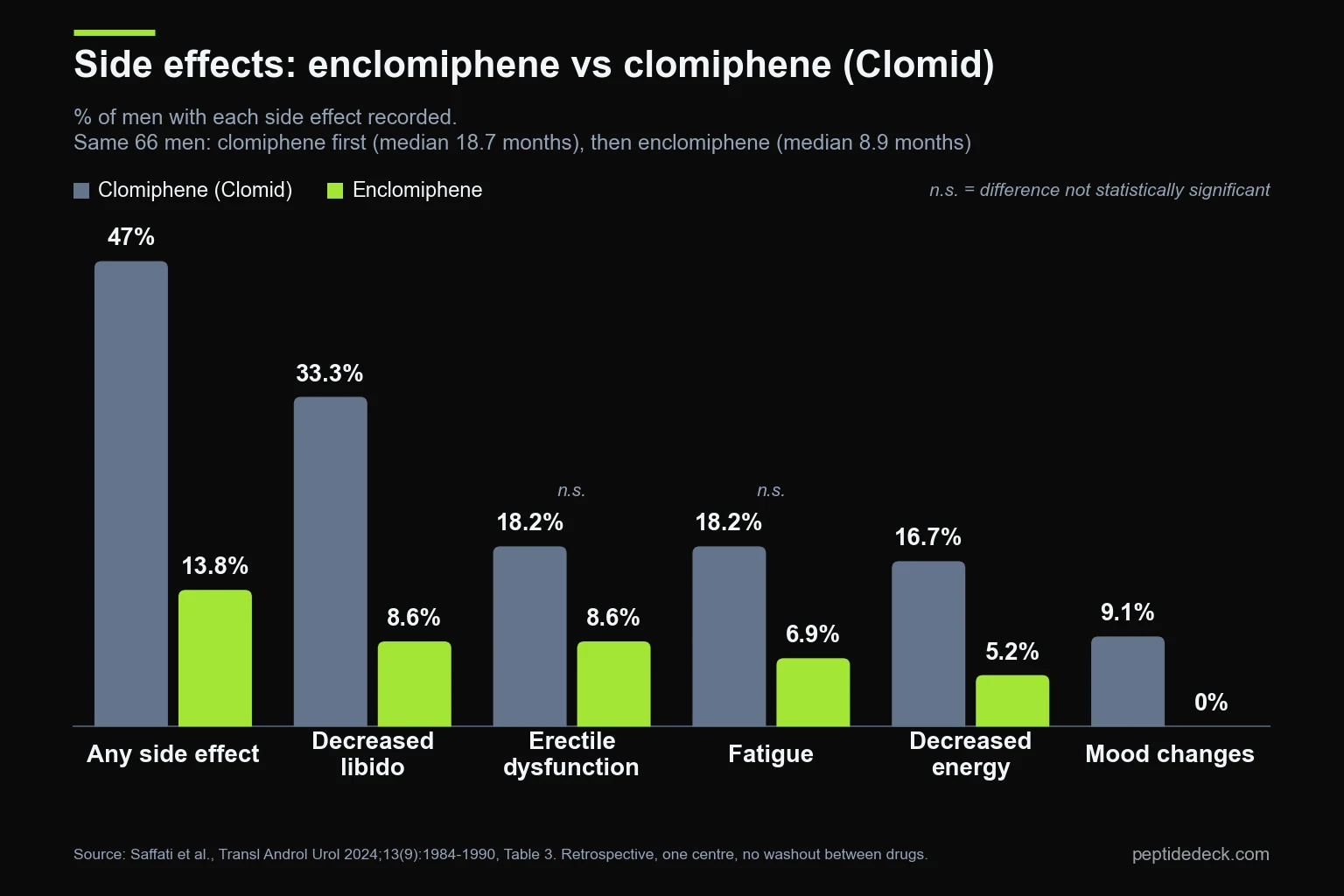
The Baylor switch study (2024). Baylor College of Medicine urologists reviewed 66 men who took clomiphene first (median 18.7 months) and then enclomiphene (median 8.9 months), with no break between [2]. Median testosterone went from 306 ng/dL before treatment to 436 on clomiphene and 499 on enclomiphene. Enclomiphene's rise is counted from where clomiphene left off, and the extra gain (+166 vs +98) was not significant (P=0.20). Estradiol rose a median 17.5 pg/mL on clomiphene and fell 5.92 on enclomiphene (P=0.001). A side effect was recorded for 47% of men on clomiphene and 13.8% on enclomiphene (odds ratio 0.18). The authors reported no funding.
Read it with four cautions. The men switched for their own reasons, so the group leans toward people who did poorly on Clomid; in a two-centre review, only 8% of 120 men on clomiphene for more than three years reported a side effect [11]. There was no washout, so the enclomiphene period likely still carried Clomid's long-lived isomer. The enclomiphene percentages only add up with 58 men, not 66, which the paper does not explain. And the AUA meeting abstract you may see listed separately (MP47-02) is this same study [2].
The Miami two-group study (2023). The University of Miami compared 46 men on enclomiphene with 32 on clomiphene for at least three months, most treated for infertility [3]. Median testosterone rose on both (390 to 581 ng/dL on enclomiphene, 244 to 470 on clomiphene), with no significant difference between groups (P=0.491). Estradiol went the other way from Baylor: 29.5 to 67 pg/mL on enclomiphene (P=0.003) against 31 to 37.6 on clomiphene (P=0.074). Doses were not matched (enclomiphene 12.5 or 25 mg daily, clomiphene 50 mg every other day), and estradiol was measured in only 18 and 11 men.
So the claim that enclomiphene spares estradiol rests on one study with no washout. In Repros Therapeutics' own phase II trial, enclomiphene raised estradiol about as much as testosterone gel did [12].
Enclomiphene vs Clomid Side Effects
Clomid's label carries the better-known warnings. Its trials were in women, but three points matter to men. Visual symptoms (blurring, spots or flashes) occurred in 1.5% of 8,029 trial patients; they can be prolonged or irreversible, and the label says to stop the drug and have an eye exam. Depression and nervous tension are listed in under 1%. And the label records gynecomastia and testicular tumors in men taking clomiphene, noting that cause and effect is not known for the tumors [1].
At Baylor, three items separated the drugs: decreased libido (33.3% vs 8.6%), decreased energy (16.7% vs 5.2%) and mood changes (9.1% vs none) [2]. Erectile dysfunction (18.2% vs 8.6%) and fatigue (18.2% vs 6.9%) were lower too, but not significantly. All of these are also symptoms of low testosterone, and neither study recorded vision, so nobody knows whether enclomiphene avoids Clomid's visual effects.
Enclomiphene's own trials reported headache, abdominal discomfort and raised estradiol [6], and the European regulator named a risk of blood clots when it refused the drug in 2018 [13]. The full list is on our enclomiphene side effects page.
Enclomiphene vs Clomid for Fertility
Both drugs keep sperm production going. That is why either is used in place of testosterone, which suppresses it. In Miami, motility improved on both, and total motile sperm count rose significantly only on enclomiphene (0.73 to 4.01 million, P=0.039; clomiphene 1.2 to 8 million, P=0.262). The between-group difference was not significant, and nobody counted pregnancies [3].
Enclomiphene's randomised sperm data are against testosterone gel, not Clomid: in two 16-week phase III trials run by Repros, sperm concentration changed +11.7% and +15.2% on enclomiphene and −56.6% and −32.8% on gel (reported arms of 41 to 43 men) [6]. Clomid's label says no adequate or well-controlled studies show it works for male infertility [1]. For the other fertility-sparing option, see enclomiphene vs HCG.
Enclomiphene vs Clomid: FDA Approval and How You Get Each
This is the sharpest difference between them. Clomid was approved on February 1, 1967, and several companies make generic 50 mg tablets [4]. Its approved use is ovulatory dysfunction in women who want to become pregnant, so every prescription for a man is off-label [1].
Enclomiphene has no FDA approval. Repros announced on December 1, 2015 that the FDA had answered its application with a Complete Response Letter, saying the phase III design was "no longer adequate to demonstrate clinical benefit" [14], and the European Medicines Agency's committee recommended refusal on January 25, 2018 [13]. No enclomiphene product is listed in Drugs@FDA [4].
It reaches patients through compounding pharmacies. Enclomiphene citrate is in Category 1 of the FDA's list of bulk substances nominated for compounding (updated May 14, 2026), and the FDA says it does not intend to take action against a compounder who uses a Category 1 substance under the conditions in its guidance [5]. That is not approval, and it may not last: the FDA proposed keeping enclomiphene off the final list, and on June 8, 2022 its advisory committee voted 8 to 4 against adding it [15].
Neither compounded capsules nor vendor capsules sold online are FDA-reviewed for strength or purity. If you are comparing where to buy enclomiphene, ask for a certificate of analysis showing isomer content: zuclomiphene contamination brings back the long half-life you were trying to leave behind.
Enclomiphene vs Clomid Cost
Clomiphene is usually called the cheaper option [6]. Pharmacies paid an average of $3.93 per 50 mg tablet in the week of November 25, 2026 (their cost, not the counter price) [9]. Two telehealth price pages opened on November 26, 2026 listed compounded enclomiphene at $99 to $116 and $165 to $206 a month, labs extra [8]. Vendor capsules cost less again: SwissChems lists 60 capsules of 12.5 mg at $71.07 on sale (checked November 25, 2026), sold without a prescription and with no FDA approval. PeptideDeck earns a commission on purchases through our links. Monthly cost depends on your prescribed dose; our enclomiphene cost page lists prices by provider.
Which Is Better: Enclomiphene or Clomid?
Neither drug wins on every count. It depends on what you need.
- You want an FDA-approved, factory-made tablet: clomiphene, though its use in men stays off-label [4].
- You had low libido, low energy or mood changes on Clomid: enclomiphene. Those were the effects that fell after the switch at Baylor [2].
- Fertility is the goal: either. Both preserved sperm measures in Miami; enclomiphene's edge on motile count is unconfirmed [3].
- Cost comes first: compare by the month, not the pill, using the figures above [9][8].
- Your LH is already high (primary hypogonadism): neither, since both need testes that can respond [6]. See enclomiphene vs TRT.
The limitation: enclomiphene's advantage rests on 144 men in two retrospective studies, with no randomised comparison and no long-term safety data. The side-effect gap in the switch study was large, so the signal is worth raising with a doctor, but "better tolerated" is a reasonable bet, not a settled fact. The British Society for Sexual Medicine said much the same in 2026: enclomiphene comes "with fewer side effects than clomiphene", yet the society "does not recommend its routine use outside specialist settings" [16].
What to ask your doctor: Is my low testosterone secondary, with LH and FSH low or normal? If I feel fine on Clomid, is there a reason to change? After a switch, when do we recheck testosterone and estradiol? Which pharmacy compounds the enclomiphene, and can I see its certificate of analysis?
Switching From Clomid to Enclomiphene
The evidence for switching is one study. The 66 Baylor men moved straight from clomiphene to enclomiphene; median testosterone rose a further 166 ng/dL and fewer side effects were recorded [2]. Because zuclomiphene clears slowly, labs and side effects in the first months can still reflect some Clomid [7]. No study has worked out an equivalent dose: the Baylor paper does not report doses, and the enclomiphene trials used 12.5 mg and 25 mg once daily [6]. Our enclomiphene dosage chart lays out those trial arms. Do not stop or swap either drug on your own.
Frequently Asked Questions
Sources
- Clomid (clomiphene citrate) tablets USP, prescribing information, revised 08/2023. DailyMed
- Saffati G, et al. Safety and efficacy of enclomiphene and clomiphene for hypogonadal men. Transl Androl Urol. 2024;13(9):1984-1990. PMID 39434750. PMC full text
- Thomas J, et al. Efficacy of clomiphene citrate versus enclomiphene citrate for male infertility treatment: a retrospective study. Cureus. 2023;15(7):e41476. PMID 37546076. PMC full text
- FDA. Drugs@FDA: Clomid, NDA 016131, approved February 1, 1967; no enclomiphene product listed. Checked November 26, 2026. Drugs@FDA
- FDA. Bulk Drug Substances Nominated for Use in Compounding Under Section 503A, updated May 14, 2026: category list and interim policy
- Rodriguez KM, Pastuszak AW, Lipshultz LI. Enclomiphene citrate for the treatment of secondary male hypogonadism. Expert Opin Pharmacother. 2016;17(11):1561-7. PMID 27337642. PMC full text
- Miller GD, et al. Hypothalamic-pituitary-testicular axis effects and urinary detection following clomiphene administration in males. J Clin Endocrinol Metab. 2019;104(3):906-914. PMID 30295816. PubMed
- Compounded enclomiphene price pages, opened November 26, 2026: GobyMeds and HealthRX
- CMS. NADAC (National Average Drug Acquisition Cost) 2026: clomiphene citrate 50 mg tablet, week of November 25, 2026. data.medicaid.gov
- Hohl A, et al. Clomiphene or enclomiphene citrate for the treatment of male hypogonadism: a systematic review and meta-analysis of randomized controlled trials. Arch Endocrinol Metab. 2025;69(5):e250093. PMID 41066380. PMC full text
- Krzastek SC, et al. Long-term safety and efficacy of clomiphene citrate for the treatment of hypogonadism. J Urol. 2019;202(5):1029-1035. PMID 31216250. PubMed
- Wiehle RD, et al.; ZA-203 Clinical Study Group. Enclomiphene citrate stimulates testosterone production while preventing oligospermia: a randomized phase II clinical trial comparing topical testosterone. Fertil Steril. 2014;102(3):720-7. PMID 25044085. PubMed
- European Medicines Agency. EnCyzix (enclomifene): refusal of the marketing authorisation, CHMP opinion of January 25, 2018. EMA
- Repros Therapeutics Inc. Form 10-K for fiscal year 2015 (Complete Response Letter of December 1, 2015). SEC EDGAR
- FDA. Final Summary Minutes of the Pharmacy Compounding Advisory Committee Meeting, June 8, 2022. FDA
- Foster J, et al. British Society of Sexual Medicine: position statement for the potential use of enclomiphene in the treatment of male hypogonadism. World J Mens Health. 2026;44(3):480-483. PMID 41714894. PMC full text
- Tamoxifen citrate tablets, prescribing information. Mylan. DailyMed
Medical Disclaimer: This article is for informational purposes only and does not constitute medical advice. Enclomiphene has no FDA approval, and clomiphene is approved only for ovulatory dysfunction in women, so its use in men is off-label. Doses mentioned are those used in clinical trials and published studies. Talk to your doctor before starting, stopping or changing any medication.