C60 promises a longer life from a spoonful of oil. That promise traces back to one 2012 study in lab animals, and buying C60 today is still a bet on that single result. Here's what carbon 60 is, what that lifespan study showed, why a 2020 replication found nothing, and how to check a bottle of C60 oil before you buy.
🔑 Key Takeaways
- The headline lifespan result has never been repeated, and the best-known attempt to repeat it failed
- Nobody has tested swallowed C60 oil in a human trial, so every dose you see is a guess
- Light can turn a good bottle into a bad one, and colour gives you a clue
- The same teaspoon can hold almost twice as much C60 depending on the brand
- The skin data is real, but it comes from creams, not from oil you swallow
Every study claim below links to its source, and the product details were checked on each seller's own page on November 5, 2026.
What Is C60 (Carbon 60)?
It's a hollow ball of 60 carbon atoms. Fullerene C60 was discovered in 1985 and goes by several names: fullerene, buckminsterfullerene, carbon 60 or buckyball. Each molecule is about 0.7 nanometres across and shaped like a soccer ball, according to the background section of the 2020 GeroScience paper discussed below.
C60 doesn't dissolve in water, but it does dissolve in oil. Olive oil holds roughly 0.6 to 1.2 mg of C60 per mL, depending on the oil and its moisture content. That's why the C60 supplement is sold as a dark purple-to-brown oil in a dropper bottle, usually labelled "C60 olive oil" or "C60 oil".
The appeal is the antioxidant idea. In test tubes C60 neutralises several kinds of free radicals, and some scientists proposed it might protect mitochondria from oxidative damage as you age. If you're comparing other compounds aimed at the same idea, our guide to anti-aging peptides by mechanism sorts them by how they're supposed to work.
The 2012 C60 Lifespan Study
One small study started the whole C60 trend. In 2012, a French-led team published a study in lab animals in the journal Biomaterials. The animals were given C60 dissolved in olive oil (0.8 mg/mL) by mouth, in repeated doses of 1.7 mg per kg of body weight.
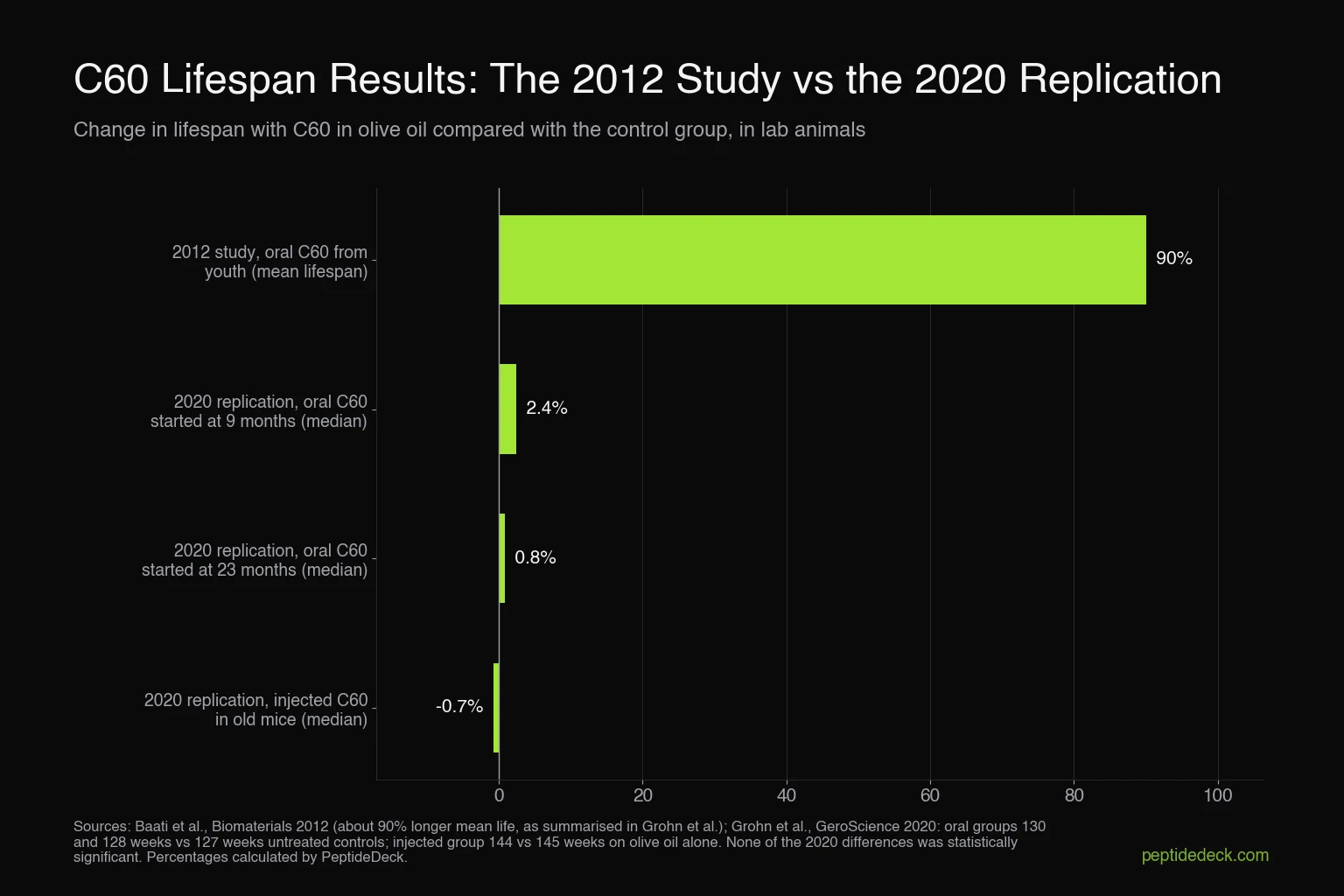
The authors reported two things. First, they saw no chronic toxicity. Second, the C60 group lived almost twice as long. The 2020 replication paper later described it as about a 90% increase in mean lifespan compared with animals given olive oil alone or nothing at all, and called it the largest life-extension effect from a chemical ever seen in that species.
The study also found that swallowed C60 was absorbed from the gut and cleared from the body within a few tens of hours. The authors linked the lifespan effect to lower oxidative stress, based on a separate liver-injury experiment.
Why one study isn't enough: the groups were small, every animal came from one lab and one strain, and only males were used. A correction to the paper was published later in 2012. A result this large normally needs independent repeats before anyone builds a habit around it.
The 2020 Replication That Found No Lifespan Gain
The independent repeat came eight years later. A team from Ichor Therapeutics in New York and an Italian ageing institute published the results in GeroScience (online October 2020). They ran two lifespan experiments in mice.
- Injections in old mice. 22 female mice, about 26 months old, got either C60 in olive oil or plain olive oil on a schedule close to the 2012 study. Median survival was 144 weeks with C60 and 145 weeks without it, which is no difference.
- Oral doses, like people take it. 66 mice were split into C60 in extra virgin olive oil, olive oil alone, or no treatment, starting at 9 or 23 months of age. The C60 was dissolved at 0.8 mg/mL, the 2012 strength, at about 4 mg/kg. Median lifespans ranged from 127 to 130 weeks across the groups, with no significant differences.
The researchers also found no improvement in grip strength, activity or body condition. Their conclusion was blunt: the results call into question any lifespan benefit of C60 in olive oil.
Two limits matter here. The groups were sized to catch a big effect like the 2012 one, so a small benefit could have been missed. And mice are a different species from the animals in 2012. A separate 2021 study in CBA/Ca mice adds a twist: C60 mice outlived olive-oil mice, but lived no longer than mice given only water. The authors read that as olive oil being harmful in that strain, with C60 cancelling it out, rather than C60 extending life.
Is There Any Human Data on C60?
Not for the oil people actually swallow. We searched PubMed and ClinicalTrials.gov on November 5, 2026 and found no published human trial of C60 oil taken by mouth. A 2024 review of C60-enriched olive oil reached the same place: human clinical studies are very limited, and no research on long-term human safety was found.
Human data does exist for C60 on the skin:
- Wrinkles. In an 8-week, double-blind, split-face trial, 23 Japanese women applied a C60 cream to one side of the face and a plain cream to the other. Wrinkle scores were better on the C60 side at week 8 but not at week 4, and skin roughness didn't differ from the plain cream.
- Radiation skin damage. In a phase II double-blind trial in 132 people with head and neck cancer, 34.8% of those using a fullerene cream developed grade 2 or worse radiation dermatitis, against 83.3% on the standard trolamine cream. A second trial in 88 people with breast cancer also found milder skin reactions, though one author worked for the cream's maker.
Those are creams on skin, not oil in your stomach, and the results don't transfer. If skin is your goal, our guide to peptides for skin covers options with more human data.
C60 Benefits: The Evidence Grade for Each Claim
Here's every common claim, graded plainly. "Lab models only" means it has only been tested in mice, other lab animals or cells.
C60 Side Effects and Safety
The biggest known risk comes from light. In the same 2020 study, C60 in olive oil broke down with a half-life of about 2 days under strong light (70,000 lux; direct sun is around 100,000 lux). That happened whether the vial was open, sealed or filled with nitrogen.
The researchers then injected the light-exposed oil into mice, four per group. Fresh oil and plain oil caused no deaths. Oil exposed for 4, 6 and 8 days killed 25%, 50% and 25% of the mice within 14 days, with damaged intestines, livers and spleens on examination. That was injection at a high dose in tiny groups, so it doesn't prove swallowing old oil is dangerous. It does explain why the bottle should be dark and the oil fresh.
Store-bought quality was the second problem. The team bought C60 oil from four popular online sellers:
- Fresh C60 oil should be a clear, deep purple. All four commercial samples were dark brown to almost black.
- The commercial oils showed extra impurity peaks on HPLC testing.
- Three of the four were more than 18% off their labelled strength, and one was off by more than 38%.
- None of them protected olive oil from oxidation significantly better than plain oil, while the fresh in-house oil did.
On genetic safety, a 2025 regulatory-style test found no DNA damage in mice given a C60/C70 olive oil mix at up to 3.6 mg/kg. That's reassuring for one type of harm, though the study was funded by SES Research, a C60 seller.
On the legal side, C60 is not approved by the FDA to treat or prevent any disease. In 2020 the FDA and FTC sent warning letters to two C60 sellers, Bioactive C60 and Heavenly Natural Products, for marketing C60 against COVID-19. The FDA classed those products as unapproved new drugs and misbranded.
What to ask your doctor before trying C60:
- "I'm thinking of taking a C60 oil with no human safety data. Is there anything in my health history that makes that a bad idea?"
- "Should I stop it before any surgery, blood test or new prescription?"
- "I'm pregnant, breastfeeding or trying to conceive. Should I skip it?" (There's no data either way, so the safe answer is usually yes.)
C60 Dosage: What People Take and Why It's Unverified
There is no tested human dose of C60. The only doses with study data come from lab animals: 1.7 mg/kg in the 2012 study and about 4 mg/kg in the 2020 mouse study.
Typical vendor doses are much rougher. SES Research, one of the larger C60 suppliers, says on its product page that most adults take 1 to 3 teaspoons a day, starting with 1. At its strength of about 0.8 mg/mL, that's roughly 4 to 12 mg of C60 a day. Treat that as unverified seller guidance, not a dose anyone has tested in people.
Concentration changes everything. A 5 mL teaspoon of a 0.8 mg/mL oil holds about 4 mg of C60, while the same teaspoon of a 1.5 mg/mL oil holds 7.5 mg. Check the mg/mL on your label before copying a dose you read elsewhere.
For a ceiling, the authors of the 2025 genetic-safety study converted their highest mouse dose (3.6 mg/kg) to about 20.6 mg a day for a 70 kg adult, using FDA conversion rules. That figure is the top dose tested for one kind of harm in mice. It is not a recommended dose.
C60 Olive Oil vs Avocado and MCT Oil
The carrier oil isn't just packaging. Olive oil is the only carrier used in the lifespan studies, which is why "C60 olive oil" is still the default. Sellers also offer C60 in avocado oil, MCT oil and other carriers, but there's no lifespan or safety data on those versions.
Don't count the oil as a bonus either. In the 2020 study, extra virgin olive oil alone did nothing for lifespan in mice, and in the 2021 CBA/Ca study it appeared to shorten it. How much C60 an oil can hold also varies with the oil, so a label strength above about 1.2 mg/mL is worth a question about which oil is used.
If you take C60 for the mitochondria idea, compounds with more direct mitochondrial data are covered in our SS-31 review and MOTS-c review.
How to Check a C60 Oil Before You Buy
Five checks catch most bad bottles. The 2020 test showed that labels and appearance can't be taken on trust.
- A batch lab report. Look for an HPLC result that gives the C60 concentration in mg/mL for your batch, not a generic certificate.
- Purity of the C60 itself. Sellers quote grades from 99.5% to 99.99%, and some describe their C60 as sublimated or solvent-free. SES Research says its 99.5% grade can contain up to 0.5% of other fullerenes such as C70. Ask for the residual solvent result rather than trusting the word on the label.
- Colour. Fresh C60 in olive oil is a clear, deep purple. A bottle that's dark brown or nearly black may have been degraded, though only a lab test confirms it.
- A dark glass bottle. A dark amber bottle limits the light that breaks C60 down. Keep it in a cupboard, and buy a size you'll finish within weeks, not months.
- A named carrier oil and a stated mg/mL. If either is missing, you can't work out your dose.
Skip any seller that says C60 treats a disease. That's exactly what drew the FDA warning letters.
C60 Price and Where to Buy It
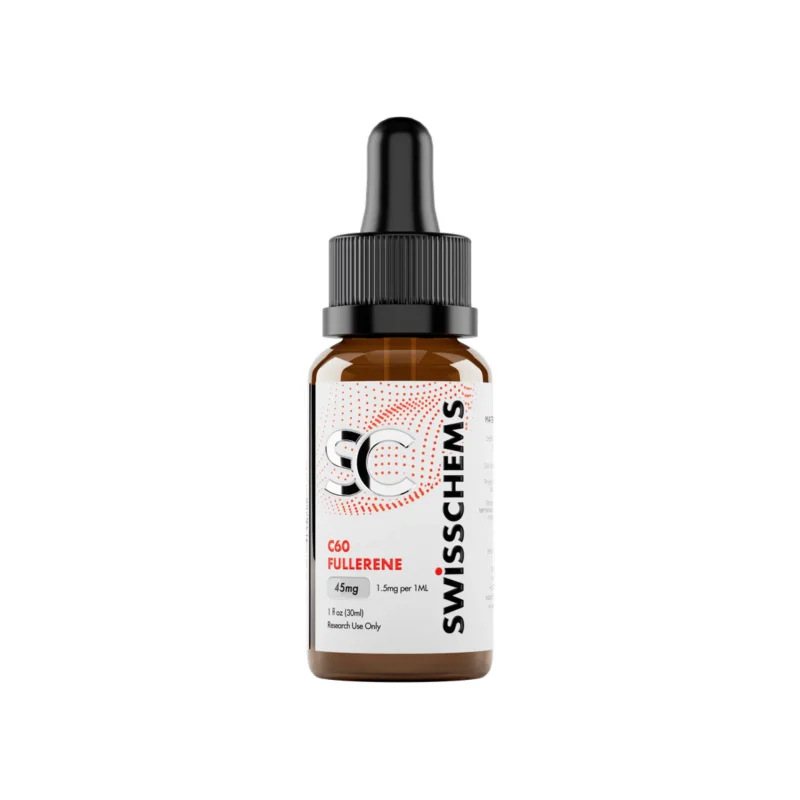
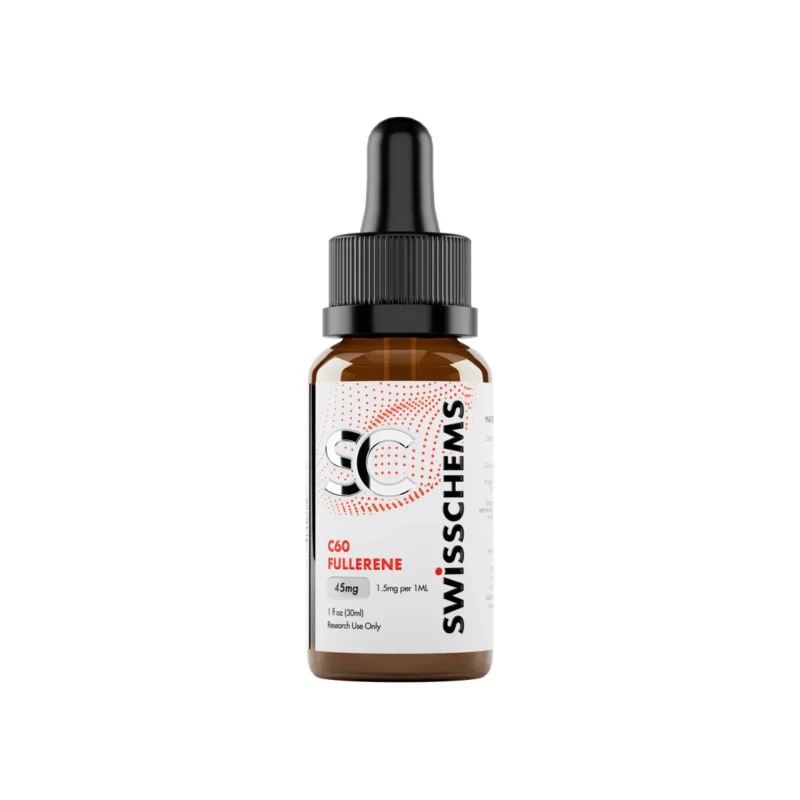
SwissChems sells C60 in a small dropper bottle. Its C60 Fullerene 1.5 mg/mL is a 30 mL (1 fl oz) bottle, and the label in the product photo states 45 mg of C60 in total, in an amber glass dropper bottle. It costs $49.99. SwissChems sells it labelled for laboratory use only, not as a dietary supplement.
Here's how the SwissChems bottle works out:
- Per mg of C60: $1.11, or $1.00 with the code.
- Per teaspoon (7.5 mg): $8.33, or $7.50 with the code.
- How long it lasts: 30 mL is 6 teaspoons, so about 6 days at one teaspoon a day.
What SwissChems states on its product page: "99% Purity Guaranteed", that every batch is independently lab tested for identity, purity and potency, and a "Check Lab Report" button. The page doesn't name the carrier oil or say whether the C60 is sublimated, so ask before you buy if those checks matter to you. Use the code jqrlsday for 10% off, which brings the bottle to $44.99. PeptideDeck earns a commission if you buy through the SwissChems link on this page.
For comparison, SES Research's 100 mL original-grade C60 olive oil holds about 80 mg of C60 for $56.95, about $0.71 per mg, at roughly half the strength per teaspoon. If you're weighing C60 against better-studied longevity options, our NAD+ benefits guide and glutathione guide cover two antioxidant-related compounds with human data.
Frequently Asked Questions
Sources
- Baati T, Bourasset F, Gharbi N, et al. Oral [60]fullerene lifespan study. Biomaterials. 2012;33(19):4936-46. PubMed 22498298
- Grohn KJ, Moyer BS, Wortel DC, et al. C60 in olive oil causes light-dependent toxicity and does not extend lifespan in mice. GeroScience. 2021;43(2):579-591 (online October 2020). PubMed 33123847, full text
- Shytikov D, Shytikova I, Rohila D, et al. Effect of long-term treatment with C60 fullerenes on the lifespan and health status of CBA/Ca mice. Rejuvenation Res. 2021;24(5):345-353. PubMed 33849306
- Ozdemir Y, Goksel Z, Yorukoglu T. The effects of fullerene (C60)-enriched olive oil on human health. Hrana i ishrana. 2024. doi:10.5937/hraish2402001o
- Kato S, Taira H, Aoshima H, et al. Clinical evaluation of fullerene-C60 dissolved in squalane for anti-wrinkle cosmetics. J Nanosci Nanotechnol. 2010;10(10):6769-74. PubMed 21137794
- Liu Z, Liu X, Li Z, et al. Fullerene for reducing acute radiation dermatitis in patients undergoing radiotherapy for head and neck cancer: a phase II, double-blind, randomized controlled trial. J Clin Oncol. 2026;44(13):1206-1215. PubMed 41861269
- Wang Q, Shi X, Guo J, et al. Topical fullerene moisturizing and repairing cream for preventing acute radiation dermatitis in breast cancer patients undergoing radiotherapy: a randomized controlled trial. Front Med. 2025;12:1604012. PubMed 40766071
- Moussa F. A regulatory-compliant genotoxicity study of a mixture of C60 and C70 fullerenes dissolved in olive oil using the mammalian micronucleus test. Nanomaterials. 2025;15(11):870. PubMed 40497917
- U.S. FDA. Warning letter to Bioactive C60/FullerLifeC60 LLC, March 30, 2020. fda.gov
- U.S. FDA. Warning letter to Heavenly Natural Products, December 2, 2020. fda.gov
- ClinicalTrials.gov search for "fullerene" and "C60 olive oil", checked November 5, 2026. clinicaltrials.gov
- Product details and prices: SwissChems C60 Fullerene 1.5 mg/mL product page and label photo, and SES Research C60 Olive Oil product page, both checked November 5, 2026.
Medical Disclaimer: This article is for informational purposes only and does not constitute medical advice. C60 oil is unapproved, has no human safety or efficacy data when taken by mouth, and the doses quoted here come from lab models or sellers, not human trials. Talk to your doctor before taking C60, especially if you're pregnant, breastfeeding, managing a medical condition or taking prescription medicines.