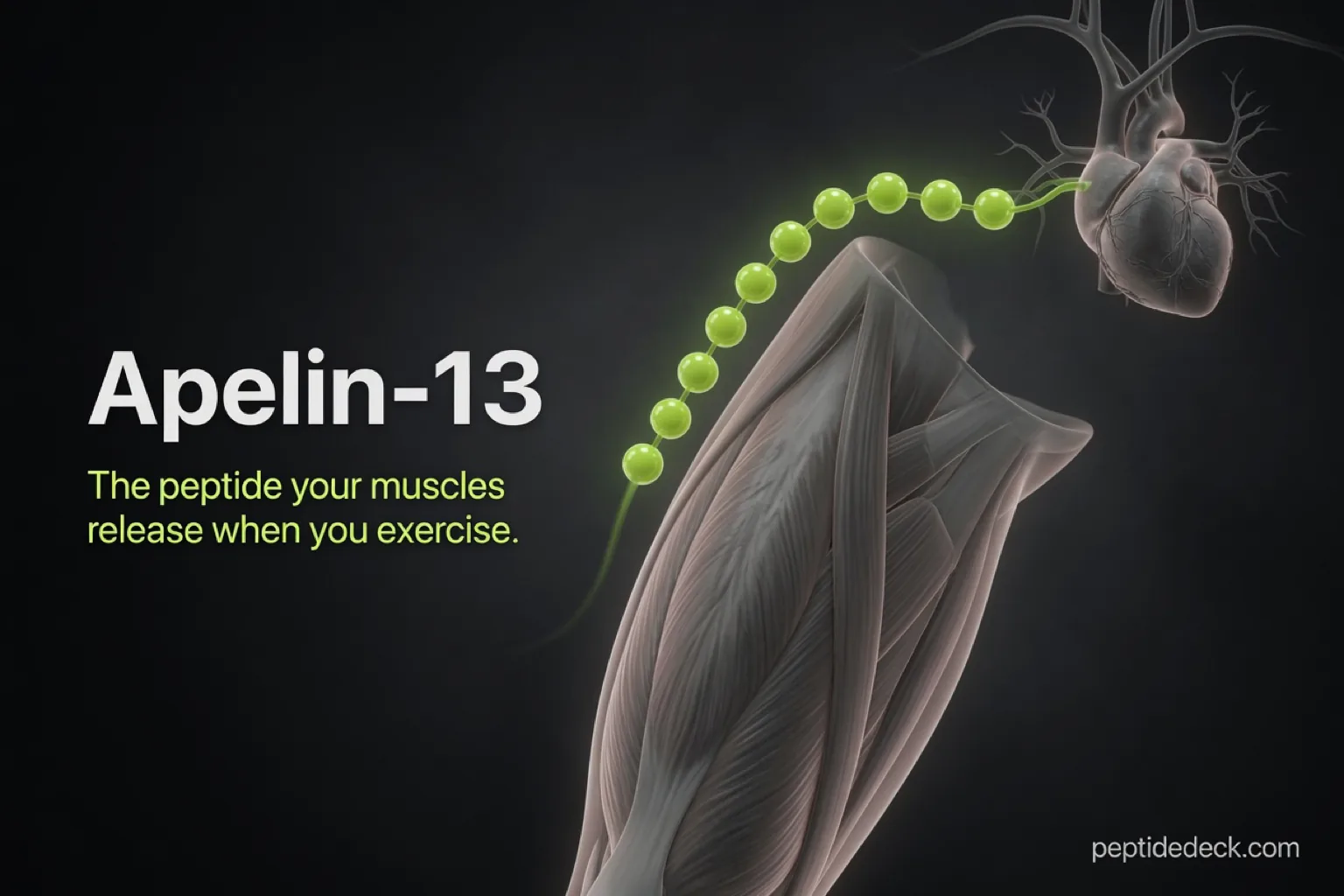
Your muscles talk to the rest of your body. You already know exercise does more than burn calories: it steadies blood sugar, keeps your heart working efficiently and slows the muscle loss that creeps in after 40. Apelin-13 is one of the messengers behind those effects, a 13-amino-acid peptide your muscles, heart and fat release, and it is why a small corner of the peptide world is suddenly paying attention.
🔑 Key Takeaways
- Apelin-13 is a natural signal your body releases, and exercise turns it up
- Your levels drop with age, which is why it keeps coming up in conversations about muscle loss
- In people it has only been given by IV, in short studies, and those studies did show real effects on insulin sensitivity and heart output
- It is cleared from human blood in under five minutes, the detail almost nobody selling it mentions
- The one company that tried to turn this pathway into an obesity pill stopped its trial in December 2024, and the reason matters
- No vendor we trust stocks it, so we cover what to check and what to consider instead
Here is what apelin-13 does, what the human evidence actually shows, why the usual online dosing doesn't fit how the peptide behaves, and where it leaves you if you want the benefits it promises.
What Is Apelin-13?
A small signal with a long job list.
Apelin was discovered in 1998, when Japanese scientists went looking for the natural partner of an "orphan" receptor called APJ, now officially named the apelin receptor (APLNR). The body makes apelin as a 77-amino-acid precursor and trims it into shorter active pieces. Apelin-13, the last 13 amino acids of the chain, is the one people mean when they talk about apelin as a peptide.
Its sequence is Gln-Arg-Pro-Arg-Leu-Ser-His-Lys-Gly-Pro-Met-Pro-Phe (QRPRLSHKGPMPF). Your body also makes a slightly modified version, [Pyr1]-apelin-13, where the first amino acid curls into a ring. That small change makes it tougher to break down, and it is the main form found in human heart tissue.
Apelin is made in fat tissue, the lining of blood vessels, the heart, the kidney, the brain and, importantly, in working muscle. Because muscle releases more of it during exercise, scientists call apelin an exerkine: a hormone-like signal that carries some of exercise's benefits to the rest of the body. A second natural partner for the same receptor, Elabela, was found in 2013.
How Apelin-13 Works in the Body
It works through one receptor, APJ.
That receptor sits on muscle cells, heart cells, blood vessel walls and fat cells, so one signal has several effects at once:
- Muscle. Apelin switches on AMPK, the same energy sensor that exercise activates. That pushes muscle to pull in more glucose, burn more fat and build new mitochondria.
- Blood vessels. It triggers nitric oxide release, which relaxes vessel walls and lowers the resistance your heart pumps against.
- Heart. It makes heart muscle contract more strongly, one reason it attracted cardiologists before anyone else.
- Fluid balance. It works against vasopressin, the hormone that makes your kidneys hold on to water.
- Fat tissue. Fat cells release apelin too, and blood levels run higher in people with obesity and high insulin. More on why that isn't a contradiction below.
If that list sounds like exercise itself, that is the whole appeal. The open question is whether giving apelin-13 from the outside reproduces those effects. That is where the human studies come in.
Apelin-13 Benefits: What Human Studies Show
Here is the short list of human data.
Most of what you will read about apelin-13 comes from cell and mouse experiments. A few human studies do exist, and they are more interesting than the pages ranking for this keyword admit.
Insulin sensitivity
This is the strongest human result.
In a randomized, double-blind, placebo-controlled crossover trial published in 2018, 16 healthy overweight men had their insulin sensitivity measured with a clamp test, the gold standard, while receiving an IV infusion of [Pyr1]-apelin-13 or saline. At 9 nmol/kg the change was slight. At 30 nmol/kg, insulin sensitivity improved significantly.
If your blood sugar has been creeping up despite doing the right things, that is the effect you want. Two caveats keep it in proportion: it was one session per dose, and the dose went straight into a vein.
Heart and blood flow
Cardiologists got there first.
In a 2010 study in Circulation, short apelin infusions in healthy volunteers and people with chronic heart failure widened blood vessels, including the coronary arteries that feed the heart, and increased the amount of blood the heart pumped per minute. That result is why drug companies started building longer-lasting molecules that act on the same receptor.
Muscle and aging
This is where the excitement comes from.
A 2018 study in Nature Medicine found that contracting muscle releases apelin, that blood levels fall with age in people, and that higher levels tracked with how much older adults gained from exercise. In aged mice, restoring apelin signaling rebuilt muscle strength by improving mitochondria, clearing damaged cell parts and waking up muscle stem cells.
For anyone who feels workouts paying off less than they used to, that is a compelling story. It is also, so far, a mouse result: no one has shown that injecting apelin-13 reverses muscle loss in a human.
Weight and body fat
There is no human weight-loss data yet.
Fat tissue produces apelin, and levels run higher in people with obesity. That sounds backwards for a fat-burning signal, but it fits a familiar pattern: like leptin, the body may make more of it when tissues stop responding. The more serious weight-loss bet came from a drug company, and it ended badly. More on that below.
Brain, kidneys and everything else
These areas are early.
Apelin-13 has been studied for recovery after stroke and spinal cord injury, kidney protection and blood vessel disease. The results are promising but come from cell and mouse work, so treat claims in these areas as a direction for future studies rather than a reason to use it.
The Half-Life Problem Nobody Mentions
Apelin-13 disappears in minutes.
In human blood, apelin has a half-life of less than five minutes. Enzymes tear it apart almost as soon as it arrives: neprilysin cuts it in the middle, ACE2 clips off the last amino acid, and plasma kallikrein chews at it too. The ring-shaped [Pyr1] form resists one end of that attack, not all of it.
That is why every human study delivered it by continuous IV infusion, sometimes straight into an artery. A single injection under the skin delivers a brief pulse that is largely gone before it could build the steady signal those studies relied on.
It is also why pharmaceutical companies stopped working with apelin-13 itself. Their candidates are either chemically stabilized versions or small molecules that switch on the same receptor and can be swallowed as a pill.
What this means for you: the benefits in the human studies came from doses and delivery that no vial sold online replicates. That doesn't make apelin-13 useless, but it does mean the online dosing charts are guesses, not tested protocols.
Apelin-13 Dosage: What Has Actually Been Used
There is no established apelin-13 dose.
No regulator has approved it for any use, and no study has tested a repeated-injection routine in people. What exists is a short list of doses from human studies and a set of numbers passed around peptide sites:
The gap is large. The 30 nmol/kg dose that improved insulin sensitivity works out to roughly 46 micrograms per kilogram, about 3.7 mg for an 80 kg adult, given into a vein. The 50 to 100 mcg injections circulating online are roughly 40 to 70 times smaller and delivered under the skin, where the peptide still faces the same enzymes.
If you handle any lyophilized peptide, the basics are the same as always: sterile bacteriostatic water, clean technique and cold storage after mixing. Our guide to how to reconstitute peptides walks through the math and the steps.
Apelin-13 Side Effects and Safety
Most of the risk is still unknown.
The human studies were short and well tolerated, but they lasted hours, not months. Based on what apelin does, these are the effects to expect or watch for:
- Lower blood pressure. Apelin widens blood vessels, so lightheadedness or dizziness is the most predictable side effect, especially if you already take blood pressure medication.
- Fluid shifts. Because it opposes vasopressin, it can change how much water your kidneys keep.
- New blood vessel growth. Apelin encourages blood vessels to grow, which helps healing but is unwelcome around tumors. Several cancers show raised apelin, so anyone with active cancer or a recent history should stay away.
- Liver enzymes. The only long human trial of an apelin receptor drug was stopped after liver enzyme rises (details below). That drug was a different molecule, but it acted on the same receptor.
- Product quality. Apelin-13 is sold only through unregulated channels, so purity, dose accuracy and sterility depend entirely on the seller.
Skip apelin-13 if you are pregnant or breastfeeding, have low blood pressure, take heart or blood pressure medication, have liver disease, or have active or recent cancer. For the wider picture on unregulated peptides, see are peptides dangerous?

The Azelaprag Story: Apelin's First Obesity Trial
One company already tested this pathway.
BioAge Labs built azelaprag, an oral drug that switches on the apelin receptor, on the same exercise-mimetic idea behind apelin-13. The plan was to pair it with tirzepatide so people losing weight on a GLP-1 would keep more muscle.
The Phase 2 trial, called STRIDES, gave 300 mg of azelaprag once or twice daily alongside 5 mg of tirzepatide weekly. On December 6, 2024, BioAge stopped it: 11 of the 204 people enrolled, all in the azelaprag groups, had developed raised liver enzymes without symptoms. No one on tirzepatide alone did.
That does not prove apelin-13 harms the liver. It does mean the one serious attempt to use this receptor for weight loss hit a safety wall, and anyone reading "fat-burning apelin" on a vendor page should know that.
Apelin-13 vs MOTS-c
Both mimic parts of exercise.
If what draws you to apelin-13 is better insulin sensitivity, more energy from your workouts or holding on to muscle, the closest peptide you can actually buy is MOTS-c. It is a small peptide made by your mitochondria that also switches on AMPK, and it is widely used for metabolic health.
The honest limitation: MOTS-c doesn't touch the apelin receptor, so it won't reproduce apelin's blood-vessel and heart effects. For the metabolic side of the promise, it is the practical choice. See the MOTS-c dosage chart for how people use it, or compare it with another exercise mimetic in SLU-PP-332 vs MOTS-c.
Where to Get Apelin-13
No vendor we trust stocks it.
We checked the catalogs of every supplier we work with in September 2026, and none sells apelin-13. It does show up at chemical suppliers and smaller online shops. If you buy it anyway, check these before you pay:
- Which form it is. Plain apelin-13 and [Pyr1]-apelin-13 are different molecules. The label and the certificate should say which.
- A recent certificate of analysis. Look for HPLC purity above 98% and a mass spectrometry result that matches the sequence QRPRLSHKGPMPF (about 1,551 daltons for plain apelin-13).
- Lyophilized powder, shipped cold. Apelin-13 breaks down easily, and pre-mixed liquid is a red flag.
- A seller with a track record. Our guide to grey market peptides covers how to tell a real source from a relabeler.
If your goal is metabolic, MOTS-c from a tested vendor is the realistic alternative, and it is the product we link to on this page.
Medical Disclaimer: This article is for informational purposes only and does not constitute medical advice. Apelin-13 has not been approved as a medicine in any country, and the human studies described here were short, supervised infusion studies. Talk to a licensed healthcare provider before using any peptide, especially if you have heart disease, low blood pressure, liver disease or a history of cancer, or take prescription medication.