7,8-DHF is sold as a pill that mimics BDNF. That claim comes from one lab's 2010 paper, and two independent teams have since tested it and could not make 7,8-dihydroxyflavone switch on the BDNF receptor in cells. If you're thinking about 7,8-DHF or its stronger-sounding cousin eutropoflavin, this guide shows what the studies actually found, why so little of a swallowed dose reaches your blood, what the R13 prodrug changes, and what people who take it report.
🔑 Key Takeaways
- Neither compound is a peptide, and that matters for how your body handles them
- The "TrkB agonist" label is now disputed, and one 2024 study offers a different explanation
- The "more potent" derivative may also be the one your gut absorbs less of
- The only version heading into human trials is neither of the two you can buy
- Every dose on a label is a vendor number, not a tested human dose
Every study claim below links to its source at the end. Prices were checked on the seller's product pages on November 5, 2026.
What Is 7,8-Dihydroxyflavone (7,8-DHF)?
It's a small plant flavone, not a peptide. 7,8-dihydroxyflavone, also called tropoflavin, belongs to the same chemical family as the flavonoids in tea and citrus. It occurs naturally in a few plants, but what's sold in capsules is made in a lab.
The interest comes from BDNF (brain-derived neurotrophic factor), a protein your brain uses to keep neurons alive and to strengthen connections when you learn. BDNF works by binding a receptor called TrkB. BDNF itself is a poor drug: it's a large protein, it breaks down fast, and it doesn't cross from your blood into your brain well. A small molecule that could switch on TrkB from a pill would be valuable, and that's the job 7,8-DHF was said to do.
In 2010, a group at Emory University led by Keqiang Ye reported that 7,8-DHF bound TrkB, made the receptor pair up and activate, and protected neurons that had TrkB but not ones that lacked it. In mice it reduced stroke damage and was protective in a Parkinson's model (Jang 2010). That paper is the source of nearly every "BDNF mimetic" claim on supplement labels today. For the wider picture of BDNF and the compounds people use to influence it, see our BDNF guide.
What Is Eutropoflavin (4'-DMA-7,8-DHF)?
Eutropoflavin is 7,8-DHF with one chemical group added. Its full name is 4'-dimethylamino-7,8-dihydroxyflavone, usually shortened to 4'-DMA-7,8-DHF. The same Emory lab made it in 2010 while testing dozens of 7,8-DHF variants.
In their cell tests it activated the TrkB pathway more strongly than 7,8-DHF at low concentrations (10 and 50 nM), though not at 100 nM and above. In mice, a single oral dose of 1 mg/kg kept TrkB signaling active for longer, and weeks of oral dosing increased new neuron growth in the hippocampus and reduced despair-like behavior in standard mouse tests (Liu 2010).
That's where the "more potent, longer-lasting" claim on eutropoflavin labels comes from. Here's the part labels leave out: in a follow-up from the same lab, adding the dimethylamino group increased how much of the compound gut-lining cells pumped back out in a standard absorption test, which the authors read as a sign of lower oral bioavailability (Liu 2013). So eutropoflavin may be stronger per molecule and still reach your blood less well.
Does 7,8-DHF Actually Activate TrkB? The Dispute
Independent labs have struggled to repeat the core finding. In 2017, a Columbia University and Broad Institute team built a set of quantitative tests for TrkB activation, downstream signaling and gene expression. BDNF lit them all up in a clear, dose-dependent way. 7,8-DHF and the other reported small-molecule TrkB agonists did not (Boltaev 2017). The authors wrote that results obtained with these compounds "must be carefully interpreted."
A drug-company team in Poland went further in 2021. They found 7,8-DHF did bind TrkB, but weakly (a dissociation constant of 1.3 μM, which is micromolar, not the nanomolar affinity often quoted). They saw no receptor activation in two nerve-cell lines. In mice given 1 mg/kg into a vein or 50 mg/kg by mouth, they found poor drug levels and no TrkB signaling in the brain. Screened against 133 other targets, 7,8-DHF showed a significant lack of selectivity, so it acts on much more than TrkB (Pankiewicz 2021).
Then, in 2024, a German group stumbled on a different target. While screening for blockers of pyridoxal phosphatase (PDXP), an enzyme that breaks down the active form of vitamin B6, they found 7,8-DHF binds and blocks it at sub-micromolar potency. In mouse hippocampal neurons, it raised active vitamin B6 levels, and only when PDXP was present (Brenner 2024). Low vitamin B6 has long been linked to poorer memory, so this offers a possible explanation for 7,8-DHF's effects in mice that doesn't involve TrkB at all.
What this means for you: 7,8-DHF clearly does something in mice. What's in dispute is how. If it isn't a true TrkB activator, "BDNF in a pill" is the wrong way to think about it, and the effects you'd expect (or wouldn't) may differ from the marketing.
7,8-DHF vs Eutropoflavin vs R13
Three related molecules get mixed up constantly. This table shows how they differ and what each claim rests on.
The pattern is simple. Each step away from plain 7,8-DHF was made to fix one problem, either strength at the receptor or survival in the gut and liver. None of the three has been tested for any outcome in people.
Why So Little 7,8-DHF Reaches Your Blood
The catechol group is the key and the weak spot. The 2010 work found those two neighbouring hydroxyl groups are essential for the activity the Emory lab measured. They're also exactly what your liver and gut tag for fast removal, through glucuronidation, sulfation and methylation.
In mice given 50 mg/kg by mouth, 7,8-DHF peaked in plasma at 70 ng/mL within 10 minutes and had a half-life of about 134 minutes. Some of what reached the brain was a methylated version, which the authors say also acted on TrkB in their tests (Liu 2013).
The R13 prodrug was built to get around this. The Emory team capped the catechol with carbamate groups so the molecule survives absorption, then gets unwrapped into 7,8-DHF by the liver. In mice, three animals per group, oral bioavailability rose from 4.6% for plain 7,8-DHF to about 10.5% for R13, and the half-life of the released 7,8-DHF rose from 134 to about 220 minutes (Chen 2018). Long-term oral R13 reduced amyloid build-up and memory loss in an Alzheimer's mouse model.
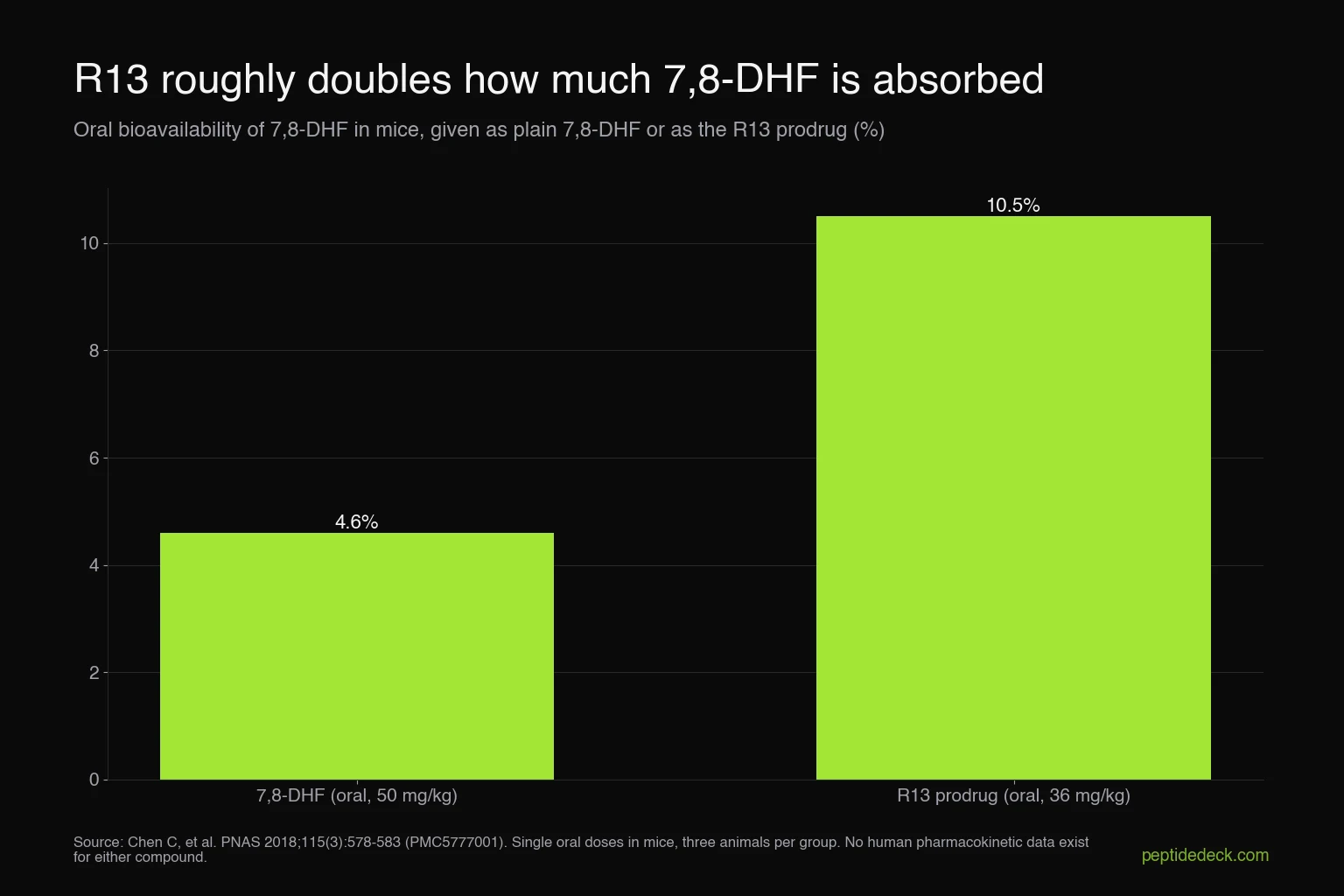
Two limits on that chart. These are mouse numbers from groups of three, and mice clear drugs much faster than people do. And "10.5%" still means roughly nine-tenths of the dose never reaches circulation as the active compound.
7,8-Dihydroxyflavone Benefits: What the Evidence Shows
Every reported benefit comes from mice or cells. Reviews list positive results in mouse models of depression, Alzheimer's, Parkinson's and other brain disorders (Yang 2022). That's a long list, but it comes with three caveats.
- No human outcomes. A search of PubMed and ClinicalTrials.gov on November 5, 2026 found no human trial of 7,8-DHF or eutropoflavin. The 2022 review states plainly that clinical trials of 7,8-DHF and its derivatives are lacking.
- Mechanism in doubt. If TrkB activation isn't real in cells, the benefits seen in mice may come from antioxidant effects, vitamin B6 changes or the many other targets it binds.
- Mostly one lab. The original TrkB papers, the eutropoflavin work and R13 all come from Keqiang Ye's group. Independent replication of the mechanism has gone the other way.
The only human study on the horizon is for R13. A 2024 review reports that BrAD-R13, the development name for R13, has been registered for a phase 1 trial in China under the number CTR20233658 (Wang 2024). A phase 1 trial tests safety and blood levels, not whether it improves memory. No results had been published when we checked.
What 7,8-DHF and Eutropoflavin Users Report
User reports are mixed and unverified. On Reddit's nootropics forums, a few themes repeat across threads. Treat these as anecdotes: there's no control group, no confirmed dose and no way to know what was in each bottle.
- Mood and energy. Some 7,8-DHF users describe a lifted mood, more energy and clearer thinking (r/Nootropics, r/NootropicsDepot).
- Timing differs by compound. Some users describe plain 7,8-DHF building up over days of use, with eutropoflavin felt sooner (r/NootropicsDepot).
- Sleep problems. Trouble falling asleep comes up repeatedly with eutropoflavin, though some users report the opposite (r/Nootropics).
- Headaches and overstimulation. Mild headaches and feeling overstimulated both come up in user threads (r/Nootropics, r/Supplements).
- Hair shedding worries. Hair shedding is raised as a worry in eutropoflavin threads (r/NootropicsDepot).
- No effect at all. Some users simply say it did nothing for them (r/NootropicsDepot).
If what you're after is a compound that raises BDNF itself, Semax is the usual alternative. It's a peptide given as a nasal spray, and in lab animals a single dose raised hippocampal BDNF protein about 1.4-fold and TrkB activation 1.6-fold (Dolotov 2006). Our Semax guide covers how it works, and our roundup of nootropic peptides compares it with Selank, Dihexa and others.
7,8-DHF Dosage: What Labels Say (Unverified)
There is no tested human dose. Because nobody has run a human trial, every figure below is a vendor or user number, not a dose shown to be safe or effective in people.
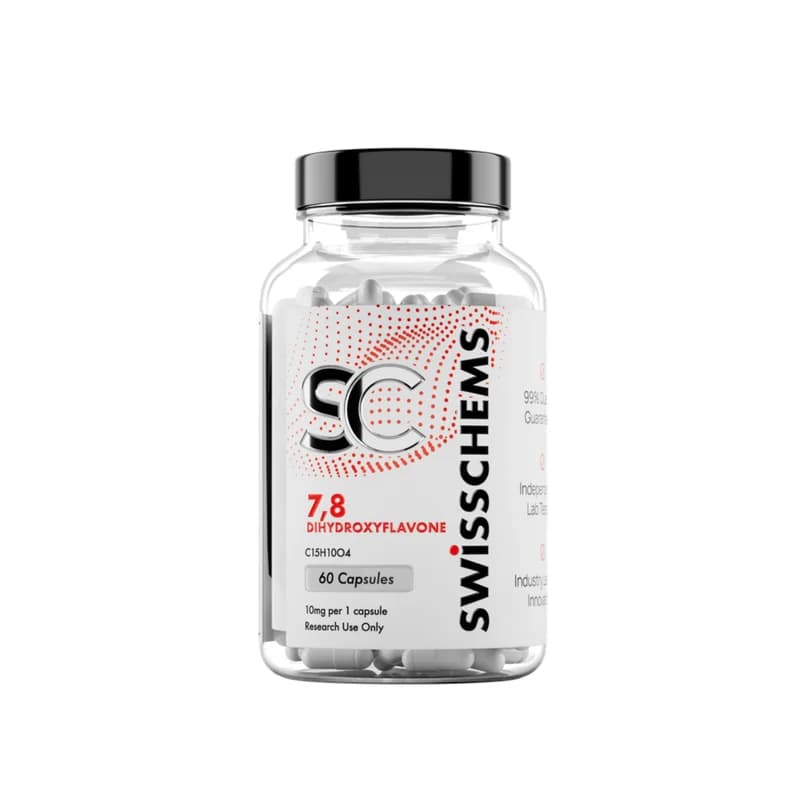
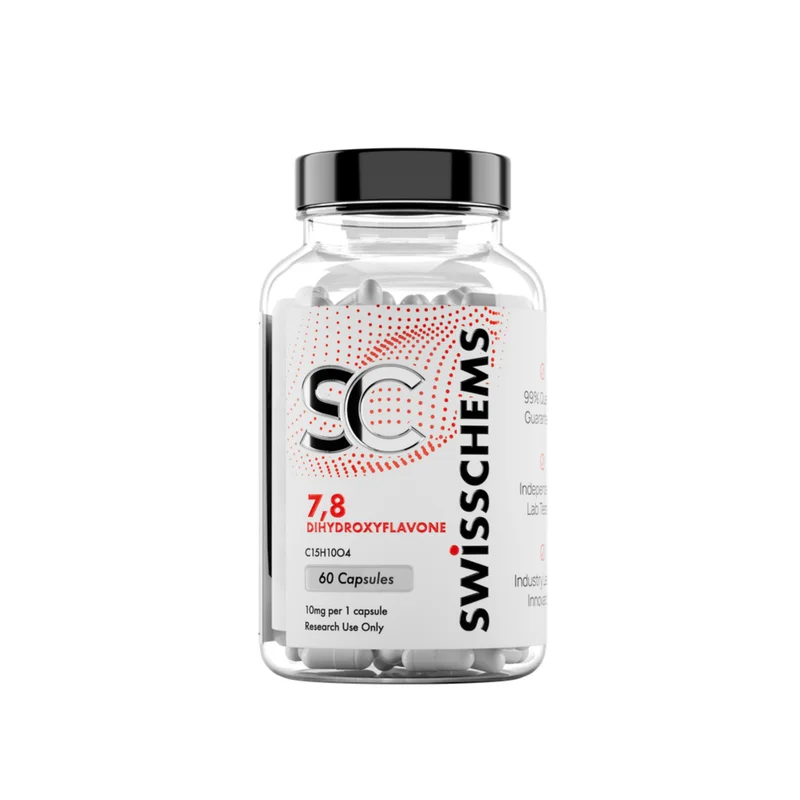
- SwissChems: both its 7,8-DHF and eutropoflavin capsules contain 10 mg each, 600 mg per bottle.
- Nootropics Depot labels: 25 mg of 7,8-DHF once or twice a day, and 10 mg of eutropoflavin once or twice a day, taken in the morning.
- User reports: 25 mg of 7,8-DHF under the tongue in the morning, and around 8 to 10 mg of eutropoflavin daily or a few times a week, appear in the threads above. Some users believe holding it under the tongue works better than swallowing, which hasn't been tested.
The mouse studies used 1 mg/kg (eutropoflavin) to 50 mg/kg (7,8-DHF) by mouth. Don't convert those to a human dose: mouse metabolism is much faster, and nothing about human safety follows from it.
Is 7,8-DHF Safe? Side Effects and Legal Status
Nobody knows its human safety profile yet. With no human trials, there's no data on side effects, drug interactions or long-term use. What the lab work does show is worth knowing.
- It isn't selective. Across 133 targets it was screened against, 7,8-DHF showed a significant lack of selectivity (Pankiewicz 2021), so effects beyond the brain are plausible.
- It changes vitamin B6 handling. Blocking PDXP raised active B6 in mouse neurons (Brenner 2024). What that means for a person taking it daily is unknown.
- Not approved. No drug containing 7,8-DHF, eutropoflavin or R13 is approved by the FDA for any use. SwissChems' own product pages state the capsules are not a drug, food or cosmetic.
What to ask your doctor: Bring the bottle. Ask whether it could interact with any antidepressant, sleep medication or stimulant you take, whether it's a reasonable risk if you're pregnant, breastfeeding or have a seizure history, and whether there's an approved treatment for the problem you're trying to fix, such as low mood, poor sleep or memory complaints.
7,8-DHF and Eutropoflavin Price: Where to Buy
Both capsules are cheap per milligram. Here's what SwissChems charged on November 5, 2026, worked out per capsule and per 100 mg.
- 7,8-Dihydroxyflavone (10 mg/capsule), 60 capsules: $19.95 for 600 mg. That's $0.33 a capsule, or $3.33 per 100 mg. With the code it's $17.96, about $0.30 a capsule.
- 4'-DMA-7,8-DHF (Eutropoflavin), 10 mg, 60 capsules: $28.95 on sale (listed down from $49.98) for 600 mg. That's $0.48 a capsule, or $4.83 per 100 mg. With the code, if it applies to the sale price, it's $26.06, about $0.43 a capsule.
- 7,8-DHF powder, 1 g: $22.99, about $2.30 per 100 mg, but you need a milligram scale to measure doses that small.
On both product pages, SwissChems says the compound is 99% pure, independently third-party HPLC-tested, with a certificate of analysis available for each batch. We did not find a 7,8-DHF or eutropoflavin report on its public test-results page when we checked, so ask for the certificate matching your batch number before you take any. The product card on this page links to the SwissChems 7,8-DHF capsules, and the code jqrlsday takes 10% off. PeptideDeck earns a commission if you buy through the SwissChems link on this page.
If you'd rather start with Semax, our guide on where to buy Semax compares sellers and prices.
Frequently Asked Questions
Sources
- Jang SW, et al. A selective TrkB agonist with potent neurotrophic activities by 7,8-dihydroxyflavone. Proc Natl Acad Sci USA. 2010;107(6):2687-92. PubMed 20133810
- Liu X, et al. A synthetic 7,8-dihydroxyflavone derivative promotes neurogenesis and exhibits potent antidepressant effect. J Med Chem. 2010;53(23):8274-86. PMC3150605
- Liu X, et al. O-methylated metabolite of 7,8-dihydroxyflavone activates TrkB receptor and displays antidepressant activity. Pharmacology. 2013;91(3-4):185-200. PMC4793717
- Boltaev U, et al. Multiplex quantitative assays indicate a need for reevaluating reported small-molecule TrkB agonists. Sci Signal. 2017;10(493):eaal1670. PubMed 28831019
- Pankiewicz P, et al. Do small molecules activate the TrkB receptor in the same manner as BDNF? Limitations of published TrkB low molecular agonists and screening for novel TrkB orthosteric agonists. Pharmaceuticals. 2021;14(8):704. PubMed 34451801
- Brenner M, et al. 7,8-Dihydroxyflavone is a direct inhibitor of human and murine pyridoxal phosphatase. eLife. 2024;13:RP93094. PubMed 38856179
- Chen C, et al. The prodrug of 7,8-dihydroxyflavone development and therapeutic efficacy for treating Alzheimer's disease. Proc Natl Acad Sci USA. 2018;115(3):578-583. PMC5777001
- Yang S, Zhu G. 7,8-Dihydroxyflavone and neuropsychiatric disorders: a translational perspective from the mechanism to drug development. Curr Neuropharmacol. 2022. PMC9881092
- Wang D, et al. Targeting brain-derived neurotrophic factor in the treatment of neurodegenerative diseases: a review. Neuroprotection. 2024;2(2):67-78. PMC12486910
- Dolotov OV, et al. Semax regulation of hippocampal BDNF and TrkB expression. Brain Res. 2006;1117(1):54-60. PubMed 16996037
- r/Nootropics: "7,8 DHF is hands down the most powerful supplement I've ever tried for energy." Thread
- r/NootropicsDepot: "Just Started 7,8 DHF." Thread
- r/NootropicsDepot: "4'-DMA-7,8-DHF initial experience report." Thread
- r/Nootropics: "Verdict on Eutropoflavin?" Thread
- r/Nootropics: "7,8 Dihydroxyflavone experience report." Thread
- r/Supplements: "The supplement 7,8-DHF (tropoflavin) has strong stimulant properties." Thread
- r/NootropicsDepot: "4DMA (eutropoflavin) — am I overreacting?" Thread
- r/NootropicsDepot: "Review Request: 7,8-DHF and/or 4'-DMA-7,8-DHF." Thread
- Prices, capsule strengths and testing statements: SwissChems product pages for 7,8-Dihydroxyflavone (10mg/capsule) 60 capsules, 4'-DMA-7,8-DHF (Eutropoflavin) 10mg 60 capsules and 7,8-Dihydroxyflavone powder 1 g, checked November 5, 2026. Label doses: Nootropics Depot 7,8-DHF powder and 4'-DMA-7,8-DHF capsule pages, checked November 5, 2026.
Medical Disclaimer: This article is for informational purposes only and does not constitute medical advice. 7,8-DHF, eutropoflavin and R13 are unapproved compounds with no published human trials, and no safe or effective human dose has been established. Talk to your doctor before taking either compound, especially if you take antidepressants, sleep medication or stimulants, are pregnant or breastfeeding, or have a seizure disorder.