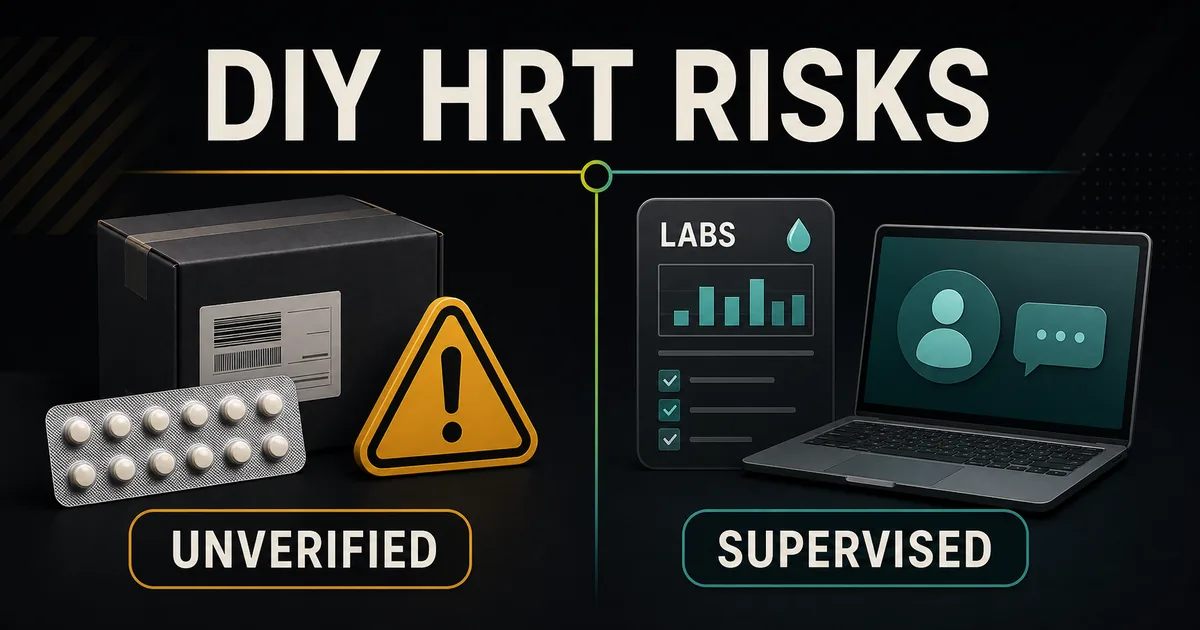

DIY HRT is hormone replacement therapy that a person obtains and self-administers without a prescription or clinical supervision, often called self-medding, self-prescribing, or self-sourcing. People search for DIY HRT for different reasons: most are looking for gender-affirming hormones (estrogen with an anti-androgen, or testosterone) outside a clinic, and a smaller number are menopausal people trying to self-source estradiol. This guide answers the questions the sourcing manuals skip: what DIY HRT actually is, why people turn to it, whether it is legal, what the real risks are, and the safer supervised options that now exist. It names no vendors, gives no doses, and does not judge anyone for asking. It is an explainer, not a how-to.
🔑 Key Takeaways
- DIY HRT means sourcing and dosing hormones yourself, without a prescriber or monitoring. It is different from the supervised "informed consent" model, which is legal and clinician-run [5].
- In the US, hormones are prescription drugs, so buying or importing them without a valid prescription is generally against federal law, with only a narrow, discretionary personal-importation gray area that is not a legal right [1].
- Testosterone is a Schedule III controlled substance, which raises the legal stakes for DIY testosterone specifically [4].
- The biggest safety gaps are product you cannot verify and no bloodwork, so counterfeit or mis-dosed hormones and undetected side effects are the real dangers, not a scare headline [2][3][6].
- Estrogen type and route change clot risk; older synthetic estrogens taken by mouth raise venous clot risk more than transdermal estradiol, which a clinician would normally choose to lower that risk [7][8].
- Supervised HRT is now fast and often low-cost, through telehealth and informed-consent clinics, which removes the monitoring and product gaps while staying legal [5][7].
What is DIY HRT?
DIY HRT (also written as "hrt diy") is the practice of buying hormones without a prescription and then managing the dosing, delivery, and monitoring on your own. The hormones may be pharmaceutical-grade products purchased from foreign or online pharmacies, or homebrew and compounded preparations, but the defining feature is the absence of a prescribing clinician. Legitimate hormone replacement therapy is a prescription medicine, and the products used in DIY regimens are the same regulated drugs, simply obtained outside the system that normally controls quality, dosing, and follow-up [1][3].
The term covers a few different situations, and it helps to keep them separate and neutral:
- Transfeminine regimens typically combine estradiol with an anti-androgen (a medicine that lowers testosterone). This is the most common context on the community forums and "diy hrt wiki" pages that dominate search results. - Transmasculine regimens (diy hrt testosterone) use testosterone. Because testosterone is a controlled substance in the US, DIY testosterone carries a distinct legal profile, covered below. - Menopausal self-sourcing is less discussed but real: some people going through menopause try to self-source estradiol when they cannot get, or cannot afford, a prescription.
Much of what circulates online about "trans diy hrt" lives in community-maintained wikis, archives, and forums. This article is deliberately not one of those resources: it names no vendors, lists no doses, and answers only the "what is this, is it legal, is it safe" questions the sourcing pages tend to skip.
Key terms you will encounter: "Self-medding" or "self-prescribing" means running your own hormone therapy without a clinician. The "informed consent" model is a legitimate, supervised route in which a licensed clinician prescribes hormones after a consent conversation, rather than requiring a long series of mental-health assessments first. Informed consent is not DIY, because a real prescriber, pharmaceutical-grade product, and lab monitoring are still part of it [5].
Why people turn to DIY HRT
People rarely choose DIY HRT because they want to skip medical care. Across the forums, blogs, and guides that discuss it, the same access barriers come up again and again, and it is worth naming them without either endorsing or dismissing them:
- Cost: the perception, sometimes accurate in the past, that a prescription and clinic visits are unaffordable. - Waitlists: long delays to see a gender clinic or a menopause-literate prescriber, sometimes many months. - Gatekeeping: frustration with assessment requirements that can feel like hurdles rather than care. - Geographic access: no suitable prescriber within a reasonable distance. - Privacy: a wish to keep hormone use out of a medical record or off insurance paperwork. - Being denied care: past refusals that leave people feeling they have no supervised option.
These are real barriers, not excuses. They also point to why the "safer alternatives" section further down matters: several of them, especially cost and waitlists, have shrunk substantially as supervised telehealth has expanded.
Is DIY HRT legal? (and is it illegal to import hormones)
Here is the clean, US-focused answer that most search results do not give directly. Hormones used in HRT are prescription drugs. Buying them, and especially importing them from outside the country, without a valid prescription is generally against US law. There is a narrow personal-importation gray area, but it is a matter of enforcement discretion, not a legal right.
The US Food and Drug Administration treats drugs that are not approved for the US market as unapproved drugs, and importing an unapproved drug generally violates federal law [1]. The FDA's personal importation policy describes limited circumstances in which the agency may choose not to stop a small personal-use shipment, but it sets conditions (such as a serious condition, no US commercialization, a limited supply, and verification that it is for personal use) and it is explicitly a matter of enforcement discretion rather than permission [1]. In plain terms: importing hormones without a prescription is not something the law affirmatively allows, even if some shipments are not stopped.
A few distinctions matter and are easy to blur:
- Possession, importation, and sale are different questions. Selling or distributing prescription hormones without authorization is treated far more seriously than a single personal shipment, and the specifics vary by jurisdiction. - Rules vary by country. Some countries sell certain hormones over the counter, and legal status differs widely. This article stays high-level on purpose and does not map country-by-country sourcing, because that is exactly the territory where a general explainer turns into a how-to. - Testosterone is a special case. In the US, testosterone and other anabolic steroids are Schedule III controlled substances under the Controlled Substances Act [4]. That means DIY testosterone (the "diy hrt testosterone" searches) carries higher legal stakes than DIY estrogen, because controlled-substance offenses can involve criminal penalties beyond ordinary drug-import rules.
The plain-language takeaway is simple, and it is a statement of fact rather than advice: legality and safety are not the same thing, and DIY HRT is not guaranteed to be either. A product can be technically obtainable and still be unsafe, and a regimen can feel routine and still be against the law.
Is DIY HRT safe? The real risks
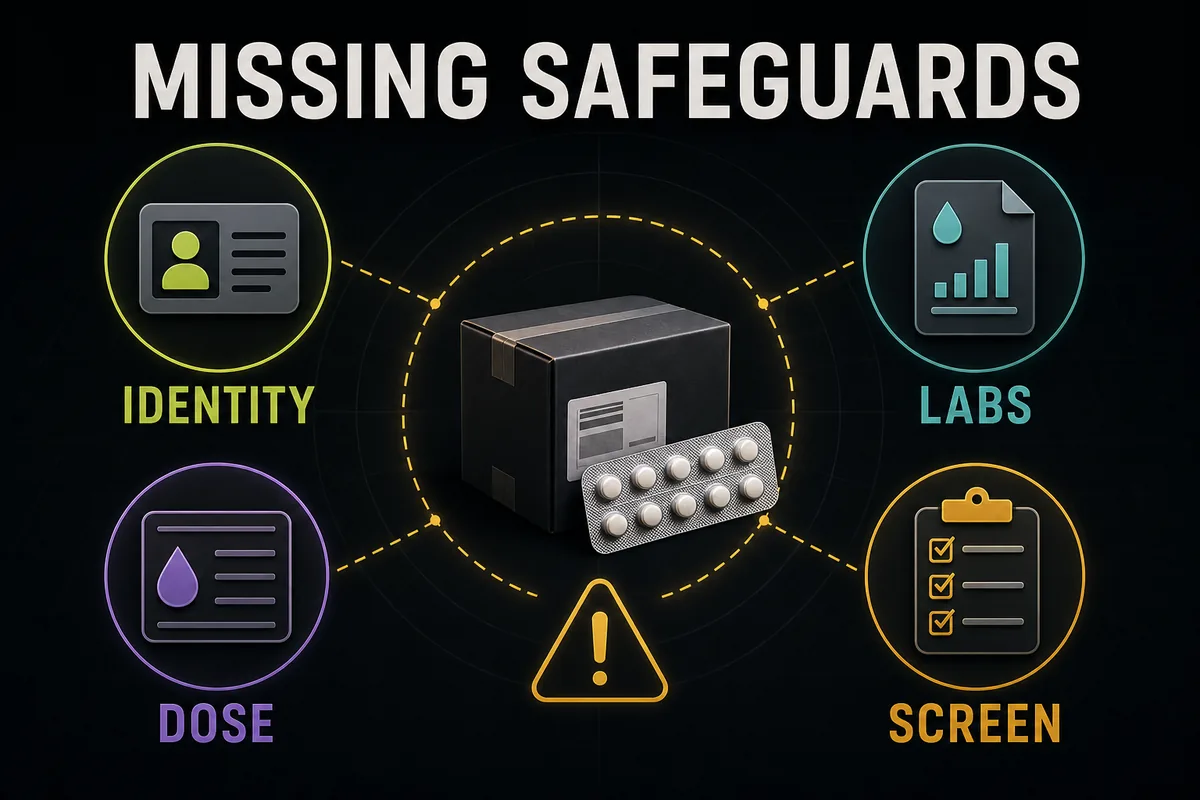
The honest answer to "is diy hrt safe" is that the hormones themselves are established medicines, but the DIY delivery of them removes the safeguards that make hormone therapy reasonably safe. The risks below are not moral warnings; they are the specific, documented gaps that supervision is designed to close.
Product you cannot verify
When hormones come from an unregulated source, there is no guarantee of identity, purity, or dose. The FDA warns that medicines from unsafe online sellers may contain the wrong ingredient, too much or too little active drug, no active drug at all, or harmful contaminants, and that counterfeit and substandard products are a real presence in the online market [2][3]. With DIY HRT you generally cannot confirm what is actually in the vial or tablet without independent testing, which most people do not do. That single unknown sits underneath every other risk on this list.
No monitoring
Supervised hormone therapy is built around bloodwork, both before starting and on a schedule afterward. Depending on the regimen, that can include estradiol and testosterone levels, liver function, potassium (important for anyone on the anti-androgen spironolactone), a complete blood count, lipids, and prolactin [5][6]. The Endocrine Society guideline recommends measuring hormone levels during treatment to keep them in a safe physiologic range, with lab checks roughly every three months in the first year and then once or twice a year [6]. WPATH's Standards of Care, Version 8, similarly frames ongoing monitoring as a core part of safe hormone therapy [5]. Without those labs, problems such as levels that are far too high, an unexpected potassium shift, or a liver signal can go undetected until they cause harm. If you want to understand what the numbers actually mean, our explainer on what your estradiol levels should be walks through the ranges a clinician watches.
Dosing errors and wrong formulation
Not all estrogens carry the same risk, and this is where DIY most often goes wrong. Older synthetic and conjugated estrogens, such as ethinylestradiol (the estrogen in many birth-control pills) and conjugated equine estrogens, raise the risk of venous thromboembolism (a blood clot in a vein) more than transdermal estradiol delivered by patch or gel [7][8]. Venous clots are uncommon in absolute terms, but they are serious when they happen, and the route and type of estrogen meaningfully change the odds. A clinician chooses the ester, dose, and delivery route deliberately to keep that risk low; a self-directed regimen using whatever product was available can unknowingly pick the higher-risk option. The Menopause Society and ACOG both note that transdermal estrogen is generally preferred when clot risk is a concern [7][8].
Injection and interaction risks
Injectable regimens add unsafe-injection risks (technique, sterility, and site problems) when there is no clinician teaching the method. Beyond that, hormones interact with other medicines and are not appropriate for everyone. HRT can be unsafe for people with certain histories, including previous blood clots, some hormone-sensitive cancers, and significant liver disease, which is why prescribers screen for contraindications before starting [9]. In a DIY setting, those contraindications may never be checked, so someone who should not be taking a given hormone at all can start it without ever being flagged.
Safer, legal alternatives to DIY HRT
Here is the update that reframes the whole DIY question: supervised HRT is now faster and often cheaper than many people assume. The access barriers that pushed people toward self-sourcing, mainly cost and long waits, have shrunk as informed-consent clinics and telehealth have expanded, so the trade-off that once looked like "DIY or nothing" is frequently no longer the real choice [5][7].
The supervised path can take a few forms, and all of them keep the safeguards DIY removes:
- Telehealth and online HRT services handle the consult, prescribing, and lab ordering remotely, then send pharmaceutical-grade product from a licensed pharmacy. If you want to understand how this route works end to end, start with our guide to supervised online HRT. - The informed-consent model shortens the path to a prescription without removing the prescriber or the monitoring, which is what separates it from DIY [5]. - In-person clinicians remain the right fit for anyone with a complex history or who prefers face-to-face care.
To compare your options, our roundup helps you compare legitimate online HRT services on what they actually include, and if you would rather stay local you can find an HRT prescriber near you. Because cost is the barrier people most often cite, it is worth seeing what supervised HRT actually costs before assuming the DIY route is the only affordable one; the gap is frequently smaller than expected once hidden DIY costs (testing, wasted product, and risk) are counted. Menopausal readers who found this page while researching self-sourcing estradiol will get more relevant guidance from our overview of supervised HRT for menopause.
There is no product being recommended here. The point is narrower: a legal, supervised route exists, it is more accessible than it used to be, and it closes the exact gaps that make DIY risky.
DIY HRT vs supervised HRT (comparison)
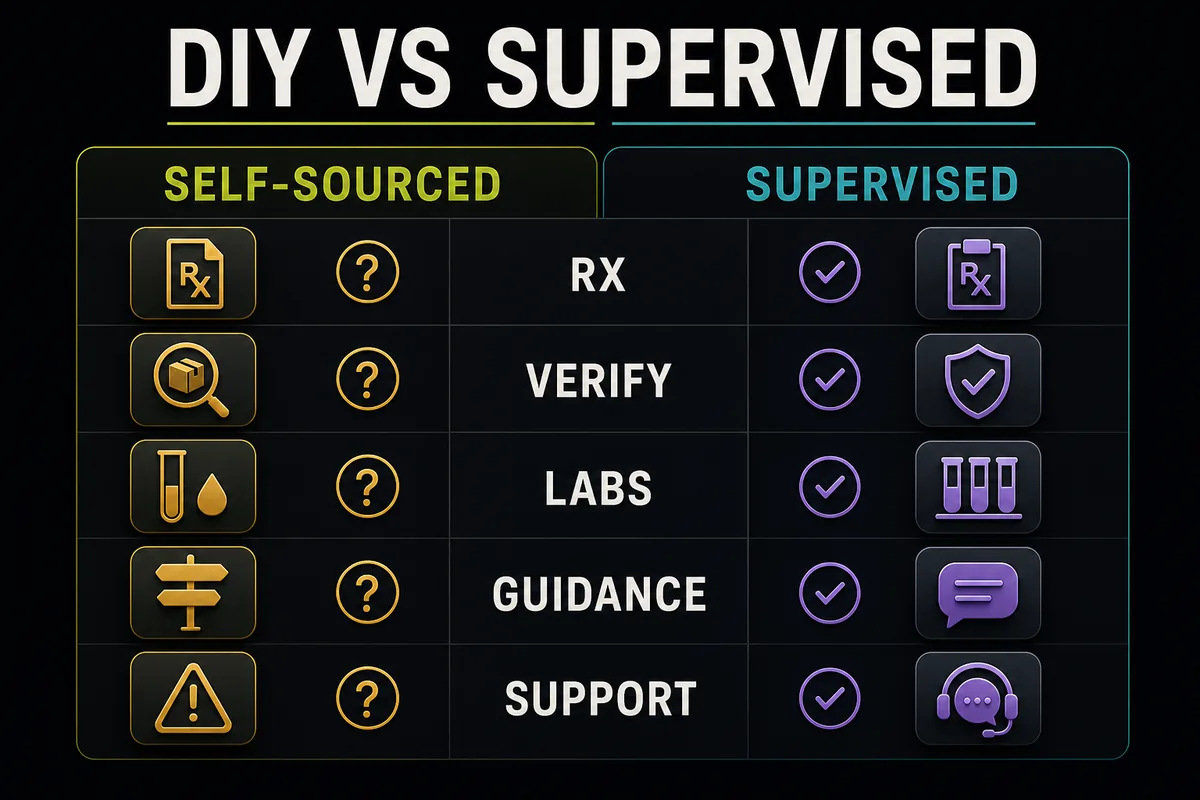
The table below lines up the two approaches on the factors that actually determine safety, rather than on cost alone.
DIY HRT vs supervised HRT at a glance
| Factor | DIY / self-sourced HRT | Supervised HRT (telehealth or clinic) |
|---|---|---|
| Prescription and legal status | No prescription; generally against US law to import, and testosterone is a controlled substance [1][4] | Prescribed legally by a licensed clinician [5] |
| Product verification | Unregulated source; identity, purity, and dose not guaranteed [2][3] | Pharmaceutical-grade product from a regulated pharmacy [3] |
| Bloodwork monitoring | Self-arranged or none | Baseline and follow-up labs included [5][6] |
| Dosing and formulation guidance | Self-directed; easy to pick a higher-risk estrogen or route | Clinician selects the route and type to lower clot risk [7][8] |
| Handling side effects and contraindications | On your own; contraindications may go unchecked [9] | Screened and managed by a clinician [9] |
| Typical access speed and cost | Variable, with hidden costs and risk | Often fast and low-cost via telehealth; see our supervised HRT cost breakdown for typical fees and timelines |
The readout is not about willpower or morality. The two columns differ mainly on product verification and monitoring, the two safeguards that turn hormone therapy from a gamble into a managed treatment. Those are also the two things a person acting alone can least easily replace, which is why the supervised route is the safer answer to the same underlying need.
Frequently Asked Questions
References
- U.S. Food and Drug Administration. Personal Importation (Import Program). FDA. Accessed 2026. https://www.fda.gov/industry/import-basics/personal-importation
- U.S. Food and Drug Administration. Counterfeit Medicine. FDA. Accessed 2026. https://www.fda.gov/drugs/buying-using-medicine-safely/counterfeit-medicine
- U.S. Food and Drug Administration. BeSafeRx: Your Source for Online Pharmacy Information. FDA. Accessed 2026. https://www.fda.gov/drugs/buying-using-medicine-safely/besaferx-your-source-online-pharmacy-information
- U.S. Drug Enforcement Administration. Drug Scheduling. DEA. Accessed 2026. https://www.dea.gov/drug-information/drug-scheduling
- World Professional Association for Transgender Health. Standards of Care for the Health of Transgender and Gender Diverse People, Version 8 (SOC-8). WPATH, 2022. https://www.wpath.org/soc8
- Endocrine Society. Endocrine Treatment of Gender-Dysphoric/Gender-Incongruent Persons: An Endocrine Society Clinical Practice Guideline. Endocrine Society, 2017. https://www.endocrine.org/clinical-practice-guidelines/gender-dysphoria-gender-incongruence
- The Menopause Society (formerly NAMS). The 2022 Hormone Therapy Position Statement. Menopause, 2022. https://menopause.org/professional-resources/position-statements
- American College of Obstetricians and Gynecologists. Hormone Therapy for Menopause (FAQ). ACOG. https://www.acog.org/womens-health/faqs/hormone-therapy-for-menopause
- NHS. Hormone replacement therapy (HRT). NHS, 2024. https://www.nhs.uk/medicines/hormone-replacement-therapy-hrt/
Disclosure: this article contains affiliate links to Gala Health. If you start care through them, we may earn a commission at no extra cost to you.