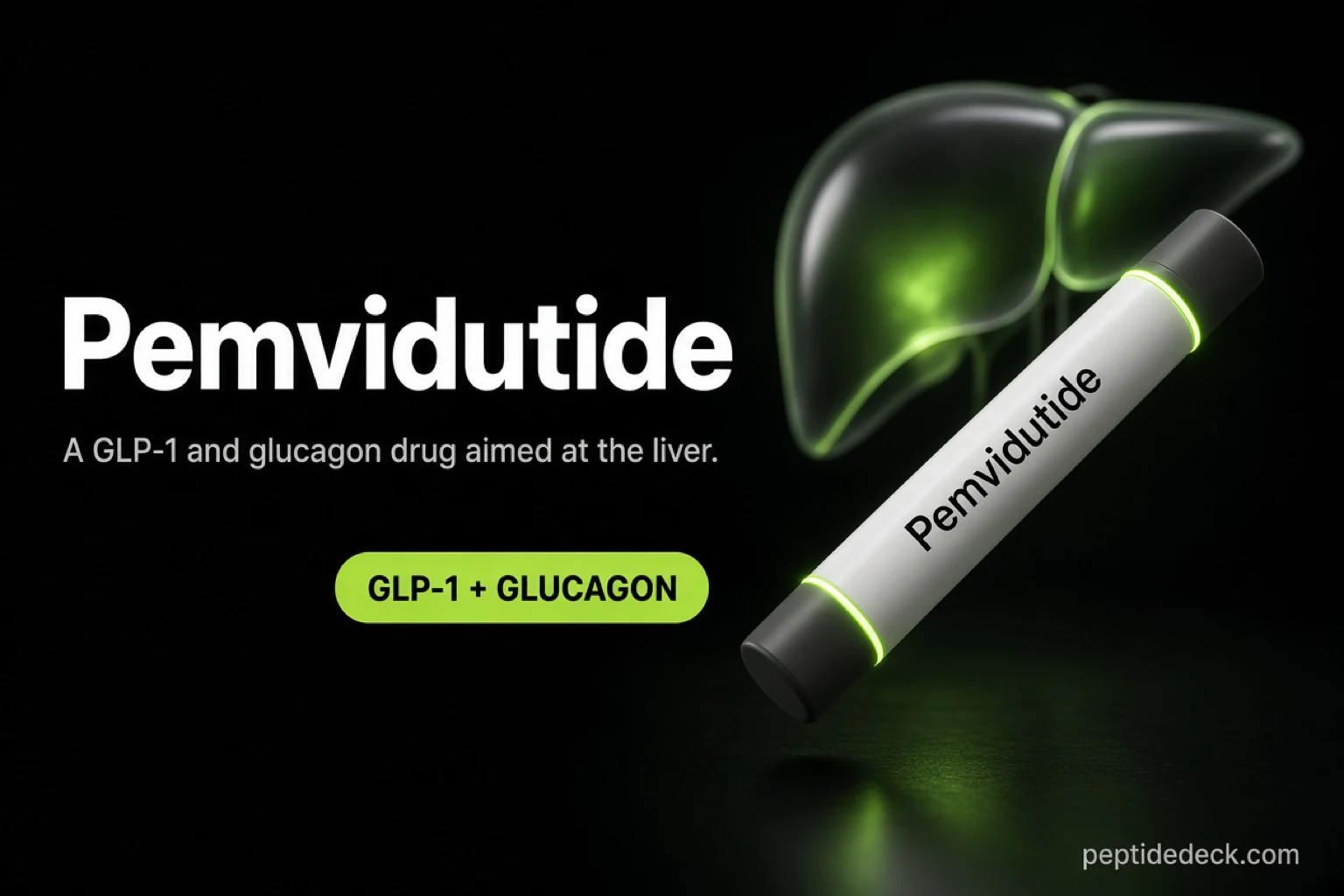
Pemvidutide is a weekly shot aimed at the liver. Made by Altimmune and coded ALT-801, it acts on two hormone receptors, GLP-1 and glucagon, and it is not approved by the FDA or any other regulator. In a 212-person trial in The Lancet, MASH (fatty liver disease with inflammation) resolved in 52% to 58% of people after 24 weeks, against 20% on placebo, but liver scarring didn't improve significantly. On November 9, 2026, an alcohol trial added a second result: fewer heavy drinking days. Here's every pemvidutide trial, the side effects, how it compares, and when it could reach a pharmacy.
🔑 Key Takeaways
- One molecule, two targets: GLP-1 for appetite, glucagon for liver fat
- It met one of its two main MASH goals and missed the other; trial length may be why
- In a 24-week alcohol trial, people drank heavily on fewer days and lost 8.7% of their weight
- Rezdiffra and Wegovy are already FDA-approved for MASH, so pemvidutide won't be first
- Phase 3 results are due in 2029, so approval before 2030 looks unlikely
Every number below comes from a journal paper, a trial registry or a company announcement, checked November 14, 2026. Where a result is a company topline that hasn't been peer reviewed, we say so. Altimmune paid for every pemvidutide trial.
What Is Pemvidutide (ALT-801)?
It's an experimental peptide injected once a week. Pemvidutide is one molecule built from pieces of two hormones, GLP-1 and glucagon, so a single shot switches on both receptors (2022 design paper). It is investigational, so no doctor can prescribe it.
Three design choices set it apart:
- Balanced action. In lab tests it hit both receptors with almost equal strength, about 1 to 1. Survodutide, its closest rival, leans toward GLP-1, about 7.5 to 1 by the same paper's count.
- A built-in anchor. A fatty side chain called EuPort latches onto albumin, a blood protein, which protects the peptide from breakdown and makes weekly dosing possible.
- A slow start. The side chain also slows the drug's release, giving a lower, later peak in lab animals. Most early trials skipped dose titration, the usual step-by-step ramp.
It's being tested for MASH (Phase 3), alcohol use disorder and alcohol-associated liver disease (Phase 2), and obesity (Phase 2 done). It shares its GLP-1 plus glucagon class with survodutide and mazdutide.
How Pemvidutide Works: Why Glucagon Matters for the Liver
GLP-1 drugs shrink liver fat the slow way. They curb appetite, weight comes off, and liver fat follows.
Glucagon takes a shortcut. It acts on liver cells directly, telling them to burn more fat and make less of it (Harrison et al., 2025). In that 94-person trial, 12 weeks on 1.8 mg cut liver fat by 68.5% while body weight fell only 4.3%.
There's a catch. Glucagon's natural job is to raise blood sugar, so trials of this drug class track glucose closely, along with heart rate. The side effects section shows what they found.
Pemvidutide Trial Results: Every Study So Far
Ten pemvidutide trials are registered so far. Nine are below: seven with results and two still running. Three numbers in a row are for 1.2, 1.8 and 2.4 mg, then placebo.
The top dose wasn't always best: at 12 weeks, 1.8 mg beat 2.4 mg on liver fat and weight. And only the liver trials have peer-reviewed papers; the rest are company announcements.
Pemvidutide for MASH: What the IMPACT Trial Found
This is the trial that matters most. MASH, once called NASH, is fatty liver disease that has progressed to inflammation and liver-cell damage. Its scarring is graded from F0 (none) to F4 (cirrhosis).
IMPACT enrolled 212 adults with biopsy-confirmed MASH and F2 or F3 scarring in the US and Australia (The Lancet, 2025). They got 1.2 mg, 1.8 mg or placebo weekly, with no dose titration. It had two main goals, both judged on a liver biopsy at week 24:
- MASH resolved, scarring no worse: 58% on 1.2 mg and 52% on 1.8 mg, vs 20% on placebo. Goal met (p<0.0001 for both doses).
- Scarring improved by at least one stage, MASH no worse: 33% and 36%, vs 28% on placebo. Goal missed (p=0.59 and p=0.27).
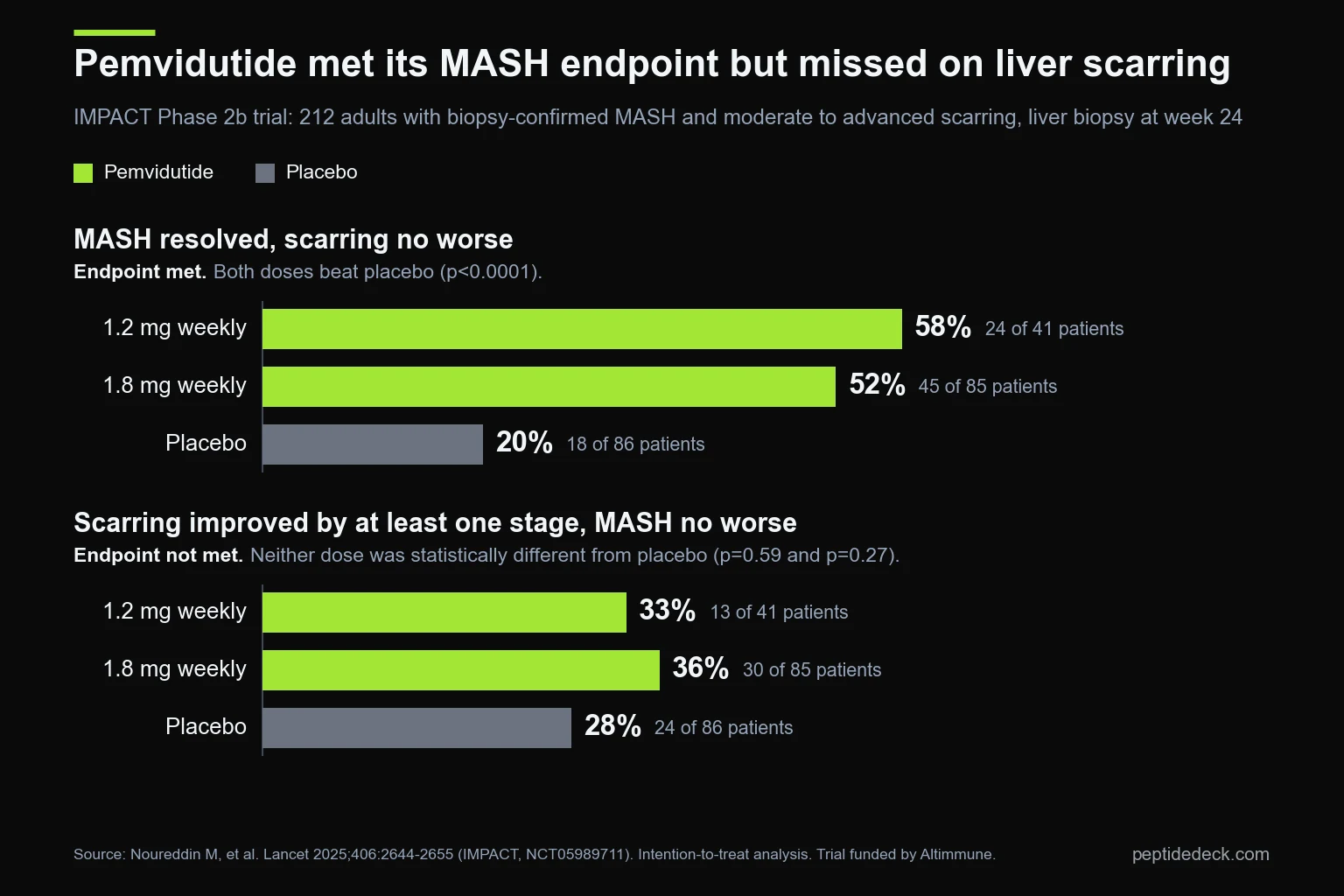
Altimmune's June 2025 release said 59.1%, 52.1% and 19.1%; we use the paper.
Why did scarring miss? One likely reason is time: the trials behind the two approved MASH drugs took biopsies at 52 and 72 weeks, not 24. That's a hypothesis until a longer trial tests it.
The 48-week results, published November 11, 2026, can't settle it: no second biopsy was taken (Lancet Gastroenterology & Hepatology). On scans and blood tests, for 1.2 mg and 1.8 mg vs placebo:
- Liver fat: down 45.2% and 54.7%, vs 8.2%
- ELF score, a blood test that tracks scarring: down 0.49 and 0.58, vs up 0.16
- Weight: down 4.5% and 7.5%, vs 0.2% (company topline, December 2025)
Those markers moved the right way, but they aren't a biopsy.
Pemvidutide and Alcohol: RECLAIM and RESTORE
This is pemvidutide's newest result. RECLAIM tested 2.4 mg weekly against placebo for 24 weeks in about 100 adults with moderate to severe alcohol use disorder and a BMI of at least 25 (NCT06987513). All drank heavily at least three days a week (five or more drinks a day for men, four for women), and all got the same behavioral program.
Results were presented on November 9, 2026 at the AASLD liver meeting in Denver (company release):
- Heavy drinking days per week: down 4.20 vs 2.75 (p=0.0014)
- No heavy drinking days in the last four weeks: 42.2% vs 17.4%
- PEth, a blood marker of recent drinking: down 153.4 ng/mL vs up 22.0
- Body weight: down 8.7% vs up 0.4%
Promising, not proven. It's a company announcement from one small, short trial. The percentages rest on 45 and 46 people although 50 per group were dosed, and the July topline doesn't say why. Nobody had a BMI under 25.
Only three medicines are FDA-approved for alcohol use disorder, and 1.6% of adults with it are prescribed one (NIAAA). Pemvidutide has FDA Fast Track status for this use, and Altimmune meets the agency in December 2026 to plan Phase 3.
RESTORE, in 121 adults, asks whether it can help a liver already damaged by alcohol; results are due in the second half of 2027 (NCT07009860). For approved GLP-1 drugs, see our guide to semaglutide and alcohol.
Pemvidutide Weight Loss: What MOMENTUM Showed
The weight loss is solid, not record-setting. MOMENTUM gave 391 adults with obesity or overweight and no diabetes 1.2 mg, 1.8 mg, 2.4 mg or placebo weekly for 48 weeks, alongside diet and exercise (company topline, November 30, 2023). Average weight loss was 10.3%, 11.2% and 15.6%, vs 2.2% on placebo.
In an MRI sub-study (67 participants, 50 on pemvidutide), lean tissue made up 21.9% of the weight lost on the drug (conference data, September 2024). No trial has compared that with another drug.
Two caveats. We found no MOMENTUM paper in PubMed on November 14, 2026. And people with MASH lost less: 7.5% at 48 weeks on 1.8 mg in IMPACT, vs 11.2% here (different trials, not head to head).
No Phase 3 obesity trial is registered. For what's approved now, see our ranking of weight loss drugs.
Pemvidutide Side Effects
Stomach trouble is the main one. Nausea, vomiting, diarrhea and constipation led the list in every trial, mostly mild to moderate. Each cell shows pemvidutide vs placebo.
IMPACT counts only nausea judged drug-related. RECLAIM's figure covers stops blamed on the drug; for any reason, 20% stopped on pemvidutide and 22% on placebo.
Nausea was worse on 1.8 mg than on 2.4 mg in MOMENTUM, where only the 2.4 mg group stepped up over four weeks. Phase 3 steps everyone up monthly from 1.2 mg.
- Heart rate. In MOMENTUM it rose 3.1 and 2.5 beats a minute on 1.8 and 2.4 mg and fell 1.4 on placebo. No major heart events were reported.
- Blood sugar. Altimmune reported no significant change in fasting glucose or HbA1c (a three-month average) in MOMENTUM or its diabetes trial. In that trial, though, average fasting glucose in the 13 people on 2.4 mg rose from 128.2 to 140.6 mg/dL.
- Serious events. One case of vomiting (MOMENTUM) was judged drug-related, and one of low blood sodium (RECLAIM) possibly related.
What we don't know yet: pemvidutide has no heart-outcomes trial and no data beyond 48 weeks. Survodutide, from the same class, passed a heart safety trial of about 5,500 people in November 2026 (The Lancet), which proves nothing about pemvidutide. For approved drugs, see our GLP-1 side effects comparison.
Pemvidutide vs Survodutide, Wegovy and Rezdiffra
No trial has compared these drugs directly. The table shows each drug's main MASH biopsy trial, drug vs placebo.
This is not head to head: the trials differ in length, patients, endpoint definitions and placebo response (10% to 34%). The fair reading: pemvidutide's MASH result at 24 weeks sits in the range others reached at 48 to 72 weeks, while its scarring result shows the smallest gap over placebo, at the earliest time point. Each trial was paid for by the drug's maker.
Pemvidutide vs survodutide. Survodutide hits the same two receptors and is further along. Its Phase 3 MASH trial began about 21 months earlier (NCT06632444), and its Phase 3 obesity trial is published: 12.2% to 13.0% weight loss at 76 weeks vs 5.4% on placebo, by the treatment-regimen estimand, which counts everyone, including people who stopped the drug (NEJM, 2026). MOMENTUM didn't say how it counted dropouts, so its 15.6% isn't comparable. See our survodutide guide.
Pemvidutide vs retatrutide. Retatrutide adds a third target, GIP. In a 98-person sub-study, liver fat fell 81.4% and 82.4% after 24 weeks on its two highest doses (Nature Medicine, 2024). Our guides cover retatrutide and tirzepatide for fatty liver.
Not every pipeline drug targets the liver: Pfizer's berobenatide is a GLP-1 shot built around once-monthly dosing.
Pemvidutide FDA Approval Status and Timeline
No regulator has approved pemvidutide yet. It holds three FDA designations: Fast Track for MASH and for alcohol use disorder, and Breakthrough Therapy for MASH, announced January 5, 2026 on the 24-week IMPACT data. They speed up FDA contact and review. They aren't approvals.
PERFORMA decides it. The trial plans about 1,800 adults with MASH and F2 or F3 scarring, roughly 990 confirmed by biopsy and 800 by scans and blood tests (company release, NCT07795164). People step up monthly from 1.2 mg to 1.8 or 2.4 mg, or get placebo. The main goals are IMPACT's two, on a biopsy at week 52, plus liver-related events over about five years.
Our estimate, not a company forecast: Altimmune expects the 52-week results in 2029 and plans an interim analysis to support an early (accelerated) approval, but it hasn't given a filing date. Add time to file and an FDA review of six months to a year, and approval before 2030 looks unlikely.
The company. Altimmune (Nasdaq: ALT), based in Morristown, New Jersey, reported $480 million in cash and investments on September 30, 2026 and a $31.6 million loss that quarter (company update).
Can You Buy Pemvidutide?
No, you can't buy pemvidutide legally. It is not approved by the FDA or any other regulator, so the only legitimate way to get it is inside a clinical trial. Catalogs that list ALT-801 as a lab chemical sell something never made for injection into people, with no sterility or dose guarantees.
What's available today depends on the condition:
- MASH with moderate to advanced scarring: Rezdiffra, a daily pill (FDA, March 14, 2024), and Wegovy, weekly semaglutide 2.4 mg (approved August 15, 2025). Both are for adults without cirrhosis, alongside diet and exercise.
- Alcohol use disorder: naltrexone, acamprosate or disulfiram, plus behavioral treatment.
- Weight loss: the approved GLP-1 medications.
If semaglutide is what your doctor recommends, our guide on where to buy semaglutide online walks through the legal routes and what each costs. One caution: the MASH approval belongs to brand-name Wegovy at the 2.4 mg dose. It does not extend to compounded semaglutide, so talk to your doctor before treating a liver condition with any other version.
PERFORMA is recruiting at US sites; if you have MASH, ask your liver specialist whether you might qualify.
Who Might Pemvidutide Suit, and What's Still Unknown
It's aimed at people whose liver is the problem. If approved, the likeliest fit is an adult with MASH, moderate to advanced scarring and extra weight: that's who the Phase 3 trial enrolls. If your main goal is weight loss, this isn't the drug to wait for.
The evidence has real limits:
- Scarring is unproven. The scarring goal was missed at 24 weeks, and no biopsy was taken at 48.
- Small and short. The largest trial had 391 people, and the longest dosing period is 48 weeks.
- Company-run. Altimmune funded every trial, its employees co-authored every paper, and the obesity and alcohol results are unpublished.
- No long-term safety data. Our guide to GLP-1 long-term risks covers what's known for approved drugs.
What to ask your doctor: How advanced is my liver scarring, and how was it measured? Am I a candidate for Rezdiffra or Wegovy now? Would a medicine for alcohol use be right for me? Is there a MASH trial I could join? Do not stop a prescribed medication to wait for pemvidutide or to qualify for a study without talking to your doctor first.
Frequently Asked Questions
Sources
- Noureddin M, et al. Weekly pemvidutide versus placebo for MASH (IMPACT): 24-week results. Lancet. 2025;406(10520):2644-2655. PubMed 41237796
- Noureddin M, et al. IMPACT: 48-week results. Lancet Gastroenterol Hepatol. Published online November 11, 2026. PubMed 43014327
- Harrison SA, et al. Effect of pemvidutide on MASLD. J Hepatol. 2025;82(1):7-17. PubMed 39002641
- Browne SK, et al. Safety and efficacy of 24 weeks of pemvidutide in MASLD. JHEP Rep. 2025;7(11):101483. PMC12529369
- Nestor JJ, et al. Paper describing the design of ALT-801 (pemvidutide). Sci Rep. 2022;12:6666. PubMed 35461369
- Altimmune. Third quarter 2026 results. November 12, 2026. BioSpace copy of the release
- Altimmune. RECLAIM data at AASLD, November 9, 2026, BioSpace; RECLAIM topline, July 28, 2026, BioSpace
- Altimmune. PERFORMA Phase 3 started, August 3, 2026, BioSpace; Breakthrough Therapy designation, January 5, 2026, BioSpace
- Altimmune. IMPACT 48-week topline, December 19, 2025, BioSpace; 24-week topline, June 26, 2025, BioSpace; Fast Track for alcohol use disorder, August 19, 2025, BioSpace
- Altimmune. MOMENTUM topline, November 30, 2023, BioSpace; MRI sub-study, September 10, 2024, BioSpace; Phase 1 results, September 28, 2021, BioSpace; diabetes trial, March 21, 2023, BioSpace
- ClinicalTrials.gov records: NCT07795164, NCT06987513, NCT07009860, NCT04561245, NCT06632444, NCT07165028. Checked November 14, 2026.
- Survodutide: Sanyal AJ, et al. Phase 2 trial in MASH. N Engl J Med. 2024;391:311-319. PubMed 38847460; le Roux CW, et al. SYNCHRONIZE-1. N Engl J Med. 2026;395:776-787. PubMed 42253238; Bozkurt B, et al. SYNCHRONIZE-CVOT. Lancet. Online November 9, 2026. PubMed 43003106
- Sanyal AJ, et al. Phase 3 trial of semaglutide in MASH (ESSENCE). N Engl J Med. 2025;392:2089-2099. PubMed 40305708; Novo Nordisk, Wegovy approved by FDA for MASH, August 15, 2025, PR Newswire
- Loomba R, et al. Tirzepatide for MASH with liver fibrosis (SYNERGY-NASH). N Engl J Med. 2024;391:299-310. PubMed 38856224
- Harrison SA, et al. Resmetirom in NASH with liver fibrosis (MAESTRO-NASH). N Engl J Med. 2024;390:497-509. PubMed 38324483; FDA, Rezdiffra approval, March 14, 2024, FDA announcement
- Sanyal AJ, et al. Retatrutide for MASLD: a phase 2a trial. Nat Med. 2024;30:2037-2048. PubMed 38858523
- National Institute on Alcohol Abuse and Alcoholism. Recommend evidence-based treatment. Revised May 8, 2025. NIAAA
Medical Disclaimer: This article is for informational purposes only and does not constitute medical advice. Pemvidutide is an investigational drug that is not approved by the FDA or any other regulator, and several of its results are company announcements that have not been peer reviewed. Doses mentioned are those used in clinical trials. Talk to your doctor before starting, stopping or changing any medication.