Berobenatide is a GLP-1 shot built for monthly dosing. Pfizer got it by buying Metsera in November 2025, and you'll also see it called PF'3944, PF-08653944, MET-097 or MET-097i. In its monthly-dosing Phase 2b trial, people lost up to 12.1% of their body weight by week 28, while the placebo group gained 0.2%. On November 11, 2026, Blackstone agreed to fund up to $1.5 billion of its development. Here's every berobenatide result so far, how it compares with Zepbound and Wegovy, and when you could realistically get it.
🔑 Key Takeaways
- It's a GLP-1-only drug like semaglutide; what's new is the schedule: 12 weekly shots, then one every four weeks
- Monthly dosing held up in two trials, but the biggest number so far came from a weekly dose
- Nausea ticked up in the week of the first monthly shot, and that shaped Phase 3
- No trial compares it head to head with Wegovy or Zepbound; one tests switching from them
- Two financial deals are tied to approval of the monthly version, not the weekly one
Berobenatide is investigational and not approved by the FDA or any other regulator. Every number below comes from a trial registry, a company document or a journal paper, checked November 14, 2026. No berobenatide trial has been published in a journal yet, so company figures are labeled as such.
What Is Berobenatide (MET-097, PF'3944)?
It's a long-acting GLP-1 drug and nothing more. Berobenatide copies GLP-1, the gut hormone that tells your brain you're full and slows how fast your stomach empties. It acts only on the GLP-1 receptor, like semaglutide (Ozempic, Wegovy) and unlike tirzepatide (Zepbound), which also hits the GIP receptor.
The names all point to one molecule. MET-097 and MET-097i were the codes at Metsera, which ran the early trials. PF-08653944, or PF'3944, is Pfizer's code, and berobenatide is the generic name.
It was first developed in Professor Stephen Bloom's lab at Imperial College London. Metsera got the license by buying a company called Zihipp in September 2023 (2024 annual report), and Pfizer completed its purchase of Metsera on November 13, 2025.
For the chemists: the FDA's substance registry lists it as a 41-amino-acid peptide built on exendin-4, a Gila monster peptide, with a 20-carbon fatty acid chain at one end. The sequence is F-Aib-EGTFTSDVSKQLEEKRVREFIEWLKQGGPSSGKPPPGKK (Aib is 2-methylalanine); the molecular weight is about 5,045.
That 41 matters. FDA rules class any peptide longer than 40 amino acids as a protein, so it would be licensed as a biologic (a protein drug), as Metsera's annual report notes. More on why under "Can You Buy Berobenatide?"
How Does Berobenatide Last a Month?
A fatty acid tail does most of the work. Metsera's design, called HALO, lets the drug ride on albumin, a common blood protein, and still reach its receptor, which slows how fast the body clears it.
In the first human trial the half-life (the time for half a dose to clear) was about 380 hours, or 15 to 16 days. Metsera put that at roughly twice semaglutide's and three times tirzepatide's.
Two more design details:
- It's "fully biased". In lab tests it switched on the cell's main GLP-1 signal (cAMP) with little or no beta-arrestin, a second signaling protein. Whether that matters in people hasn't been shown.
- The monthly dose is four weekly doses in one. Weekly dosing builds drug levels up about four-fold. So trials start with 12 weekly shots, then give four times the weekly dose every four weeks: 0.8 mg weekly becomes 3.2 mg monthly.
"Monthly" means every four weeks: 13 shots a year after the weekly start, instead of 52. Pfizer says the monthly dose fits in a 0.5 mL injection.
Berobenatide Weight Loss Results: Every Trial So Far
Four trials have reported results. All ran in the US and were paid for by Metsera or Pfizer.
Weight loss rose with dose in the weekly trials, and the groups were small: 20 to 54 people per dose.
VESPER-1 is the only one with results posted on ClinicalTrials.gov. Its 239 participants averaged 40 years old; 63% were women and 74% were Hispanic or Latino.
They got a fixed weekly dose from day one, with no step-up. Here's how weight tracked with dose.
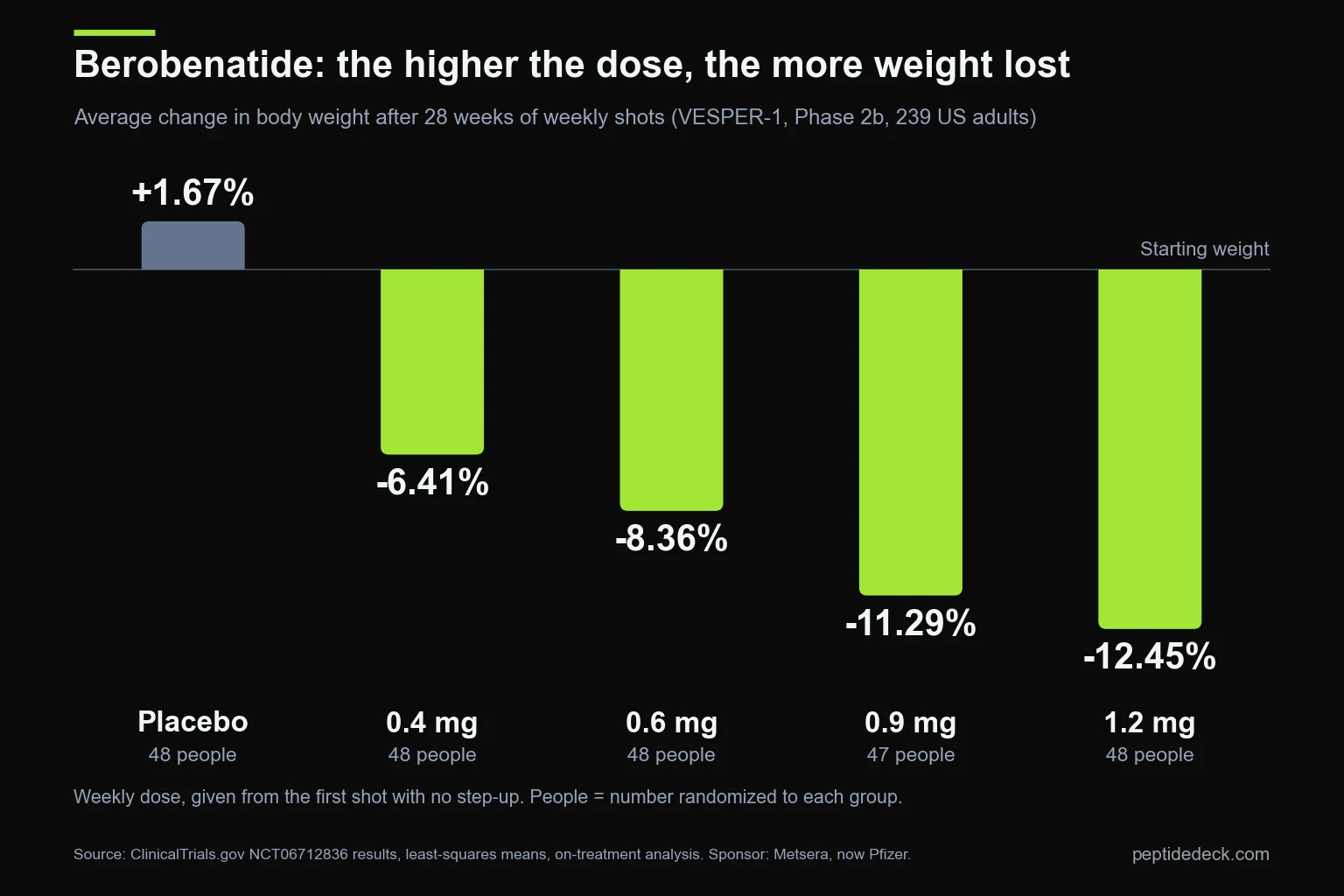
The gap between the top dose and placebo was 14.1 percentage points. That's the placebo-adjusted figure: the drug group's change minus the placebo group's. One caution: the analysis counts people only while they stayed on the drug, and of 48 people assigned to 1.2 mg, 37 were in it.
VESPER-3: What Happened When Berobenatide Went Monthly
This is the trial the monthly claim rests on. VESPER-3 enrolled 268 US adults without diabetes (average weight 102.8 kg, 71% women). Everyone got 12 weekly shots, then a monthly dose four times the size of their last weekly one.
Average weight change at week 28, after four monthly shots, from Pfizer's slides for the June 6, 2026 American Diabetes Association (ADA) meeting:
- 0.4 then 0.8 mg weekly, 3.2 mg monthly: -9.8%
- 0.8 mg weekly, 3.2 mg monthly: -11.8%
- 0.4, 0.8 then 1.2 mg weekly, 4.8 mg monthly: -12.1%
- 0.6 then 1.2 mg weekly, 4.8 mg monthly: -11.9%
- Placebo: +0.2%
The headline 12.3% is the best group minus placebo. It uses an "efficacy estimand", a pre-set analysis that counts people only while they stay on treatment. Counting everyone (the "treatment policy" estimand), the two groups Pfizer reported came out at 8.4% and 10.5% instead of 10.0% and 12.3% (February 3, 2026 release).
The trial ran on to week 64 and was completed on October 19, 2026, per the registry. We found no 64-week results as of November 14, 2026.
The longest monthly data come from the VESPER-1 extension. People who took 1.2 mg weekly for 36 weeks, then 4.8 mg monthly, were 14.9% below their starting weight at week 60 (43 people).
The biggest number came from weekly dosing. Two groups that began on placebo, then stepped up to 1.6 mg or 2.4 mg a week, lost 16.8% and 15.9% in 32 weeks, with 22 people in each.
The extension was mostly open label (people knew what they were taking), with no placebo group after week 28.
Berobenatide for Type 2 Diabetes: The A1c Results
VESPER-2 tested it in 133 adults with type 2 diabetes. They started with an average HbA1c (a three-month measure of blood sugar) of 8.2%.
After 28 weeks on the top dose, 1.6 mg weekly, HbA1c fell 2.2 points versus 0.2 on placebo (Pfizer release), and weight fell 10.2% versus 0.7%. Nobody had severe low blood sugar. With 26 or 27 people per group, treat these as early signals; the 1,078-person VESPER-5 trial will show whether they hold.
Berobenatide Side Effects
The side effects are the familiar GLP-1 ones. In VESPER-3, 215 people got the drug and 53 got placebo (Pfizer's slides):
- Nausea: 37.7% vs 15.1% on placebo
- Vomiting: 23.3% vs 1.9%
- Constipation: 20.9% vs 3.8%
- Diarrhea: 14.4% vs 5.7%
- Stopping because of side effects: 9.3% vs none on placebo
Most cases were mild; 1.4% had severe nausea and 1.4% severe vomiting.
Starting fast costs more. In the first-in-human trial, putting 20 people straight onto 1.2 mg gave 65% nausea and 60% vomiting; two step-ups cut that to 5% and 10% (annual report). In VESPER-1, which also skipped step-ups, nausea hit 31.3% to 50.0% versus 27.1% on placebo (registry).
What happened at the switch to monthly? In VESPER-3's two 4.8 mg groups, new nausea went from 0% and 4.4% in the last weekly week to 10.0% and 13.3% in the week of the first monthly shot, then back to 0%.
New vomiting that week was 8.0% and 6.7%. The VESPER-1 extension showed the same blip, all of it mild or moderate.
Serious events were few. VESPER-1 recorded three among 191 people on the drug (a pancreatitis, a burst appendix and an alcohol poisoning), none on placebo and no deaths. In the extension, two people stopped because of gallbladder inflammation.
Phase 2b didn't let anyone drop back to a lower dose. Phase 3 does, and adds extra dose steps.
What we don't know yet: the effects on muscle, the heart, the gallbladder and the pancreas over years. The longest follow-up is 60 weeks in a few hundred people. For approved drugs, see our GLP-1 side effects comparison.
Berobenatide vs Tirzepatide, Semaglutide and MariTide
No trial has compared them head to head. Pfizer's investor slides offer a cross-trial chart instead: at week 28, weight loss beyond placebo was 12.0% to 12.3% on berobenatide 4.8 mg monthly, against about 9.0% for semaglutide 2.4 mg and about 12.5% for tirzepatide 10 mg. The slide itself says no firm conclusions can be drawn across trials.
Here are the published numbers, not head to head:
Don't read that column as a ranking. Berobenatide's figure is a 28-week Phase 2 number that counts people only while on treatment; the Wegovy and Zepbound figures are 68 and 72-week Phase 3 numbers that count everyone.
MariTide, Amgen's every-four-weeks shot, is further along. Its 3,853-person MARITIME-1 trial is due to finish its main phase in January 2027, more than a year before berobenatide's monthly trial. Pfizer's slides say "first approved monthly GLP-1 RA peptide", and that last word is chosen with care: MariTide is antibody-based.
The closest thing to a head-to-head is VESPER-SWITCH. It randomly assigns 660 adults who lost weight on weekly semaglutide or tirzepatide to stay put or switch to monthly berobenatide, and compares weight at 32 weeks. It tests holding weight, not losing more.
Other pipeline drugs add a second hormone: retatrutide adds two, and pemvidutide pairs GLP-1 with glucagon in a weekly shot aimed at MASH, a serious form of fatty liver disease.
The Phase 3 Program: 13 Trials Registered
Pfizer talks about 10 Phase 3 trials. ClinicalTrials.gov listed 13 on November 14, 2026, with room for about 10,200 people.
Two details matter:
- Doses. The weekly groups test 0.8, 1.2 and 2.4 mg after step-ups from 0.4 mg. The monthly groups test 3.2, 4.8 and 9.6 mg. No reported trial has given 9.6 mg monthly; its stand-in is 2.4 mg weekly, taken by 22 people.
- Follow-ons. SOLIS-1 is testing berobenatide with PF-08653945, a monthly amylin analog (a copy of a second fullness hormone), in 940 adults. Pfizer's slides also list a "potential quarterly" version, PF-08656795, with a first trial registered (NCT07876518), and Metsera's annual report lists an oral form. None has published results.
The Metsera Purchase and the Blackstone Deal
Two deals hinge on the monthly version.
Metsera. Pfizer first agreed to pay $47.50 a share, about $4.9 billion, on September 22, 2025. After a bidding contest with Novo Nordisk, it paid $65.60 a share in cash, about $7 billion, plus up to $20.65 a share later. BioPharma Dive puts the package at about $10 billion.
One later payment, $6.40 a share, is due only if the FDA approves monthly berobenatide for chronic weight management by December 31, 2029 (Metsera's SEC filing).
Blackstone. On November 11, 2026, Pfizer said Blackstone funds will pay up to $1.5 billion of berobenatide's development costs through 2028. Blackstone gets no rights to the drug, only milestone payments if the FDA approves the monthly version on its own for chronic weight management and if sales targets are met.
Berobenatide FDA Approval Status and Timeline
Berobenatide is not approved by the FDA. No other regulator has approved it either; it's an investigational drug in Phase 3.
What Pfizer has said. Its June 6, 2026 slides target "the first of a series of potential approvals beginning in 2028". Neither the November 3, 2026 quarterly results nor the Blackstone release gives a filing date.
Our estimate, not a company forecast. The two big weekly trials finish their main phase in September and October 2027, the monthly trial in May 2028. An FDA review usually takes about a year, so late 2028 is the earliest realistic date for weekly dosing, and 2029 is more likely for monthly.
Price. None has been announced. Pfizer told investors it plans a cash-pay, direct-to-consumer option from launch day.
Can You Buy Berobenatide?
No, you can't legally buy it anywhere. It is not approved by the FDA or any other regulator, so the only legitimate way to get it is inside a clinical trial. Chemical catalogs that list berobenatide or PF-08653944 sell a lab chemical that was never made for injection into people, with no sterility or dosing guarantees.
Compounded copies look unlikely too, even after approval. As a 41-amino-acid peptide it counts as a biologic, and FDA guidance says biologics don't qualify for the exemptions that let pharmacies compound drugs such as semaglutide.
What you can get today are approved drugs: weekly Wegovy or Zepbound, or the daily Foundayo pill. Our list of GLP-1 medications covers every option. If cost or access is the hurdle, our guide on where to buy semaglutide online compares the legal routes, from brand-name Wegovy through telehealth to retail pharmacies, with prices.
Trials are recruiting. VESPER-6 lists 80 sites in 11 countries, 35 of them in the US; search ClinicalTrials.gov for "berobenatide".
Who Might Berobenatide Suit, and What's Still Unknown
It's aimed at people who don't stay on weekly shots. In US health records, 64.8% of adults without diabetes who started a GLP-1 drug had stopped within a year (JAMA Network Open, 2025). If the weekly routine trips you up, or you've hit your goal and want lighter upkeep, 13 shots a year could matter more than an extra point of weight loss.
The evidence has real limits:
- Nothing peer reviewed. PubMed listed no paper on berobenatide under any of its names on November 14, 2026.
- Small, short, US-only trials. Phase 2b groups had 22 to 54 people, and the placebo comparison lasted 28 weeks.
- Flattering analyses. Headline figures count people only while on treatment, and 17.2% of those on the drug in VESPER-3 stopped early (11.3% on placebo).
- Company-run. Metsera or Pfizer paid for every trial, and there's no heart outcomes trial yet.
What to ask your doctor: Is a weekly GLP-1 right for me now, rather than waiting for a monthly one? If the shots are the problem, would a daily pill suit me? What's my plan to hold my weight if I stop? Am I eligible for a berobenatide trial near me?
Frequently Asked Questions
Sources
- ClinicalTrials.gov. VESPER-1 posted results. Record updated August 28, 2026. NCT06712836
- Pfizer. Phase 2b data for berobenatide at the ADA Scientific Sessions. June 6, 2026. Pfizer
- Pfizer. Investor presentation with the ADA slides for the VESPER-1 extension, VESPER-2 and VESPER-3. June 6, 2026. Pfizer investor site (PDF)
- Pfizer. VESPER-3 topline results. February 3, 2026. Pfizer
- Pfizer. Blackstone Life Sciences funding agreement for obesity program. November 11, 2026. Pfizer
- Pfizer. Completion of the Metsera acquisition. November 13, 2025. Pfizer
- Pfizer. Agreement to acquire Metsera. September 22, 2025. Pfizer
- Pfizer. Third-quarter 2026 results. November 3, 2026. Pfizer investor site (PDF)
- Metsera. Annual report (Form 10-K) for 2024. SEC
- Metsera. Form 8-K, amended merger terms. Filed November 10, 2025. SEC
- Metsera. First-in-human results for MET-097. September 24, 2024. BioSpace copy of the release
- FDA and NCATS Global Substance Registration System. Berobenatide, UNII UN3RWY4TEG. GSRS record
- 21 CFR 600.3(h)(6), definition of a protein. govinfo.gov; FDA guidance on mixing, diluting or repackaging biological products. January 2018. FDA (PDF)
- ClinicalTrials.gov records: NCT06857617, NCT06897202, NCT06973720, NCT07311850, NCT07400653, NCT07595549, NCT07845500, NCT07823608, NCT07881757, NCT07919678, NCT07915609, NCT07932925, NCT07794761, NCT07794774, NCT07792954, NCT07874633, NCT07575932, NCT07876518, NCT06858839. Checked November 14, 2026.
- Wilding JPH, et al. Once-weekly semaglutide in adults with overweight or obesity (STEP 1). N Engl J Med. 2021;384:989-1002. PubMed 33567185
- Jastreboff AM, et al. Tirzepatide once weekly for the treatment of obesity (SURMOUNT-1). N Engl J Med. 2022;387:205-216. PubMed 35658024
- Jastreboff AM, et al. Once-monthly maridebart cafraglutide for the treatment of obesity: a phase 2 trial. N Engl J Med. 2025;393:843-857. PubMed 40549887
- Rodriguez PJ, et al. Discontinuation and reinitiation of dual-labeled GLP-1 receptor agonists among US adults with overweight or obesity. JAMA Netw Open. 2025;8(1):e2457349. PubMed 39888616
- Gan & Lee Pharmaceuticals. Bofanglutide toplines: GRADUAL-1, June 12, 2026, PR Newswire; GRADUAL-3, November 4, 2026, PR Newswire
- BioPharma Dive. Blackstone and Pfizer deal for berobenatide. November 12, 2026. BioPharma Dive
Medical Disclaimer: This article is for informational purposes only and does not constitute medical advice. Berobenatide is an investigational drug that is not approved by the FDA or any other regulator, and its results so far are company data that have not been peer reviewed. Doses mentioned are those used in clinical trials. Talk to your doctor before starting, stopping or changing any weight-loss or diabetes medication.