Bofanglutide is a GLP-1 shot taken every two weeks. Made by China's Gan & Lee Pharmaceuticals and coded GZR18, it works like semaglutide but needs 26 injections a year instead of 52. In its first Phase 3 trial, people on the top dose lost an average of 18.54% of their body weight in a year. China accepted its marketing application on September 2, 2026, and on November 4 the company reported that a once-a-month dose kept that weight off. Here's every bofanglutide trial so far, how it stacks up against tirzepatide, and when you could realistically get it.
🔑 Key Takeaways
- It's a plain GLP-1 drug, not a dual or triple agonist, so the every-two-weeks schedule is its main selling point
- The one trial against tirzepatide didn't go bofanglutide's way, and the design detail behind it matters
- A monthly upkeep dose stopped the weight regain seen when people switched to placebo
- Stomach side effects were common at fast dose increases, which is why the Phase 3 schedule is slower
- No US Phase 3 trial is registered yet, so a US launch is years away
Every number below comes from a trial registry, journal paper or company announcement, checked November 5, 2026. Where a result is an unreviewed company topline, we say so.
What Is Bofanglutide (GZR18)?
It's a long-acting copy of a gut hormone. Bofanglutide is a modified version of human GLP-1, the hormone that tells your brain you're full and slows how fast your stomach empties. It acts only on the GLP-1 receptor, like semaglutide (Ozempic, Wegovy) and unlike tirzepatide, which also hits the GIP receptor.
Gan & Lee, a Beijing insulin maker, built the long action in two ways, per its 2026 type 2 diabetes paper:
- Amino acid changes in the GLP-1 backbone protect it from DPP-4, the enzyme that breaks natural GLP-1 down within minutes.
- A 22-carbon fatty acid chain lets it latch onto albumin in your blood, which slows its release from the injection site and its clearance.
The result is a half-life of about 7 days in both American and Chinese volunteers (Phase 1), with gentle, sustained activity rather than a sharp peak.
There are four versions in development:
- The injection every two weeks, in Phase 3 and under review in China.
- A once-monthly injection for keeping weight off after the main treatment phase (GRADUAL-3, below).
- A daily tablet using SNAC, the same absorption helper as the Rybelsus pill. In a 92-person Phase 1, a tablet delivered only 0.56% to 1.31% of an injection's exposure, and 60 mg a day for two weeks gave 4.16% weight loss (2026 paper, company release).
- GZR102, a fixed combination with Gan & Lee's weekly insulin, now in a Phase 2 trial in type 2 diabetes (NCT07055386).
How Can It Work Every Two Weeks?
A one-week half-life sounds too short for that. The trick is dose size. In the 340-person Phase 2b trial, 48 mg every two weeks and 24 mg every week gave almost the same drug exposure over a two-week cycle, and almost the same weight loss: 16.09% versus 16.69% at 30 weeks, a difference that wasn't statistically meaningful (Ji et al., 2026).
The authors also saw stomach side effects ease in the second week of each cycle, so if weekly shots give you a rough day or two, those days may come half as often.
Bofanglutide Weight Loss Results: Every Trial So Far
Nine trials of the injection have reported results. The table lists them roughly in the order they ran, with the main result from each.
Three things stand out. Weight loss rose with dose in every obesity trial. Weight was still falling when the 30-week Phase 2b ended, which fits the higher 52-week Phase 3 result. And apart from one Phase 1 and the US Phase 2, every trial enrolled only Chinese participants; the Phase 2b group averaged just 33 years old.
The Phase 2b is the only obesity trial with a full peer-reviewed paper. Here's how weight loss tracked with dose after 30 weeks.
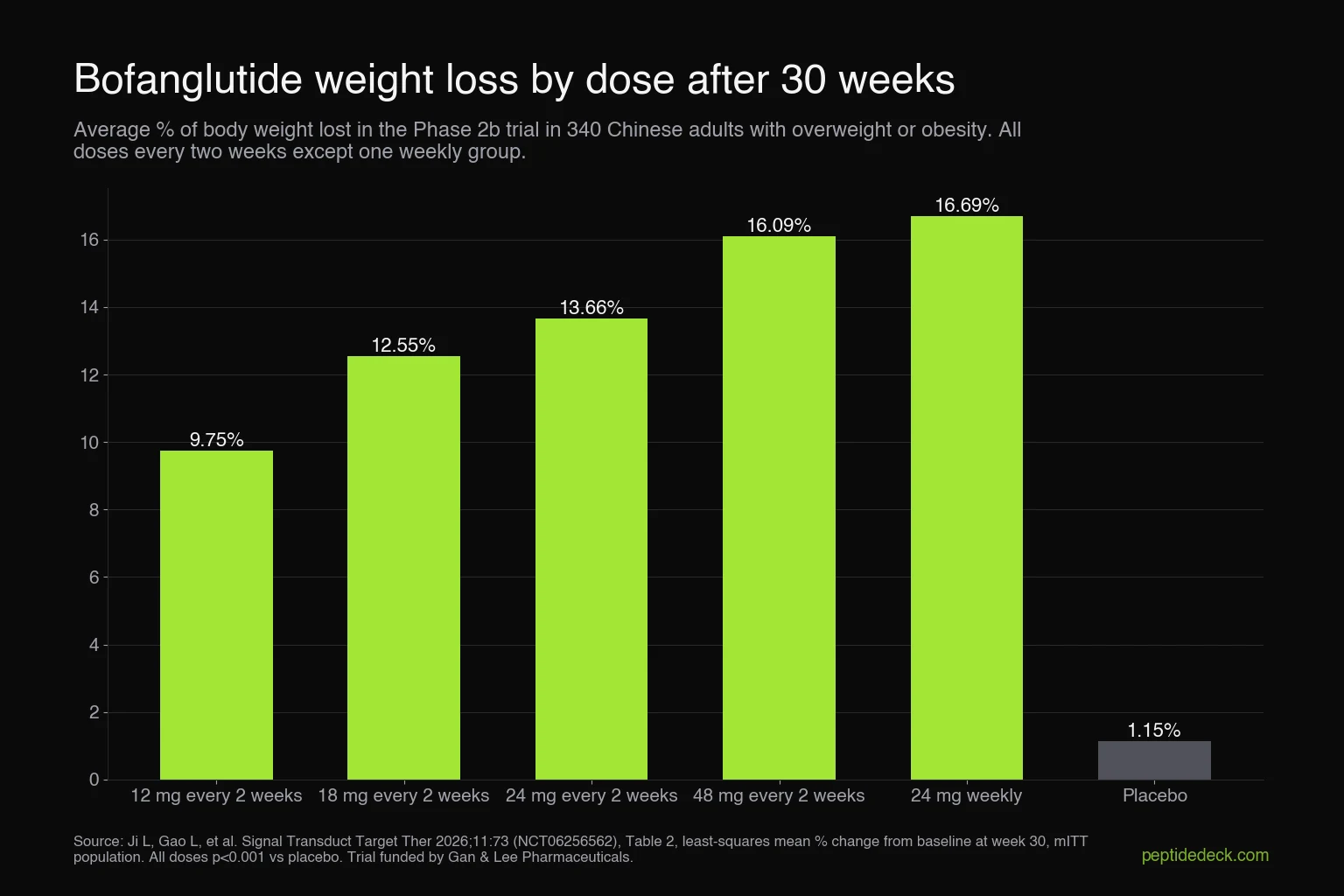
In that trial, 61.5% of people on 48 mg every two weeks lost at least 15% of their body weight, and 39.2% lost at least 20%. On placebo the figures were 3.9% and 3.5%.
Bofanglutide vs Tirzepatide: The US Head-to-Head
This is the trial most US readers care about. Gan & Lee ran a 36-week Phase 2 at 20 US sites in 326 adults with obesity or overweight and no diabetes (NCT06737042). People got bofanglutide 24, 36 or 48 mg every two weeks, placebo, or tirzepatide 15 mg weekly.
The June 2026 topline gave one comparison: 15.18% average weight loss on 48 mg versus 16.93% on tirzepatide 15 mg. Weight on bofanglutide hadn't plateaued.
Four caveats apply:
- Tirzepatide was ahead, by about 1.75 percentage points.
- It wasn't built to compare them. The registered goal was beating placebo, and tirzepatide was given open-label.
- It's a per-protocol analysis, counting only people who stuck to the plan, which flatters both drugs.
- The 24 mg and 36 mg results weren't released, and no paper had appeared by November 5, 2026.
The fair summary: slightly behind tirzepatide, with half the injections. Against semaglutide it looks better. In a 24-week Phase 2b in 272 Chinese adults with type 2 diabetes, 18 mg every two weeks lowered HbA1c by 2.28 points versus 1.60 for semaglutide 1 mg, a significant difference (Annals of Internal Medicine, 2026). A 52-week Phase 3 against Wegovy 2.4 mg is still running (GRADUAL-2, due June 2027). For the two approved drugs side by side, see our tirzepatide vs semaglutide breakdown.
Bofanglutide Side Effects
The side effects are the usual GLP-1 ones. In the peer-reviewed Phase 2b, stomach and gut side effects hit 78.8% to 90.6% of people on bofanglutide versus 33.3% on placebo, mostly grade 1 to 2 and mostly during the dose increases.
- Nausea: 34.6% to 64.1% across doses (9.1% on placebo)
- Vomiting: 25.0% to 62.5% (12.1% on placebo)
- Diarrhea: 26.9% to 49.1% (18.2% on placebo)
- Injection-site reactions: 48.2% vs 33.3% on placebo, mostly pain (the authors blame the solvent)
- Quitting because of side effects: 1.9% to 15.6% vs 4.5% on placebo
The 15.6% dropout was in the 48 mg group, which jumped straight from 6 mg to 12 mg. Phase 3 uses a slower trial ladder: 3, 6, 9, 12, 18, 24 mg, then 36 and 48 mg for the top dose.
The same trial found no severe low blood sugar, no pancreatitis and no neutralizing antibodies (32.7% to 52.8% developed non-neutralizing ones, with no effect on weight loss). In the type 2 diabetes trial, gut side effects were more common on bofanglutide (81.8% to 87.3%) than on semaglutide 1 mg (51.9%).
What we don't know yet: the Phase 3 toplines only call side effects "mostly mild to moderate and transient", with no rates published. For approved drugs, see our GLP-1 side effects comparison.
Monthly Dosing: What GRADUAL-3 Found
This is the newest result, published November 4, 2026. GRADUAL-3 randomly switched people who had finished 52 weeks of GRADUAL-1 to a monthly dose (24 or 48 mg) or placebo for 24 weeks (company release).
- Monthly 24 mg: weight changed by +0.41%
- Monthly 48 mg: weight changed by -0.12%
- Placebo: weight went back up by 8.52%
The placebo group shows what happens when the drug stops; the monthly shot prevented that for six months. The release didn't give participant numbers, and full data are promised later.
If you care about keeping weight off for years, this is the most interesting bofanglutide finding. It isn't a monthly drug for losing weight, but it may become one for holding it.
Bofanglutide FDA Status and Launch Timeline
It isn't approved by any regulator yet. Here's how it got to where it stands.
China. China's drug regulator accepted the weight-management application on September 2, 2026 (Yicai), with no approval date announced. More Phase 3 trials are running, including two in type 2 diabetes (NCT06778967, NCT06777238) and two in obstructive sleep apnea.
United States. The tirzepatide comparison trial finished in February 2026, and ClinicalTrials.gov lists no US Phase 3 as of November 5, 2026. The Menarini announcement says a global Phase 3 program is planned for Europe and other highly regulated markets, without dates.
Our estimate, not a company forecast: a Phase 3 program means about a year of dosing plus enrolment and analysis, and an FDA review usually adds about a year. With no US Phase 3 registered, a US launch before 2029 looks unlikely.
Other markets. Partners hold rights in India (Lupin), South Korea (JW Pharmaceutical), Europe (Menarini) and Latin America. Two Phase 3 trials against semaglutide are registered in Mexico (BALANCE-OBS, BALANCE-DM2).
How Bofanglutide Compares With Other GLP-1 Drugs
The dosing schedule is what sets it apart. Here's each drug's best published weight loss result, dosing and status.
These are different trials in different people over different lengths of time, so don't read the weight loss column as a ranking. Chinese trials started from lower body weights (93.7 kg on average in GRADUAL-1, 87.2 kg in GLORY-1) than SURMOUNT-1 (104.8 kg) or TRIUMPH-1 (112.7 kg), and the retatrutide and bofanglutide figures are company toplines. Still, bofanglutide sits in the semaglutide-to-tirzepatide range; its edge is fewer injections, not more weight loss. Our guides to retatrutide, mazdutide, Foundayo (orforglipron) and eloralintide cover the other pipeline drugs in detail.
Can You Buy Bofanglutide?
No, you can't legally buy it anywhere. It isn't approved in any country, so the only legitimate way to get it is inside a clinical trial. Chemical catalogs that list GZR18 as a lab reagent sell a product never made for injection into people, with no sterility or dosing guarantees.
What you can get now are approved drugs: weekly Wegovy or Zepbound, or the daily Foundayo pill if you'd rather skip needles. Our list of GLP-1 medications covers every approved option, and if cost is what's holding you back, our guide to the cheapest GLP-1 options compares cash prices, manufacturer programs and telehealth.
Trials now recruiting are in China; search ClinicalTrials.gov for "GZR18" to watch for new sites.
Who Might Bofanglutide Suit, and What's Still Unknown
It's built for people who find weekly shots a burden. If the injection routine is what makes you quit, or you've reached your goal and want the lightest upkeep, fewer shots could matter more than an extra point of weight loss.
The evidence has real limits:
- Mostly one population. Apart from a small Phase 1 and the US Phase 2, every reported trial enrolled only Chinese participants. The US Phase 2 hasn't been published.
- Sponsor-run. Every trial was funded by Gan & Lee, and company employees co-authored the papers.
- Short follow-up. The longest completed dosing period is 52 weeks, plus 24 weeks of monthly upkeep. There's no heart outcomes trial.
- Unpublished Phase 3. GRADUAL-1, GRADUAL-3 and the US Phase 2 are company toplines, and the GRADUAL-1 registry lists its endpoint at week 48, not the reported week 52.
What to ask your doctor: Is a weekly GLP-1 right for me now, rather than waiting for a newer drug? Would a slower dose increase help with nausea? If I stop, what's my plan to avoid regaining weight? Am I eligible for any GLP-1 trials nearby?
Frequently Asked Questions
Sources
- Ji L, Gao L, et al. Efficacy and safety of bofanglutide in Chinese adults with overweight or obesity: a randomized, double-blind, placebo-controlled phase 2b trial. Signal Transduct Target Ther. 2026;11:73. PMC12948953
- Liu M, Cheng Z, et al. Weekly and biweekly bofanglutide versus semaglutide in Chinese patients with type 2 diabetes: a phase 2b randomized clinical trial. Ann Intern Med. 2026;179(8):1107-1116. PubMed 42372276
- Ji L, Gao L, et al. GZR18, a GLP-1 analog with once-weekly or bi-weekly dosing for body weight management: a phase 1b/2a trial. Cell Rep Med. 2026;7(4):102743. PubMed 41956096
- Liu M, Wang X, et al. Safety and efficacy of GZR18 in Chinese patients with type 2 diabetes: a phase 1b/2a trial. Cell Rep Med. 2026;7(7):102874. PubMed 42320483
- Liu Y, Chen W, et al. Safety, tolerability, pharmacokinetics and pharmacodynamics of GZR18 in healthy American and Chinese adults. Diabetes Obes Metab. 2025;27(5):2777-2789. PubMed 40028667
- Hao X, Liu L, et al. Oral bofanglutide in healthy Chinese participants. Diabetes Res Clin Pract. 2026;239:113437. PubMed 42442555
- Gan & Lee Pharmaceuticals. GRADUAL-1 and US Phase 2 topline results. June 12, 2026. PR Newswire
- Gan & Lee Pharmaceuticals. GRADUAL-3 once-monthly maintenance topline results. November 4, 2026. PR Newswire
- Gan & Lee Pharmaceuticals. GRADUAL-3 initiation and GRADUAL program design. November 27, 2025. PR Newswire
- Gan & Lee Pharmaceuticals. Phase 2a and 2b type 2 diabetes results at ADA 2025. June 21, 2025. PR Newswire
- Gan & Lee Pharmaceuticals. Oral GZR18 tablet Phase 1 results. November 12, 2024. PR Newswire
- Gan & Lee Pharmaceuticals. FDA clears IND for Phase 2 head-to-head with tirzepatide. December 18, 2024. PR Newswire
- Gan & Lee Pharmaceuticals. First participant dosed in the US Phase 2. March 10, 2025. PR Newswire
- Gan & Lee Pharmaceuticals. License agreement with JW Pharmaceutical. April 9, 2026. PR Newswire
- Menarini Group. Gan & Lee and Menarini partner to advance bofanglutide in Europe. September 3, 2026. Menarini
- Lupin. Exclusive licensing agreement with Gan & Lee for bofanglutide. December 29, 2025. Lupin
- Yicai. Gan & Lee's biweekly GLP-1 bofanglutide marketing application accepted by the NMPA. September 2, 2026. Yicai
- ClinicalTrials.gov records: NCT06737042, NCT06728124, NCT07150975, NCT07292441, NCT06778967, NCT06777238, NCT07622810, NCT07628985, NCT07501832, NCT07493057. Checked November 5, 2026.
- Wilding JPH, et al. Once-weekly semaglutide in adults with overweight or obesity (STEP 1). N Engl J Med. 2021;384:989-1002. PubMed 33567185
- Jastreboff AM, et al. Tirzepatide once weekly for the treatment of obesity (SURMOUNT-1). N Engl J Med. 2022;387:205-216. PubMed 35658024
- Eli Lilly. TRIUMPH-1 retatrutide topline results. May 21, 2026. PR Newswire
- Orforglipron for obesity (ATTAIN-1). N Engl J Med. 2025;393:1796-1806. PubMed 40960239; Eli Lilly, FDA approves Foundayo, April 1, 2026, PR Newswire
- Once-weekly mazdutide in Chinese adults with obesity or overweight (GLORY-1). N Engl J Med. 2025;392:2215-2225. PubMed 40421736; Shirley M. Mazdutide: first approval. Drugs. 2025. PubMed 41028652
- Ji L, et al. Ecnoglutide in adults with overweight or obesity: a phase 3 trial. Lancet Diabetes Endocrinol. 2025;13(9):777-789. PubMed 40555243; Shirley M. Ecnoglutide: first approvals. Drugs. 2026. PubMed 42412371
Medical Disclaimer: This article is for informational purposes only and does not constitute medical advice. Bofanglutide is an investigational drug that is not approved by the FDA or any other regulator, and most of its newest results are company announcements that have not been peer reviewed. Doses mentioned are those used in clinical trials. Talk to your doctor before starting, stopping or changing any weight-loss or diabetes medication.