Losing weight on semaglutide also costs you muscle. Trevogrumab is Regeneron's answer: an experimental antibody that blocks myostatin, the protein that tells your body to keep muscle in check. In the Phase 2 COURAGE trial, adding trevogrumab to semaglutide roughly halved the share of weight lost as lean mass. This guide covers what trevogrumab is (and why it is not a peptide), the full COURAGE results through the 2026 one-year data, the side effects, how it compares with other muscle-sparing drugs, and what to know before buying a vial sold online as "trevogrumab".
🔑 Key Takeaways
- Trevogrumab is a full-size antibody, roughly 35 times heavier than semaglutide, so the "peptide" label doesn't fit
- It protected lean mass in COURAGE, but it did not add meaningful weight loss on its own
- Adding a second antibody, garetosmab, saved the most muscle and caused the most trouble
- The 2026 one-year data held up, and Regeneron's next trial targets older adults
- The 1 mg vials sold online are a tiny fraction of any dose used in the trial
Every trial number below comes from Regeneron's own releases, ClinicalTrials.gov or peer-reviewed papers, checked on November 5, 2026. Links are in the sources list at the end.
What Is Trevogrumab?
Trevogrumab is a fully human monoclonal antibody. Regeneron developed it under the code REGN1033 (also listed as SAR391786), and its only target is myostatin, also called GDF-8.
It is not a peptide. Its listed formula gives a molecular weight of about 144,000 daltons, built from two heavy chains of 447 amino acids and two light chains of 214, according to the KEGG drug record. That is 1,322 amino acids in total. U.S. regulations call any defined amino acid chain longer than 40 amino acids a protein, not a peptide (21 CFR 600.3). Semaglutide, for comparison, weighs about 4,114 daltons.
That matters for you: antibodies are made in living cell cultures, not by the chemical synthesis used for short peptides, and they are dosed in tens or hundreds of milligrams.
How Trevogrumab Works on Muscle
Myostatin is your body's brake on muscle growth. It signals through activin type IIB receptors on muscle cells and tells them to stop building. Trevogrumab binds myostatin and stops that signal.
Regeneron's bet is that releasing this brake during GLP-1 weight loss lets your body hold on to muscle while it still burns fat. It is one part of a wider Regeneron muscle preservation program for GLP-1 therapy, which in COURAGE also included garetosmab, an antibody against activin A, a related protein that acts on the same receptors.
Trevogrumab has a longer history than the GLP-1 headlines suggest. ClinicalTrials.gov lists five completed Phase 1 studies involving REGN1033 and a completed Phase 2 study in 253 older adults with sarcopenia that started in 2013.
Why Muscle Loss on GLP-1 Drugs Matters
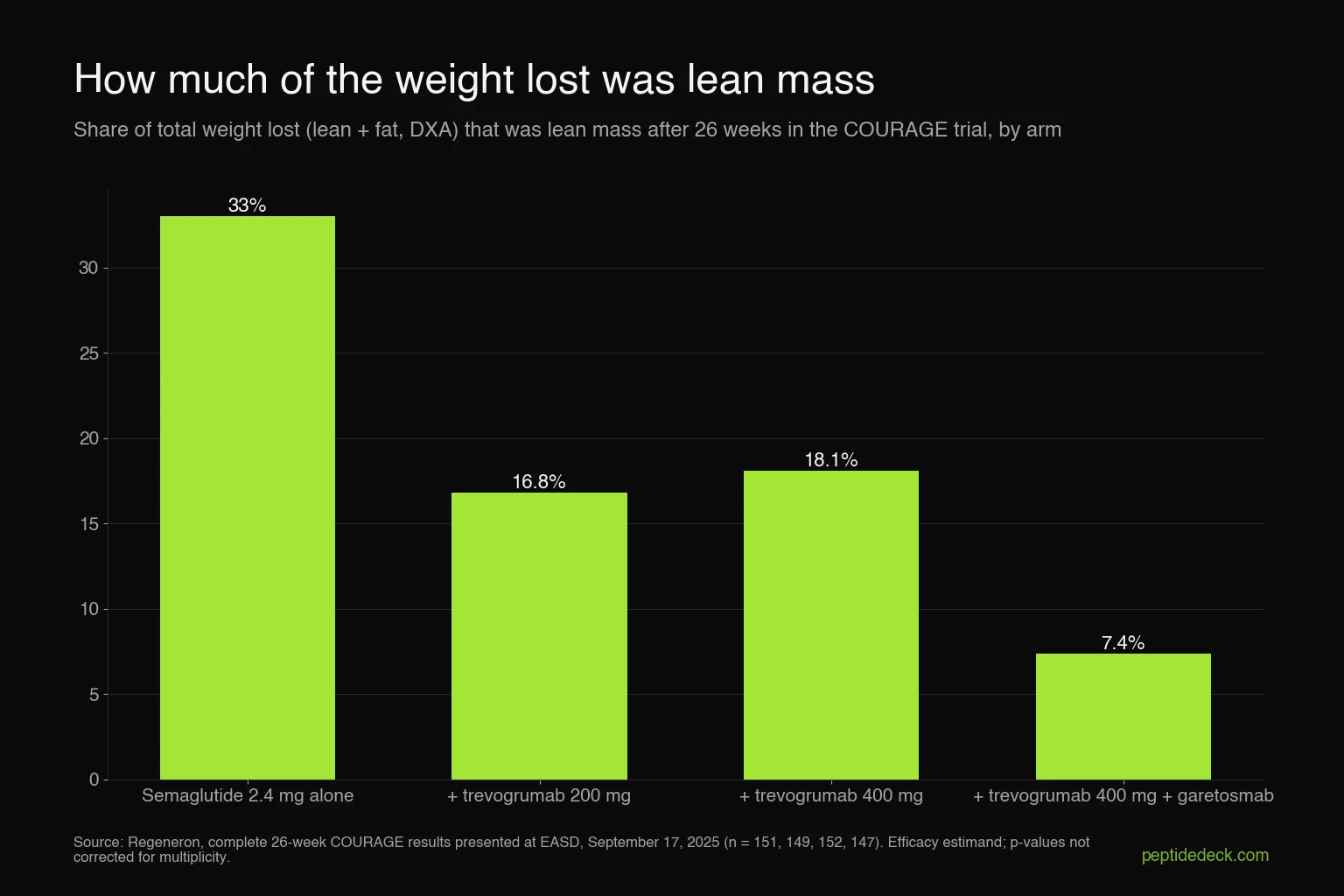
Not all weight lost on a GLP-1 is fat. In COURAGE, people on semaglutide alone lost 10.6% of their body weight in 26 weeks, and DXA scans showed that 33% of what they lost was lean mass, according to Regeneron's September 2025 results.
Lean mass includes muscle, organs and water, so it isn't all muscle. But if you are older or already low on muscle, that share is the number to watch. A 2026 review in Diabetes, Obesity and Metabolism noted that a considerable portion of GLP-1 weight loss comes from fat-free mass and called for larger trials before any muscle-sparing add-on reaches clinics (PubMed 41178728).
For the practical side (protein, lifting, pacing the dose), see our guide to muscle loss on retatrutide.
The COURAGE Trial: Trevogrumab With Semaglutide
COURAGE is a placebo-controlled Phase 2 obesity trial. The two main portions enrolled 975 adults with a BMI of 30 or higher (NCT06299098 lists 1,005 enrolled across all parts of the study). Evidence grade: one human randomized controlled trial, sponsored by Regeneron. It ran in two independent portions:
- Higher-dose portion (26 + 26 weeks). Everyone took semaglutide 2.4 mg for 26 weeks, plus placebo, trevogrumab 200 mg, trevogrumab 400 mg, or trevogrumab 400 mg with garetosmab 10 mg/kg given into a vein. Semaglutide then stopped, and people were re-randomized to trevogrumab 400 mg or placebo for 26 more weeks.
- Lower-dose portion (52 weeks). Semaglutide 2.4 mg for a full year, plus placebo, trevogrumab 25 mg or trevogrumab 75 mg.
Body composition was measured by DXA scan. The releases give each dose but not how often it was injected, so the schedule is not stated here.
COURAGE results at 26 weeks
Here are the complete 26-week numbers from the higher-dose portion, presented at EASD in September 2025.
*Share of people who stopped treatment because of an adverse event, from the June 2025 interim analysis (safety groups of 151, 148, 151 and 149 people). Weight and lean mass figures are from the September 2025 complete 26-week analysis, which excluded data after people stopped treatment.
Both trevogrumab doses cut the lean share of weight loss roughly in half without adding much weight loss (9.9% and 11.1% against 10.6%). What changed was the mix: more of the weight lost came from fat. Only the triplet with garetosmab clearly lost more weight (13.4%), at a price covered in the safety section.
Trevogrumab Results at One Year (2026 Update)
The one-year data arrived in October 2026. Regeneron presented them at EASD 2026 on October 1, and says the paper is in press with The Lancet (Regeneron, October 2026).
In the lower-dose portion, both doses preserved lean mass at 52 weeks, the primary endpoint, though only the 75 mg difference was statistically significant, per the Lancet summary. Most lean mass was lost in the first six months, when weight came off fastest.
The MRI numbers come from a small exploratory substudy of 76 people, as reported by News-Medical's summary of the Lancet paper. MRI measures thigh muscle directly, unlike DXA's broader "lean mass". Regeneron also reported that people who started the trial with low lean mass lost more on semaglutide alone and saw numerically more protection with trevogrumab.
After semaglutide stopped in the higher-dose portion, the same summary reports lean mass at week 52 of -2.4% from baseline on placebo against +0.4% on trevogrumab 400 mg. Fat mass and body weight stayed below baseline in both groups. The regain figures themselves were not in the material we could open.
The limitation to keep in mind: COURAGE measured body composition, not strength, walking speed or falls. More lean mass on a scan does not yet prove you'll be stronger or healthier, and the published summary says that question needs further study. Regeneron sponsored the trial, and the full paper was not yet indexed on PubMed when we checked.
Trevogrumab and Garetosmab: Why the Triplet Struggled
The triplet with garetosmab saved the most muscle. In the triplet arm, only 7.4% of weight lost was lean mass, and fat loss was the largest of any group.
But in the June 2025 interim analysis, 28.3% of people on the triplet stopped treatment because of side effects, against 4.6% on semaglutide alone. Severe adverse events hit 10.1% against 2.0%, and serious adverse events 6.7% against 0.7% (Regeneron, June 2025).
Two people in the triplet group died, one from an undetermined cause in a person with several heart risk factors and one from cardiac arrest in a person with a history of heart disease. Regeneron says it has not found a causal link to treatment. Muscle spasms affected 41% of the triplet group, against 8% on trevogrumab alone and 5% on placebo, per the Lancet summary. Regeneron described the higher dropout as consistent with what it had already seen with garetosmab alone.
Regeneron's 2026 plans center on trevogrumab alone. If you read about "trevogrumab garetosmab" stacks online, remember that the combination that protected the most muscle was also the one people couldn't tolerate.
Trevogrumab Side Effects
On its own with semaglutide, trevogrumab was generally well tolerated. In the higher-dose portion, adverse events that hit at least 5% of any group included muscle spasms, nausea, constipation, fatigue, diarrhea, headache, vomiting, reflux and common infections such as colds, urinary tract infections, flu and COVID-19. Most were mild to moderate.
In the lower-dose portion, 77% of people on trevogrumab had at least one adverse event, against 82% on placebo. The most common were nausea, constipation, diarrhea and vomiting, which are the usual semaglutide side effects.
One signal to watch: in the interim data, 10.6% of people on the 400 mg dose stopped for side effects, against 4.1% on 200 mg and 4.6% on semaglutide alone. Safety beyond one year is unknown.
What to ask your doctor if you're worried about muscle on a GLP-1:
- Should I get a DXA scan now, so we have a baseline for lean mass?
- How much protein should I eat each day at my current dose?
- Would a slower dose increase reduce how much muscle I lose? (Our semaglutide dosing guide shows the standard steps.)
- Am I eligible for any muscle-preservation trial near me, including Regeneron's planned study in older adults?
Trevogrumab vs Bimagrumab, Apitegromab, ACE-031 and Follistatin
Several drugs chase the same goal by different routes. Here's the short version, with links to our full comparisons rather than repeating them.
Trevogrumab and apitegromab both aim at myostatin itself. Bimagrumab blocks the receptor, which also shuts out activins, and in its trial it added about 3.6 kg of weight loss over semaglutide 2.4 mg alone at 48 weeks, with muscle spasms, diarrhea and acne as common side effects (BELIEVE, Nature Medicine 2026). The apitegromab numbers are from the EMBRAZE trial, and the ACE-031 result from a randomized trial in boys with Duchenne muscular dystrophy.
Follistatin, a natural protein, binds both myostatin and activins (Metabolism review, 2024). These trials used different GLP-1 drugs, doses and lengths, so they can't be ranked head to head. For a peptide that targets the same pathway but has only been tested in mice so far, see our HM500197 guide.
Where Trevogrumab Stands in 2026
Trevogrumab is still an investigational drug. No regulator has approved it for any use, and Regeneron states that its safety and efficacy have not been evaluated by any regulatory authority.
- COURAGE: listed as active, not recruiting, with primary completion in June 2026 and study completion estimated for October 2026, according to ClinicalTrials.gov.
- Next step: Regeneron says it plans a new Phase 2 trial of trevogrumab with GLP-1-based therapies in older adults with obesity and low muscle mass or strength.
- Phase 3: none announced in the Regeneron releases we reviewed.
- Sport: the 2026 WADA Prohibited List bans myostatin-neutralizing antibodies and activin A-neutralizing antibodies under section S4. Trevogrumab isn't named, but the list says "including, but not limited to", so tested athletes should treat it as banned.
Can You Buy Trevogrumab?
Not as the drug Regeneron is testing. Regeneron does not sell trevogrumab, and the COURAGE record lists no expanded access program, so its trials are the only route to the real thing. Vials sold online under the name come from other makers, and nothing on the label tells you whether they hold a working anti-myostatin antibody.
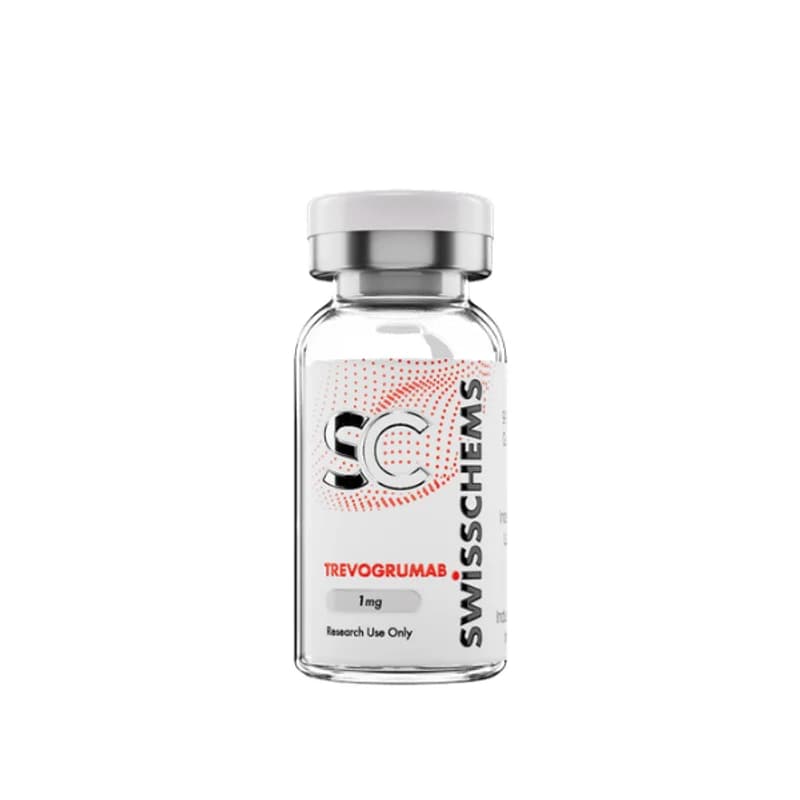
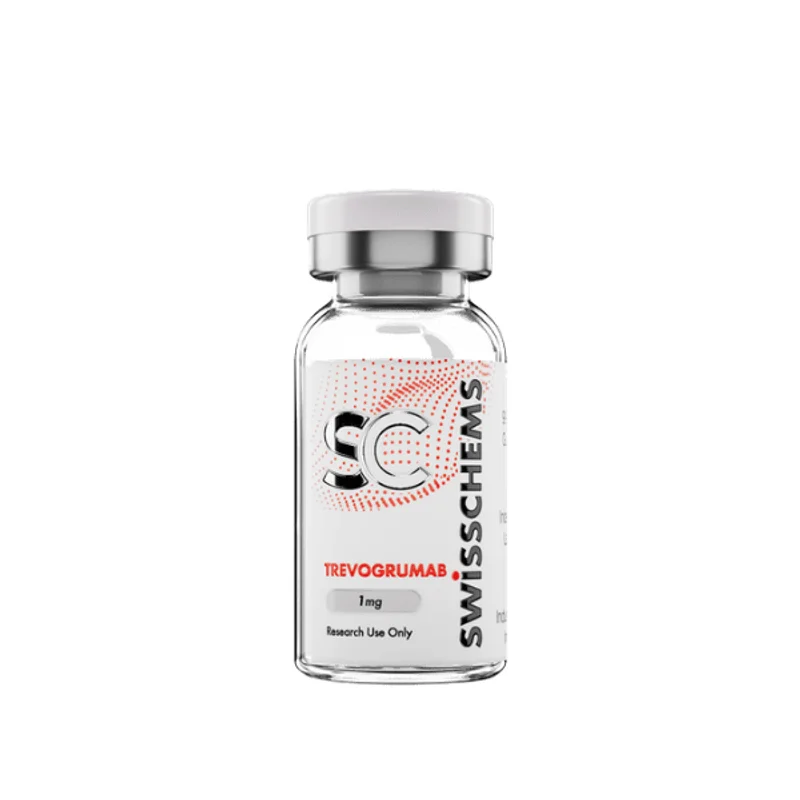
The product card on this page links to SwissChems' "Trevogrumab 1mg" listing. Here's what its product page said when we checked it on November 5, 2026:
- Size and price: one 1 mg vial for $194.95. A 10-vial kit was listed at $1,940 but shown as out of stock.
- Testing claims: "99% Purity Guaranteed" and "Independently third-party HPLC-tested; COA available per batch." Its lab tab says every batch is tested for identity, purity and potency.
- What we couldn't find: no trevogrumab report in SwissChems' public test-results library. A search there for "trevo", "REGN" and "myostatin" returned nothing.
- Intended use: the page says the product is for laboratory use only and that putting it into humans or animals is prohibited.
Two caveats are worth being plain about. First, an HPLC purity figure shows how much of a sample is one main substance. It doesn't confirm that a protein is correctly folded or that it actually binds myostatin, which would take identity tests such as mass spectrometry and a binding assay. Second, the dose gap is huge:
A single 1 mg vial is 1/25th of the lowest dose anyone received in COURAGE, and there is no human data at 1 mg. If you still buy it, code jqrlsday takes 10% off at SwissChems, bringing one vial to $175.46. PeptideDeck earns a commission if you buy through the SwissChems link on this page.
Frequently Asked Questions
Sources
- Regeneron. Phase 2 COURAGE trial confirms trevogrumab prevents lean mass and muscle loss during GLP-1 receptor agonist-induced weight loss. October 1, 2026. investor.regeneron.com
- Regeneron. Results from Phase 2 COURAGE trial presented at EASD (complete 26-week results). September 17, 2025. investor.regeneron.com
- Regeneron. Interim results from ongoing Phase 2 COURAGE trial. June 2, 2025. newsroom.regeneron.com
- ClinicalTrials.gov. NCT06299098 (COURAGE), record last updated September 1, 2026; and REGN1033 studies NCT01963598, NCT01910220, NCT01720576, NCT01507402, NCT02741739, NCT02943239, NCT03710941. clinicaltrials.gov
- News-Medical. Trevogrumab cuts semaglutide-induced lean mass loss by half, study shows (summary of the Lancet paper). October 1, 2026. news-medical.net
- KEGG DRUG. D11242 Trevogrumab (formula, molecular weight, chain sequences). kegg.jp
- U.S. Code of Federal Regulations. 21 CFR 600.3(h)(6), definition of a protein. ecfr.gov
- Aimelet V, Holst JJ. Pharmacological intervention: challenges and promising outcomes for fat loss and preservation of lean body mass. Diabetes Obes Metab. 2026;28(2):803-816. PubMed 41178728
- Heymsfield SB, et al. Bimagrumab plus semaglutide alone or in combination for the treatment of obesity: a randomized phase 2 trial (BELIEVE). Nat Med. 2026;32(3):869-882. PubMed 41772149
- Pratley RE, et al. Apitegromab for lean mass preservation during tirzepatide-induced weight loss (EMBRAZE). Nat Med. 2026;32(7):2673-2678. PubMed 42260100
- Campbell C, et al. Myostatin inhibitor ACE-031 treatment of ambulatory boys with Duchenne muscular dystrophy. Muscle Nerve. 2017;55(4):458-464. PubMed 27462804
- World Anti-Doping Agency 2026 Prohibited List, S4 section 3, as reproduced by the German Sport University Cologne. dshs-koeln.de
- Stefanakis K, Kokkorakis M, Mantzoros CS. The impact of weight loss on fat-free mass, muscle, bone and hematopoiesis health. Metabolism. 2024;161:156057. PubMed 39481534
- PubChem. Semaglutide (CID 56843331), molecular weight. pubchem.ncbi.nlm.nih.gov
- SwissChems "Trevogrumab 1mg" product page and independent test-results library, checked November 5, 2026.
Medical Disclaimer: This article is for informational purposes only and does not constitute medical advice. Trevogrumab is an investigational drug that no regulator has approved, and its only human data come from clinical trials run by its maker. Products sold online under its name are unverified. Talk to your doctor before changing any weight-loss treatment, and ask about clinical trials if you want access to muscle-preserving drugs under medical supervision.